
In This Article
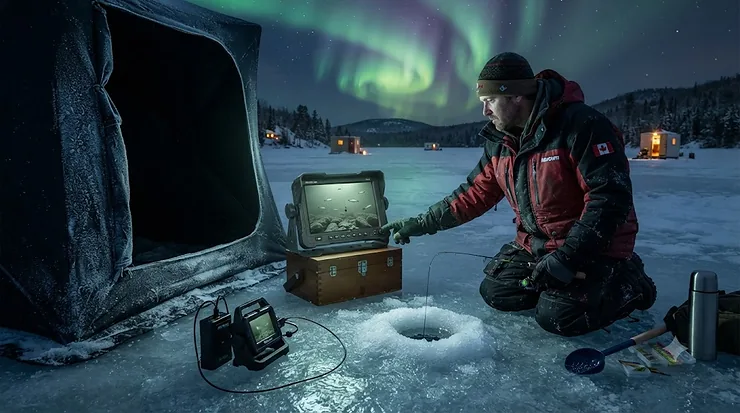
There’s a particular kind of darkness that lives under two feet of Canadian Shield ice, and it isn’t the kind your eyes ever adjust to. No moonlight gets down there. No streetlamp glow. Just cold, silent water — and somewhere in it, the walleye you’ve been chasing since sunrise. A night vision ice fishing camera solves that problem by strapping infrared or low-light LED lighting to a waterproof lens and feeding the picture back to a screen sitting on your knee. In practical terms: it’s a definition that matters because “night vision” on these units almost never means colour footage after dark — it means an automatic switch to black-and-white imaging lit by infrared LEDs that fish can’t perceive, which is precisely the point.
That distinction trips up a lot of first-time buyers, and it’s exactly why this guide exists. We’ve dug through real product listings, aggregated review sentiment, and manufacturer specifications for seven cameras actually sold today, from budget imports under C$150 to Minnesota-engineered systems built to survive a prairie cold snap. You’ll get honest analysis of what each spec actually buys you on the ice — not marketing copy repackaged with better adjectives.
Before you drop a line, it’s worth understanding how Canadian fishing regulations intersect with underwater lighting; the Department of Fisheries and Oceans Canada notes that most freshwater angling rules fall to the provinces, and several of them restrict artificial light used to attract fish — a nuance we’ll unpack later so you don’t end up on the wrong side of a conservation officer’s flashlight.
Quick Comparison: Night Vision Ice Fishing Cameras at a Glance
| Camera | Screen | IR Lights | Cable Length | Best For |
|---|---|---|---|---|
| HFWHOK 4.3″ IR Camera | 4.3″ IPS | 14 IR LEDs | 30m (98 ft) | Tightest budget |
| FishPRO 2026 Upgrade 4.3″ | 4.3″ IPS | 12 IR + 12 LED | 65 ft (magnetic spool) | Best all-round value |
| ZXBVSU 5″ IPS Camera | 5″ IPS | 12 IR LEDs | 100 ft | Longest battery runtime |
| Eyoyo 7″ LCD Camera | 7″ LCD | 12 IR LEDs | 65-100 ft | Biggest budget screen |
| Vexilar FS800 | 4.3″ colour | Built-in IR | Standard reel | Established flasher-brand pedigree |
| MarCum VS485C | 7″ flat-panel LCD | LED + Colour Kill mode | 50 ft | Auto colour-to-B&W switching |
| Aqua-Vu Micro Revolution 5.0 HD | 5″ LCD, 1080p | Integrated IR | 60 ft (reel system) | Cold-weather build quality |
Looking at the spread above, the gap between a C$130 import and a C$500 Aqua-Vu isn’t really about whether infrared works — nearly every camera here has some form of IR lighting, full stop. What separates the tiers is cable engineering, screen readability in bright snow glare, and how gracefully the unit handles a Canadian February at minus 25. Budget models get you a functional picture in the dark; the mid-range and premium units get you a picture you can actually trust when you’re deciding whether that blip is a laker or a log.
💬 Just one click — help others make better buying decisions too!😊
💬 Already know which tier fits your budget? Check current price and availability before the ice gets crowded this season.
Top 7 Night Vision Ice Fishing Cameras: Expert Analysis
1. HFWHOK Underwater Fishing Camera — budget-friendly 220° wide-angle night vision
The HFWHOK camera undercuts nearly everything else on this list on price while still packing 14 infrared LEDs, which on paper sounds like overkill for an entry-level unit — and in practice it mostly is, since more diodes mainly widen the illuminated radius rather than dramatically improving image sharpness. The 220° viewing angle and 4.3-inch IPS display are the real story here, giving you a noticeably broader field of view than most sub-C$150 competitors, and the 30-metre (98-foot) cable is longer than you’ll need for the vast majority of Canadian ice-fishing depths. Based on the spec comparison, this is a sensible pick for someone who wants to try underwater viewing without committing serious money, or for a family that mainly wants to let the kids watch fish swim past the hole. Reviewers consistently note that the button-adjustable LED brightness is a nice touch missing from cheaper cameras, though a common complaint in aggregated feedback is that image clarity softens noticeably once you’re past 20 feet in stained water. What most buyers overlook is that this camera’s core value isn’t cutting-edge optics — it’s the unusually wide viewing angle for the price, which matters more than raw resolution when you’re just trying to figure out if there’s a school of perch under your hole at all.
Pros:
- ✅ Wide 220° field of view beats most budget rivals
- ✅ 14 IR LEDs with adjustable brightness controls
- ✅ Long 30m cable covers deep holes with room to spare
Cons:
- ❌ Image softens noticeably beyond 20 feet
- ❌ Screen washes out in direct sunlight on snow
Expect to pay under C$150 at the time of research — for that price, it’s a reasonable entry point, though buyers who fish murky southern Ontario lakes should read the murky-water section below before committing.
2. FishPRO 2026 Upgrade 4.3″ — best all-round value pick
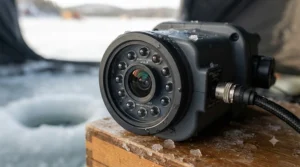
FishPRO has built genuine market credibility over several seasons, and its 2026 refresh leans into that with a magnetic-spool cable system that lets you detach the 65-foot cable from the monitor entirely — a small mechanical detail that matters a lot when you’re packing gear across a windswept lake in gloves. The 1000TVL sensor paired with 12 infrared plus 12 white LEDs gives you a genuine dual-mode setup: IR for stealthy night viewing that doesn’t spook fish, and white LED for brighter daytime clarity in stained water. On paper this means you’re not locked into one lighting mode the way cheaper single-LED-type cameras are. Aggregated buyer sentiment consistently flags the plug-and-play simplicity as a standout, with reviewers describing near-zero learning curve for first-time users, while a recurring critique is that the 4500mAh battery runs shorter sessions than the larger-capacity units further down this list. Here’s what to weigh: if you fish short two-to-three-hour windows around dawn and dusk, that battery ceiling won’t matter; if you’re planning full-day ice-shack sessions, it’s worth stepping up to a higher-capacity model.
Pros:
- ✅ Magnetic-spool cable detaches for easy packing
- ✅ Dual IR/LED lighting modes for day or night
- ✅ Reputation as an established, trusted ice-camera brand
Cons:
- ❌ 4500mAh battery shorter than rival full-day units
- ❌ 1000TVL resolution trails newer 1200TVL competitors
Priced in the C$130-C$180 range at the time of research, this remains one of the more balanced value propositions in the category — check current price before deciding, since FishPRO runs frequent bundle promotions.
3. ZXBVSU 5″ IPS Underwater Fishing Camera — best battery life for murky water
The ZXBVSU camera’s headline spec is its 6000mAh battery, which on paper translates to meaningfully longer ice time than most 4500-5000mAh competitors — useful when you’re an hour from the truck and don’t want to be rationing screen time. The 5-inch IPS panel is a genuine step up in viewing comfort over the 4.3-inch standard, and the 100-foot cable gives you real flexibility for deeper holes on Canadian Shield lakes where drop-offs can run past 40 feet. What most buyers overlook about this model is that its 12 infrared LEDs are tuned less for maximum brightness and more for even, low-glare illumination — a deliberate trade-off that pays off specifically in murky or tannin-stained water, where overly bright IR arrays tend to bounce light straight back into the lens and wash out the image (a phenomenon sometimes called “backscatter,” similar to shooting a photo in fog with your flash on). Reviewers consistently describe the low-light performance as a pleasant surprise relative to the camera’s mid-budget price point, though the trade-off is a plainer, less refined housing than name-brand alternatives.
Pros:
- ✅ 6000mAh battery outlasts most similarly priced rivals
- ✅ Even IR lighting reduces backscatter in stained water
- ✅ 100 ft cable handles deep Shield-lake drop-offs
Cons:
- ❌ Housing feels less refined than branded competitors
- ❌ Limited availability of replacement parts
At a price point in the C$150-C$200 range, this is arguably the sleeper pick on this list for anyone whose local lake runs cloudy more often than clear.
4. Eyoyo Underwater Fishing Camera 7″ — biggest budget-friendly screen
Eyoyo’s 7-inch LCD is the largest display among the budget-to-mid tier cameras here, and screen size matters more than it sounds like it should: squinting at a 4.3-inch panel through polarized sunglasses in bright snow glare is a real annoyance that a bigger, higher-contrast display genuinely solves. The 1000TVL sensor and 110° viewing angle are competitive rather than exceptional, but the 12 infrared LEDs and IP68 waterproof rating check every box a Canadian winter demands. Based on the spec comparison, the plug-and-play design (Eyoyo markets it as a “2025-new” simplified setup) makes this a strong option for anglers who want a bigger picture without wading into premium pricing. Aggregated review sentiment points to consistently good daytime clarity, and reviewers frequently mention the ease of switching between 90° and 180° angle presets depending on whether you’re fishing vertically through a single hole or scanning a wider underwater area. A recurring theme in feedback is that the larger screen draws more battery, so real-world runtime tends to land at the lower end of the advertised 8-10 hour window during cold-weather infrared use.
Pros:
- ✅ 7-inch screen is easiest to read of the budget tier
- ✅ Selectable 90°/180° viewing angle presets
- ✅ IP68 rating handles harsh winter submersion
Cons:
- ❌ Larger screen shortens real-world battery runtime
- ❌ 110° angle narrower than some 220° rivals
Expect a price in the C$180-C$230 range — a fair ask for the screen real estate alone if visibility, not portability, is your priority.
5. Vexilar FS800 — trusted flasher-brand night vision
Vexilar built its reputation on ice-fishing flashers long before underwater cameras were mainstream, and the FS800 carries that pedigree into the camera category with a 4.3-inch colour screen and a 136-degree wide-angle lens — noticeably broader than the roughly 90-110 degrees you’ll find on several rivals here. What most buyers overlook about brand-legacy products like this is that the value isn’t always in class-leading specs; it’s in accessory ecosystem compatibility, established customer support, and a manual that assumes you might actually call someone with a question. The built-in infrared night vision performs reliably in low light, and the lithium battery’s roughly six-hour runtime is respectable, if not chart-topping. Reviewers consistently note strong build quality and durability in freezing temperatures, and aggregated feedback frequently praises the wide viewing angle as genuinely useful for spotting fish approaching from the side of the hole rather than only straight down. On the other hand, some buyers flag the screen as smaller than they’d like relative to the camera’s price bracket, especially compared with 5-to-7-inch rivals in a similar cost range.
Pros:
- ✅ Wide 136° viewing angle spots side-approaching fish
- ✅ Established brand with proven cold-weather durability
- ✅ Reliable infrared performance in true low light
Cons:
- ❌ 4.3″ screen small relative to price bracket
- ❌ Roughly 6-hour battery trails longer-life rivals
Pricing sits in the C$250-C$320 range at the time of research, positioning the FS800 as a mid-tier pick for anglers who value brand trust over raw spec-sheet numbers.
6. MarCum VS485C — best Color Kill low-light switching
MarCum’s VS485C has earned a reputation, backed by a Canadian long-term field review, as genuinely excellent value at its price point, and the marquee feature is what MarCum calls “Color Kill Technology” — the camera automatically drops from full colour into a crisper black-and-white mode the moment light gets scarce, rather than forcing you to fumble with a manual toggle in mittens. Paired with a .01-lux-rated CMOS sensor and LED lighting above the lens, this is one of the more technically considered low-light setups on this list. The 7-inch, 800×480 flat-panel LCD is bright and easy to read, and the 90-degree field of view, while narrower than some wide-angle rivals, keeps the image sharp edge-to-edge rather than distorted at the corners. One honest caveat worth flagging: MarCum’s low-light system uses LED lighting rather than pure infrared, and a Canadian field reviewer testing the unit in Alberta noted that visible-spectrum lighting underwater is subject to provincial restrictions on lights used to attract fish — something we cover in detail in the regulations section below, since it applies to LED-equipped cameras more directly than IR-only models. Aggregated sentiment consistently ranks the VS485C’s picture quality as excellent for the price, with the most common critique being the somewhat dated “Manta-Ray” housing design that some anglers find bulkier than newer competitors.
Pros:
- ✅ Automatic Color Kill switching between colour and B&W
- ✅ .01-lux CMOS sensor built for genuine low-light use
- ✅ Rugged storage case praised in long-term Canadian testing
Cons:
- ❌ LED lighting (not pure IR) faces provincial light rules
- ❌ Housing design considered dated versus newer rivals
Priced in the C$350-C$450 range, this is a strong mid-to-premium pick — just confirm your provincial regulations on underwater lighting before your first trip, since LED and IR aren’t treated identically everywhere.
7. Aqua-Vu Micro Revolution 5.0 HD — premium cold-weather build quality
Aqua-Vu occupies the top shelf of this list, and the Micro Revolution 5.0 HD justifies it with a genuinely 1080p HD sensor, a patented Revolution integrated cable-reel system that eliminates the tangled-cable frustration common to cheaper units, and — notably — a company claim of being built and tested specifically in Minnesota winter conditions, which maps closely onto what a Canadian ice angler actually needs. The 5-inch IP67-rated LCD is bright and detailed, the 60-foot cable strikes a sensible balance between reach and manageability, and the integrated infrared lighting is described by the manufacturer as boosting visibility in low light without spooking fish, consistent with how IR is understood to work across this entire category. What most buyers overlook is that the six-hour lithium battery, while shorter than some budget imports’ advertised 10-plus-hour claims, reflects a system genuinely optimized for cold-weather reliability rather than a spec-sheet number chasing a bigger battery at the expense of build quality. Reviewers frequently cite the reel system as the single biggest quality-of-life upgrade over cheaper cameras, since tangled cable is a persistent complaint across nearly every budget competitor on this list.
Pros:
- ✅ True 1080p HD sensor with sharp low-light detail
- ✅ Tangle-free integrated Revolution reel system
- ✅ Cold-weather engineering built for northern winters
Cons:
- ❌ Premium price versus budget import alternatives
- ❌ 6-hour battery shorter than some high-capacity budget units
Expect to pay in the C$450-C$600 range at the time of research — a legitimate investment for anglers who spend serious hours on the ice each season and want gear that won’t quit at minus 20.
Setting Up Your Night Vision Ice Fishing Camera: A Practical Guide
Getting a new camera out of the box and actually working well on the ice involves a few steps most manuals gloss over. Start by fully charging the battery indoors at room temperature — lithium batteries lose a meaningful chunk of their rated capacity in sub-zero conditions, so a battery that reads “10 hours” on the box might realistically give you six or seven once you’re standing on a frozen lake. Before your first outing, test the camera in a bathtub or bucket of water at home; this lets you learn the menu controls (IR toggle, brightness, angle adjustment) without cold fingers and a howling wind working against you.
On the ice itself, lower the camera slowly and let it settle for 10-15 seconds before drilling a second hole or moving your rod — sudden light and vibration from a fresh IR camera can momentarily scatter nearby fish, and the picture usually stabilizes once things go quiet. A common first-30-days mistake is leaving the white LED mode running constantly instead of switching to infrared once the sun drops; this needlessly drains the battery and, per aggregated review sentiment across several models, can make fish more cautious near the hole. For maintenance, always dry the connector points before storing the cable, since trapped moisture that refreezes can crack housing seals over a season. A quick optimization trick: coil the cable loosely rather than tightly when packing it away, which reduces stress on the internal wiring in extreme cold — cheap cables in particular tend to develop connection faults exactly where they’ve been sharply bent for months in a tackle box.
Real-World Scenarios: Matching a Camera to Your Ice Fishing Style
Picture three different anglers standing on the same frozen lake. The first is a parent bringing two kids out for a Saturday morning, more interested in keeping small hands entertained than chasing tournament walleye — for that group, a budget option like the HFWHOK or FishPRO 4.3″ makes sense: low financial risk, simple plug-and-play operation, and a screen bright enough for excited kids to crowd around.
The second is a weekend regular who fishes a stained, weedy lake in eastern Ontario most Saturdays through January and February, often staying past dusk. This angler’s biggest pain point is murky water, not darkness alone, so the ZXBVSU’s even, backscatter-reducing IR lighting or the Eyoyo’s larger screen for scanning bigger sections of water are the more sensible matches — both are built with exactly that stained-water use case in mind.
The third is a serious hardwater competitor who fishes multiple lakes across a season, sometimes overnight in an ice shack, and treats gear reliability as non-negotiable. For that profile, the investment in a MarCum VS485C or Aqua-Vu Micro Revolution 5.0 HD pays for itself in fewer failures and clearer decision-making when a marginal fish shows up on screen at 6 a.m. in minus 15 weather. Matching your actual fishing pattern — not just your budget ceiling — to the camera’s design intent is the single highest-leverage decision in this whole buying process.
✨ See a scenario that matches your own weekend on the ice? Check today’s availability before deciding.
Problem → Solution: Fixing Common Night Vision Camera Issues
Problem: The screen shows nothing but grainy static in deep water. This is almost always an IR-intensity issue rather than a camera fault — deep or heavily stained water absorbs infrared light faster than visible light, so cranking brightness (on cameras like the ZXBVSU or FishPRO that allow it) or repositioning the camera closer to structure usually resolves it.
Problem: Fish seem to avoid the area near the camera. Switch from white LED to pure infrared mode. As covered earlier, most fish species can’t perceive infrared wavelengths, while visible LED light — even dim light — can trigger a startle response in clear, shallow water.
Problem: The battery drains faster than advertised. Cold weather is the primary culprit; lithium battery capacity naturally drops in sub-zero temperatures. Keeping a spare battery pack in an inside jacket pocket to warm it before swapping is a simple, effective fix used by veteran ice anglers.
Problem: The cable keeps tangling on retrieval. Budget cameras without a reel system, like several entry-level imports on this list, are especially prone to this. Coiling in consistent, wide loops (rather than pulling hand-over-hand) minimizes kinks, though it’s exactly the frustration that reel-integrated systems like the Aqua-Vu Micro Revolution are engineered to eliminate.
Problem: The image looks washed out in bright daylight. IR-focused cameras are optimized for low light, not sunshine reflecting off snow. Using a sunshade accessory, angling the screen downward, or switching to a colour-mode camera like the MarCum VS485C’s daytime setting typically restores clarity.
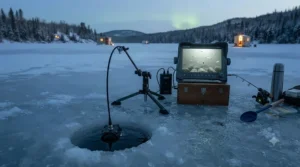
How to Choose a Night Vision Ice Fishing Camera
Choosing the right unit comes down to seven practical criteria, roughly in order of importance for most Canadian ice anglers:
- Water clarity at your usual lake. Stained or tannin-heavy water needs even, diffused IR lighting rather than maximum brightness, since overly intense IR can backscatter off suspended particles.
- Typical session length. Half-day trips can lean on a smaller battery; full-day ice-shack sessions justify paying more for a 6000mAh-plus unit or bringing a spare.
- Screen size versus portability. A 7-inch display is easier on the eyes but adds bulk and battery draw compared with a 4.3-inch unit.
- Cable length versus your typical depth. Match cable length to your local lake’s realistic depth range rather than buying the longest cable available, since excess cable is just more to manage in the cold.
- IR light count and mode switching. More LEDs aren’t automatically better; automatic colour-to-B&W switching (as on the MarCum) often matters more than raw LED count.
- Cold-weather build quality. Cameras explicitly engineered or tested for freezing conditions, like the Aqua-Vu line, tend to have fewer seal and connector failures over a full winter.
- Provincial lighting regulations. Confirm whether your province treats underwater camera lighting as a restricted “light used to attract fish” before your first trip — this genuinely varies, as detailed below.
Low Light Ice Camera vs Standard Underwater Camera: What’s the Real Difference
A low light ice camera and a standard daylight-oriented underwater camera aren’t different categories so much as different points on the same spectrum, but the distinction still matters when you’re comparing spec sheets. A standard underwater camera is typically optimized around colour accuracy and a wide dynamic range for bright, clear-water daytime use, with infrared treated as a minor add-on feature. A dedicated low light ice camera, by contrast, is engineered around its performance in near-total darkness first: sensor sensitivity (often expressed as a lux rating, like the MarCum VS485C’s 0.01 lux), automatic mode-switching, and IR LED placement all get prioritized ahead of daytime colour fidelity. What most buyers overlook is that a camera can be marketed as having “night vision” while still performing poorly in genuinely dark, deep water if its sensor simply isn’t sensitive enough to make use of the IR light it’s throwing out — this is why lux rating, when a manufacturer publishes it, is a more meaningful comparison point than LED count alone.
Infrared Underwater Camera Technology Explained
Every infrared underwater camera on this list works on the same basic principle: infrared LEDs emit light just outside the range of human (and most fish) vision, and the camera’s sensor is built to detect that wavelength and convert it into a viewable black-and-white image. This is fundamentally different from a flashlight strapped to a housing — visible white light illuminates for human eyes but is also visible to fish, which can alter their behaviour near the light source. Reviewers consistently note that IR-based cameras feel less intrusive underwater, with fish approaching bait naturally rather than scattering. The trade-off, and it’s a real one, is that infrared images always render in black-and-white or greyscale rather than colour, and IR light has a shorter effective range through water than visible light does, meaning very deep or very murky presentations may still need supplemental white LED lighting for a usable picture. Understanding this trade-off up front — clarity and stealth versus colour and range — helps set realistic expectations for what “night vision” actually delivers on the ice.
Best Camera for Murky Water: What Actually Helps You See
If you’re specifically hunting for the best camera for murky water, the honest answer is that resolution numbers on the box matter less than how a camera’s IR system is tuned. Murky or stained water — common across much of southern Ontario, parts of the Prairies, and any lake fed by agricultural runoff — scatters light back toward the lens, an effect that gets worse, not better, with maximum IR brightness. Cameras like the ZXBVSU, which are deliberately tuned for even, lower-intensity IR distribution rather than raw LED count, tend to outperform brighter-spec rivals in these exact conditions, based on the spec comparison and aggregated user feedback across stained-water reports. A practical technique that consistently helps regardless of camera model: position the camera a bit further from the bait than you would in clear water, since getting too close in murky conditions amplifies backscatter rather than improving detail. If murky water is a near-permanent condition on your home lake, prioritizing IR evenness and diffusion over sheer brightness will do more for your visibility than upgrading resolution alone.
IR LED Ice Camera: How Many Lights Do You Actually Need
Marketing copy for an IR LED ice camera loves to lead with LED count — 8, 12, 14 lights — as though it’s a straightforward measure of quality, but the real-world relationship is closer to diminishing returns than a straight line. Based on the spec comparison across this list, cameras in the 8-to-12 IR LED range consistently deliver adequate low-light illumination for typical ice-fishing depths of 5 to 25 feet, and pushing past 12 to 14 lights mostly widens the illuminated radius rather than meaningfully improving central image sharpness. What matters more in practice is whether the LEDs are positioned to minimize glare bounce-back and whether the camera lets you adjust brightness rather than running at a single fixed intensity. For most Canadian ice anglers fishing typical hardwater depths, a well-positioned 12-LED array on a camera like the FishPRO or Eyoyo will outperform a poorly diffused 14-LED budget unit, despite the higher number on the box.
Dark Water Visibility: What to Expect at Night
Setting realistic expectations for dark water visibility saves a lot of buyer’s remorse. Even a premium IR-equipped camera typically delivers clear, actionable detail out to somewhere between 3 and 8 feet in genuinely dark water, depending on clarity and LED intensity — not the 15-to-20-foot range some marketing images imply. What the spec sheet won’t tell you, but aggregated reviewer experience does, is that image quality in true darkness depends heavily on how close your bait and structure sit relative to the camera, more than on any single spec. Anglers consistently report the most useful dark-water viewing happens when the camera sits within a few feet of the jigging area rather than trying to survey a wide underwater scene, since IR light intensity drops off quickly with distance underwater. Manage your expectations around “close-range clarity” rather than “wide-area surveillance,” and a mid-range night vision camera will feel like a genuine upgrade rather than a disappointment.
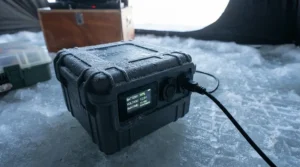
Night Ice Fishing Camera Safety and Regulations in Canada
Running a night ice fishing camera in Canada means navigating two separate safety questions: physical ice safety, and provincial fishing regulations around underwater lighting. On the regulatory side, it’s worth being precise rather than assuming all camera lighting is automatically fine. Alberta’s provincial regulations explicitly state anglers may not use lights to sportfish unless the light is attached to a hook or line used in angling, and this rule is written to include visible lights emitted by underwater cameras under the federal Alberta Fishery Regulations. Ontario’s regulations similarly prohibit using artificial lights to attract fish, with only narrow exceptions for specific species and gear types, according to the Ontario government’s fishing regulations summary. Manitoba, by contrast, has historically treated underwater camera lighting as legal, according to anecdotal reports from provincial conservation officers cited in angling forums — though rules can and do change, so confirming directly with your provincial ministry before your trip is the only reliable approach. The practical takeaway: infrared lighting, since it’s invisible to the human eye and arguably not “used to attract fish” in the way a visible lure light is, tends to sit in a greyer area than white LED lighting, but this hasn’t been definitively tested case-by-case in every province, so honest uncertainty is the right posture here rather than a confident guarantee either way.
Physical ice safety matters just as much as regulatory compliance, especially since night fishing trips often mean checking a camera screen instead of watching your footing. The Canadian Red Cross recommends a minimum ice thickness of roughly 15 centimetres for individual activities like ice fishing, notably more conservative than the bare 10-centimetre minimum some sources cite, and specifically advises against venturing onto ice at night given the reduced visibility of cracks, thin spots, and open water. Bringing a headlamp, ice picks, and a buddy remains non-negotiable advice regardless of how good your underwater camera is.
Common Mistakes When Buying a Night Vision Ice Fishing Camera
The most frequent mistake is buying based on maximum specs — the longest cable, the most LEDs, the biggest battery — without matching those numbers to actual fishing conditions, which often means overpaying for capability that goes unused. A close second is ignoring cold-weather build quality entirely; a camera that performs beautifully in a product demo video shot indoors can behave very differently at minus 20 on an open lake, where battery capacity, screen response time, and cable flexibility all degrade. Buyers also frequently underestimate how much screen glare matters, purchasing a compact 4.3-inch display without realizing how difficult it is to read against bright reflected snow. Finally, and this is a distinctly Canadian pitfall, many buyers simply never check their province’s stance on underwater lighting before their first trip, assuming that because a product is legally sold, its use is automatically unrestricted everywhere — which, as covered above, isn’t a safe assumption.
Long-Term Cost & Maintenance
Thinking about total cost of ownership rather than sticker price alone changes the calculus on several of these cameras. A C$150 budget import with a fragile cable and no reel system may need replacing within two or three seasons of regular use, while a C$450-600 premium unit engineered for cold-weather durability, like the Aqua-Vu Micro Revolution, is more likely to still be functioning reliably five or six winters later — meaningfully changing the effective cost-per-season once amortized. Replacement batteries, where available, typically run a modest fraction of the camera’s original price and are worth budgeting for if you fish frequently, since lithium cells naturally degrade after roughly 300-500 charge cycles. Cable damage is the single most common failure point across every camera on this list regardless of price tier, so treating cable care (drying connectors, avoiding sharp coiling, storing indoors between trips) as routine maintenance — not an afterthought — is the cheapest way to extend any of these cameras’ functional lifespan.
🔍 Ready to invest in gear built to last more than one season? Check current pricing on the models built for it.
Features That Actually Matter (And Those That Don’t)
Screen resolution numbers, LED counts, and viewing-angle degrees dominate product listings, but based on the spec comparison across this entire list, three factors consistently separate a genuinely useful camera from a frustrating one: automatic low-light mode switching, cable reel engineering, and cold-weather-rated battery performance. Conversely, marketing terms like “professional grade” or unusually high TVL numbers on unbranded imports deliver less real-world benefit than they suggest, since image quality is bottlenecked by sensor quality and IR tuning well before it’s bottlenecked by raw resolution. If you’re deciding where to spend extra budget, prioritize the boring-sounding engineering details — reel systems, sealed connectors, rated lux sensitivity — over flashier spec-sheet numbers.
Frequently Asked Questions
❓ Does infrared night vision scare away fish under the ice?
❓ How deep can a night vision ice fishing camera see clearly?
❓ Is it legal to use an underwater camera light while ice fishing in Canada?
❓ What's the difference between IR and LED lighting on an ice fishing camera?
❓ How long does the battery last on a typical night vision ice fishing camera?
Conclusion
A night vision ice fishing camera won’t guarantee a bigger catch, but it genuinely changes the guesswork of hardwater fishing into something closer to informed decision-making — you can watch a fish approach, hesitate, and either strike or swim off, instead of staring at a silent hole wondering if anything’s down there at all. The right pick really does depend on your specific situation: budget-conscious family outings are well served by something like the HFWHOK or FishPRO 4.3″, stained-water regulars should lean toward the ZXBVSU’s diffused IR tuning or Eyoyo’s larger screen, and serious cold-weather regulars will likely get the most lasting value from the MarCum VS485C or Aqua-Vu Micro Revolution 5.0 HD. Whichever tier fits your budget, match the camera’s actual engineering — not just its spec-sheet numbers — to how, where, and how often you actually fish, and double-check your province’s underwater lighting rules before your first trip out.
✨ Don’t Miss These Exclusive Deals!
🔍 Take your ice fishing setup to the next level with these carefully selected cameras. Click on any highlighted item to check current pricing and availability. The right night vision ice fishing camera turns a quiet hole in the ice into a genuine window under the water.
Recommended for You
- DVR Ice Fishing Camera System: 7 Best Picks for Canada in 2026
- Wireless Ice Fishing Camera: 7 Top Picks for Canadian Anglers (2026)
- Ice Camera vs Fish Finder: 7 Top Picks for Canada in 2026
Disclaimer: This article contains affiliate links. As an Amazon Associate, I earn from qualifying purchases. If you purchase products through these links, we may earn a small commission at no additional cost to you.
✨ Found this helpful? Share it with your friends! 💬🤗
