
In This Article
Every ice angler has a story about the one that got away. Nobody tells the story about the scoop that slipped out of their mitt, did a slow graceful pirouette, and vanished down a 20 cm hole. It happens anyway. Usually on the first cold morning, usually while you’re juggling a rod, a tip-up and a coffee.
That’s the whole case for a floating ice scoop. It’s a C$5-to-C$30 tool, and losing one is a nuisance. Losing one when you’re hours from the nearest hardware store is a different kind of annoying. A float handle ice scoop bobs up to the surface instead of sinking, and a bright colored scoop makes it easy to spot against slush and snow.
Here’s something most listicles won’t tell you: very few products on the market explicitly claim to float. After researching current listings, I found one clearly documented floating handle, and several other well-regarded skimmers that rely on bright colour, lanyards, or folding designs instead. This guide sorts the real floaters from the lookalikes, with honest analysis rather than marketing gloss. It’s built from published specs and aggregated review sentiment, not from hands-on testing I haven’t done. Availability on amazon.ca changes constantly, so check each listing’s current stock before you plan around it. And since a safety ice scoop is only useful if you’re on safe ice, you’ll also find the Canadian ice-thickness guidance here.
Quick Comparison Table: 7 Skimmers at a Glance
| Product | Handle / Float Status | Standout Trait | Best For |
|---|---|---|---|
| Northland Flipper Dipper | Wood handle, documented as floating | Bright yellow, easy to retrieve | Anglers who fear dropping it |
| Frabill Ice Scooper (30 in) | Polypropylene and nylon, no float claim | Long handle, ruler, lifetime warranty | Back-friendly, shelter fishing |
| Clam Super Ice Skimmer | Aluminum rod in handle, no float claim | Deep 6 in scoop, measuring tape | Heavy slush |
| Rapala Folding Ice Scoop | Plastic handle, no float claim | Hi-vis, folds flat | Packable backup |
| HT Polar Alumi-Flex Skimmer | Aluminum handle, will not float | Flexible cup sheds ice | Budget hole-hopping |
| Eagle Claw Telescopic Skimmer | Aluminum handle, will not float | Extends to 32 in | Tall anglers, small sleds |
| StrikeMaster Compact Mega Scoop | Folding, wrist lanyard, no float claim | Lanyard tethers it to you | Retrieval by tether |
Reading across the table, the Northland Flipper Dipper is the only one where flotation is part of the manufacturer’s own description. The StrikeMaster Compact Mega Scoop solves the same “don’t lose it” problem differently, with a wrist lanyard. The rest are fine skimmers, but they depend on you not dropping them, or on a workaround covered later in this guide.
💬 Just one click — help others make better buying decisions too!😊
Top 7 Floating Ice Scoop Picks: Expert Analysis
Prices below are ranges in Canadian dollars, converted loosely where the listing I found was in US dollars. They shift constantly, so check current price on amazon.ca.
1. Northland Flipper Dipper — wood handle that actually floats
The listing for this scoop highlights a floating wood handle and a bright yellow body, which is exactly the combination you want when something slips into open water.
On paper, it’s a high-impact plastic scoop that resists freeze-up, about 85 cm (34 in) long. That length matters: you can clear a hole from a standing or half-crouched position instead of kneeling in wet slush. Wood is less dense than water, so the handle should keep the whole scoop riding at the surface, with the yellow cup easy to spot.
Based on the spec comparison, this is the clearest answer to the keyword itself. It suits anglers who’ve dropped gear before, or who fish from a boat-launch-style hole near moving water. I couldn’t find enough verifiable customer reviews to summarize its sentiment honestly, so treat it as spec-supported rather than review-proven.
Pros:
- ✅ Handle documented as floating
- ✅ Bright yellow, easy to retrieve
- ✅ Long reach saves your back
Cons:
- ❌ Few verifiable reviews to confirm durability
- ❌ Long length is awkward in small sleds
Price range: roughly C$20-C$30, a fair value for the one product here with a documented float.
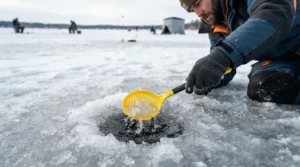
2. Frabill Ice Scooper (30 in) — long reach, lifetime warranty
The Frabill Ice Scooper is the scoop other scoops get compared to.
It’s built from polypropylene and reinforced nylon, and the listing mentions a 30 in engraved ruler on the handle and a limited lifetime warranty. That ruler turns the handle into a tape for measuring ice thickness or a fish, which is a feature you’ll use more than you expect. The large scoop moves more slush per pass, and the length means less bending.
Frabill makes no flotation claim, so don’t count on it floating. An In-Fisherman staff write-up praised its toughness and said it was the only scoop the writer kept handy. On the ice forums, one angler called it a longtime favourite, though another reported a buddy cracking the handle on the larger black-and-yellow model. Overall sentiment leans positive with the occasional breakage report.
Pros:
- ✅ Handy 30 in ruler on the handle
- ✅ Large scoop clears slush quickly
- ✅ Limited lifetime warranty
Cons:
- ❌ No documented flotation
- ❌ One forum report of a cracked handle
Price range: roughly C$30-C$40 once converted, a premium price justified by the warranty and reach.
3. Clam Super Ice Skimmer — deep scoop for heavy slush
The Clam Super Ice Skimmer is the one to reach for when a hole refuses to stay clear.
It’s polyethylene plastic with an aluminum rod in the handle, a 6 in deep scoop, a 32 in handle and a built-in measuring tape for ice or fish. That depth is the practical headline: a deeper cup means fewer trips, which matters when slush refreezes in minutes at -20°C.
The aluminum rod inside the handle works against buoyancy, so I wouldn’t expect this one to float, and the manufacturer doesn’t claim it. At one US retailer, the rating sat at 3.2 out of 5, which suggests it’s a polarizing tool. Treat that as one data point, not a verdict. It’s best for big holes and heavy early-season slush, and less so for packing light.
Pros:
- ✅ Deep 6 in scoop moves more slush
- ✅ Includes measuring tape
- ✅ Long 32 in handle reduces bending
Cons:
- ❌ Aluminum core makes floating unlikely
- ❌ Middling rating at one retailer
Price range: around C$20-C$30, reasonable if you fish lots of slush.
4. Rapala Folding Ice Scoop — hi-vis scoop that packs flat
The Rapala Folding Ice Scoop is the “just in case” scoop.
The listing describes a plastic handle with a foldable scoop, a hi-vis colour that’s easy to find in low light, and a co-molded design. The fold is the point: it packs down small enough to live in a jacket pocket as a backup. A bright colored scoop is genuinely useful in the grey half-light of early morning, when a dark scoop on dark slush is nearly invisible.
No flotation is claimed, and I found no verifiable customer reviews at a Canadian retailer, so durability of the hinge is an open question. Folding mechanisms are a common failure point on cheap tools, so check the hinge when it arrives.
Pros:
- ✅ Hi-vis colour easy to spot
- ✅ Folds small for pocket carry
- ✅ Very low price
Cons:
- ❌ No float claim
- ❌ Hinge durability unverified
Price range: under C$10, a no-brainer backup at that price.
5. HT Polar Alumi-Flex Skimmer — flexible cup sheds ice
Ice sticking to a skimmer is its own minor misery, and the HT Polar Alumi-Flex Skimmer attacks it directly.
It pairs a flexible 5 in perforated plastic cup with a 16 in aluminum handle. You squeeze the cup and the buildup pops off, instead of hammering it against your boot. The perforations let water drain, so you lift slush, not a bucket of heavy water. Aluminum won’t float, so this is a “hold on tight” tool.
Review sentiment was mostly “good for the price,” with one buyer noting the cup stays flexible even in deep cold. A recurring complaint was that the aluminum handle bends under heavy slush, so it’s better as a maintenance skimmer than a first-drill digger.
Pros:
- ✅ Flexible cup releases stuck ice
- ✅ Perforated cup drains water
- ✅ Lightweight and inexpensive
Cons:
- ❌ Handle can bend under heavy slush
- ❌ Aluminum handle will not float
Price range: likely under C$25, so check current price; strong value as a light backup.
6. Eagle Claw Telescopic Ice Fishing Skimmer — extends to 32 in
Tall people and small sleds rarely get along, and the Eagle Claw Telescopic Ice Fishing Skimmer is the compromise.
It extends to 32 in and retracts to 18 in, with a lightweight aluminum handle and a 5.75 in plastic scoop. The practical upshot is a skimmer that stays out of the way during transport and still saves your lower back during use. Telescoping joints are also the first thing to ice up and stick, so rinse and dry it carefully.
It’s aluminum, so it won’t float. The only review I could find was a single five-star note about its reach, which isn’t enough to draw conclusions. Think of it as a sensible spec-sheet pick rather than a proven winner.
Pros:
- ✅ Extends to 32 in, stores at 18 in
- ✅ Large 5.75 in scoop
- ✅ Lightweight aluminum build
Cons:
- ❌ Telescoping joint may ice up
- ❌ Very few reviews to lean on
Price range: roughly C$15-C$25; fair value for adjustable reach.
7. StrikeMaster Compact Mega Scoop — wrist lanyard instead of a float
The StrikeMaster Compact Mega Scoop approaches “don’t lose it” from the opposite direction: tether it.
It’s a 13.5 in fold-up design with a large fold-in scoop and an adjustable wrist lanyard. A lanyard can’t fix a scoop that slips from a cold hand, but it stops it from leaving your wrist at all. That’s arguably a more reliable retrieve ice scoop strategy than hoping something floats. The fold keeps it compact for hole-hopping.
No float claim here either. I couldn’t verify customer reviews or a current price, so I’m leaving both honestly blank rather than guessing. Check the current listing before you decide.
Pros:
- ✅ Wrist lanyard prevents drops
- ✅ Compact 13.5 in fold-up design
- ✅ Large scoop for its size
Cons:
- ❌ No documented flotation
- ❌ Short reach means more bending
Price range: not verified at time of research, so check current price.
Top 7 Specs Comparison
| Product | Length | Float Claim | Colour / Visibility | Best For |
|---|---|---|---|---|
| Northland Flipper Dipper | About 85 cm (34 in) | Yes, wood handle | Bright yellow | Drop-prone anglers |
| Frabill Ice Scooper | 30 in (76 cm) | No | Varies | Reach and warranty |
| Clam Super Ice Skimmer | 32 in handle | No | Varies | Heavy slush |
| Rapala Folding Ice Scoop | Folds flat | No | Hi-vis | Backup |
| HT Polar Alumi-Flex Skimmer | 16 in | No | Varies | Budget |
| Eagle Claw Telescopic Skimmer | 18-32 in | No | Assorted | Adjustable reach |
| StrikeMaster Compact Mega Scoop | 13.5 in | No | Varies | Lanyard security |
The table makes the trade-off plain: reach and capacity cost you pocket space, while the one floating handle comes with moderate length. If retrieval is your priority, the Northland Flipper Dipper and the lanyard on the StrikeMaster Compact Mega Scoop are the two logical answers. Budget buyers will be happy with the Rapala Folding Ice Scoop as a hi-vis backup, while the Frabill Ice Scooper earns its higher price through the warranty.
What Is a Floating Ice Scoop?
A floating ice scoop is a slotted or solid-cup skimmer, used to clear slush and ice from a drilled hole, whose handle or body is buoyant enough to stay on the surface if dropped. Most feature a bright colour so the scoop is easy to spot and retrieve.
It’s a close cousin of the standard ice skimmer, with one extra job. The usual purpose, keeping a fishing hole open, is well documented in the broader history of ice fishing, where simple hand tools have been used for generations. Floating just adds recovery. Because buoyancy depends on materials, many plastic cups are naturally buoyant on their own, while aluminum rods and metal fittings pull a scoop under. That’s why checking the handle matters more than the headline.
How to Choose a Floating Ice Scoop
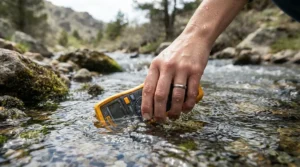
- Check the handle material first. Wood and foam float, plastic usually does, aluminum and steel don’t. A “floating” claim should name the handle.
- Look for bright colour. A yellow, orange or red bright colored scoop is far easier to spot on slush.
- Match length to your body and sled. Long handles save backs, short ones fit sleds. Telescoping and folding models split the difference.
- Think about cup size. Deeper scoops move more slush but need larger holes. Perforations drain water faster.
- Consider a lanyard. A wrist loop beats any float for prevention.
- Check cold-weather behaviour. Flexible cups shed ice; stiff ones can crack in deep cold.
- Confirm warranty and availability. A lifetime warranty offsets a higher price; stock changes, so verify on amazon.ca.
Float Handle Ice Scoop: What Actually Floats
The phrase float handle ice scoop sounds like a spec. In reality it’s a materials question, and it’s worth thirty seconds of thought before you buy.
Wood has long been used for floating tools because it’s lighter than water. That’s the logic behind the Northland scoop’s wood handle. A foam handle scoop works on the same principle: closed-cell foam is mostly trapped air, so it floats readily and also insulates your fingers from cold metal. The catch is that true foam-handle ice scoops are scarce. One foldable skimmer I found uses ABS and EVA materials, and EVA is a foam-like plastic, but the listing doesn’t promise it floats, so I wouldn’t assume.
Plastics like polyethylene and polypropylene are generally lighter than water, which is why many plastic scoops bob. The problem is the hidden metal, such as the aluminum core in the Clam Super Ice Skimmer or the aluminum handles on the HT Polar Alumi-Flex Skimmer and Eagle Claw Telescopic Ice Fishing Skimmer. Metal sinks, and it can drag an otherwise buoyant plastic cup down with it.
Rule of thumb: if the handle is aluminum, plan on it sinking. If it’s wood or foam, it should float. If it’s all plastic, test it in a bucket before you trust it.
Unsinkable Ice Skimmer: Marketing Promise or Real Thing?
An unsinkable ice skimmer sounds comforting, and honestly it’s overselling. Nothing sold for hole-clearing is truly unsinkable. Water-logged foam, a cracked handle or a heavy attachment can all change the story.
What you really want is “reliably buoyant and easy to find.” That means three things working together: a buoyant handle, a high-visibility colour, and ideally a tether. Think of it like a lifejacket strategy for your gear: float, flag, and fasten. A scoop that floats but is white against white snow still leaves you squinting. A bright one that sinks still disappears. Combine all three and you’ll actually get it back.
When marketing says unsinkable, read it as “designed to float.” Verify the handle material, then decide whether you need a backup.
Bright Colored Scoop: Why Hi-Vis Matters More Than You’d Think
You’d think colour was cosmetic. On the ice it’s functional.
Early-morning and late-afternoon light flatten everything into blue-grey. A black or dark-grey scoop tossed on slush disappears. A bright colored scoop in yellow, orange or red stays visible against snow, slush and the dark water of an open hole. The Northland Flipper Dipper leans on yellow, and the Rapala Folding Ice Scoop advertises a hi-vis colour for low-light finding.
Think of colour as the cheapest safety feature you’ll ever buy. If you lose a scoop to a hole, bright colour helps you spot it floating. If you leave it behind on the ice at the end of the day, it also helps you find it in a sled full of black gear.
A practical trick: if your favourite scoop is dull, wrap a few turns of bright tape around the handle. It costs pennies and makes a real difference, as long as the tape doesn’t interfere with a folding hinge.
Retrieve Ice Scoop: How to Get One Back Before It Sinks
Most scoops are lost in the first thirty seconds after they drop. That’s your window.
Problem 1: it floats but drifts. Light handles ride the current near moving water. Keep a pole with a hook or a gaff handy and reach immediately; don’t lean over the hole.
Problem 2: it sinks. Accept the loss. A scoop isn’t worth risking your footing. Carry a spare, like a folding Rapala Folding Ice Scoop, in a pocket.
Problem 3: it slips from cold fingers. Fix the cause with a wrist lanyard. The StrikeMaster Compact Mega Scoop includes one, and adding a loop of cord to any scoop is easy.
Problem 4: you can’t tell where it went. Choose bright colour and keep the hole clear of slush so the surface is visible.
Problem 5: you’re alone. Don’t go on the ice alone in the first place. More on that below.
A retrieve ice scoop strategy isn’t about one clever gadget. It’s a cheap, layered system, like a seatbelt, an airbag and careful driving.
Safety Ice Scoop: Ice Thickness, Regulations and Common Sense
A safety ice scoop sounds like marketing, and the truth is simpler: the scoop is a hole-maintenance tool that earns its “safety” label only when paired with safe ice and safe habits.
The Lifesaving Society recommends a minimum of 10 cm (4 in) of clear, hard ice for a single person walking, ice fishing or cross-country skiing, and notes that all ice carries risk. Its National Ice Safety Day guidance also stresses wearing a lifejacket or float coat, and describes the cold-water timeline: roughly one minute to control your breathing, ten minutes to self-rescue, and about an hour before hypothermia sets in. The Society’s data shows over half of ice-related fatalities occurred when the person was alone.
Slush is another signal. Saskatchewan’s ministry has noted that slush means ice is eroding from above and below, and that thermal cracks and pressure ridges are warning signs, so skimming slush isn’t a licence to ignore conditions. Read more about why ice can be so deceiving in CBC’s coverage, which quotes the Lifesaving Society on how often drownings happen between October and May.
Pair your skimmer with ice picks worn around your neck. Floating picks, such as the Clam Floating Ice Picks, add a self-rescue tool to the kit, though they’re a separate product from a scoop. Always check your province’s rules too. Ontario’s Recreational Fishing Regulations Summary is the reference for licences and limits there.
Floating Ice Scoop vs Standard Metal Skimmer
Which should you actually use? Honestly, many anglers carry both.
A metal skimmer is thin, strong, and cuts through refrozen crust. It’s also cold on bare skin and won’t float. A floating ice scoop, with a wood, foam or buoyant plastic handle, is warmer to hold and recoverable, but may flex or bend under heavy loads.
| Feature | Floating Ice Scoop | Standard Metal Skimmer |
|---|---|---|
| Recoverable if dropped | Usually yes | Rarely |
| Cold-hand comfort | Better (wood, plastic, foam) | Worse |
| Strength on thick crust | Moderate | Strong |
| Visibility | Often bright | Often dull |
| Best For | Drop-prone anglers, open holes | Heavy-duty ice breaking |
The table shows the split clearly. Metal wins on strength; a floating handle wins on recovery and comfort. For a typical day of hole-hopping with moderate slush, the Northland Flipper Dipper or Frabill Ice Scooper will serve most anglers. If you’re clearing very hard crust, add a metal skimmer such as an aluminum-handled HT Polar Alumi-Flex Skimmer as a second tool. Between a stiff handle bending and a drop that loses the scoop, many buyers will accept a bit of flex for the peace of mind.
Long-Term Cost and Maintenance
A C$25 scoop that lasts six seasons costs about C$4 a year. A C$5 scoop that cracks in January costs you a trip to buy another. That’s the logic behind paying more for the Frabill Ice Scooper‘s warranty.
Maintenance is mostly about not abusing the tool. Rinse off salt, dirt and slime, dry the scoop before storing it, and keep it out of hot cars, where plastics can warp. Check wood handles for splits, since moisture swelling and freezing can crack them over time. Inspect folding hinges, like those on the Rapala Folding Ice Scoop, for cracks before each season, and lubricate telescoping joints on the Eagle Claw Telescopic Ice Fishing Skimmer sparingly with something that won’t freeze.
Total cost of ownership also includes replacement trips and the lost-scoop tax. If you lose one a year, a floating model pays for itself quickly.
Practical Usage Guide: Getting the Most From Your Scoop
Treat the first outing as a test, not a trial by fire.
Before the season: test buoyancy at home. Drop the scoop in a bucket or tub and see whether it floats upright, sideways or sinks. If it floats badly, wrap closed-cell foam, such as a section of pool noodle, around the handle with tape. Test again; it’s cheap and effective, though it won’t suit every scoop.
On the ice: after drilling, scoop in smooth passes, lifting slowly so water drains from perforations. Knock buildup off by squeezing a flexible cup, rather than hammering it.
Common mistakes in the first 30 days: leaving a wet scoop on the ice to freeze solid, using a thin aluminum handle as a pry bar, and forgetting a lanyard until the day you drop it.
Maintenance: rinse, dry, inspect. Store flat or hanging, not under heavy gear.
Small habits add up. A scoop that’s treated well will outlast three that aren’t.
Real-World Scenarios: Which Scoop for Which Angler?
The weekend angler with a pop-up shelter. Budget around C$40 total for two tools: a long-reach Frabill Ice Scooper for inside the shelter and a pocket Rapala Folding Ice Scoop as backup. Fishing a few times a month on a small lake, that covers slush and surprises.
The first-timer on a borrowed sled. You’ll probably drop something. Start with the Northland Flipper Dipper for its floating wood handle, then add a lanyard. Total cost stays near C$25.
The hole-hopper chasing perch. Moving every twenty minutes means a tool that packs small. The StrikeMaster Compact Mega Scoop folds to 13.5 in, and a wrist lanyard keeps it attached while you move.
The heavy-slush specialist on big water. You’ll want volume. The Clam Super Ice Skimmer moves more slush per pass; keep a spare nearby.
FAQ
❓ Do floating ice scoops really float?
❓ What is the best foam handle scoop for ice fishing?
❓ Can I use a safety ice scoop instead of ice picks?
❓ How do I retrieve an ice scoop that fell in the hole?
❓ Is a bright colored scoop worth paying extra for?
Conclusion
A floating ice scoop won’t catch you a single fish. It will, however, save you from a small, recurring, entirely preventable annoyance, and it does it for the price of a coffee and a muffin.
Here’s the honest summary. The Northland Flipper Dipper is the one product with a documented floating handle and a bright yellow body, which makes it the top pick for this keyword. The Frabill Ice Scooper is the reach-and-warranty choice. The Clam Super Ice Skimmer handles heavy slush. The Rapala Folding Ice Scoop and HT Polar Alumi-Flex Skimmer are cheap, sensible backups. The Eagle Claw Telescopic Ice Fishing Skimmer adjusts to your height, and the StrikeMaster Compact Mega Scoop tethers to your wrist.
Whichever you choose, treat “floating” as one layer of protection alongside bright colour and a lanyard. Check the ice, bring a buddy, and carry picks. Then go catch something.
✨ Ready to gear up before the ice arrives?
🎣 Click through to check current prices and availability on amazon.ca, and pick the scoop that suits the way you actually fish!
Recommended for You
- Ice Scoop For Ice Fishing: 7 Best Picks, Ultimate 2026 Guide
- Shelter Rod Holder Ice Fishing: 7 Essential Picks For 2026
- Hands Free Rod Holder Ice Fishing: 7 Proven Picks (2026)
Disclaimer: This article contains affiliate links. As an Amazon Associate, I earn from qualifying purchases. If you purchase products through these links, we may earn a small commission at no additional cost to you.
✨ Found this helpful? Share it with your friends! 💬🤗
