
In This Article
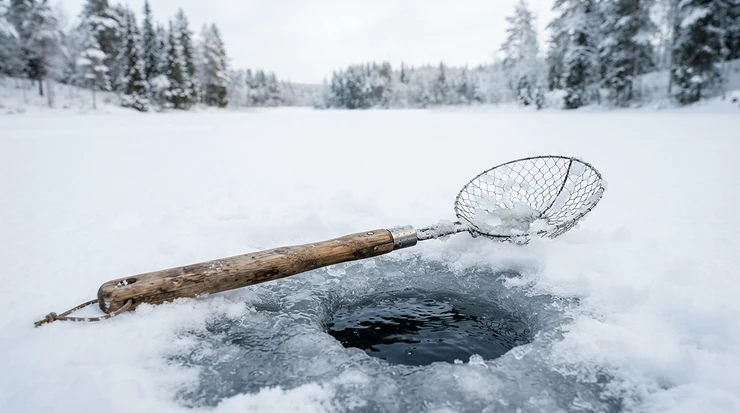
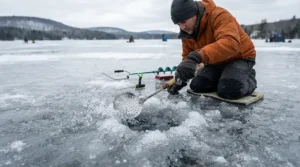
An ice scoop for ice fishing is a long-handled, cup-shaped tool, usually perforated or slotted, that lifts slush, floating chips and skim ice out of a freshly drilled hole so your line drops cleanly and the hole stays open. Think of it as the dustpan of hard-water angling: dull, unglamorous and completely non-negotiable.
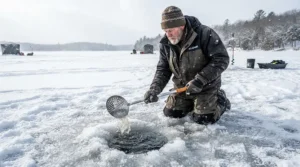
Here’s why it matters more than its price tag suggests. Every hole you drill fills with a cold porridge of ice shavings. Leave it, and your jig tangles, your sonar loses its view, and in a hard freeze the whole thing glazes over before the fish ever show up. A good ice scoop for ice fishing turns that chore into a ten-second job. A bad one turns it into a frozen-fingered wrestling match.
Freeze-up is coming, which makes October a smart month to shop. Ice angling is hardly new in this country: ice fishing has deep roots in Canada, with the Ojibwe of northern Ontario among the first to rely on it for food. The gear, though, has changed plenty, and the choice of scoops has quietly exploded.
This guide ranks seven real options, from pocket-friendly plastic to premium plate-style skimmers. You’ll get specs translated into plain language, the patterns that keep showing up in buyer reviews on retailer listings and angler forums, and a clear sense of who each tool actually suits. One honest note up front: I haven’t field-tested these, so you won’t find invented ice-hut stories here. What you will find is spec-driven analysis and aggregated review sentiment, caveats included.
Along the way we’ll tackle slush scoop ice fishing headaches, give each contender an ice hole scoop review, explain how a skimmer scoop ice tool differs from a plain ladle, show why a perforated ice scoop usually beats a solid one, and unpack what makes a durable ice skimmer worth paying for. Let’s dig in.
Ice Scoop for Ice Fishing: Quick Comparison Table
| Product | Design | Key Dimensions | Price Range (CAD) | Best For |
|---|---|---|---|---|
| HT Enterprises Poly-Flex Ice Skimmer | Flexible perforated cup, aluminum handle | 13 cm (5 in) cup | Under C$15 | Budget hole-hoppers |
| Rapala Compact Mega Ice Scoop | Fold-in scoop, floats, wrist lanyard | 26 cm (10 in) assembled | C$12-C$20 | Light packers who trek far |
| HT Enterprises Telescopic Ice Skimmer | Locking telescopic handle | 13 cm (5 in) scoop | C$12-C$20 | Anglers who hate bending |
| Woods Ice Scoop with Chipper | Steel scoop, chisel point | 51 cm (20 in) handle | C$12-C$20 | Refrozen holes in deep cold |
| HT Enterprises Chip N’ Dip Skimmer | Steel handle, ruler and chipper | 58 cm (23 in) handle, 15 cm (6 in) cup | C$25-C$35 | Measuring ice and chipping |
| Frabill Ice Scooper | Large ladle, engraved ruler | 76 cm (30 in) handle | C$30-C$40 | Shelter and sled-side fishing |
| Deep Freeze One-Shot Ice Skimmer Pro Edition | Plate-style skimmer, swappable plates | 15, 20 or 25 cm (6, 8 or 10 in) plate | Premium tier | Power-auger anglers |
Prices are approximate ranges in Canadian dollars at the time of research. Stock rotates with the season, so check current price and availability on Amazon.ca.
Looking at the table, the HT Enterprises Poly-Flex Ice Skimmer wins on raw value, while the Frabill Ice Scooper earns its higher range with reach and a built-in ruler. Anglers who run power augers should look hard at the Deep Freeze One-Shot Ice Skimmer Pro Edition, whereas anyone who spends the day reopening glazed holes will get more from the Woods Ice Scoop with Chipper or the HT Enterprises Chip N’ Dip Skimmer.
Notice how the cheapest picks cluster under C$20. The extra money in this category mostly buys handle length, steel and ruler marks, not a fundamentally better cup. That’s useful to know before you overspend on an ice scoop for ice fishing, and it’s why a perforated ice scoop in the budget tier can still outwork a pricey solid one.
💬 Just one click — help others make better buying decisions too!😊
Ice Hole Scoop Review: The Top 7 Picks for an Ice Scoop for Ice Fishing
Every pick below follows the same drill: the standout feature, what the specs mean out on the ice, an analytical take, the pattern in real buyer reviews, pros and cons, and a price range. Ratings and review counts only appear when a listing actually showed them, and every price is a range, not a quote.
1. HT Enterprises Poly-Flex Ice Skimmer — flexible cup that sheds ice with a squeeze
The star here is the cup itself: a soft, flexible 13 cm (5 in) plastic bowl dotted with drain holes, paired with a lightweight aluminum handle. Flex it and the ice cracks free.
Those perforations let water drain as you lift, so you haul chunks rather than a bucketful of icy slop. The squeezable plastic matters just as much, because it means you never have to hammer the cup against the ice to clear it, which is the habit that bends and breaks rigid metal skimmers. Five inches also slips comfortably into a standard 15 cm (6 in) auger hole.
Based on the spec comparison, this is the textbook slush scoop ice fishing tool for people who hop between holes all day. It weighs next to nothing and lives happily in a bucket. The trade-off is the handle: light metal is also bendable metal.
Reviewers on a fishing retailer’s listing consistently praise how the cup stays supple in the cold and clears with a tap against a boot. The most common caution is that the aluminum handle can bend under heavy slush, so it suits hole maintenance better than gutting a freshly drilled hole.
Pros:
- ✅ Flexible cup sheds ice with a quick squeeze
- ✅ Perforations drain water on the lift
- ✅ Feather-light and bucket-friendly
Cons:
- ❌ Aluminum handle can bend under heavy slush
- ❌ Not meant for chipping refrozen ice
Expect to pay under C$15, which makes this one of the cheapest routes to a proper perforated ice scoop. Value verdict: superb as a first scoop or a spare.
2. Rapala Compact Mega Ice Scoop — folds small and floats if you drop it
This is the pocket-sized option, built around a large fold-in scoop and an adjustable wrist lanyard. It floats, too, which quietly solves the classic “watched it sink down the hole” tragedy.
Assembled, it stands roughly 26 cm (10 in) tall, and folded it practically disappears into a jacket pocket. That compactness is the whole pitch: the maker aims it at anglers who keep tools on their person while moving from hole to hole. A bigger scoop face means fewer passes per hole, which is a clever way to use a short tool.
Here’s what to weigh. A short handle means more bending, so this is a sidekick for trekkers and run-and-gun panfish crews rather than a shelter workhorse. Pair it with a longer main scoop and you’ve covered both situations.
One Canadian Tire reviewer noted the scoop isn’t especially tough and wouldn’t trust it to break open holes that have started to refreeze. That fits the design: it’s for scooping, not chiselling.
Pros:
- ✅ Folds small enough for a coat pocket
- ✅ Floats and ships with a wrist lanyard
- ✅ Large scoop face clears slush quickly
Cons:
- ❌ Short handle means more bending
- ❌ Not built for breaking refrozen ice
The range sits around C$12-C$20. Value verdict: a smart second tool, not a first and only.
3. HT Enterprises Telescopic Ice Skimmer — extends so your back doesn’t have to bend
A locking collar lets this skimmer grow or shrink to fit the moment, topped with a 13 cm (5 in) scoop and a rubber handle designed for a firm grip in frigid air.
Telescoping handles solve a real problem: standing on open ice you want reach, while inside a cramped shelter you want it short. The collar is the make-or-break part, since a collar that creeps under load defeats the point. Rubber grip also beats bare metal when you’re wearing damp gloves at -20°C.
In plain terms, this is the ice scoop for ice fishing that makes the most sense for anglers with sore backs, or anyone who spends long sessions standing over holes. Any telescoping joint adds a wear point, so treat the collar gently and keep it free of ice.
Buyer comments on a Canadian retailer’s page say it works well and cuts down on bending and squatting. One reviewer wished the handle ended in a hard chisel tip, a feature this model leaves out.
Pros:
- ✅ Adjustable reach saves your back
- ✅ Rubber handle grips in the cold
- ✅ Collapses for easy storage
Cons:
- ❌ No chisel end on the handle
- ❌ Telescoping collar is a potential wear point
The range sits around C$12-C$20. Value verdict: very good for the money if comfort matters more than chipping power.
4. Woods Ice Scoop with Chipper — steel chisel point that reopens refrozen holes
Here’s a two-in-one: a durable steel scoop on a 51 cm (20 in) handle that ends in a sharp chipping chisel point. Scoop the slush, flip it around, and break the skim ice.
Steel changes the personality of a tool. It won’t flex like plastic, but it shrugs off the cold, resists the cracking that plagues brittle cups, and gives you a chisel for glazed holes during a hard freeze. The 20 in handle is a middle path: longer than pocket scoops, shorter than the lanky models, so it works inside shelters without poking the roof.
What most buyers overlook is the de-icing problem. Steel gets coated in ice, and with no flex to snap it free, you end up knocking it on the surface. Angler forum threads describe metal scoops slowly bending from exactly that habit, so tap gently or knock it against a boot sole instead.
The retailer flagged this model as top rated, though the written reviews I found were brief, mostly confirming it works as a long-handled ice scoop for ice fishing. Treat that as a modest signal, not a deep review base.
Pros:
- ✅ Steel build handles cold snaps
- ✅ Chisel point reopens refrozen holes
- ✅ Mid-length handle suits shelters
Cons:
- ❌ Ice clings to bare steel
- ❌ Can bend if banged to de-ice
Price sits around C$15, in the mid-C$10s. Value verdict: excellent for anglers who fish deep-cold, high-glaze conditions.
5. HT Enterprises Chip N’ Dip Skimmer — 58 cm handle with built-in ruler and chipper
This one packs three jobs into a single heavy-duty tool: a 58 cm (23 in) metal handle with a stamped ruler, a 15 cm (6 in) riveted cup and an integrated chipper.
That ruler is more than a gimmick. Measuring ice thickness as you drill is a safety habit, and a scoop that doubles as the gauge means one less item in your pocket. The riveted cup, rather than a glued or snap-on one, should survive repeated knocks, and the 6 in cup is sized for larger 20 cm (8 in) holes where a 5 in cup would feel like a teaspoon.
Based on the spec comparison, this is the best-equipped metal skimmer scoop ice option for anglers who chip, scoop and measure all in one visit. The cost is weight and the usual steel ice-up problem.
The review pool is small: a single retailer review praised the thick steel handle, the welded chipper and the galvanized finish that resists rust. One positive review isn’t a verdict, so weigh this on its spec sheet more than its stars.
Pros:
- ✅ Ruler, scoop and chipper in one tool
- ✅ Riveted cup built for repeated knocks
- ✅ Large cup suits 20 cm holes
Cons:
- ❌ Heavier than plastic and aluminum rivals
- ❌ Very small pool of buyer reviews
The range runs about C$25-C$35. Value verdict: fair to good, best for people who’ll use all three functions.

6. Frabill Ice Scooper — 76 cm reach, engraved ruler and a wrist loop
Made of polypropylene and reinforced nylon, this big ladle-style scoop pairs a roomy cup with a 76 cm (30 in) handle engraved with a ruler, plus a large bungee loop that keeps it from dropping into the hole.
Length is the secret weapon. A long handle lets you scoop a hole while standing nearly upright, which your lower back will thank you for after four hours on the ice. Plastic is also easier to de-ice than steel, since a quick twist or squeeze cracks the buildup off. One retailer listing even mentions a limited lifetime warranty, though you should confirm current terms before relying on it.
On paper this is the ice scoop for ice fishing that suits shelters and sled-side fishing, where hole maintenance is constant. The long handle is the catch: it can be awkward to pack in a small bucket.
In-Fisherman’s staff write that they’ve been through plenty of scoops and this one just keeps surviving. Angler forum posters call it a favourite, though one noted a buddy cracking the handle, and another thought it wasn’t worth paying extra for a premium scoop.
Pros:
- ✅ Long handle spares your lower back
- ✅ Engraved ruler for ice and fish
- ✅ Wrist loop prevents drops
Cons:
- ❌ Bulky to pack in a bucket
- ❌ Handle can crack under abuse
Expect around C$30-C$40. Value verdict: good for heavy users, overkill for occasional anglers.
7. Deep Freeze One-Shot Ice Skimmer Pro Edition — swappable plates for 15, 20 or 25 cm holes
This is the premium pick: a zinc-coated steel and polypropylene skimmer that accepts 6, 8 or 10 inch plates, so the scoop matches your hole instead of the other way round. The listing states it’s made in the USA.
The one-shot idea is simple. A plate sized to your auger hole catches nearly everything on a single dip, so you spend seconds per hole instead of minutes. Zinc-coated steel also helps resist rust, an underrated bonus when gear lives in a damp truck bed.
Here’s what to weigh. Forum anglers report that skimmers like this work very well with sharp augers or chipper blades, but aren’t always truly one-shot on very thick ice or when snow-ice mush floats up. If you drill dozens of holes per trip, the time saved adds up. If you drill four, it won’t.
One retailer listing showed a 4.7 star average from 64 reviews at the time of research, which is a stronger signal than most scoops here. A skeptical forum poster did question paying extra for it, so be honest about how often you really hole-hop.
Pros:
- ✅ Plate matches 15, 20 or 25 cm holes
- ✅ Zinc-coated steel resists rust
- ✅ Strong review average on one retailer page
Cons:
- ❌ Premium pricing versus basic scoops
- ❌ Less effective with mushy snow-ice
It sits in the premium tier, so check current price before deciding. Value verdict: worth it for high-volume hole-hoppers.
Head-to-Head: How the Top 7 Stack Up
| Product | Build | Review Signal | Price Range (CAD) | Best For |
|---|---|---|---|---|
| HT Enterprises Poly-Flex Ice Skimmer | Flexible plastic cup, aluminum handle | Praised for cold flex; handle bends | Under C$15 | Budget perforated ice scoop |
| Rapala Compact Mega Ice Scoop | Folding plastic, floats | One reviewer: not tough | C$12-C$20 | Packable backup |
| HT Enterprises Telescopic Ice Skimmer | Telescoping handle, rubber grip | Works well, less bending | C$12-C$20 | Sore backs |
| Woods Ice Scoop with Chipper | Steel with chisel point | Retailer-flagged top rated | C$12-C$20 | Glazed holes |
| HT Enterprises Chip N’ Dip Skimmer | Steel, riveted cup, ruler | One positive review | C$25-C$35 | Chip and measure |
| Frabill Ice Scooper | Polypropylene and nylon | Staff and forum favourite | C$30-C$40 | Shelter fishing |
| Deep Freeze One-Shot Ice Skimmer Pro Edition | Zinc-coated steel, plates | 4.7 stars, 64 reviews (one retailer) | Premium tier | High-volume holes |
The table shows a clean pattern: spend under C$20 for flexibility or packability, move to the mid-C$20s and beyond for steel and rulers, and pay premium only for speed. The Frabill Ice Scooper and the Deep Freeze One-Shot Ice Skimmer Pro Edition have the strongest durability reputations, but the Woods Ice Scoop with Chipper gives the best chisel-plus-scoop combination for the money. Review signals come from retailer listings and forums, not Amazon.ca specifically, so check each product’s current Amazon.ca reviews before buying.
How to Set Up and Maintain Your Ice Scoop for Ice Fishing
Amazon listings stop at “buy it.” Here’s the part they skip: what to do in the first ten minutes, and the thirty days after.
First-Use Setup
- Add a leash. Even floating scoops sink when a boot kicks them in. A simple wrist loop or paracord lanyard costs nothing and saves a trip.
- Mark your own ruler. If your handle has no ruler, scratch or paint a mark every 5 cm. Measuring as you drill is a habit worth building.
- Pre-chill it. Leave the scoop outside the shelter, in the same air as the ice. A warm scoop dipped in a cold hole instantly glazes over.
- Test the fit. Drop the cup into a drilled hole once. A cup that scrapes the edges snags on every lift.
Maintenance Schedule
- After each trip: Rinse off lake grit, shake it dry, and let it air out. Never zip a wet scoop into a closed bag.
- Monthly in season: Check rivets, handle collars and any plastic seam for hairline cracks.
- End of season: Wipe metal parts with a dry cloth and store the scoop somewhere dry, since even galvanized or zinc-coated steel can rust if left damp.
Mistakes to Avoid in the First 30 Days
Stepping on a plastic scoop is the classic way to lose one; angler forum posts describe exactly that. Hammering a metal skimmer on the ice to shed buildup bends it, so use a boot or a gentle flex instead. And don’t leave the scoop sitting in the hole, where it freezes in place and tears when you yank it. Treat your ice scoop for ice fishing like a tool, not a shovel, and a decent one will give you many seasons.
Real-World Scenarios: Matching an Ice Scoop for Ice Fishing to Your Style
Three typical anglers, three different answers. These are illustrative profiles, built from the spec comparison above, not case studies of real customers.
Scenario 1: The Weekend Panfish Hole-Hopper
Picture someone with a C$20 scoop budget who drills 20 or more holes per outing on a snow-covered lake, walking between spots with a bucket and sled. Weight and packability rule everything here. The HT Enterprises Poly-Flex Ice Skimmer is the workhorse, with the Rapala Compact Mega Ice Scoop riding in a pocket as a backup. Together they sit comfortably in the mid-C$20s.
Scenario 2: The Shelter Angler With a Cranky Back
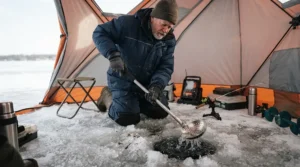
Now imagine a weekend angler fishing inside a portable shelter, four to six hours at a time, hole always within arm’s reach. Reach matters more than weight. The Frabill Ice Scooper or the HT Enterprises Telescopic Ice Skimmer lets them clear slush from an upright stance, which is the difference between a relaxing Saturday and a sore Sunday. Budget: anywhere from C$15 to C$40.
Scenario 3: The Power-Auger Perch Crew
Finally, picture a group drilling 40 or more holes across a derby day with a gas or electric auger. Time per hole is the currency. The Deep Freeze One-Shot Ice Skimmer Pro Edition, with a plate matched to the auger bit, is built for this rhythm. The Woods Ice Scoop with Chipper makes a cheap partner for the inevitable refrozen holes.
If you’re somewhere in between, choose by environment first: deep cold and glaze call for steel and a chisel, soft slush calls for flexible plastic, and cramped shelters call for reach.
Slush Scoop Ice Fishing: 5 Common Problems and How to Fix Them
Slush scoop ice fishing sounds simple until it’s -25°C and the wind is doing its best impression of a hair dryer. These are the five headaches that come up most, with practical fixes.
Problem 1: Holes refreeze before you can fish them. Scoop more often and reach for a model with a chisel end. The Woods Ice Scoop with Chipper and the HT Enterprises Chip N’ Dip Skimmer both break skim ice that a plain cup would only smear around.
Problem 2: The scoop ices up mid-session. Metal clings to ice, so switch to flexible plastic like the HT Enterprises Poly-Flex Ice Skimmer, or tap steel gently against a boot. Dip, lift and shake rather than leaving it sitting in the water.
Problem 3: Fresh holes are full of chips. Often that’s the auger, not the scoop. Forum anglers report that a sharp blade, or briefly running a drill in reverse after you break through, leaves far less debris behind. Then a single pass with a perforated ice scoop finishes the job.
Problem 4: Dropping the scoop down the hole. Use a lanyard. The Rapala Compact Mega Ice Scoop floats and includes one, and the Frabill Ice Scooper has a large wrist loop for the same reason.
Problem 5: Back pain from constant bending. Lengthen your reach. The HT Enterprises Telescopic Ice Skimmer adjusts, and the 76 cm Frabill Ice Scooper simply starts long.
A good rule of thumb: match the fix to the failure, not the other way round. If your holes keep glazing, buy a chisel, not a bigger cup.
How to Choose an Ice Scoop for Ice Fishing
The short answer: match the cup to your hole, the material to your climate and the handle to your posture. Here are the seven steps, in the order that matters.
- Match the cup to your hole. A 13 cm (5 in) cup suits a 15 cm (6 in) auger hole, a 15 cm cup suits 20 cm (8 in), and anything wider needs a plate-style skimmer. Too small and you make endless passes; too big and it jams.
- Pick the material for your climate. Flexible plastic sheds ice with a squeeze and thrives in wet slush. Steel survives abuse and chisels skim ice, but clings to buildup.
- Choose handle length by where you fish. Shelters reward 50 cm or shorter handles, open ice rewards reach, and anyone with a sore back should lean toward 75 cm or telescoping.
- Insist on perforations or slots. Holes let water drain on the lift, which keeps weight down and stops you flinging icy water onto your boots.
- Decide whether you want a ruler or chisel. A ruler turns your scoop into a gauge. The Canadian Red Cross advises at least 15 cm of ice for walking and 25 cm for snowmobiles, and notes that white, opaque ice is roughly half as strong as clear blue ice, so measuring is worth doing as you drill.
- Add a leash. A wrist loop or floating design protects against the one mistake you only make once.
- Set a budget by how often you fish. Occasional anglers do fine under C$20. Weekly anglers should consider steel or long-handled models in the C$25-C$40 range, where the Frabill Ice Scooper and the HT Enterprises Chip N’ Dip Skimmer live.
And if you only remember one thing: the best ice scoop for ice fishing is the one that fits your hole, your hand and your habits, not the one with the longest feature list.
Perforated Ice Scoop vs Solid Ladle: Which Wins on the Ice?
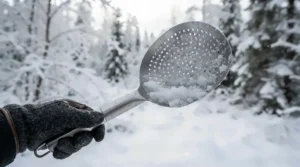
A perforated ice scoop lets water drain through holes or slots as you lift, so you carry mostly ice. A solid ladle holds everything, water included. On paper that sounds like a clear win for perforation, and in most conditions it is, but there are nuances worth understanding.
Where perforation wins
Slush is mostly water with ambition. A drained cup lifts lighter, drips less onto your boots and leaves less liquid on the surface to refreeze into a skating rink. That’s why the HT Enterprises Poly-Flex Ice Skimmer, with its perforated 13 cm cup, is such a sensible budget buy. The perforations also help the scoop clear faster, because less water means less weight to wrestle.
Where a solid ladle holds its own
Deep ladle-style cups carry more per scoop, and some anglers also use them as minnow dippers. The large ladle on the Frabill Ice Scooper is built on that idea: a big ladle that moves a lot of slush in one go, which suits shelters where the hole is cleaned constantly. Check the listing for its exact cup design before assuming it drains.
The wildcard: angle and shape
Some forum anglers report that a slotted kitchen utensil, with the cup angled roughly 130 to 140 degrees from the handle, outperformed a purpose-built scoop for them. That’s anecdotal, but it hints at something real: geometry matters as much as holes.
If you fish mostly soft slush, go perforated. If your holes glaze or you’re after bigger volume, a solid ladle with a long handle may serve you better. For most Canadians drilling through variable ice, a perforated ice scoop is the safer default, and one decent perforated model beats three mediocre solid ones.
Durable Ice Skimmer: Materials, Longevity and Long-Term Cost
A durable ice skimmer isn’t simply a strong one. It’s one that survives the specific ways scoops die: brittle cold cracks, rust, bent handles, creeping collars and the stray boot. Each material in this guide handles those failure modes differently.
- Polypropylene and reinforced nylon (the Frabill Ice Scooper): shrugs off cold-brittleness, though one forum poster reported a cracked handle on a friend’s scoop.
- Zinc-coated and galvanized steel (the Deep Freeze One-Shot Ice Skimmer Pro Edition and the HT Enterprises Chip N’ Dip Skimmer): resists rust and suits riveted or welded construction, but ices up.
- Aluminum handle with flexible cup (the HT Enterprises Poly-Flex Ice Skimmer): light and cheap, but handle bending is the recurring complaint.
- Plain steel (the Woods Ice Scoop with Chipper): tough, though forum posts describe steel scoops bending when hammered clean.
Cost per Season: A Quick Illustration
These numbers are assumptions to show the logic, not measured lifespans.
| Scenario | Assumed Upfront (CAD) | Assumed Life | Approx. Cost per Season |
|---|---|---|---|
| Entry-level plastic and aluminum scoop | About C$10 | 2 seasons | About C$5 |
| Mid-range steel scoop | About C$15 | 4 seasons | About C$4 |
| Long-handled premium scoop | About C$35 | 8 seasons | About C$4.50 |
Looking at the table, the cost per season barely moves, which is the useful insight: a durable ice skimmer in the C$30s only beats a C$10 one if you actually keep it for years. If you fish ten times a winter, a cheap perforated ice scoop replaced occasionally is perfectly rational. If you fish weekly and care about comfort, paying more for reach and warranty-backed plastic like the Frabill Ice Scooper starts making financial sense.
Features That Actually Matter (And Those That Don’t)
Scoop marketing loves adjectives. Here’s how to filter the useful from the decorative.
Features worth your attention
- ✅ Cup size matched to hole size. It’s the single biggest factor in speed.
- ✅ Drainage holes or slots. They cut weight and reduce refreezing meltwater.
- ✅ A leash or flotation. Cheap insurance, which is why the Rapala Compact Mega Ice Scoop earns points for including both.
- ✅ Handle length that fits your posture. Back comfort compounds over a long day.
- ✅ Rust-resistant coatings. Zinc-coated or galvanized steel lasts longer in a damp truck.
- ✅ A ruler. Genuinely useful, though it only supplements proper ice checks.
Features that matter less than they sound
- ❌ Bright colours. Hi-vis is nice in low light, but it won’t make the scoop work better.
- ❌ “Ultra-light” claims on no-name listings. Light is good, but a flimsy handle that bends under slush isn’t a win.
- ❌ Folding gimmicks on large scoops. Compact folding suits pocket carry on the Rapala Compact Mega Ice Scoop, but extra hinges on a heavy scoop just add wear points.
- ❌ Warranty language you haven’t verified. One listing mentions a limited lifetime warranty on the Frabill Ice Scooper, but terms can change, so confirm on the current listing.
Here’s the plain truth: no scoop feature rescues a bad fit. A scoop too wide for your holes or too short for your back will frustrate you however many extras it carries. Get the basics right, and you’ll rarely need to pay for the rest.
Skimmer Scoop Ice Tools vs Traditional Alternatives
Plenty of anglers clear holes with whatever’s lying around. Forum threads are full of improvisations: bait nets, slotted kitchen utensils, even drilling a hole twice. Are they worth it? Here’s how a dedicated skimmer scoop ice tool stacks up.
| Method | Speed | Cost | Comfort in Cold | Best For |
|---|---|---|---|---|
| Dedicated skimmer scoop ice tool | Fast | Low (C$10-C$40) | Good, with handle and grip | Everyday anglers |
| Bait net or minnow net | Moderate | Often already owned | Fair | Anglers with a spare net |
| Slotted kitchen utensil | Moderate | Very low | Poor, short handle | Emergency backup |
| Drill in reverse or re-drill | Fast but fussy | Free | Good | Hand-auger users with a drill |
Looking at the comparison, a dedicated tool wins on handle length, grip and consistency, which is why even the cheapest HT Enterprises Poly-Flex Ice Skimmer beats a kitchen spoon over a long day. Improvised methods are creative and some forum anglers swear by them, but they trade comfort and reliability for a small saving. The drill-in-reverse trick is genuinely clever, yet it only helps if you’re drilling with a power tool in the first place.
In practice the smartest setup is a dedicated scoop plus one improvisation you know works. Treat the alternatives as a bonus, not a replacement, because a proper ice scoop for ice fishing costs less than a coffee-and-sandwich lunch and saves you a lot of cold, wet fingers.
Ice Safety and Regulations Every Canadian Angler Should Know
A scoop keeps your hole open. It does nothing to keep you safe, so let’s talk about the part that matters most.
The Ontario Conservation Officers Association has repeatedly urged anglers to check ice conditions often. Its widely repeated guidance, which it attributes to the Lifesaving Society, puts the minimum for walking and ice fishing at 10 cm of clear ice, with 12 cm for one snowmobile or ATV and 20 to 30 cm for a car or small pickup. The Canadian Red Cross is more conservative, recommending at least 15 cm for walking or skating alone and 25 cm for snowmobiles. When sources differ, take the cautious number.
Practical Habits That Pair With Your Scoop
- ✅ Check colour as well as thickness. Clear blue ice is strongest, white opaque ice is roughly half as strong, and grey ice is unsafe.
- ✅ Measure repeatedly. Thickness varies across a lake, so check every few metres and re-check as you move. A scoop with a ruler makes that effortless.
- ✅ Carry the basics. Ice picks, a floatation or survival suit, a whistle and a charged phone are standard advice from conservation officers.
- ✅ Don’t go alone. Tell someone where you’re parked and when you’ll be back.
- ✅ Mind moving water. Rivers, locks and spring-fed areas are less reliable at any time of winter.
Licences and Rules
Fishing licence requirements, catch limits and hole-size or gear rules differ by province and territory, and they change. Carry your valid licence, and read your province’s current regulations before heading out. Those rules govern what you do on the ice; this guide only covers the tool that keeps your hole clear.
FAQs
❓ What size ice scoop for ice fishing holes works best?
❓ Do I still need a scoop if I use a power auger?
❓ Can an ice scoop double as a minnow scoop?
❓ How much should I spend on an ice scoop for ice fishing in Canada?
❓ Is a wrist lanyard really necessary on an ice scoop?
Conclusion
The best ice scoop for ice fishing isn’t a mystery. It’s the one that fits your hole, your hands and your habits, and the field of seven above covers nearly every situation you’ll meet on a Canadian lake.
On a tight budget, the HT Enterprises Poly-Flex Ice Skimmer is hard to argue with. For pocket-sized backup, the Rapala Compact Mega Ice Scoop earns its place. If your back protests, the HT Enterprises Telescopic Ice Skimmer or the Frabill Ice Scooper gives you reach. Cold snaps and refrozen holes favour the Woods Ice Scoop with Chipper or the HT Enterprises Chip N’ Dip Skimmer, and high-volume drillers should weigh the Deep Freeze One-Shot Ice Skimmer Pro Edition.
A reminder about the evidence: the review patterns quoted here come from retailer listings, magazine commentary and angler forums, and they’re a guide, not a guarantee. Check current Amazon.ca reviews and availability before you buy.
And please, put safety ahead of gadgets. Measure your ice, carry your picks, and read the latest rules for your province, such as the Ontario Fishing Regulations Summary if you fish there. A clean hole is great. Getting home safely is better.
✨ Your Hard-Water Season Starts With One Smart Pick!
🎣 Choose the scoop that fits your style, click any highlighted product name to check current pricing and availability on Amazon.ca, and get ready for a smoother, warmer, more productive winter on the ice!
Recommended for You
- Shelter Rod Holder Ice Fishing: 7 Essential Picks For 2026
- Hands Free Rod Holder Ice Fishing: 7 Proven Picks (2026)
- Ice Fishing Rod Holder: 7 Ultimate Picks For Canada (2026)
Disclaimer: This article contains affiliate links. As an Amazon Associate, I earn from qualifying purchases. If you purchase products through these links, we may earn a small commission at no additional cost to you.
✨ Found this helpful? Share it with your friends! 💬🤗
