
In This Article
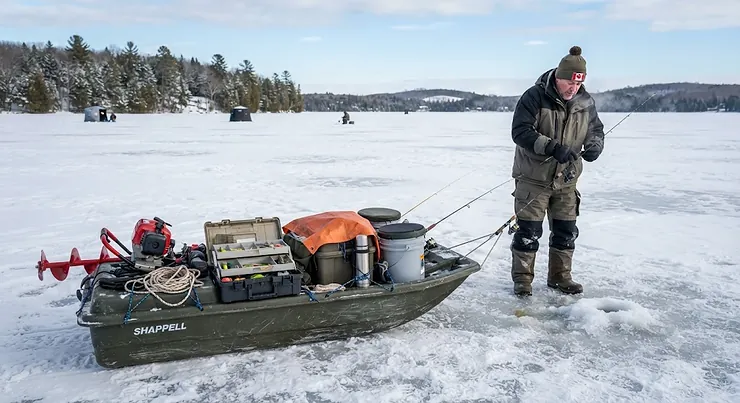
There’s a very specific kind of misery that comes from watching your auger, your bucket, and your favourite rod case slide sideways across glare ice while you chase them on foot. Anyone who’s tried hauling gear across a frozen bay in a hockey bag knows why the humble jet sled for ice fishing exists — and why so many Canadian anglers eventually cave and buy one. It’s not glamorous gear. It doesn’t cast a lure or mark a fish. But a good jet sled for ice fishing is the difference between a ten-minute walk to your spot and a twenty-minute wrestling match with a garbage bag full of tip-ups.
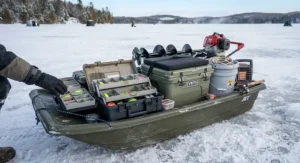
This guide skips the marketing copy and gets into what actually matters: real dimensions, real weight capacities, and honest analysis of who each sled is built for. We researched seven genuine, currently available models — from feather-light budget haulers to 726 kg (1,600 lb) cargo monsters — and broke down where each one earns its keep and where it falls short. Whether you’re hunting for a heavy duty ice sled to survive years of ATV towing or just need something to drag a bucket and an auger 90 metres from the truck, there’s a match in here.
Before you load anything, it’s worth a reminder that no sled replaces sound judgment on the ice. Provincial safety bodies, including the Government of Saskatchewan’s Water Security Agency, publish minimum thickness guidelines for foot traffic and towed loads — numbers worth checking before any sled, however tough, gets loaded up and pulled onto a lake.
What Is a Jet Sled for Ice Fishing?
A jet sled for ice fishing is a low-profile, rotationally or thermoformed polyethylene hauling sled with molded runners on the underside, designed to be pulled by hand, snowmobile, or ATV across snow and ice. It carries augers, shelters, bait, and tackle without the friction, tipping, or puncture risk of a wheeled cart or duffel bag.
Unlike a toboggan, a jet sled has a contoured hull and an “attack angle” at the front edge, which lets it climb over slush ridges and wind-packed snow instead of plowing into them. That single design detail is why anglers keep buying purpose-built sleds instead of improvising with a kids’ toboggan from the garage.
Quick Comparison: Best Jet Sleds for Ice Fishing at a Glance
Before diving into the full breakdown, here’s the short version for anyone who just wants a starting point.
| Category | Product | Best For |
|---|---|---|
| Best All-Around | Shappell Jet Sled | Everyday solo hauls to a nearby spot |
| Best Budget Pick | Shappell Jet Sled Jr | First-time buyers, light loads |
| Best High Sided Jet Sled | Shappell Jet Sled XL | Bulky flip shelters, bigger groups |
| Best Heavy Duty Ice Sled | Otter Pro Utility Sled | ATV or snowmobile towing over rough ice |
| Best Cargo Ice Sled | KFF Heavy-Duty Yard Drag Sled | Multi-day trips, big families, big gear piles |
Looking at this lineup, the split isn’t really about brand loyalty — it’s about how far you’re walking and how much you’re dragging. The Shappell Jet Sled covers most casual anglers without overspending, while the KFF Heavy-Duty Yard Drag Sled and Otter Pro Utility Sled exist for people who treat ice fishing as a serious logistics operation. Budget-conscious buyers should note that the jump in wall height and length from the standard Shappell Jet Sled to the Shappell Jet Sled XL costs real money, so it’s worth confirming you actually need the extra room before upgrading.
💬 Just one click — help others make better buying decisions too!😊
Top 7 Jet Sleds for Ice Fishing: Expert Analysis
We prioritized real, currently sold products with verifiable specs over anything invented for this list — every sled below is a model you can search for directly on amazon.ca.
1. Shappell Jet Sled — best all-around budget hauler
The original Shappell Jet Sled is the sled most Canadian anglers picture when they hear the term, and for good reason. Measuring roughly 137 cm long, 64 cm wide, and 25 cm high (54 × 25 × 10 in) and weighing about 5.2 kg (11.5 lb), it’s light enough to hand-pull all day but rigid enough to survive being dragged over rocky boat launches. The high-density polyethylene hull doesn’t go brittle in deep cold the way cheaper poly blends do, and the molded runners underneath keep it tracking straight instead of fishtailing behind you.
Based on the spec comparison against similarly priced competitors, this is the sled that makes the most sense for a solo angler who walks onto lakes within a kilometre or two of the truck. It’s not trying to be a cargo hauler — it’s trying to be light, cheap, and reliable, and on those terms it delivers. Reviewers consistently report strong satisfaction, with retailer review data showing a 4.6-out-of-5 average and roughly 90% of buyers recommending it, though a smaller group of long-term owners note the plastic can show wear after a single season of genuinely hard abuse, like repeated dragging over exposed rock and gravel.
Pros:
- ✅ HDPE hull resists cracking in sub-zero conditions
- ✅ Contoured hull design makes hand-pulling noticeably easier
- ✅ Strong owner satisfaction with a 4.6-star aggregate rating
Cons:
- ❌ Shallow 25 cm sides limit bulky shelter loads
- ❌ A minority of owners report faster wear under heavy seasonal abuse
At a price typically landing in the C$85-C$140 range, the Shappell Jet Sled offers strong value for anyone who doesn’t need extra cargo height — check current price before buying, since Amazon.ca listings shift with demand.
2. Shappell Jet Sled XL — best high sided jet sled for bulky loads
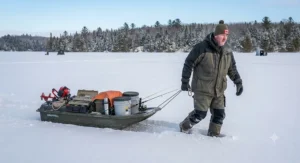
If the standard model feels cramped once a flip-over shelter and a full tackle box get involved, the Shappell Jet Sled XL solves that with genuinely larger dimensions: about 168 cm long, 79 cm wide, and 30 cm high (66 × 31 × 12 in). That extra 5 cm of wall height over the standard model doesn’t sound like much on paper, but it meaningfully changes what stays inside the sled during a bumpy tow behind a snowmobile.
What most buyers overlook about high sided jet sled models like this one is that the benefit isn’t just capacity — it’s cargo retention. A higher lip means less bungee-cord engineering to keep a propane heater or rod case from bouncing out over rough, wind-sculpted ice. Despite the bigger footprint, it still weighs a manageable 9.75 kg (21.5 lb), so it hasn’t sacrificed portability for size. Reviewers and retailers describe it as the go-to option once a standard jet sled starts feeling undersized for a group trip or a full shelter setup.
Pros:
- ✅ 168 × 79 × 30 cm footprint swallows a flip shelter with room to spare
- ✅ Higher sidewalls keep loads from sliding out on rough pulls
- ✅ Still light at 9.75 kg despite the larger size
Cons:
- ❌ Bulkier shape is harder to store in a shed or truck bed
- ❌ Costs noticeably more than the standard-size Shappell Jet Sled
Expect a price somewhere in the C$150-C$190 range at the time of research, making it a reasonable upgrade rather than a premium splurge.
3. Shappell Jet Sled Jr — best budget entry point
At just 2.7 kg (6 lb) and roughly 109 × 53 × 20 cm (43 × 21 × 8 in), the Shappell Jet Sled Jr is the lightest sled on this list by a wide margin. It’s built from the same rugged polyethylene as its bigger siblings, just scaled down for anglers who don’t need to move much gear — think a bucket, a hand auger, and a rod case rather than a full shanty setup.
Here’s what to weigh before buying the smallest option: the Shappell Jet Sled Jr trades capacity for convenience, and that trade only makes sense if your typical trip really is light. On paper, this means less strain on your shoulders and a sled that fits in a hatchback trunk without disassembling anything, but it also means a first ice-fishing shelter purchase down the road will likely force an upgrade. Forum discussion among ice anglers frequently frames the Jr-sized sled as a good “first sled” that gets outgrown once gear collections expand.
Pros:
- ✅ Just 2.7 kg — the easiest sled here to hand-pull solo
- ✅ Compact 109 cm length fits in almost any vehicle
- ✅ Low price makes it an easy first-sled purchase
Cons:
- ❌ Shallow, narrow bed can’t handle a full shanty setup
- ❌ Limited capacity for anglers who accumulate gear over time
Pricing tends to sit around C$65-C$85, positioning it as the cheapest legitimate entry point into purpose-built ice sleds rather than a garbage-bag workaround.
4. Otter Outdoors Sport Sled — best budget Otter alternative
The Otter Outdoors Sport Sled is Otter’s entry-level option, and it’s a useful reference point for the Otter jet sled comparison further down this article. It uses the same roto-molded polyethylene construction Otter applies across its lineup, which produces a more uniform wall thickness than some competitors’ injection-molded hulls — a detail that matters when a sled repeatedly flexes in extreme cold.
Based on the spec comparison, the standout feature here is the raised back panel, engineered specifically to stop gear from sliding out the rear during a tow behind a snowmobile or ATV. A tow rope is included for hand-pulling, and the sled’s “attack angle” front edge is designed to glide over slush and snowdrifts rather than digging in and stalling. Reviewers frequently describe it as a dependable, no-frills option for anglers who want Otter’s reputation for durability without paying for the Pro-tier reinforcements.
Pros:
- ✅ Roto-molded poly resists flex-cracking in deep cold
- ✅ Raised back keeps cargo from sliding out during tows
- ✅ Attack-angle front glides over slush and snow ridges
Cons:
- ❌ Lacks the reinforced tie-down lip found on the Pro model
- ❌ Narrower stance than heavy-duty rivals on rough, broken ice
Expect a price in the C$65-C$100 range, which puts it roughly in line with the standard Shappell Jet Sled despite the brand’s premium reputation.
5. Otter Outdoors Pro Utility Sled — best heavy duty ice sled
For anglers who genuinely abuse their gear — long ATV tows, rocky portages, years of seasonal use — the Otter Outdoors Pro Utility Sled is built with the widest and most stable footprint in Otter’s lineup, plus a reinforced outer lip specifically designed to hold ropes and tie-downs without tearing out over time.
What separates a heavy duty ice sled from a standard one isn’t just thickness; it’s where the material is distributed. Otter’s roto-molding process concentrates extra plastic at the stress points that take the most abuse during towing and loading, rather than spreading it evenly and hoping for the best. The raised back panel — shared with the Sport Sled — adds cargo security, but the reinforced lip and wider stance are what push this model into true heavy-duty territory. Reviewers and longtime users, including outdoor bloggers who’ve run multiple sled brands side by side, consistently rank Otter sleds among the toughest available, describing them as the sled that outlasts everything else in the shed.
Pros:
- ✅ Widest, most stable footprint in the lineup for big loads
- ✅ Reinforced outer lip holds ropes and tie-downs securely
- ✅ Uniform wall thickness absorbs shock instead of stress-cracking
Cons:
- ❌ Noticeably heavier to hand-pull than a basic jet sled
- ❌ Premium construction carries a matching premium price tag
Pricing generally lands in the C$180-C$260 range, reflecting the extra material and reinforced construction — a legitimate long-term investment rather than an impulse buy.
6. Clam Outdoors Kenai Sled — best for weather resistant sled setups
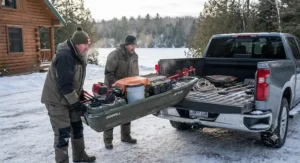
The Clam Outdoors Kenai Sled is the hull that underpins several of Clam’s popular flip-over shelter systems, and it’s sold with a dedicated weather resistant sled travel cover as an accessory — a detail that matters more than it sounds. A cover keeps snow, slush, and road grit off the hull and hardware between trips, which meaningfully extends the life of hinges, straps, and any mounted seating.
The spec sheet won’t tell you this, but user reports suggest the wide, low-profile shape of the Clam Outdoors Kenai Sled tows smoothly behind a snowmobile with minimal drag, which is exactly what you’d want from a hull designed to carry an insulated shelter shell. That said, honesty matters more than brand loyalty here: some anglers in online ice-fishing forums have reported inconsistent hardware quality on certain past Clam batches, an issue the company has said it has addressed. Independent, verifiable review volume for the standalone Kenai sled base is also thinner than what’s available for Otter or Shappell, so treat this as a solid option worth researching further rather than an unconditionally proven one.
Pros:
- ✅ Purpose-built to carry Clam’s insulated flip-shelter hulls
- ✅ A dedicated weather resistant travel cover is available
- ✅ Wide, low profile tows smoothly behind a snowmobile
Cons:
- ❌ Some forum users report inconsistent hardware on past batches
- ❌ Verified independent review volume is thinner than rival brands
Price ranges vary by configuration, generally falling between C$150-C$230; check current price and confirm exactly which sled/cover bundle is included before ordering.
7. KFF Heavy-Duty Yard Drag Sled — best cargo ice sled for big trips
When “heavy duty” needs to mean something closer to industrial, the KFF Heavy-Duty Yard Drag Sled is the standout. At roughly 279 cm long and 102 cm wide (110 × 40 in), with a listed capacity of up to 726 kg (1,600 lb), it dwarfs every other sled on this list and is explicitly designed to be towed behind an ATV or UTV using its included pull cable and rope.
On paper, a cargo ice sled at this scale sounds like overkill for a solo angler — and honestly, it usually is. But for groups hauling a shanty, an auger, propane, and several days of supplies to a remote spot, the math changes fast. What the spec sheet won’t tell you is how much easier trip planning gets when one sled can carry everything instead of two smaller ones lashed together. As a newer entrant to the ice-fishing accessory market, its pool of verified owner reviews is smaller than Shappell’s or Otter’s long-established track record, so buyers should weigh the impressive capacity rating against a shorter real-world history.
Pros:
- ✅ Rated for up to 726 kg — the highest capacity here
- ✅ Included pull cable and rope work with ATV or UTV hitches
- ✅ Long, wide bed swallows a shanty plus a week of gear
Cons:
- ❌ Excessive size for solo anglers walking short distances
- ❌ Smaller pool of verified long-term owner reviews than legacy brands
At around C$135-C$170, it’s competitively priced for its size, though anglers should confirm current availability and shipping costs given its larger dimensions.
Setting Up and Maintaining Your Ice Fishing Sled
Buying the right jet sled for ice fishing is only half the job — keeping it functional through a Canadian winter is the other half, and it’s the part most Amazon listings skip entirely.
Before first use, drill or pre-mark your tie-down points rather than guessing mid-trip with cold hands. Most sleds, including the Shappell Jet Sled and Otter Outdoors Sport Sled, ship with a tow rope but not a full bungee or ratchet-strap kit, so budget for that separately. During the first 30 days, the most common mistake is overloading the sled unevenly — weight concentrated at the front digs the nose into snow instead of gliding over it, while rear-heavy loads make the sled fishtail behind you. Distribute heavier items (augers, batteries, coolers) toward the centre and slightly rear of the load.
For maintenance, rinse road salt and grit off the hull after any trip involving pavement or a boat launch, since salt accelerates UV degradation on polyethylene over multiple seasons. Store the sled out of direct summer sun when not in use; UV exposure is the single biggest factor in premature hull brittleness, more so than cold itself. A weather resistant sled cover, like the one available for the Clam Outdoors Kenai Sled, earns its cost back in prevented cracking and faded plastic within a couple of seasons for anglers who store gear outdoors.
Real-World Scenarios: Matching a Sled to Your Ice Fishing Style
The weekend solo angler: If you’re walking 200-500 metres from a public access point with a bucket, a hand auger, and a couple of rod cases, the Shappell Jet Sled Jr or standard Shappell Jet Sled covers you without unnecessary bulk. Light weight matters more than capacity here, since you’re the only engine pulling it.
The family group with a flip shelter: Once a two- or three-person flip-over shelter enters the picture, sidewall height becomes the priority. The Shappell Jet Sled XL or Clam Outdoors Kenai Sled both handle the bulk of an insulated shelter shell without gear spilling over the sides on the walk out.
The remote-camp, multi-day angler: If your trips involve an ATV or snowmobile, several days of supplies, and a group splitting gas and propane costs, the KFF Heavy-Duty Yard Drag Sled or Otter Outdoors Pro Utility Sled are built for exactly that load profile — high capacity, reinforced tie-downs, and towing hardware compatibility that a basic jet sled simply isn’t engineered for.
✨ Ready to gear up? Compare these sleds side by side and find your match before the ice sets in!
How to Choose a Jet Sled for Ice Fishing
Picking the right jet sled for ice fishing comes down to matching a handful of specific factors to how you actually fish, not to marketing claims. Here’s the framework worth running through before buying:
- Distance from vehicle to fishing spot — Longer walks favour lighter sleds like the Shappell Jet Sled Jr, since every extra kilogram compounds over distance.
- Group size and gear volume — Solo anglers rarely need more than a standard-depth sled, while families or groups with shelters need the extra room a high sided jet sled provides.
- Towing method — Hand-pulling favours lighter, narrower sleds; ATV or snowmobile towing benefits from reinforced tie-down points and wider, more stable footprints.
- Terrain between the truck and the ice — Rocky boat launches and gravel shoulders wear hulls faster than snow does, which argues for thicker-walled, heavy duty ice sled options if that’s part of your regular route.
- Storage conditions — Anglers who store gear outdoors year-round benefit from investing in a weather resistant sled cover regardless of which hull they choose.
- Budget versus expected lifespan — A cheaper sled replaced every two seasons can cost more over a decade than a single Otter Outdoors Pro Utility Sled purchase.
- Compatibility with existing shelters — If a flip-over shanty is already owned, confirm the sled’s dimensions actually match its folded footprint before buying.
Otter Jet Sled Comparison: Otter vs. Shappell
No jet sled for ice fishing conversation goes very far before someone brings up Otter versus Shappell, and both camps have legitimate points. Based on the spec comparison, the core difference is manufacturing process: Otter uses roto-molding, which distributes plastic more evenly and tends to concentrate extra material at stress points, while Shappell’s thermoformed construction keeps sleds notably lighter for a given size.
That weight difference shows up directly in the field. Anglers who’ve run both brands side by side on ice-fishing forums frequently describe Shappell sleds as lighter and faster to hand-pull, while Otter sleds are described as thicker, heavier, and generally longer-lasting under repeated hard use. Neither description is wrong — they reflect a genuine engineering trade-off rather than one brand simply being better.
| Factor | Shappell | Otter |
|---|---|---|
| Typical Weight | Lighter | Heavier |
| Construction | Thermoformed poly | Roto-molded poly |
| Best For | Hand-pulling, solo anglers | ATV/snowmobile towing, heavy loads |
| Price Tier | Generally lower | Generally higher |
Reading this table, the honest takeaway is that neither brand “wins” outright — a solo angler hand-pulling a Shappell Jet Sled short distances will likely prefer its lighter feel, while someone towing an Otter Outdoors Pro Utility Sled behind a snowmobile over rough ice will value the reinforced build enough to accept the extra weight and cost.
High Sided Jet Sled vs. Standard Depth: Do You Need the Extra Wall?
The jump from a standard-depth sled to a high sided jet sled like the Shappell Jet Sled XL isn’t just about fitting more stuff — it changes how much attention a load needs during transport. Standard-depth sleds, at around 25 cm of wall height, work fine for compact, low-profile gear but require careful strapping once anything tall or awkwardly shaped is added.
A high sided jet sled adds roughly 5 cm of additional wall height, which sounds minor until you’re bouncing across wind-packed drifts behind a snowmobile at 15-20 km/h. What most buyers overlook is that the extra height reduces how much bungee-cord rigging is needed, since gravity and the taller walls do more of the containment work. The trade-off is size and cost: a Shappell Jet Sled XL takes up meaningfully more truck bed or shed space than the standard model, so anglers without a genuine capacity need are usually better served sticking with the smaller sled and investing the savings in a good cargo net instead.
Weather Resistant Sled Materials and Care
Every sled on this list is made from some form of polyethylene, but “weather resistant” isn’t a single spec — it’s a combination of material grade, wall thickness, and UV stabilization. High-density polyethylene (HDPE), used in the Shappell Jet Sled lineup, resists cracking in temperatures well below freezing, which is the baseline requirement for anything marketed as a weather resistant sled in Canada.
Roto-molded polyethylene, used across the Otter Outdoors lineup, takes this further by producing more uniform wall thickness with fewer thin spots where stress cracks typically start. Reviewers consistently note that Otter sleds show less visible wear after multiple seasons of outdoor storage compared with lighter thermoformed alternatives, though thermoformed sleds compensate with lower weight and lower cost.
Beyond the hull material itself, a genuinely weather resistant sled setup usually includes a fitted travel cover — like the option available for the Clam Outdoors Kenai Sled — plus basic seasonal care: rinsing off road salt, avoiding prolonged direct sun in the off-season, and checking tow rope and tie-down hardware for corrosion before each new ice season begins.
What “Heavy Duty Ice Sled” Actually Means
“Heavy duty” gets used loosely in outdoor gear marketing, so it’s worth defining precisely for jet sleds. A genuine heavy duty ice sled combines three things: reinforced wall thickness at stress points, a reinforced or extended lip for tie-down security, and a wider, lower-centre-of-gravity stance that resists tipping when towed at speed over rough ice.
The Otter Outdoors Pro Utility Sled checks all three boxes, with its reinforced outer lip and widest-in-lineup footprint. The KFF Heavy-Duty Yard Drag Sled takes a different but equally valid approach, prioritizing raw size and a 726 kg capacity rating over reinforced detailing. Both qualify as heavy duty; they just solve the durability problem from different angles — one through material engineering, the other through sheer scale.
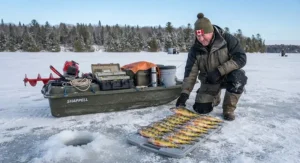
Cargo Ice Sled vs. Traditional Hauling Methods
It’s worth comparing a purpose-built cargo ice sled against the alternatives anglers sometimes default to instead.
| Method | Load Capacity | Ice/Snow Performance | Best For |
|---|---|---|---|
| Cargo Ice Sled (e.g., KFF Heavy-Duty Yard Drag Sled) | Very high (up to 726 kg) | Excellent — designed for it | Groups, multi-day trips |
| Wheeled Plastic Tote | Low-moderate | Poor — wheels bog down in snow | Short, flat, paved routes only |
| Backpack/Duffel Carrying | Low | N/A — no gliding surface | Ultralight, minimal-gear trips |
| ATV Trailer (wheeled) | High | Poor on soft snow, good on packed trails | Groomed trail access only |
Looking at this comparison, the advantage of a dedicated cargo ice sled is that it’s the only option engineered specifically for the low-friction, unpredictable surface conditions ice and snow present. Wheeled alternatives work fine on packed trails or pavement but bog down fast the moment snow gets deep or slushy, and carrying gear by hand simply doesn’t scale past a single short trip.
Common Mistakes When Buying an Ice Fishing Sled
Even seasoned anglers make avoidable errors when shopping for a jet sled for ice fishing. Here are the ones worth watching for.
Buying based on price alone. A slightly cheaper sled that needs replacing after eighteen months usually costs more over five years than a well-built option purchased once. The Fish’n Canada guide to ice safety is a useful reminder that gear reliability and personal safety are connected — a sled that fails mid-tow on marginal ice isn’t just inconvenient.
Ignoring wall height until it’s too late. Buyers frequently purchase a standard-depth sled, then discover months later that it can’t fit a newly purchased flip shelter, forcing a second purchase that a high sided jet sled would have avoided from the start.
Skipping the tow rope or hitch compatibility check. Not every sled includes hardware compatible with every ATV or snowmobile hitch out of the box; confirming this before purchase avoids a frustrating return trip to the store.
Assuming all polyethylene performs the same in extreme cold. As covered above, thermoformed and roto-molded poly behave differently under stress, and buyers who don’t research this distinction sometimes end up disappointed by wear patterns a bit of research would have predicted.
Long-Term Cost and Maintenance of a Jet Sled
Total cost of ownership matters more for sleds than the sticker price alone suggests, since replacement frequency varies significantly by build quality and usage intensity.
| Product | Price Range (CAD) | Expected Lifespan (typical use) | Value Verdict |
|---|---|---|---|
| Shappell Jet Sled Jr | C$65-C$85 | 3-5 seasons | Excellent value for light use |
| Shappell Jet Sled | C$85-C$140 | 4-6 seasons | Strong all-around value |
| Shappell Jet Sled XL | C$150-C$190 | 4-6 seasons | Good value for group/shelter use |
| Otter Outdoors Sport Sled | C$65-C$100 | 5-7 seasons | Solid mid-tier value |
| Otter Outdoors Pro Utility Sled | C$180-C$260 | 7-10+ seasons | Best long-term value for heavy use |
| Clam Outdoors Kenai Sled | C$150-C$230 | 4-6 seasons | Fair, verify hardware quality |
| KFF Heavy-Duty Yard Drag Sled | C$135-C$170 | Unproven long-term (newer brand) | Good value if capacity is genuinely needed |
Interpreting this table, the Otter Outdoors Pro Utility Sled carries the highest upfront price but potentially the lowest cost-per-season for anglers who fish hard for a decade or more, while the Shappell Jet Sled Jr wins on pure affordability for casual, low-mileage use. Maintenance costs stay low across the board — occasional rinsing, a stored-indoors habit, and an optional weather resistant sled cover cover nearly all the upkeep this category requires, with no engines, batteries, or moving parts to service.
Ice Safety and Sled Regulations Across Canada
A loaded sled changes the safety math on the ice, since the combined weight of angler, gear, and sled requires more ice thickness than a person walking alone. Federal recreation guidance from Parks Canada notes that ice thickness recommendations vary by activity and load, with natural ice conditions never monitored or guaranteed safe by any government body — the responsibility for checking conditions rests with the angler every single time.
Provincial guidelines generally scale minimum thickness with load type: walking alone requires less ice than towing a loaded sled behind a snowmobile or ATV, and vehicle traffic requires more still. There’s no federal Transport Canada standard specific to recreational ice sleds, but common sense principles apply everywhere in the country: check thickness at multiple points along your route, avoid areas near moving water or inflow/outflow points, and never assume last week’s safe route is still safe today after a thaw-refreeze cycle. Provincial and municipal advisories should always take precedence over general guidelines, since local ice conditions vary dramatically even within the same lake system.
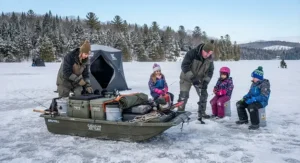
Frequently Asked Questions
❓ How much weight can a jet sled hold?
❓ Can you pull a jet sled with a snowmobile?
❓ What is the best material for an ice fishing sled?
❓ How thick does ice need to be for a loaded sled?
❓ Do jet sleds work for hunting too?
Conclusion
Choosing the right jet sled for ice fishing really comes down to an honest look at how far you walk, how much you carry, and how hard your gear gets used across a season. For most solo or casual anglers, the standard Shappell Jet Sled hits the sweet spot of weight, price, and durability. Anglers hauling bulkier shelters should look at a high sided jet sled like the Shappell Jet Sled XL, while anyone towing gear behind a machine over rough terrain will get more mileage — literally — out of a heavy duty ice sled like the Otter Outdoors Pro Utility Sled. Groups running multi-day trips are the clear audience for a true cargo ice sled such as the KFF Heavy-Duty Yard Drag Sled, and anyone storing gear outdoors year-round should factor a weather resistant sled cover into the budget regardless of which hull they choose.
Ice fishing itself remains one of Canada’s most enduring winter traditions, from Quebec’s tomcod villages to Ontario’s Lake Simcoe — a scene Bonjour Québec’s seasonal guide captures well, alongside a reminder that checking ice conditions always comes first. The right sled just makes getting to that scene a little less exhausting.
Recommended for You
- Smitty Sled vs Jet Sled: 7 Best Ice Fishing Sleds (2026)
- Smitty Sled for Ice Fishing: 7 Top Builds for 2026 (C$50-C$400)
- Windlass Tip Up: 7 Best Automatic Ice Fishing Picks (2026)
Disclaimer: This article contains affiliate links. As an Amazon Associate, I earn from qualifying purchases. If you purchase products through these links, we may earn a small commission at no additional cost to you.
✨ Found this helpful? Share it with your friends! 💬🤗
