
In This Article
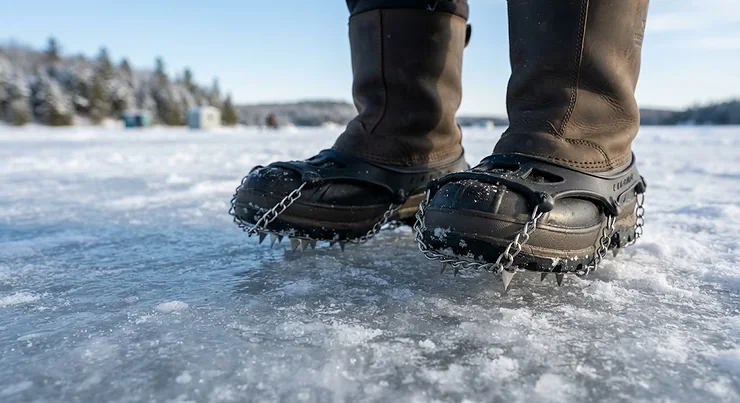
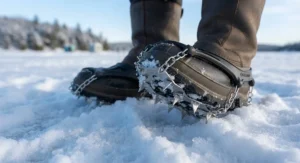
Ice fishing traction cleats are slip-on or screw-in traction devices that attach to winter boots and use metal spikes, carbide studs or steel coils to grip smooth ice. They cut the risk of slips and falls while you walk to your spot, drill holes and haul gear across a frozen lake. Most fit over the boots you already own.
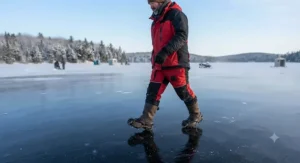
Here’s the thing about a frozen lake: it looks like a parking lot, and it behaves like a hockey rink. Wind scours the snow off in patches, leaving black ice polished like a bowling lane. Then you add a 20-litre pail of gear, a hand auger and a sled rope wrapped around one wrist. It’s a bad recipe for your tailbone, and worse for a wrist or hip.
Ice fishing has been a survival skill and a social ritual for thousands of years, and in Canada it’s now a winter religion. Modern traction gear means you don’t have to shuffle like a penguin to take part. The catch is that “ice cleats” is a crowded category. Some designs are built for trail runners. Others are built for casual dog walkers. A few really suit an angler with a heavy boot, a heavy sled and no patience for fiddly straps.
This guide sorts through it. You’ll find seven real products, how their designs differ, and where anti slip ice cleats, studded ice grips, metal spike cleats and rubber ice grips each earn their keep. It also covers yaktrax ice fishing, removable ice cleats, and the safety rules no set of spikes can replace. All prices are Canadian ranges, so check current pricing before you buy.
Quick Comparison: Ice Fishing Traction Cleats at a Glance
Before the deep dive, here’s the short version. Weights and scores come from a published 2026 independent test guide (CleverHiker) where available. Untested products are marked accordingly.
| Product | Traction Type | Weight (pair) | Price Range (CAD) | Best For |
|---|---|---|---|---|
| Kahtoola MICROspikes | Stainless steel spikes on chain | ~337 g (11.9 oz) | C$110–C$150 | Kahtoola MICROspikes: all-round lake use |
| Black Diamond Access Spike | 14 stainless steel spikes | ~252 g (8.9 oz) | C$130–C$160 | Black Diamond Access Spike: comfort and aggressive grip |
| Korkers Ice Runner | Replaceable carbide studs + BOA dial | ~312 g (11 oz) | C$90–C$120 | Korkers Ice Runner: secure fit over bulky boots |
| Kahtoola EXOspikes | Tungsten carbide studs | ~207 g (7.3 oz) | C$100–C$140 | Kahtoola EXOspikes: long shoreline walks and mixed terrain |
| Yaktrax Walk | Steel coils | ~91 g (3.2 oz) | Under C$40 | Yaktrax Walk: budget, casual shore use |
| Icespike | Screw-in spikes (32 per set) | Negligible | C$30–C$50 | Icespike: permanent, removable ice cleats |
| Cimkiz 19-Spike Cleats | 19 stainless steel spikes, TPE harness | ~268 g (0.59 lb, reported) | Under C$40 (verify) | Cimkiz 19-Spike Cleats: value-first shopping |
The table shows a trade-off you’ll see all guide long: the more aggressive the bite, the more weight and bulk you carry. Black Diamond Access Spike and Kahtoola MICROspikes sit in the sweet spot for most anglers. The Yaktrax Walk wins on price and packability, but gives up hard-ice bite. Pay attention to the “Best For” column. A cleat that’s perfect for a nature trail may feel underpowered on a windswept, glazed lake.
💬 Just one click — help others make better buying decisions too!😊
Top 7 Ice Fishing Traction Cleats: Expert Analysis
The seven picks below cover budget, mid-range and premium tiers. They also cover spikes, studs, coils and screw-in designs, so you can match the tool to your own lake. Specs and test findings come from published sources. Where I couldn’t verify customer reviews, I say so rather than guess.
1. Kahtoola MICROspikes — the do-it-all benchmark
The Kahtoola MICROspikes are the reference point most other cleats get measured against. Their 9.5 mm stainless steel spikes sit on a chain, so they flex with your foot instead of fighting it.
In practice, that spike length is long enough to bite into glare ice but short enough that you can cross a bare rock or a wooden dock without swapping gear. At about 337 g (11.9 oz) a pair, they’re noticeable but not exhausting over a full day on the lake. The thermoplastic elastomer harness stays stretchy in serious cold, which matters when you’re pulling them on at –25°C with numb fingers.
If you want one pair that handles the trudge to your hole, the walk to the shore and a stop at the truck, this is the safe choice. Independent testers rate them highly for traction and durability. A common gripe is that the heel can slip down and need re-snugging, and they cost more than several rivals. Check sizing carefully against your boots, since bulky pac boots can be a tight squeeze.
Pros:
- ✅ Aggressive bite on hard ice
- ✅ Reinforced, repairable chain construction
- ✅ Harness stays flexible in deep cold
Cons:
- ❌ Pricier than most alternatives
- ❌ Heel can creep down over time
Price range: roughly C$110–C$150. Verdict: strong value for regular anglers who fish most weekends.
2. Black Diamond Access Spike — the comfort-first premium pick
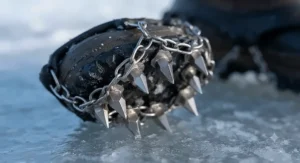
The Black Diamond Access Spike takes the same basic idea and tunes it for comfort. It uses 14 stainless steel spikes, a full-coverage elastomer harness and an enclosed toe box.
That enclosed toe box matters more than it sounds. On ice, the cleat that shifts by even a centimetre is the cleat that catches an edge and sends you sprawling. Pull tabs help you get them on with mittens, and the included stuff sack keeps sharp points off your flask and thermos. At about 252 g (8.9 oz) a pair, they’re lighter than the Kahtoola MICROspikes.
Independent testers named it their top overall pick in 2026, praising the fit and traction. The trade-off is that it’s slightly less heavy-duty than some competitors, and a bit awkward on dry ground. For an angler who stays on ice all day and walks a lot on mixed surfaces, the fit alone might be worth the premium.
Pros:
- ✅ Secure enclosed-toe harness with pull tabs
- ✅ Lightweight and packs small
- ✅ Includes a stuff sack
Cons:
- ❌ Premium price tier
- ❌ Less rugged than heavier competitors
Price range: about C$130–C$160. Verdict: worth it if you value fit and low fatigue over saving C$30.
3. Korkers Ice Runner — BOA dial for a locked-in fit
The Korkers Ice Runner solves the problem every angler with bulky boots knows: stretchy harnesses that never quite feel secure. It uses a BOA dial and a wraparound harness that you tighten in seconds, even with gloves on.
Replaceable carbide studs mean the cleat can outlast the studs themselves. That’s a real long-term win over models where worn spikes mean a whole new pair. Testers praised the fit as the most secure they’d tested and the studs as long-lasting. The catch is traction: a single forward toe stud and no studs under the arch leave gaps, and the whole thing is bulkier, at around 312 g (11 oz).
For anglers who mostly shuffle across flat lakes rather than climb steep banks, that trade-off is acceptable. If your route involves hills, look elsewhere. This is a “walk to the shack” cleat, not a “climb the snowbank” cleat.
Pros:
- ✅ Best-in-class secure fit
- ✅ Replaceable carbide studs
- ✅ BOA dial adjusts with gloves on
Cons:
- ❌ Traction gaps under the arch
- ❌ Heavier and bulkier than spikes
Price range: about C$90–C$120. Verdict: excellent value for flat-lake anglers with big boots.
4. Kahtoola EXOspikes — carbide studs for mixed terrain
The Kahtoola EXOspikes replace long spikes with 7.4 mm tungsten carbide studs arranged in a concave pattern. Testers note that carbide is far more abrasion-resistant than steel, which suggests they’ll stay sharp across many seasons.
Studs are lower-profile than spikes, so you can walk on gravel launch ramps and bare pavement at the lot without feeling like a cat on a hot tin roof. At about 207 g (7.3 oz), they’re light too. The downside is deep snow. Testers found studs lose effectiveness in more than an inch or two of fresh snow, which matters if your lake is snow-covered.
If your lake is scoured or polished ice with light snow, these are a versatile pick. On heavily snowed-in lakes, spikes bite deeper. Consider these studded ice grips for the angler who walks across multiple surface types in a single outing.
Pros:
- ✅ Very durable carbide studs
- ✅ Low profile for dry-ground walking
- ✅ Light and comfortable
Cons:
- ❌ Loses grip in deeper snow
- ❌ Plastic matrix could wear over time
Price range: roughly C$100–C$140. Verdict: strong value for mixed-surface routes.
5. Yaktrax Walk — cheap, light and honest about its limits
The Yaktrax Walk uses steel coils wrapped around a rubber harness. It’s the cleat everyone recognizes, and it’s what most people mean when they search yaktrax ice fishing.
At about 91 g (3.2 oz), it’s featherweight, and testers describe the feel underfoot as smooth and unobtrusive. On packed snow and gentle icy patches, it adds a real margin of confidence. On steep or hard, glazed ice, coils don’t dig in the way spikes do, so they’re not built for a windswept lake.
The other caveat is longevity. Testers reported snapping coils and harnesses over multiple seasons. That’s fine at a low price point, but don’t expect a decade. For a casual angler who fishes a few times a winter near shore, it’s a sensible, low-risk buy.
Pros:
- ✅ Extremely light and easy to pack
- ✅ Very affordable
- ✅ Widely available in Canada
Cons:
- ❌ Light bite on hard, glazed ice
- ❌ Coils and harness can snap over time
Price range: under C$40. Verdict: great starter, but upgrade if you’re on hard ice weekly.
6. Icespike — removable ice cleats screwed into your soles
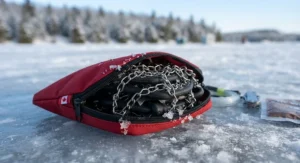
The Icespike system is different. Instead of a harness, you screw small metal spikes directly into your boot soles using a precision tool. The Deluxe package includes the tool and 32 spikes.
The appeal is obvious: no straps, no shifting, no forgetting them in the truck. The downsides are just as obvious. You’re modifying your boots, and a spike that’s too long for your sole thickness is a problem. Follow the manufacturer’s sizing guidance carefully, and don’t install spikes in soles thinner than recommended. Hard floors, heated shack floors and vinyl truck mats won’t love them.
The company sells these primarily through its own store in US dollars, so check whether an amazon.ca listing exists before you plan your purchase. I couldn’t verify a Canadian listing or customer review data. Treat this as a specialist option for anglers who live in one dedicated pair of boots all winter.
Pros:
- ✅ Permanent traction with no straps
- ✅ Very low cost per boot pair
- ✅ Spike sets are replaceable
Cons:
- ❌ Modifies your boot soles
- ❌ Rough on shack floors and truck mats
Price range: about C$30–C$50 (excluding shipping and duties). Verdict: excellent value for dedicated ice boots.
7. Cimkiz 19-Spike Cleats — budget spikes with a rubber harness
The Cimkiz 19-Spike Cleats offer 19 stainless steel spikes per foot on a TPE harness. A review site reports the material stays flexible down to around –45°C, though that’s a marketing-style claim worth taking with a grain of salt.
More spikes on a wider harness generally means broader coverage on glare ice, and a double-chain design spreads stress across multiple points. One reviewer reported roughly 0.59 lb (about 268 g) and noted they feel heavier than thin coil designs. That’s real, but it’s also the price of durability.
I couldn’t verify a large pool of independent customer reviews, so check the current listing’s rating and read the low-star comments for harness failures before buying. For someone who wants rubber ice grips with genuine spikes on a tight budget, this is a reasonable gamble.
Pros:
- ✅ 19 spikes for broad coverage
- ✅ Cold-rated TPE harness
- ✅ Low entry price
Cons:
- ❌ Limited independent testing available
- ❌ Heavier than coil designs
Price range: under C$40 (verify current price). Verdict: good value if reviews hold up.
Top 7 at a Glance: Specs and Independent Scores
| Product | Type | Independent Score | Price Range (CAD) | Best For |
|---|---|---|---|---|
| Black Diamond Access Spike | Spikes | 4.8/5 | C$130–C$160 | Black Diamond Access Spike: all-day comfort |
| Kahtoola MICROspikes | Spikes | 4.7/5 | C$110–C$150 | Kahtoola MICROspikes: versatility |
| Kahtoola EXOspikes | Studs | 4.6/5 | C$100–C$140 | Kahtoola EXOspikes: mixed surfaces |
| Korkers Ice Runner | Studs | 4.5/5 | C$90–C$120 | Korkers Ice Runner: secure fit |
| Yaktrax Walk | Coils | 4.2/5 | Under C$40 | Yaktrax Walk: casual use |
| Icespike | Screw-in | Not rated | C$30–C$50 | Icespike: dedicated boots |
| Cimkiz 19-Spike Cleats | Spikes | Not rated | Under C$40 | Cimkiz 19-Spike Cleats: budget shoppers |
Scores are from a published 2026 gear test where available. The top four sit within a fraction of a point, so fit and boot compatibility should decide it, not the score. The Yaktrax Walk and Cimkiz 19-Spike Cleats are the cheapest options, but the score gap shows what you sacrifice on hard ice.
How to Choose Ice Fishing Traction Cleats
Choosing the right pair comes down to a handful of practical questions. Work through them in order.
- Match traction type to your ice. Polished black ice rewards long metal spikes. Snow-dusted or mixed surfaces suit carbide studs. Casual slush and packed snow work with coils.
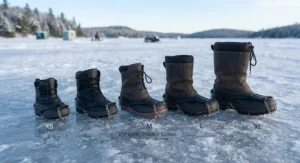
- Check boot compatibility first. Ice fishing boots are big. Many harnesses are sized for hiking boots or running shoes, so confirm the size chart against your actual boot, liner and all.
- Weigh your walking distance. A 200-metre walk to a nearby hole doesn’t need the same gear as a 3 km trek across a bay. Lighter cleats reduce fatigue on longer treks.
- Consider cold-weather materials. A harness that stiffens at –30°C is a harness that pops off. Look for thermoplastic elastomer designs rated for serious cold.
- Plan for dry-ground transitions. If you cross bare gravel, docks or a heated shack floor, lower-profile studs save your gear and your balance.
- Think about repairability. Replaceable studs or chain links extend the life of a pair, which improves value over several seasons.
- Set a realistic budget. You generally get what you pay for in durability. Budget picks are fine for casual use, but weekly anglers benefit from stepping up.
Studded Ice Grips vs Metal Spike Cleats: Which Bites Harder?
This is the core design debate, and it’s worth understanding. Studded ice grips use short carbide or steel studs mounted on a plate or harness. Metal spike cleats use longer, sharper points, usually on chains.
Studs are shorter, more abrasion-resistant and easier to walk on across mixed surfaces. Carbide is dramatically harder than steel, so studs tend to keep their edge longer. The compromise is bite depth on soft or snow-covered ice, where short studs may skate across the surface.
Metal spike cleats dig deeper. On hard, glazed ice, a longer point penetrates the surface and gives you a positive mechanical lock. In deeper snow, spikes also reach through to the ice beneath. The cost is weight, bulk and awkwardness on dry ground, plus a risk of snagging on shack mats and truck floors.
Here’s the practical rule. If your lake is wind-scoured and mostly bare, choose spikes. If your route mixes ice with gravel, ramps and dry patches, choose studs. Many serious anglers own both and pick based on conditions that morning.
Yaktrax Ice Fishing: Do Coil Cleats Actually Work?
Yaktrax ice fishing is one of the most searched combinations, so it deserves a straight answer. Yaktrax-style coils are designed for walking on packed snow and light ice, not for demanding lake use.
Coils wrap around the sole, providing many small edges rather than a few deep points. On snow-packed shorelines and lightly frosted ice, they add genuine grip and feel natural underfoot. On smooth, glazed black ice, they slide more than spikes do, because they can’t penetrate.
Durability is the other consideration. Independent testers reported snapped coils and harnesses over multiple seasons, and the elastic harness can shift on uneven ground. For a once-or-twice-a-season angler who walks short distances, that’s acceptable at a low price. For weekly fishing, most experienced anglers step up to spikes or studs.
The honest verdict: yaktrax ice fishing works for casual, near-shore use. It’s a reasonable emergency backup for your truck, but not a primary tool for hard ice.
✨ Don’t Miss These Exclusive Deals!
🔍 Take your ice fishing traction cleats setup to the next level with these carefully selected picks. Click on any highlighted product name to check current pricing and availability. The right pair will keep you upright, confident and fishing longer on every trip!
Rubber Ice Grips: What the Harness Really Does
When people say rubber ice grips, they usually mean the stretchy harness that holds spikes or studs to your boot. That rubber (usually thermoplastic elastomer, or TPE) is the unsung hero of every cleat.
Cold is the enemy. Ordinary rubber stiffens and cracks in deep freeze, which is why cheap cleats sometimes fail at the worst moment. Good TPE stays elastic to very low temperatures, so the cleat stays tight on your boot instead of popping loose. Testers left cleats outside overnight in an arctic blast to check exactly this.
Some products also use purely rubber grip patterns without metal. Those may help on wet, rubbery surfaces, but on hard ice they generally can’t match metal. If you’re shopping for rubber ice grips on their own, be realistic: they reduce slip on snowy, frosty surfaces but aren’t a substitute for spikes on glare ice.
Inspect the harness every few trips for cracks, thinning and stretched-out holes. A worn harness is the most common failure point, and it’s usually cheap to spot early.
Removable Ice Cleats: Slip-On vs Screw-In Systems
Removable ice cleats come in two flavours, and the choice affects convenience and boot life.
Slip-on cleats stretch over your boot and come off when you’re done. They’re flexible, transferable across boots and easy to stash in a pack. The trade-off is that a harness can shift, especially with thick pac boots.
Screw-in systems like Icespike thread metal spikes into your soles. Once installed, there’s no strap to slip, and no cleat to forget. The trade-off is commitment: those boots now have spikes, which is rough on heated shack floors, vinyl vehicle mats and hardwood cabins.
For anglers who fish three or four days a week all winter in a dedicated pair of boots, screw-in is attractive. For weekend anglers with one pair of boots that also do driveway duty, slip-on is safer and more flexible.
Anti Slip Ice Cleats vs Bare Boots and Traditional Alternatives
Are anti slip ice cleats actually better than what anglers used for generations? Here’s how they compare.
| Option | Grip on Glare Ice | Convenience | Cost | Best For |
|---|---|---|---|---|
| Bare winter boots | Poor | Excellent | C$0 | Short shore walks only |
| Felt or rubber-lugged boots | Fair | Excellent | Moderate | Snowy conditions |
| Yaktrax Walk coils | Fair to good | Very good | Under C$40 | Yaktrax Walk: casual near-shore use |
| Kahtoola MICROspikes / Black Diamond Access Spike | Excellent | Good | C$110–C$160 | Kahtoola MICROspikes and Black Diamond Access Spike: regular anglers |
| Icespike screw-ins | Good to excellent | Set-and-forget | C$30–C$50 | Icespike: dedicated ice boots |
Bare boots and lugged soles are fine until they aren’t. The moment you hit a glazed patch with a loaded sled, lugs offer almost nothing. Cleats add a mechanical grip that soles can’t match.
The value case is simple. A quality pair costs less than a single urgent-care visit and lasts several seasons. The Kahtoola MICROspikes, for instance, are built with reinforced, repairable attachment points, so a pair can serve many winters.
Safety, Regulations and Ice Conditions: What Cleats Can’t Fix
Cleats stop you from slipping. They do nothing about thin ice, and that’s the bigger risk. Treat traction as one layer in a safety system.
The Lifesaving Society advises a minimum of 10 cm (4 inches) of clear ice for walking or skating alone, and cautions that white ice with air or snow inside should be considered suspect. It also advises never going onto ice alone, staying off river ice with currents, and avoiding ice at night. Spring ice is especially unreliable, even at a thickness that looked fine in January.
Wear a flotation device or buoyant suit, and carry ice picks, rope and a whistle. Cleats can make you feel invincible, which is exactly the wrong feeling. Measure thickness in several places as you walk out.
Rules also vary by province. Ontario, for instance, requires registration of many ice huts and their removal before breakup dates. Check the Ontario ice fishing rules or your own province’s regulations before heading out. Also remember that cleats can damage indoor flooring, so take them off before entering a heated hut with delicate floors.
Practical Usage Guide: Fit, Use and Maintenance
A good pair of cleats performs badly if you set them up wrong. Here’s a simple routine.
Before your first trip:
- Try them on at home with your actual boots and liners. Bulky pac boots need the right size, not the size on your hiking boots.
- Practise putting them on with mittens, so you’re not fumbling at –20°C.
- Locate the front and back markings so you don’t put them on backwards.
On the ice:
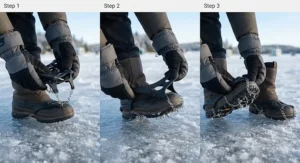
- Stretch the harness over the toe first, then the heel, and check the heel strap sits snug.
- Re-check tightness after your first 10 minutes. Cold changes how elastomer sits.
- Walk with a slightly flatter foot placement, letting all the spikes engage.
After each trip:
- Rinse off salt, sand and slush, and dry them fully before storage.
- Inspect chain links, harness and studs for wear.
- Store them in a stuff sack, away from your other gear.
Common first-30-day mistakes: leaving them on inside heated shacks, storing them wet, and ignoring a stretched-out harness until it fails. These are all cheap habits to fix.
Real-World Scenarios: Matching Cleats to Your Style
Here are three typical angler profiles and the picks that suit them.
The weekend regular. You fish two or three Saturdays a month, walk a few hundred metres to your spot and haul a sled. A pair of Kahtoola MICROspikes or Black Diamond Access Spike is the sensible investment: strong bite, good durability and versatility for shoreline transitions. Budget around C$110–C$160.
The bulky-boot angler. You wear insulated pac boots and worry about cleats slipping. The Korkers Ice Runner, with its BOA dial and wraparound harness, is designed for a secure fit. Accept the bulk in exchange for stability, and keep to flatter routes.
The casual family outing. You fish a few times a season near shore with kids in tow. A budget pair like Yaktrax Walk or Cimkiz 19-Spike Cleats keeps costs low. Pair them with close supervision and thickness checks, since cleats don’t make thin ice safe.
If you’re a dedicated all-winter angler in one pair of boots, Icespike screw-ins are worth a look. Just confirm sole thickness first.
Long-Term Cost and Maintenance: What You Really Pay per Season
The sticker price is only part of the picture. Think in cost per season.
A C$40 coil pair that lasts one or two seasons costs C$20–C$40 a year. A C$130 premium pair that lasts five or more seasons costs C$26 or less a year, and it grips better while it lasts. That’s a real argument for stepping up if you fish regularly.
Repairability matters too. Chain-link designs like the Kahtoola MICROspikes allow easy repairs, and the Korkers Ice Runner lets you replace worn studs. Carbide studs on the Kahtoola EXOspikes are far more wear-resistant than steel, which extends life in gritty conditions.
Maintenance costs almost nothing: rinse, dry, inspect. Neglect is what kills cleats early. Spikes rust if stored wet, and stretched harnesses fail when they’re most needed.
Factor in one last cost: a fall. A wrist fracture or worse dwarfs the price of any pair here.
FAQ
❓ Are ice fishing traction cleats worth buying?
❓ Can you wear cleats over insulated pac boots?
❓ Do metal spike cleats damage hut floors and truck mats?
❓ How long do studded ice grips last?
❓ Are removable ice cleats better than screw-in spikes?
Conclusion
Choosing ice fishing traction cleats isn’t about finding a single winner. It’s about matching a tool to your ice, boots and habits. The Black Diamond Access Spike and Kahtoola MICROspikes lead for regular anglers who want a proven bite and durability. The Korkers Ice Runner is a smart pick for bulky boots and flatter routes, while the Kahtoola EXOspikes shine on mixed surfaces. For casual outings, the Yaktrax Walk and Cimkiz 19-Spike Cleats keep costs low, and Icespike suits dedicated boots.
Whatever you choose, remember what cleats can’t do. They stop slips, not thin ice. Measure thickness, wear flotation, carry picks and never go alone. Then read the Outdoor Canada guide to judging safe ice before your first outing of the season. Check current prices, confirm your boot fit and get out there safely.
✨ Ready to walk the ice with confidence? 🎣
Check current pricing and availability on your favourite pair today, and make this the safest season on the lake yet! ❄️
Recommended for You
- 7 Best Ice Cleats For Ice Fishing In Canada (2026 Guide)
- Ice Fishing Rescue Rope: 7 Best Lifesaving Picks For 2026
- 7 Best Ice Fishing Flotation Devices In Canada 2026
Disclaimer: This article contains affiliate links. As an Amazon Associate, I earn from qualifying purchases. If you purchase products through these links, we may earn a small commission at no cost to you.
✨ Found this helpful? Share it with your friends! 💬🤗
