
In This Article
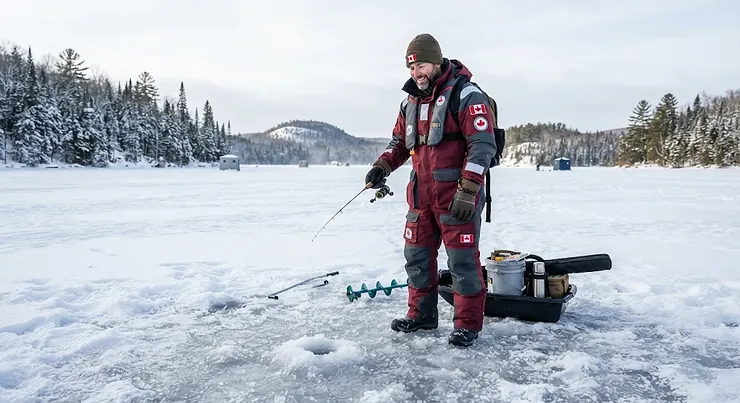
Here’s an uncomfortable truth nobody tells you at the tackle shop: the ice that held a snowmobile yesterday can swallow a boot today. Temperature swings, current under the surface, and springs you can’t see from above all conspire to make “it looked fine” the last sentence in a lot of very bad stories. That’s exactly why an ice fishing flotation device belongs on your gear list right next to your auger and your rod case, not as an afterthought stuffed in the truck box.
This guide breaks down seven real, purchasable options — insulated float suits, standalone life jackets, inflatable PFDs, and the rescue rope that should live in every sled bag — so you can outfit yourself properly for 2026. We’ll compare specs honestly, translate marketing language into what it actually means when you’re kneeling over a hole at -20°C (-4°F), and walk through the Canadian ice-safety context that makes this gear non-negotiable rather than optional. The Canadian Red Cross warns that fluctuating temperatures make ice unstable, so staying alert for unsafe conditions matters just as much as the gear you wear. A properly chosen flotation device won’t make bad ice safe, but it dramatically improves your odds if you misjudge it.
What Is an Ice Fishing Flotation Device?
An ice fishing flotation device is any piece of wearable gear — a float suit, standalone life jacket, or inflatable PFD — built with buoyant foam or an inflation system strong enough to keep an angler’s head and shoulders above water after an unexpected break-through. Unlike a general-purpose life jacket, most ice-specific models add cold-weather insulation, ice pick holsters, and rapid-drainage panels designed for the specific failure mode of falling through hard water rather than tipping out of a canoe.
Quick Comparison Table
| Product | Type | Insulation Level | Best For |
|---|---|---|---|
| Onyx MoveVent Curve | Standalone vest | None (layer underneath) | Budget-conscious anglers who already own warm outerwear |
| Onyx M-16 Belt Pack | Manual inflatable PFD | None | Anglers who hate wearing bulk while walking |
| Striker Predator Bib | Float bib | 100g Thermadex | Mobile anglers who roam between holes all day |
| Frabill I5 Jacket | Float jacket | 150g 3M Thinsulate | Anglers who want built-in self-rescue tools |
| Clam IceArmor Ascent Bib | Float bib | Removable fleece liner | Anglers who fish both early/late season and deep winter |
| Mustang Survival MD3183 | Auto-inflatable PFD | None | Anglers who want marine-grade, hands-free protection |
| NRS Pro Rescue Throw Bag | Rescue rope | N/A | Every ice angler’s sled bag, full stop |
Looking at the table, the split really comes down to two philosophies: wear your flotation built into your outerwear (Striker Predator Bib, Frabill I5 Jacket, Clam IceArmor Ascent Bib), or wear a dedicated life jacket or inflatable PFD over whatever you’re already wearing (Onyx MoveVent Curve, Onyx M-16 Belt Pack, Mustang Survival MD3183). Neither approach is objectively better — it depends on how you already dress for the ice and how much bulk you’re willing to tolerate. The NRS Pro Rescue Throw Bag isn’t flotation at all, but no comparison here is complete without it, since it’s the tool your fishing partner uses to actually get you out.
💬 Just one click — help others make better buying decisions too!😊
Top 7 Ice Fishing Flotation Devices: Expert Analysis
1. Onyx MoveVent Curve Paddle Vest — budget-friendly and Transport Canada approved
The standout here is straightforward: this is a genuine life jacket, not a “flotation-assist” garment, and it costs a fraction of a full float suit. Built as a Type III PFD, it uses soft, segmented flotation foam with vented mesh channels front and back, and — importantly for Canadian buyers — it carries both U.S. Coast Guard and Transport Canada approval printed on the label.
Here’s what that spec actually buys you: sculpted foam panels that flex with your shoulders instead of riding up around your ears when you bend over a hole, and enough ventilation that you won’t be soaked in sweat hauling a sled across the lake. Based on the spec comparison against the float-suit options below, the trade-off is obvious — you get zero insulation, so this vest is strictly a layering piece worn over your parka, not a replacement for one.
This vest is for anglers who already own a solid insulated suit and simply need certified flotation added on top, or budget-conscious anglers who’d rather spend their money on an auger than a full float suit. Reviewers consistently note that the mesh ventilation prevents overheating during the walk out, and that sizing runs true across the Small/Medium/Large chest ranges — though a handful mention the armholes feel snug over a bulky parka, so sizing up is worth considering.
Pros:
- ✅ Genuine Transport Canada approved PFD, not just “assist” foam
- ✅ Vented design prevents overheating while hauling gear
- ✅ Noticeably cheaper than any float suit on this list
Cons:
- ❌ No insulation — must be worn over warm layers
- ❌ Bulkier over a thick parka than a purpose-built float suit
Priced in the C$80-C$130 range, the Onyx MoveVent Curve is the easiest entry point into certified flotation for anglers second-guessing whether they need “one more piece of gear.” Check current price before heading out, as availability shifts by size and colour.
2. Onyx M-16 Manual Inflatable Belt Pack — lowest-profile inflatable PFD on this list
The standout feature is size: this is a fanny-pack-sized PFD that disappears until you need it. A 16-gram CO2 cartridge inflates the bladder to roughly 7.7 kg (17 lbs) of buoyancy the instant you pull the manual activation handle, with an oral backup tube available if the cartridge misfires or you need extra lift.
What most buyers overlook about a belt-pack PFD is that it’s manual, not automatic — you have to consciously pull the toggle, which matters if cold shock hits and your hands aren’t cooperating in the first ten seconds. On the flip side, the low profile means anglers who find float suits claustrophobic while walking or drilling holes will actually wear this one consistently, and a PFD you wear beats a PFD left in the truck every time. Reviewers report the CO2 cartridge swap after activation is genuinely quick — screw-in, no tools — though several note the rearming kit is sold separately and easy to forget about until the moment you need it and discover it’s empty.
This inflatable PFD ice anglers who fish solo or who move constantly between spots tend to favour it, since it doesn’t interfere with drilling, netting, or bending over a hole the way a float suit’s segmented foam can. It is not recommended for non-swimmers, and Transport Canada guidance is clear that inflatable PFDs like this one must stay readily accessible and worn as directed, since they aren’t considered appropriate for anyone under 16 years of age or under 36.3 kg (80 lbs).
Pros:
- ✅ Nearly invisible bulk compared to any float suit
- ✅ 7.7 kg (17 lbs) buoyancy on activation, expandable orally
- ✅ Adjustable belt fits a wide range of body types
Cons:
- ❌ Manual pull activation, not automatic on submersion
- ❌ Rearming cartridge is a separate purchase anglers forget
In the C$90-C$140 range before the rearming kit, the Onyx M-16 Manual Inflatable Belt Pack suits anglers who prioritize freedom of movement over built-in warmth.
3. Striker Predator Bib — best all-rounder for anglers who roam the ice
The Predator’s standout is its balance: this is the bib worn by guides and tournament anglers who move constantly, because it doesn’t turn into a sweat suit the second you start walking. Sureflote flotation-assist technology is built permanently into the bib’s structure, paired with 100 grams of Thermadex insulation that’s warm without being stifling.
In practical terms, 100 grams of insulation sits in the middle of the pack — warmer than a plain vest, lighter than a heavily-loaded parka system, which means you can layer underneath on brutal days and shed a layer on milder ones. The 1600-denier snakeskin knee panels are a detail spec sheets rarely explain well: they’re there because kneeling on ice to sight a jig destroys ordinary nylon knees within a season, and Striker built this bib specifically for anglers who kneel a lot. What most buyers overlook is that Sureflote is described by the manufacturer as flotation-assist, not a certified life jacket replacement — it buys you time and buoyancy, but it isn’t a substitute for a Transport Canada approved PFD if you’re also boating to your spot.
This bib is for the angler who’s out from sunrise to sunset, checking multiple holes, pulling a sled, and needs gear that survives that abuse. Reviewers consistently report the adjustable inseam and side zippers make the bib easy to get in and out of over boots, and that the bib runs true to size, though a few mention the reinforced knee panels add noticeable stiffness in extreme cold.
Pros:
- ✅ Built-in Sureflote flotation-assist technology
- ✅ 1600D snakeskin knee panels survive years of kneeling
- ✅ Adjustable inseam and 3-way leg zippers for easy on/off
Cons:
- ❌ Flotation-assist, not a certified standalone PFD
- ❌ Bulkier fit runs warm on milder shoulder-season days
Expect the Striker Predator Bib to land in the C$250-C$350 range depending on size, with the matching jacket sold separately — a fair value verdict given the specialized knee construction alone typically outlasts cheaper alternatives by several seasons.
4. Frabill I5 Jacket — best for built-in self-rescue tools
The standout feature on the I5 is that Frabill designed the whole jacket around the break-through scenario, not just added flotation as an afterthought. It ships with dedicated ice pick holsters and a complimentary set of ice picks already installed, plus mesh drainage zones engineered to shed the extra weight of soaked fabric as you pull yourself back onto solid ice.
Here’s the real-world translation: a soaked winter suit can gain several kilograms of water weight in seconds, and that added weight is exactly what exhausts your arms during the critical first ten minutes of cold incapacitation. Frabill’s mesh drainage areas are a direct answer to that problem, expelling water fast rather than trapping it. The 150-gram 3M Thinsulate removable mid-layer means you can strip insulation for early-season fishing and layer back up for January, giving this jacket genuine three-season flexibility that a fixed-insulation suit can’t match.
This jacket is for anglers who take the self-rescue conversation seriously and want the tools for it built in rather than purchased separately and forgotten in a tackle box. Aggregated reviewer sentiment is largely positive on warmth-to-weight ratio and the zipper quality, with a recurring note that the reflective 3M Scotchlite trim genuinely helps other anglers and snowmobilers spot you in low light — a safety detail that matters as much as the flotation itself.
Pros:
- ✅ Ice pick holsters and picks included, not sold separately
- ✅ Rapid-drainage mesh sheds water weight during self-rescue
- ✅ Removable 150g Thinsulate liner adds three-season versatility
Cons:
- ❌ Bib sold separately, adding to the total suit cost
- ❌ Cordura ripstop shell is stiffer than softer competing fabrics
Priced around the C$280-C$380 range for the jacket alone, the Frabill I5 Jacket earns its spot through function most competitors treat as an add-on rather than the design’s whole point.
5. Clam IceArmor Ascent Float Bib — most flexible mobility on the ice
The Ascent’s standout is Motion Float Technology: instead of one solid slab of flotation foam across the torso, Clam segments it into baffled panels that bend with your body. That single design choice is the difference between a bib that fights you every time you crouch over a hole and one that moves the way your body does.
The practical payoff of segmented flotation is real mobility — anglers who spend hours jigging, netting, and adjusting shanty gear will feel the difference within the first outing. A removable fleece liner extends this bib from deep-winter duty into shoulder-season open-water fishing, which is a genuine value point: one bib covering both ends of the season instead of buying separate gear. Clam is explicit that Motion Float is a buoyancy-assist system and not a Coast Guard-approved PFD, an honesty point worth noting since some competitors blur that line in marketing copy.
This bib suits anglers who prioritize freedom of movement above all else and who fish enough different conditions — late fall through deep winter — to justify a suit with a removable liner. Reviewer sentiment consistently highlights the improved mobility versus older, single-slab float bibs, alongside praise for heel drag protection that keeps ice chunks from packing into pant cuffs; a smaller number of reviewers note the segmented design trades a bit of raw warmth for that flexibility compared to denser competitors.
Pros:
- ✅ Segmented Motion Float panels move naturally with your body
- ✅ Removable fleece liner extends use into open-water season
- ✅ Reinforced heel and knee panels resist ice-block drag
Cons:
- ❌ Slightly less raw warmth than denser fixed-foam competitors
- ❌ Not Coast Guard approved as a standalone PFD
Expect the Clam IceArmor Ascent Float Bib in the C$220-C$320 range, positioning it as a strong mid-to-premium value pick for anglers who move a lot on the ice.
✨ Don’t Miss These Exclusive Deals! 🔍
Take your ice safety setup to the next level with these carefully selected products — click any highlighted item to check current pricing and availability. The right gear helps you build the confident, well-prepared outings your family will thank you for!
6. Mustang Survival MD3183 Inflatable PFD — marine-grade automatic protection
The standout on the Mustang Survival MD3183 is Hydrostatic Inflator Technology, which triggers automatically once the unit is submerged roughly 10 cm (4 inches) or more underwater — no toggle-pull required, no fumbling with cold hands. Mustang Survival is headquartered in Richmond, British Columbia, and builds this PFD to serve police, EMS, and commercial marine crews who need reliability in the worst conditions, which is a meaningfully different design brief than recreational paddling vests.
What the spec sheet won’t fully convey is how much that automatic trigger matters during the cold shock response — the involuntary gasp reflex that hits within the first minute of icy immersion. If a hand injury, panic, or simple disorientation stops you from pulling a manual toggle, an automatic hydrostatic inflator still deploys. The low-profile design also means it layers comfortably under or over winter outerwear without the bulk of a fixed-foam suit, and the SecureZip closure is built to survive far more rugged handling than a standard zipper.
This PFD suits anglers who also travel by boat or ATV to reach their ice fishing spot, since it’s rated for genuine marine use rather than ice-specific recreational wear alone. Aggregated commercial and recreational review sentiment consistently praises the low-maintenance, five-year service interval and the reliability of the Hammar hydrostatic inflator, with occasional notes that the initial investment is noticeably higher than recreational-grade alternatives.
Pros:
- ✅ Automatic hydrostatic inflation — no manual pull required
- ✅ Marine-grade build trusted by professional users
- ✅ Five-year maintenance-free service interval
Cons:
- ❌ Premium price point compared to recreational PFDs
- ❌ Not designed to provide standalone cold-weather insulation
Positioned in the C$400-C$500 range, the Mustang Survival MD3183 is the premium PFD ice safety pick for anglers who want the same technology marine professionals rely on.
7. NRS Pro Rescue Throw Bag — the rescue rope every ice angler’s partner needs
The standout here isn’t flotation for the wearer at all — it’s flotation and reach for whoever is doing the rescuing. This bag packs 23 metres (75 feet) of floating polypropylene-sheathed rope rated to roughly 2,375 kg (5,237 lbs) tensile strength into a compact, throwable Cordura sack.
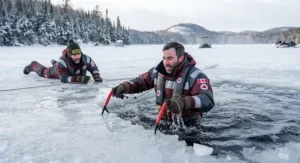
Here’s why that spec matters in an ice context specifically: standard cold-water safety guidance advises anyone approaching a person who’s broken through to lie down to distribute their weight and extend or throw a rescue device — a rope, pole, or branch — rather than walking directly to the hole. A stuffed throw rope ice rescue bag lets a fishing partner deliver that line from a safe distance in seconds rather than fumbling with a coiled rope that tangles under pressure. The floating rope material also means it stays visible and retrievable on open water near the break, not just on the ice itself.
This throw bag is for every ice fishing group, full stop — it’s inexpensive relative to everything else on this list, and it’s the one item that directly enables a partner-assisted rescue rather than protecting only the person wearing it. Reviewer sentiment across the outdoor and swiftwater community consistently highlights how quickly the bag can be re-stuffed after use and how the mesh drainage panel keeps the rope from freezing solid between outings, with a small number of reviewers noting the 23-metre (75-foot) length is more rope than most small-pond situations require.
Pros:
- ✅ 23 m (75 ft) of floating rope rated near 2,375 kg (5,237 lbs)
- ✅ Compact, throwable bag deploys in seconds
- ✅ Mesh panel prevents the rope from freezing between trips
Cons:
- ❌ Doesn’t protect the person wearing it, only the rescuer’s reach
- ❌ Bulkier length than needed for very small ponds
At around C$45-C$75, the NRS Pro Rescue Throw Bag may be the single best value-per-dollar safety item on this entire list.
Setting Up and Maintaining Your Ice Fishing Flotation Gear
Buying the gear is step one; setting it up correctly is what actually makes it useful in an emergency. Before your first outing, try a full dress rehearsal at home: put on your base layers, your flotation suit or vest, and confirm you can still reach your ice picks, phone, and any inflation toggle without fighting zippers or pockets. If you’re wearing an inflatable PFD like the Onyx M-16 or Mustang Survival MD3183, physically locate the activation handle with gloves on, since that’s exactly how you’ll need to find it in a real emergency.
A common first-30-days mistake is treating float suits like ordinary winter gear and washing them with heavy detergent or high heat, which can degrade the flotation foam’s buoyancy over time — always check the manufacturer’s care label first. For inflatable units, an annual inflation test (orally inflating the bladder and leaving it overnight to check for slow leaks) is standard maintenance that too many anglers skip. Store CO2 cartridges and rearming kits somewhere you’ll actually remember, ideally inside the PFD’s own storage pocket, and inspect ice pick holsters each season to confirm the picks haven’t corroded shut. None of this takes more than fifteen minutes, and all of it is the difference between gear that works when you need it and gear that fails silently in your closet. It’s also worth reviewing a Canadian outdoor publication’s field-tested ice safety tips alongside your gear checklist, since equipment and technique work together, not as substitutes for one another.
Real-World Scenarios: Matching the Right Flotation Device to Your Ice Fishing Style
The weekend social angler. You fish a handful of times each season with friends, mostly on well-travelled lakes with established ice roads. Budget matters, and you already own a warm parka. The Onyx MoveVent Curve layered over your existing outerwear covers you without a major gear overhaul, and pairing it with a shared NRS Pro Rescue Throw Bag in the group’s sled gives everyone a safety net for a modest combined cost.
The all-day mobile angler. You’re drilling a dozen holes a day, pulling a sled across kilometres of ice, and sweating through even the coldest afternoons. Bulk and overheating are your real enemies here. The Striker Predator Bib or Clam IceArmor Ascent Float Bib — both built for mobility with segmented or assist flotation — outperform a bulky standalone vest, since you need gear that moves with a body in constant motion, not gear that adds resistance to every step.
The remote or solo angler. You fish isolated lakes, sometimes alone, sometimes reached by boat or ATV before the season fully locks in. This is where a certified, marine-grade solution earns its higher price. The Mustang Survival MD3183‘s automatic hydrostatic inflation removes the “did I remember to pull the toggle” variable entirely, and it’s rated for genuine marine use if part of your trip involves open water before the ice sets firm.
Common Ice Safety Problems and How the Right Gear Solves Them
Problem: You break through and your suit fills with water, dragging you down. Solution: prioritize a suit or PFD with rapid-drainage mesh, like the Frabill I5 Jacket, which is specifically engineered to shed the added weight of soaked fabric during the climb back onto solid ice.
Problem: Cold shock hits and your hands won’t cooperate enough to pull a manual toggle. Solution: an automatic hydrostatic inflator like the one built into the Mustang Survival MD3183 removes that dependency entirely, triggering on submersion rather than on a conscious action.
Problem: You’re fishing solo and no one’s nearby to help if you go through. Solution: no flotation device solves isolation on its own — treat a solo trip as a reason to double down on the buddy system where possible, and carry a charged phone in a waterproof pocket alongside your flotation gear.
Problem: Your fishing partner sees you go through but can’t safely reach you. Solution: this is precisely what a stuffed throw rope ice rescue setup like the NRS Pro Rescue Throw Bag is for — it lets your partner extend help from a safe distance rather than risking a second person going through thin ice near the same hole.
Problem: You own a float suit but never actually wear the PFD you also bought for boat travel to your spot. Solution: the low-profile Onyx M-16 Belt Pack exists specifically to solve “I own a PFD but find it too bulky to wear consistently” — the safety flotation vest or PFD that stays in the truck protects nobody.
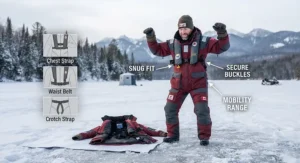
How to Choose an Ice Fishing Flotation Device
- Match the device to how you fish. Anglers who roam constantly between holes benefit from mobility-focused float bibs; anglers who sit still in a shanty for hours may prefer a standalone vest they can remove indoors.
- Decide between built-in flotation and a standalone PFD. Float suits integrate buoyancy into your outerwear; standalone vests or inflatables let you wear your own preferred parka underneath.
- Check for genuine certification versus “flotation-assist” marketing. Products labelled Coast Guard or Transport Canada approved meet tested buoyancy standards; “assist” technology adds buoyancy but isn’t a certified PFD substitute.
- Weigh automatic versus manual inflation if going inflatable. Automatic hydrostatic triggers remove the need for a conscious action during cold shock; manual units are typically lighter and less expensive.
- Look for self-rescue extras. Ice pick holsters, rapid-drainage panels, and reflective trim all meaningfully improve your odds after a break-through, not just your comfort before one.
- Confirm sizing over your actual winter layering. A float suit sized for a t-shirt will fit very differently over a heavy base layer — check manufacturer sizing charts against your real cold-weather outfit.
- Budget for the whole system, not just one item. A flotation suit without a rescue rope in the group’s sled leaves half the safety equation unaddressed.
Ice Fishing Flotation Suits vs Standalone Life Jackets
The core trade-off between a dedicated float suit and a standalone life jacket comes down to integration versus flexibility. A float suit like the Striker Predator Bib or Clam IceArmor Ascent Float Bib builds buoyancy directly into the garment you’re already wearing for warmth, which means there’s nothing extra to remember to put on — the flotation is simply part of getting dressed. The trade-off is cost and specificity: these suits are a bigger investment, and the flotation is generally described by manufacturers as “assist” technology rather than a certified PFD replacement.
A standalone life jacket ice fishing anglers wear over their existing outerwear, such as the Onyx MoveVent Curve, offers the opposite trade-off. It’s genuinely certified, cheaper, and works with whatever parka you already own, but it adds a visible layer of bulk and is one more item you have to consciously put on rather than something built into your regular dressing routine. Reviewers who switch from standalone vests to float suits often cite convenience as the deciding factor; reviewers who stick with standalone vests usually cite budget and the flexibility to use gear they already own.
For most weekend anglers, the honest answer is that either category, worn consistently, beats the alternative of owning excellent gear that stays in the closet because it felt like a hassle. The Life Saving Society and Canadian Red Cross messaging is consistent on this point: a PFD only works if it’s actually on your body when the ice gives way.
Common Mistakes When Buying Ice Fishing Flotation Devices
The most common mistake is assuming “float suit” automatically means “certified life jacket” — as the product reviews above show, most float-assist suits explicitly state they are not Coast Guard or Transport Canada approved PFDs, even though they genuinely add buoyancy. Read the label, not just the marketing copy on the box.
A second frequent error is buying based on insulation weight alone without considering mobility. A heavily insulated 200-gram suit sounds warmer on paper, but if it restricts your movement so much that you avoid wearing it while walking to your spot, a lighter, more mobile option that you’ll actually wear every outing delivers better real-world protection. A third mistake is treating the rescue rope as optional. Buyers consistently over-invest in flotation for themselves while skipping the C$45-C$75 throw bag that would let a partner actually pull them out — both halves of the equation matter, and neither substitutes for the other.
Features That Actually Matter (And Those That Don’t)
Features that genuinely matter: certified buoyancy ratings backed by an actual approval label, rapid-drainage panels that shed water weight during self-rescue, reflective trim for low-light visibility, and — for inflatables — the choice between manual and automatic triggering based on your realistic risk scenario.
Features that matter less than the marketing suggests: exotic camo patterns that add cost without adding safety, and pocket count beyond what you’ll genuinely use, since more zippers simply mean more points of failure in extreme cold. Insulation weight matters, but only relative to your actual activity level — a suit rated for sitting still in a shanty may run uncomfortably warm for an angler who’s constantly on the move, so match the insulation to your fishing style rather than chasing the highest gram count on the label.
Long-Term Cost & Maintenance
| Category | Typical CAD Range | Expected Lifespan | Annual Maintenance |
|---|---|---|---|
| Standalone vest (Onyx MoveVent Curve) | C$80-C$130 | 5-8 seasons | Rinse, air dry, inspect foam |
| Manual inflatable PFD (Onyx M-16) | C$90-C$140 + rearming kits | 5+ seasons | Annual inflation test, cartridge swap |
| Mid-range float bib (Striker Predator, Clam Ascent) | C$220-C$350 | 4-7 seasons | Gentle wash per care label, zipper care |
| Self-rescue jacket (Frabill I5) | C$280-C$380 | 4-7 seasons | Check pick holsters, mesh drainage |
| Marine-grade auto PFD (Mustang MD3183) | C$400-C$500 | 5-year service interval | Hydrostatic inflator inspection |
| Rescue rope (NRS Pro Throw Bag) | C$45-C$75 | Many seasons | Freeze-check, dry storage |
Looking at total cost of ownership rather than sticker price, the inflatable options actually carry a recurring cost that fixed-foam suits don’t — rearming kits and CO2 cartridges after any real deployment or annual testing. That said, a C$45-C$75 throw rope delivers safety value disproportionate to its cost, since it protects everyone in the group rather than just the person wearing a single suit. Anglers on a tight budget are generally better served spending first on a certified standalone vest plus a throw bag before upgrading to a premium float suit.
Ice Safety Regulations and Compliance in Canada
Canada doesn’t have a single federal law mandating flotation devices for ice fishing specifically, but the surrounding regulatory context still matters. Transport Canada’s small vessel and PFD standards, which govern approved lifejackets and personal flotation devices for boats, set the baseline that most ice-specific PFDs (including inflatable models) reference for their certification. You can review the current Transport Canada PFD policy framework for the technical standards these products are tested against.
Provincially, expectations vary — some conservation authorities and provincial parks post recommended ice thickness guidelines and strongly encourage flotation gear near river mouths and current areas, where ice is notoriously unpredictable even when the rest of the lake looks solid. Regardless of jurisdiction, the physiological reality doesn’t change: researchers at the University of Manitoba’s cold-water immersion research program have shown that most cold-water deaths happen within the first minute of cold shock or the following ten minutes of incapacitation — long before hypothermia itself becomes the danger. That’s the exact window a well-chosen flotation device and a partner-operated throw rope are built to cover.
Frequently Asked Questions
❓ Do I legally need to wear a life jacket while ice fishing in Canada?
❓ Is a float suit the same thing as a certified PFD?
❓ How thick does ice need to be before it's considered safe?
❓ Should I choose a manual or automatic inflatable PFD for ice fishing?
❓ What should I do if my fishing partner falls through the ice?
Conclusion
There’s no single “correct” ice fishing flotation device — the right choice depends on how you actually fish, how far you travel to reach your spot, and how much bulk you’re realistically willing to wear every single outing. What matters more than which product you pick is that you pick one and wear it consistently, alongside a rescue rope your group can actually reach in seconds. Budget-conscious anglers get real, certified protection from the Onyx MoveVent Curve; mobile anglers who roam the ice all day are better served by the Striker Predator Bib or Clam IceArmor Ascent Float Bib; and anglers who want the same hands-free reliability marine professionals trust should look hard at the Mustang Survival MD3183. Whatever you choose, pair it with the NRS Pro Rescue Throw Bag — the item on this list that protects everyone in your group, not just the person wearing it.
Cold water doesn’t negotiate, and neither does thin ice near a current seam you couldn’t see from twenty feet away. Gear up properly this season, dress rehearse your setup before opening day, and make sure the person fishing beside you knows exactly where your rope bag lives.
Recommended for You
- Ice Chisel For Safety: 7 Top Picks Ranked For 2026
- How To Use Ice Spud Bar The Right Way: 7 Top Tools For 2026
- Best Ice Spud Bar: 7 Top Picks for Ice Safety In 2026
Disclaimer: This article contains affiliate links. As an Amazon Associate, I earn from qualifying purchases. If you purchase products through these links, we may earn a small commission at no additional cost to you.
✨ Found this helpful? Share it with your friends! 💬🤗
