
In This Article
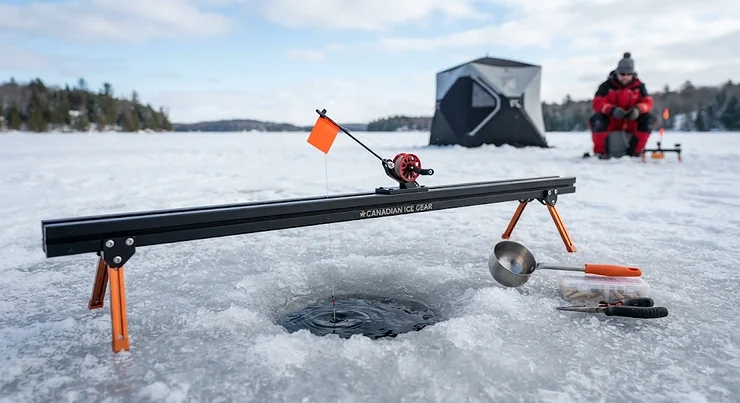
There’s a very specific kind of heartbreak that comes with ice fishing: you’ve drilled six holes, set six lines, and you’re huddled in a shack sipping lukewarm coffee when you glance up to see… nothing. No flags. No wiggle. Just a flat, indifferent lake staring back at you. A windlass tip up exists to fix exactly that problem — it uses the wind itself to keep your bait moving so you’re not just waiting around for a fish to stumble onto a motionless minnow.
A windlass tip up is a wind-powered ice fishing device that uses a small paddle or plate to catch a breeze and jig live bait up and down, even when nobody’s touching the line, triggering a flag when a fish strikes. It’s one branch of a much bigger family of “hands-off” ice fishing tools that also includes automatic hook-setters, battery-powered jiggers, and wireless bite alarms — all built around the same idea: let the gear do some of the waiting for you.
This guide breaks down seven real products you can research on amazon.ca, spanning true wind-driven windlass designs, mechanical automatic tip-ups, and powered electronic systems, so you can figure out which style actually suits your lake, your budget, and your patience level. We’ll also dig into the regulatory side, since — spoiler — not every “automatic” gadget you see online is legal to leave unattended in every province.
Quick Comparison Table
| Product | Type | Price Range (CAD) | Best For |
|---|---|---|---|
| HT Enterprises Windlass Tip-Up (TU-1) | Wind-driven jigging tip-up | around C$25-C$35 | Budget-conscious anglers wanting true wind action |
| JawJacker Deluxe Hook Setting System | Mechanical automatic hook-setter | C$45-C$65 range | Anglers tired of missed strikes on dead-sticked rods |
| Catch-On Automatic Jigging Rod Holder | Battery-powered auto-jig | C$55-C$80 range | Anglers who want jigging action without wind |
| Frabill Pro Thermal Tip-Up | Freeze-proof mechanical spool tip-up | under C$45 | Cold-snap fishing where holes keep icing over |
| Clam Arctic Warrior Tip-Up (Model 8840) | Strike-activated rod holder | C$70-C$100 range | Multi-rod spreads on organized ice |
| Vulture Revo Ice Fishing Tip-Up Sensor | Wireless electronic bite alert | in the mid-C$100s | Anglers running long spreads across big bays |
| Vexan Ice Fishing Tip-Up | High-visibility mechanical tip-up | C$30-C$45 range | Anglers who want a dependable, no-fuss classic |
Looking at the table above, the HT Enterprises Windlass Tip-Up and the Vexan Ice Fishing Tip-Up anchor the budget end for anglers who mostly want reliable mechanics without paying for batteries or electronics. The Clam Arctic Warrior Tip-Up and Vulture Revo Ice Fishing Tip-Up Sensor sit at the premium end because they solve a different problem — visibility and alert range across a large spread — rather than simply jigging bait. If your priority is hands-free hook-setting rather than bait movement, the JawJacker Deluxe Hook Setting System occupies its own lane entirely, and it’s worth reading the “vs” section below before you assume it does the same job as a windlass.
💬 Just one click — help others make better buying decisions too!😊
Top 7 Windlass & Automatic Tip-Ups: Expert Analysis
1. HT Enterprises Windlass Tip-Up (TU-1) — the original wind-jigging classic
The HT Enterprises Windlass Tip-Up is the product most anglers actually picture when they hear the word “windlass,” and for good reason — it’s been the standard-bearer for wind-driven jigging since long before “automatic” gear became a category. A metal wind plate sits at the end of a horizontal rocker arm; catch a breeze, and the plate bobs the arm, transmitting a lifelike jigging motion down the line to your bait, even in dead-calm-looking conditions where a stiff plastic base tip-up would sit motionless. The 500-foot spool and 13-inch (33 cm) base give it enough capacity for most walleye and pike depths, and the spring-adjustment bracket lets you dial the jig height up for bulkier baits like suckers or down for finicky panfish presentations.
Based on the spec comparison with fixed-base tip-ups, the real advantage here isn’t raw strength — it’s presentation. Reviewers consistently report that the windlass action out-produces flat, motionless tip-ups on slow days, particularly for pike and walleye that respond to movement more than scent alone. That said, aggregated buyer feedback also flags a real limitation: the ABS plastic hinge and drag mechanism can bind up in sub-zero temperatures unless you keep it dry and lightly lubricated, and the jigging action essentially disappears on dead-calm days, which is precisely when you might want it most.
Pros:
- ✅ Genuine wind-powered jigging action with no batteries
- ✅ Adjustable spring bracket tunes motion to bait size
- ✅ Folds flat for easy hauling to remote holes
Cons:
- ❌ Useless on dead-calm days with zero wind
- ❌ Plastic hinge can stiffen up in extreme cold
At around C$25-C$35, this is one of the most affordable ways to add genuine jigging action to a spread, and the value verdict is straightforward: buy two or three to mix into a traditional tip-up line, rather than betting your whole day on wind cooperating.
2. JawJacker Deluxe Hook Setting System — spring-triggered automatic hook-setter
The JawJacker Deluxe Hook Setting System isn’t a windlass at all — it’s a mechanical hook-setter that bends your actual ice rod into tension, then releases it the instant a fish pulls on the trigger, snapping the rod tip up to set the hook for you. It folds down to about 16.5 inches (42 cm) by 3 inches (7.6 cm), fits ice rods up to 30 inches (76 cm) and some up to 36 inches (91 cm) depending on flex, and adjusts via a wing nut that controls how much pressure trips the release.
What most buyers overlook about this style of device is that it’s solving a completely different problem than a windlass: it’s not about attracting bites, it’s about converting light bites into landed fish before a walleye or panfish can mouth the bait and spit it back out. Aggregated review sentiment across major retailers is strongly positive on hookup percentage, with several reviewers describing dramatic jumps in catch rate on short-strike species like trout and crappie once they switched from a passive dead-stick setup. The trade-off, based on the spec sheet, is that you’re tying up an actual rod and reel per hole rather than a dedicated cheap tip-up frame, which raises your per-hole cost if you’re running a big spread.
Pros:
- ✅ Converts light bites into solid hooksets automatically
- ✅ Adjustable trigger tension for different species
- ✅ Compact folding design, easy to carry in bulk
Cons:
- ❌ Requires a dedicated rod and reel per unit
- ❌ Not legal in every jurisdiction — check local rules first
Priced in the C$45-C$65 range, the value case is strongest for anglers targeting light-biting species where missed hooksets are the real bottleneck, not bait attraction.
3. Catch-On Automatic Jigging Rod Holder — battery-powered auto-jig, made in Canada
The Catch-On Automatic Jigging Rod Holder takes the “let the wind do the work” concept from a windlass and replaces the wind with a single AA battery, giving you continuous, adjustable jigging motion regardless of weather. A patented mechanism smoothly lifts and drops the rod tip on a repeating cycle, and newer versions add multiple jigging-speed settings so you can dial in a slow finesse wiggle for panfish or a more aggressive pump for aggressive predators.
Here’s what to weigh: because it’s motorized and continuous, it delivers consistent action on the calm, bluebird days when a true windlass tip-up goes completely still — which is precisely the gap it’s designed to fill. Reviewers who fish flat-calm inland lakes report noticeably more strikes compared to a passive rod holder, and the fact that it’s designed and tested in Canada is a genuine plus for anglers dealing with our colder average ice-fishing temperatures. On the downside, it’s a rod holder, not a signalling tip-up — you still need to watch the rod tip or pair it with your own strike detection, and cold can shorten AA battery life significantly, so a spare set in your pocket (not your sled) is worth the habit.
Pros:
- ✅ Works in dead-calm conditions unlike wind-based units
- ✅ Adjustable jigging speed for different species
- ✅ Designed and tested for Canadian winter conditions
Cons:
- ❌ Battery performance drops in extreme cold
- ❌ No built-in strike flag — pair with visual bite detection
Expect to pay in the C$55-C$80 range; it earns that premium over a basic windlass by working on the calm days when wind-based jigging simply can’t.
4. Frabill Pro Thermal Tip-Up — freeze-proof mechanical trigger system
The Frabill Pro Thermal Tip-Up swaps the windlass’s wind-catching plate for a different automation problem entirely: keeping your hole and your trigger mechanism from freezing solid on brutally cold days. A thick insulated cover seals over the hole, blocking snow, slush, and direct light while the internal spool and flag-trigger mechanism operate below the insulation, largely shielded from ambient wind chill.
The spec sheet detail that matters in practice: because the trigger sits inside an insulated housing rather than exposed on an open frame like most windlass units, it keeps functioning reliably on the exact days — deep cold snaps with biting wind — when open-frame mechanical tip-ups are most likely to gum up or freeze in place. Aggregated customer sentiment consistently praises the freeze resistance and the disc shape that stacks neatly into a five-gallon bucket for hauling a full spread. What reviewers flag as the trade-off is that, unlike a true windlass, there’s no active jigging motion here at all — this is a passive but reliable mechanical tip-up, not an automatic bait-mover, so it’s a different tool for a different job on your spread.
Pros:
- ✅ Insulated design resists freeze-in during deep cold
- ✅ Stacks compactly for hauling a full spread
- ✅ Blocks sunlight, reducing spooked fish under the hole
Cons:
- ❌ No active jigging or wind-driven bait movement
- ❌ Round thermal cover only fits standard hole sizes
Sitting under C$45, this is best framed as your cold-snap workhorse — pair a couple with a windlass-style unit so you’ve got both freeze protection and active jigging covered across your spread.
5. Clam Arctic Warrior Tip-Up (Model 8840) — strike-activated rod holder
The Clam Arctic Warrior Tip-Up approaches automation from the strike-detection side rather than the bait-movement side. It’s a rod holder engineered to work with most existing rod-and-reel combos, using a strike-activated release so the rod tip pops up visibly the moment a fish takes line, functioning as a hands-free flag substitute for anglers who’d rather fish with real rods than dedicated tip-up spools.
Based on the spec comparison, the appeal here is flexibility: instead of committing to a single-purpose tip-up frame, you’re upgrading rods you already own into semi-automatic strike detectors, which matters a lot if you already carry two or three quality rod-and-reel setups per outing. What most buyers overlook is that the strike sensitivity needs to be matched to bait weight — set too loose with a heavy sucker and you’ll get false triggers from current or wave action under the ice, set too tight with a light jig and you might miss subtle pike pickups. Reviewers who fish deeper basin water report the strongest results, since it holds up well under sustained line tension from bigger fish running with bait.
Pros:
- ✅ Works with rods and reels you already own
- ✅ Visible strike-activated release, easy to spot at distance
- ✅ Durable build rated for cold-weather use
Cons:
- ❌ Sensitivity tuning takes trial and error per bait size
- ❌ Costs more than a comparable dedicated tip-up frame
In the C$70-C$100 range, the value case is clearest for anglers who already own several capable rod-and-reel combos and want to convert them into a hands-free spread rather than buying dedicated tip-up hardware from scratch.
6. Vulture Revo Ice Fishing Tip-Up Sensor — wireless electronic bite alert
The Vulture Revo Ice Fishing Tip-Up Sensor represents the most “powered” end of this category — a wireless electronic transmitter mounted at the hole that detects motion or spin and sends a two-way alert to a compact handheld receiver, complete with an LED indicator visible across a spread. Instead of relying on your eyes to catch a distant flag, the unit effectively pages you the moment something happens at any monitored hole.
What the spec sheet won’t tell you, but the design implies, is the real use case: this shines on big, open bays where a traditional flag might be 200-plus metres away and easy to miss in flat light or blowing snow. Reviewers describe the biggest benefit as peace of mind — you can duck into a shack, warm up, and still get notified the instant a hole goes off, rather than doing visual sweeps every few minutes. The honest trade-off is battery management in extreme cold (lithium cells lose capacity fast below about -20°C/-4°F) and the fact that you’re adding an electronic layer to a sport that traditionally runs on almost nothing but mechanical parts, which some purists will find unnecessary and others will find liberating.
Pros:
- ✅ Two-way wireless alert reaches you at distance
- ✅ LED visual indicator works in low light or snow
- ✅ Reduces need for constant visual hole checks
Cons:
- ❌ Cold weather shortens battery runtime noticeably
- ❌ Adds an electronic point of failure to your spread
At in the mid-C$100s, it’s the priciest pick here, but for anglers regularly running a wide spread across open ice, the reduction in missed flags can genuinely justify the premium.
7. Vexan Ice Fishing Tip-Up — high-visibility mechanical spool classic
The Vexan Ice Fishing Tip-Up rounds out the list as the dependable, no-drama mechanical option — a traditional flag-and-spool design built around a bright, high-visibility green frame and a reflective strike indicator flag rated for an 18-inch (46 cm) max span, aimed at anglers who want easy-deploy hardware without wind dependency or batteries.
Here’s the honest framing: this isn’t an automatic bait-mover like the windlass or Catch-On units, and it isn’t a hook-setter like the JawJacker — it’s a refined version of the mechanical tip-up format that’s been catching fish for generations, with modern materials and a reflective flag that’s genuinely easier to spot at dusk or under grey skies. Based on the spec comparison, the appeal is reliability under adverse conditions: no wind dependency, no batteries to die, no electronics to short out. Aggregated buyer sentiment on similar high-visibility mechanical tip-ups typically centres on the flag’s spring tension holding up over repeated freeze-thaw cycles, and on how easy the units are to deploy quickly with cold hands and thick gloves — a detail that matters more than most spec sheets admit.
Pros:
- ✅ Bright, reflective flag spotted easily at distance
- ✅ No batteries or wind dependency to worry about
- ✅ Simple, glove-friendly deployment in the cold
Cons:
- ❌ No active jigging motion built in
- ❌ Basic spool capacity limits very deep-water sets
In the C$30-C$45 range, this is the pick for anglers who want a dependable core spread they can round out with one or two automatic units for variety.
Practical Usage Guide: Setting Up Your Windlass Tip-Up
Getting a windlass tip up performing at its best takes more than dropping bait down a hole. Start by setting the wind plate’s spring tension light for finesse baits like small jigs and heavier for live minnows or suckers, since an over-tensioned spring won’t move under a modest breeze. On your first outing, test the rocker arm’s motion by hand before drilling, confirming the hinge moves freely — cold-soaked plastic hinges benefit from a light coat of silicone-based (never petroleum-based) lubricant, since petroleum products can gum up and attract dirt in freezing conditions.
For maintenance, rinse the mechanism with fresh water and dry it thoroughly at the end of each season before storage; residual lake water left in a hinge is the number one cause of a windlass jamming solid by the following winter. A common first-30-days mistake is setting depth incorrectly — for suspended species like walleye, aim for the middle of the water column rather than bottom-bouncing, and re-check depth settings each time you move holes, since bottom contours shift more than anglers expect across a single bay.
Real-World Scenarios: Matching the Tip-Up to Your Ice
If you’re a weekend angler fishing a small inland lake with your kids, a couple of Vexan Ice Fishing Tip-Ups paired with one HT Enterprises Windlass Tip-Up gives you reliable, low-maintenance flags plus a bit of jigging variety without anyone needing to babysit batteries. If you’re a serious walleye angler running a five-to-six-hole spread on a big reservoir most weekends of the season, the Vulture Revo Ice Fishing Tip-Up Sensor on your farthest holes and a Clam Arctic Warrior Tip-Up on your closer rods lets you cover more water without constant visual sweeps. And if you mostly deadstick for trout or crappie and keep losing fish to short strikes, budget C$45-C$65 for a JawJacker Deluxe Hook Setting System before you spend another dollar on bait — it solves the specific problem you actually have.
Problem → Solution: Fixing Common Windlass Tip-Up Headaches
Problem: No wind, no jigging action. A pure windlass tip up goes still on calm bluebird days. Solution: swap in a battery-powered unit like the Catch-On Automatic Jigging Rod Holder for those specific conditions, or pair windlass units with a couple of scented or livelier bait presentations to compensate.
Problem: Frozen or sluggish mechanisms. Cold-soaked plastic hinges and springs bind up after repeated wet-dry cycles. Solution: dry and lightly lubricate mechanisms after every trip, and consider a freeze-resistant design like the Frabill Pro Thermal Tip-Up for extended deep-cold outings.
Problem: Missed hooksets on light bites. Panfish and trout often mouth bait without triggering a traditional flag hard enough. Solution: a mechanical hook-setter such as the JawJacker Deluxe Hook Setting System converts marginal pressure into a confirmed hookset automatically.
Problem: Missing flags across a wide spread. On big water, a distant flag can go unnoticed for many minutes. Solution: a wireless unit like the Vulture Revo Ice Fishing Tip-Up Sensor pages you directly instead of relying on line-of-sight checks.
🎣 Ready to Round Out Your Spread?
🔍 Compare current pricing and availability on any of these automatic and windlass tip-ups before your next trip out. A well-matched spread — mixing wind-driven, mechanical, and powered units — covers more conditions than any single style can on its own.
How to Choose a Windlass or Automatic Tip-Up
- Match the mechanism to your typical weather. If your lake is reliably windy, a true windlass tip up like the HT Enterprises Windlass Tip-Up delivers real jigging value; on consistently calm inland ponds, a battery-powered unit performs more predictably.
- Decide whether you need bait movement or bite conversion. A windlass attracts strikes through motion; a hook-setter like the JawJacker Deluxe Hook Setting System converts strikes you’re already getting into landed fish. These solve different problems, so don’t assume one replaces the other.
- Check your province’s tip-up and spring-loaded device rules first. Some jurisdictions restrict spring-loaded hook-setters near open water or cap how many lines you can legally run — verify before you build a spread around a specific mechanism.
- Budget for a mixed spread, not one style. Reviewers consistently report the best results from combining two or three device types rather than betting an entire spread on one mechanism.
- Weigh battery dependence against wind dependence. Powered units solve the calm-day problem but introduce cold-weather battery drain; wind-driven units solve the battery problem but go still without a breeze.
- Prioritize freeze resistance for deep-cold trips. If you regularly fish through extended cold snaps, an insulated design like the Frabill Pro Thermal Tip-Up will outperform an open-frame mechanism on functionality alone.
- Factor in visibility across your typical spread distance. Wide-open bays reward high-visibility flags or wireless alerts; tight, sheltered bays with close-set holes rarely need that extra range.
Common Mistakes When Buying Automatic Tip-Ups
The single most common mistake is assuming “windlass” and “automatic” are interchangeable terms describing the same product — they’re not, and buying a mechanical hook-setter when what you actually wanted was wind-driven jigging action leads to disappointment that has nothing to do with product quality. A second frequent misstep is under-budgeting for a full spread; buying one premium wireless sensor and five bargain-bin plastic tip-ups creates an uneven setup where your best technology can’t compensate for weak mechanics elsewhere. Reviewers also commonly flag buyer’s remorse around ignoring local regulations — purchasing a spring-loaded hook-setter without first confirming it’s permitted within your fishing zone is an expensive and entirely avoidable error. Finally, many first-time buyers skip reading the trigger-sensitivity adjustment instructions, then blame the product for false triggers or missed hooksets that were actually a tuning issue solvable in under a minute.
Windlass Tip-Ups vs Automatic Hook-Setting Systems
These two categories get lumped together constantly, but they solve genuinely different problems, and understanding the split will save you money. A windlass tip up, like the HT Enterprises Windlass Tip-Up, is fundamentally about presentation: it moves your bait to attract a strike in the first place, using either wind or a small motor as the Catch-On unit does. An automatic hook-setting system, like the JawJacker Deluxe Hook Setting System, doesn’t attract anything — it assumes a fish has already found your bait and focuses entirely on converting that bite into a solid hookset before the fish can spit the hook.
| Feature | Windlass-Style Tip-Up | Automatic Hook-Setter |
|---|---|---|
| Primary job | Attracts strikes via bait movement | Converts strikes into landed fish |
| Power source | Wind or battery | Spring tension, mechanical |
| Best species fit | Pike, walleye, active predators | Trout, crappie, light-biting panfish |
| Regulatory note | Generally treated as a standard tip-up | Some provinces restrict spring-loaded hook-setters near water |
Reading the table above, the practical takeaway is that serious anglers running mixed species often want both categories represented in a spread rather than choosing one exclusively — a windlass style unit to draw strikes on your speculative holes, and a hook-setter on your known light-biting spots where missed sets are the actual bottleneck. The HT Enterprises Windlass Tip-Up and JawJacker Deluxe Hook Setting System genuinely complement each other more than they compete.
What to Expect: Real-World Performance on the Ice
On paper, a windlass tip up sounds almost magical — free, wind-powered jigging with zero effort. In practice, expect the effect to be subtle rather than dramatic on any single outing; you won’t necessarily see fish “attack” a jigging bait the moment wind picks up, but aggregated review sentiment across multiple retailers consistently shows anglers reporting better results over a season of comparative use, not necessarily every single trip. Automatic hook-setters like the JawJacker Deluxe Hook Setting System tend to show more immediately obvious results, since a converted hookset is a binary, countable outcome rather than a subjective “seemed livelier” impression. Powered units such as the Catch-On Automatic Jigging Rod Holder and Vulture Revo Ice Fishing Tip-Up Sensor deliver the most consistent performance day-to-day precisely because they don’t depend on variable natural conditions — the honest trade-off is that consistency costs more upfront and requires you to actually manage batteries.
Features That Actually Matter (And Those That Don’t)
Adjustable trigger or spring tension matters enormously — it’s the single feature most responsible for the difference between a device that works for your target species and one that constantly false-triggers or misses light bites. Freeze resistance matters if you fish through genuine cold snaps regularly, but it’s largely irrelevant if your season mostly happens in milder, above-freezing windows. Wireless range on electronic sensors matters only if you’re actually fishing spreads wide enough to need it — on a tight cluster of holes 20 metres (65 ft) apart, you’re paying for range you’ll never use. On the other hand, marketing language around “guaranteed” catch-rate increases doesn’t matter and shouldn’t factor into your decision — no mechanism, however well engineered, overrides fish behaviour, water clarity, or barometric pressure on a given day, and reviewers who report the biggest gains are almost always describing incremental, season-long improvements rather than single-outing miracles.
Long-Term Cost & Maintenance of Automatic Tip-Up Systems
| Budget Tier | Price Range (CAD) | What You Get | Best For |
|---|---|---|---|
| Budget | under C$45 | Reliable mechanical tip-ups (windlass or standard) | Building out a full spread affordably |
| Mid-Range | C$45-C$100 | Hook-setters, battery-powered jiggers, strike-activated holders | Solving a specific problem (missed sets, calm days) |
| Premium | C$100+ | Wireless electronic sensor systems | Wide spreads on big, open water |
Looking at total cost of ownership rather than sticker price alone, purely mechanical units like the HT Enterprises Windlass Tip-Up and Vexan Ice Fishing Tip-Up have the lowest long-term cost since there’s no recurring battery expense — just occasional line replacement and hinge lubrication. Powered units add a modest but real ongoing cost in cold-rated batteries, particularly if you’re running several units through a full season, and it’s worth budgeting for lithium AA cells rather than standard alkaline, since lithium holds capacity far better below freezing. Maintenance-wise, a rinse-and-dry routine after every outing, plus a pre-season inspection of springs and hinges, will meaningfully extend the working life of any mechanical unit on this list.
Safety, Regulations & Compliance for Automatic Tip-Ups in Canada
This is where honesty matters more than marketing copy, and it’s worth being direct: no consumer product on the market today is a true “automatic retrieve tip up” in the sense of a device that hooks, reels in, and lands a fish with zero angler involvement while unattended. That’s not an oversight in current product design — it reflects deliberate provincial regulation. In Ontario, for example, any spring-loaded device that sets the hook for an angler may not be possessed within 30 metres of any waters in certain contexts, and anglers must stay within 60 metres of any line or tip-up with a clear, unobstructed view of it at all times — meaning you can’t legally set a hook-setter or windlass tip up and walk away for an extended period, no matter how “automatic” the marketing sounds. Regulators in neighbouring jurisdictions have taken a similar approach: hook-setting components are permitted in some places, but the rules explicitly draw a line at devices that would automatically reel in or retrieve fish, which remain prohibited.
Practically, this means “self winding tip up” and “powered tip up” products on the market genuinely automate bait movement or hook-setting, not unattended retrieval — and any listing implying otherwise deserves scepticism. Before buying, check your provincial fishing regulations summary for line limits, spring-loaded device restrictions, and ice hut rules, since these vary by zone and are updated annually.
Frequently Asked Questions
❓ What is a windlass tip up used for?
❓ Is a windlass tip up the same as an automatic tip up?
❓ Are automatic hook-setting tip-ups legal in Canada?
❓ Do windlass tip-ups work without wind?
❓ How much line do I need on an automatic or windlass tip-up?
Conclusion
There’s no single “best” windlass tip up that fits every angler, every lake, and every budget — and honestly, that’s the real takeaway here. If you fish windy, open water and want genuine bait movement without batteries, the HT Enterprises Windlass Tip-Up remains the benchmark. If missed hooksets on light-biting species are your actual problem, no amount of jigging action will out-perform the JawJacker Deluxe Hook Setting System‘s mechanical hookset. And if you’re covering wide, unpredictable water where visibility is the bottleneck, the Vulture Revo Ice Fishing Tip-Up Sensor solves a problem the others simply weren’t built for.
The smartest approach for most serious ice anglers isn’t picking one winner — it’s building a small, mixed spread that covers wind-driven jigging, freeze-proof reliability, and hookset conversion across your holes, then adjusting the mix as you learn which conditions your specific lake actually throws at you. Whatever you choose, take five minutes to check your provincial fishing regulations before you set anything unattended, since the rules genuinely do vary and they change annually.
✨ Found this helpful? Share it with your fellow ice anglers before the next cold snap! 💬🎣
Recommended for You
- Thermal vs Standard Tip Up: 7 Picks That Won’t Freeze in 2026
- Thermal Tip Ups: 7 Insulated Picks That Beat the Freeze (2026)
- Wooden Tip Up vs Plastic: 7 Best Options Ranked for 2026
Disclaimer: This article contains affiliate links. As an Amazon Associate, I earn from qualifying purchases. If you purchase products through these links, we may earn a small commission at no additional cost to you.
✨ Found this helpful? Share it with your friends! 💬🤗
