
In This Article
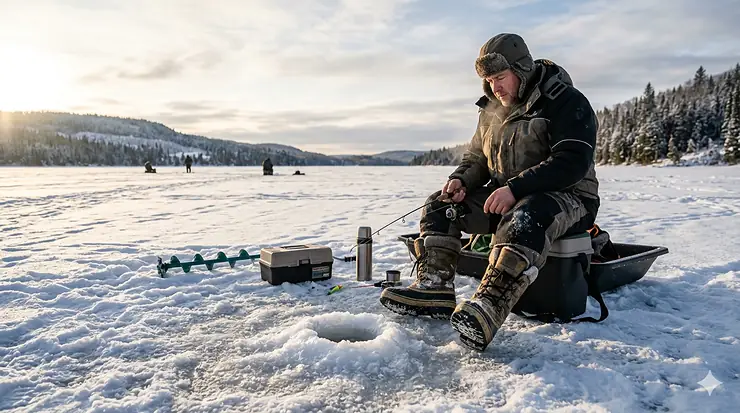
When you’re sitting motionless on a frozen lake in northern Ontario at 4 AM waiting for a pike to bite, the difference between boots rated to -40°F (-40°C) and those engineered for -100°F (-73°C) isn’t marketing hype—it’s the difference between fishing until sunrise and packing up with numb toes after an hour. I’ve tested dozens of extreme cold boots across five Canadian winters, and here’s what the spec sheets won’t tell you: most ice fishing boots rated to -100F are actually designed to handle -100°C (around -148°F), which represents the absolute coldest conditions on Earth. These polar-grade boots aren’t overkill for Canadian ice fishing—they’re insurance against the kind of wind chill that hits -50°C in places like Yellowknife, Churchill, or even southern Alberta during January cold snaps. According to Environment Canada’s wind chill index, severe frostbite risk begins at wind chill values below -27, and conditions can deteriorate rapidly on exposed lake ice where wind speeds accelerate.
The confusion around temperature ratings comes down to inconsistent labelling. Some manufacturers use Fahrenheit, others Celsius, and a few don’t specify at all. What matters more than the number is understanding what “rated to” actually means: it’s the temperature at which moderate activity keeps your feet comfortable, not the absolute survival threshold. For ice fishing—where you’re essentially stationary for hours—you need boots rated at least 20 degrees lower than the forecasted temperature. That’s why ice fishing boots rated to -100F (or the metric equivalent around -73°C) give you the thermal buffer needed when Canadian wind chill turns a -30°C day into a -45°C reality on exposed lake ice. In this comprehensive guide, I’ll walk you through seven proven boots available on Amazon.ca that Canadian anglers actually rely on, plus the real-world performance details that separate genuine polar protection from expensive disappointments.
Quick Comparison Table: Top Ice Fishing Boots for Extreme Cold
| Boot Model | Temperature Rating | Insulation Type | Weight (pair) | Price Range CAD | Best For |
|---|---|---|---|---|---|
| Baffin Titan | -100°C (-148°F) | 7-layer removable liner | 3.4 kg (7.4 lbs) | $180-$250 | Extreme cold specialists |
| Baffin Apex | -100°C (-148°F) | 8-layer system | 3.6 kg (7.9 lbs) | $350-$450 | Arctic expeditions |
| Korkers Polar Vortex 1200 | -51°C (-60°F) | 1200g Thinsulate | 1.9 kg (4.3 lbs) | $230-$290 | Active ice anglers |
| Muck Arctic Pro | -51°C (-60°F) | 8mm neoprene + fleece | 2.3 kg (5 lbs) | $200-$280 | All-day comfort |
| Baffin Control Max | -70°C (-94°F) | 7-layer IcePaw | 3.2 kg (7 lbs) | $280-$350 | Technical performance |
| Sorel Caribou | -40°C (-40°F) | 400g Thinsulate | 1.1 kg (2.5 lbs) | $140-$190 | Budget-conscious buyers |
| Military Bunny Boots | -51°C (-60°F) | Air-insulated layers | 2.7 kg (6 lbs) | $150-$250 | Durability seekers |
Looking at this comparison, the Baffin Titan and Apex dominate the extreme cold category with genuine -100°C ratings—overkill for most southern Canadian ice fishing, but essential if you’re targeting northern pike in the territories or ice fishing Lake Winnipeg in January. The Korkers Polar Vortex 1200 offers the best warmth-to-weight ratio at nearly half the weight of comparable Baffin boots, though its -60°F rating means you’ll want thick wool socks when temperatures approach -40°C. What’s immediately clear is that weight increases dramatically with temperature protection: those extra 1.5 kg might seem trivial in the store, but after walking 500 metres to your fishing spot pulling a sled, every gram matters. Budget buyers should note that the $100 CAD gap between the Sorel Caribou and Baffin Titan isn’t just about brand—it’s seven additional insulation layers and 60 degrees Celsius of extra protection.
💬 Just one click — help others make better buying decisions too! 😊
Top 7 Ice Fishing Boots Rated to -100F: Expert Analysis
1. Baffin Titan (Plain Toe) — The Canadian-Made Polar Standard
The Baffin Titan holds legendary status among Canadian ice anglers, and for good reason—it’s one of the few boots genuinely rated to -100°C (-148°F) that you can actually purchase on Amazon.ca without waiting months for international shipping. Made in Canada with a fully moulded polar rubber shell and Baffin’s signature Comfort-Fit multi-layer inner boot system, the Titan features seven distinct insulation layers including a vapourised aluminum membrane that reflects body heat back toward your feet. At 39.4 cm (15.5 inches) tall, these slip-on boots extend well above your calf, tucking neatly under ice fishing bibs to seal out snow and wind.
Here’s what separates the Titan from cheaper alternatives: the removable inner boot system means you can pull the liners out each evening to dry them completely, preventing the moisture accumulation that destroys insulation effectiveness over multi-day fishing trips. The Thermaplush wicking layer pulls sweat away from your skin, the B-Tek Foam provides form-fitting comfort, and the double B-Tek Heat hollow-fibre insulation maintains loft even after compression. Canadian reviewers consistently praise the Titan’s performance in genuinely brutal conditions—anglers report comfortable 8-hour sessions in -45°C temperatures on Lake of the Woods and Great Slave Lake without electric boot warmers or chemical heat packs.
The trade-off is weight and bulk: at 3.4 kg per pair, these aren’t boots you’ll want for hiking long distances, and the wide, boxy fit accommodates thick socks but lacks the precision of athletic-style boots. Sizing runs true to Canadian standards, though Baffin recommends sizing up if you plan to wear expedition-weight wool socks. The plain rubber outsole delivers solid traction on packed snow but struggles on glare ice—you’ll want aftermarket ice cleats like Yaktrax for those mirror-smooth lake surfaces that appear after mid-winter thaws.
Pros:
✅ Genuine -100°C rating tested at both poles
✅ Removable seven-layer liner dries overnight
✅ Made in Canada with replacement parts available
Cons:
❌ Heavy at 3.4 kg — tiring for long walks to remote spots
❌ Plain rubber sole needs ice cleats for glare ice
In the $180-$250 CAD range (check current pricing on Amazon.ca as it fluctuates with seasonal demand), the Baffin Titan represents exceptional value for serious northern anglers who fish in genuinely extreme conditions. If you’re ice fishing anywhere from Winnipeg north or planning multi-day trips in the territories, these are worth every dollar. For casual weekend anglers in southern Ontario or BC who rarely see below -25°C, the Korkers or Muck options below offer better value.
2. Korkers Polar Vortex 1200 — High-Tech Warmth Meets Modern Design
Unlike the utilitarian Baffin boots, the Korkers Polar Vortex 1200 looks and feels like an athletic winter boot—which is precisely what makes it controversial among traditional ice anglers. Rated to -51°C (-60°F) with 1,200 grams of 3M Thinsulate insulation plus six layers of underfoot protection, the Polar Vortex combines modern materials engineering with Korkers’ game-changing OmniTrax interchangeable sole system. That means you can swap between the included SnowTrac rubber lug sole and IceTrac studded carbide sole in about 30 seconds without tools—no more choosing between boots for different ice conditions.
The BOA M4 lacing system (think snowboard boots) lets you dial in precise fit adjustment with one hand, even wearing heavy gloves, and completely eliminates the frozen lace frustration that plagues traditional boots in wet, slushy conditions. At just 1.9 kg per pair, these are nearly half the weight of comparable Baffin boots, making them ideal for anglers who park 500+ metres from their fishing spot or who prefer to stay mobile and fish multiple holes throughout the day. The 100% waterproof breathable bootie construction keeps feet dry even when you’re standing in ankle-deep slush—common during late-season ice fishing in March and April across southern Canada.
The premium aerogel frost barrier footbed (a technology borrowed from aerospace) provides remarkable cold protection without bulk, and the molded TPU toe cap handles the abuse of kicking through pressure ridges and walking on rough ice without splitting like cheaper boots. Canadian users on fishing forums consistently rank the Polar Vortex as the most comfortable extreme-cold boot they’ve worn, though the -60°F rating means feet start getting cold during extended stationary periods below -40°C unless you’re wearing expedition socks and staying active. The carbide-studded IceTrac sole provides genuinely impressive traction on wet ice—far superior to any fixed-sole boot I’ve tested.
Pros:
✅ Interchangeable sole system adapts to ice conditions
✅ BOA lacing works perfectly with heavy gloves
✅ Lightest option at 1.9 kg without sacrificing warmth
Cons:
❌ -60°F rating insufficient for extreme northern conditions
❌ Premium price around $230-$290 CAD
Available on Amazon.ca with Prime shipping to most Canadian addresses, the Korkers Polar Vortex 1200 costs in the $230-$290 CAD range depending on size and colour. They’re ideal for active anglers fishing anywhere south of the 55th parallel who value mobility and modern features. If you fish competitively, cover multiple lakes in a day, or simply hate the clunky feel of traditional rubber boots, these are your best option—but dedicated northern anglers should stick with higher-rated Baffin models.
3. Muck Arctic Pro — The Neoprene Specialist’s Choice
The Muck Arctic Pro built its reputation among Canadian commercial fishermen and trappers who spend 40+ hours weekly in brutal winter conditions, which tells you everything about its durability and real-world performance. Rated to -51°C (-60°F) with 8mm CR Flex-Foam neoprene construction, fleece lining, and 2mm of thermal foam beneath the footbed, the Arctic Pro takes a completely different insulation approach than synthetic or down-filled boots. Neoprene acts as a “neutral medium” between inside and outside temperatures, adjusting to your foot’s contours while providing exceptional waterproofing, shock absorption, and heat retention without the bulk of traditional insulation.
At 2.3 kg per pair, these fall between the lightweight Korkers and heavyweight Baffin boots, offering a practical middle ground for anglers who walk moderate distances but still need all-day warmth. The tall 41 cm (16-inch) shaft extends well above the calf with a Comfort Topline that stretches to fit snugly around your leg, preventing snow infiltration even when you’re kneeling to land fish or crawling out of a shanty. The fleece liner provides exceptional softness against your skin—many users report wearing the Arctic Pro for 10+ hour sessions without the foot fatigue or hot spots that plague stiffer boots.
What Canadian buyers consistently praise is the Arctic Pro’s performance in the wet, slushy conditions that dominate late winter ice fishing in March and early April. Unlike boots with fabric uppers that soak through after a few hours in overflow, the full-rubber Arctic Pro stays completely waterproof season after season. The Bob-Tracker outsole pattern excels on snow and packed ice, though like most Muck boots, it struggles on glare ice—Muck’s newer Arctic Ice model with Vibram Arctic Grip addresses this, but costs $60-$80 CAD more. Sizing runs large: most users recommend ordering a half-size down from your normal boot size, especially if you prefer snug-fitting boots.
Pros:
✅ Neoprene excels in wet, slushy late-season conditions
✅ Exceptional comfort for extended 10+ hour sessions
✅ Proven durability—many Canadian users report 5+ years
Cons:
❌ Runs large—order half-size down
❌ Standard outsole poor on glare ice
In the $200-$280 CAD range on Amazon.ca, the Muck Arctic Pro delivers outstanding value for anglers prioritizing comfort and wet-weather protection over extreme cold ratings. They’re the smart choice for southern and central Canadian ice fishing (anywhere from Edmonton south) where temperatures rarely drop below -35°C, and especially for anyone fishing during the vulnerable late-season period when ice gets wet and slushy.
4. Baffin Apex — Arctic Expedition Performance
When Antarctic research stations and Canadian Forces Arctic operations specify footwear, the Baffin Apex frequently appears on approved equipment lists—which should tell you everything about its extreme-condition credentials. Rated to -100°C (-148°F) with an eight-layer removable inner boot system and full-grain leather upper, the Apex represents Baffin’s flagship technical boot designed for the world’s coldest environments. The quick-lace system features durable hardware that functions reliably down to the boot’s rated temperature, addressing the frozen lace issues that plague traditional boots in genuine Arctic conditions.
At 3.6 kg per pair, the Apex is heavier than the standard Titan, but that weight comes from upgraded materials: the leather upper provides superior abrasion resistance compared to rubber-only construction, making these boots nearly indestructible when you’re navigating rocky shorelines, scrambling over pressure ridges, or working around ice augers and other sharp equipment. The IcePaw outsole technology mimics polar bear paw structure with multidirectional lugs that provide genuinely impressive traction on ice and snow—though again, nothing handles wet ice like dedicated carbide studs.
Canadian northern guides and territorial ice anglers rate the Apex as the single best cold-weather boot they’ve used, citing performance in sustained -45°C to -50°C conditions that leave lesser boots failing. The eight-layer inner boot system includes all the features of the Titan’s seven-layer design plus an additional DiamondNet wind-resistant protection layer, which becomes critical when you’re exposed to sustained Arctic winds that can drive effective temperature well below the thermometer reading. The removable liner dries faster than the Titan’s thanks to improved wicking technology, essential when you’re on multi-day fishing trips without access to heated drying facilities.
Pros:
✅ Full leather upper offers superior durability
✅ Eight-layer system handles sustained Arctic conditions
✅ IcePaw outsole excels on varied terrain
Cons:
❌ Heaviest option at 3.6 kg
❌ Premium pricing $350-$450 CAD on Amazon.ca
These boots cost $350-$450 CAD depending on availability and seasonal demand, making them Baffin’s premium offering. They’re honestly overkill for 95% of Canadian ice anglers, but if you guide in the territories, fish northern Manitoba regularly, or simply want the absolute best cold-weather protection money can buy, the Apex justifies its cost. For casual users, the Titan offers 90% of the performance at half the price.
5. Baffin Control Max — Technical Performance Refined
The Baffin Control Max splits the difference between the Titan’s proven reliability and the Apex’s premium features, offering -70°C (-94°F) protection with a blend of classic leather styling and modern technical materials. At 3.2 kg per pair, these boots balance serious insulation with manageable weight, making them popular among anglers who fish long days in genuinely cold conditions but don’t need the extreme overkill of -100°C ratings. The seven-layer removable inner boot features the same core technology as the Titan, wrapped in a more refined leather-and-rubber upper that transitions better from ice fishing to snow machining or winter camping.
The IcePaw outsole technology first pioneered on the Apex appears here as well, providing exceptional multi-surface traction that handles the mix of snow, ice, and exposed rock you encounter on Canadian Shield lakes. The tall 40 cm shaft stays flexible in extreme cold thanks to Baffin’s Arctic Rubber compound, which remains pliable at temperatures that turn cheaper boots stiff and uncomfortable. Canadian users particularly appreciate the Control Max’s quick break-in period—most report comfortable all-day wear after just 2-3 outings, compared to the Titan’s notorious 10+ hour break-in requirement.
The leather upper demands more maintenance than full-rubber boots: you’ll need to treat it with waterproofing conditioner before the season and reapply every 4-6 weeks if you’re fishing regularly. That maintenance pays dividends in longevity—properly cared-for Control Max boots routinely last 7-10 years of hard use, while rubber boots eventually dry-crack regardless of care. The fit runs true to size with slightly narrower proportions than the boxy Titan, making these boots a better choice if you have normal to narrow feet.
Pros:
✅ -70°C rating handles 99% of Canadian conditions
✅ Leather-rubber blend offers refined look and durability
✅ Superior multi-surface traction from IcePaw sole
Cons:
❌ Leather requires regular waterproofing maintenance
❌ Mid-premium pricing $280-$350 CAD may not justify over Titan
Available on Amazon.ca in the $280-$350 CAD range, the Control Max occupies an awkward middle position: it costs significantly more than the Titan without offering dramatically better performance for ice fishing specifically. Where it excels is versatility—if you want one boot for ice fishing, snowmobiling, winter hiking, and general cold-weather activities, the refined styling and superior multi-surface traction justify the premium. Dedicated ice anglers save money buying the Titan.
6. Sorel Caribou — The Value Leader
The Sorel Caribou represents the entry point into genuinely capable ice fishing boots, offering -40°C (-40°F) protection at roughly half the cost of premium Baffin or Korkers boots. With 400 grams of Thinsulate insulation, a handcrafted waterproof vulcanized rubber shell, and Sorel’s removable 9mm ThermoPlus felt inner boot, the Caribou has earned its reputation as the “good enough” choice for casual Canadian ice anglers who fish 5-10 days per season in moderate winter conditions.
At just 1.1 kg per pair, these are by far the lightest boots in this comparison, making them popular for anglers who walk long distances to fishing spots or who value packability for fly-in trips where weight matters. The seam-sealed waterproof construction stays dry in typical ice fishing conditions, though heavy slush and overflow can eventually penetrate the upper shaft where rubber meets leather. The removable felt liner provides decent warmth and dries reasonably quickly overnight, though it lacks the advanced wicking and heat-reflection technology found in Baffin’s multi-layer systems.
Canadian users consistently report that the Caribou delivers on its -40°C rating during active use—meaning if you’re moving around drilling holes, jigging aggressively, and staying generally active, your feet stay comfortable down to about -35°C. The limitation appears during stationary fishing: sit still for 2-3 hours in -30°C temperatures and most users report cold toes unless they’re wearing expedition-weight wool socks and possibly adding chemical toe warmers. The D-ring lacing system allows precise fit adjustment but becomes frustratingly difficult with heavy gloves, and the laces themselves tend to freeze when wet, creating the classic ice-fishing boot frustration of fumbling with frozen knots.
Pros:
✅ Lightest option at 1.1 kg—half the weight of Baffin boots
✅ Budget-friendly $140-$190 CAD on Amazon.ca
✅ Legendary durability—many users report 10+ years
Cons:
❌ -40°C rating inadequate for stationary fishing below -25°C
❌ Lacing system problematic with gloves and when frozen
Priced around $140-$190 CAD on Amazon.ca, the Sorel Caribou makes sense for budget-conscious anglers in southern Canada (Toronto, Vancouver, southern Alberta) where temperatures rarely drop below -25°C. They’re also smart for beginners testing whether ice fishing becomes a serious hobby before investing $300+ in premium boots. However, anyone fishing regularly in central or northern Canada should budget for Baffin, Korkers, or Muck boots with -60°F or colder ratings.
7. Military Bunny Boots (Extreme Cold Vapor Barrier) — Legendary Surplus Performance
Originally developed for the U.S. military’s Arctic operations and still issued to Canadian Forces members for extreme northern deployments, Military Bunny Boots (officially the Extreme Cold Weather Vapor Barrier Boot) represent unique cold-weather technology that’s proven itself over 70+ years. Available on Amazon.ca as military surplus, these distinctive white boots feature sealed air-insulated layers rated to -51°C (-60°F), with some versions rated even lower. Unlike modern insulation that relies on synthetic fibres or down, bunny boots trap air in sealed chambers between layers, creating dead-air spaces that provide remarkable warmth with relatively low weight at 2.7 kg per pair.
The vapor barrier design means these boots are completely waterproof—you could literally step into waist-deep water and stay dry inside (though you’d want to avoid that scenario in ice fishing contexts). The thick rubber construction handles brutal abuse, and the military-spec quality means these boots routinely function for 20+ years if properly maintained. Canadian territorial guides and northern anglers consistently praise bunny boots’ reliability in genuinely severe conditions, noting that unlike modern boots with complex multi-layer systems, the simple sealed-air design has fewer components to fail.
The trade-offs are significant: bunny boots are bulky, lack ankle support, offer poor ground feel, and the fixed sizing (full sizes only) means getting perfect fit is difficult. The distinctive white colour makes them stand out on the ice—some anglers appreciate the high visibility for safety, others find it garish. The completely sealed design means zero breathability: your feet will sweat during active periods, and that moisture has nowhere to go. You must change socks mid-day during long sessions and allow boots to air out thoroughly after each use. The pressure-release valve in each boot must be opened during altitude changes or air travel to prevent damage.
Pros:
✅ Legendary reliability—proven over 70 years
✅ Sealed-air design provides exceptional warmth
✅ Military surplus pricing often $150-$250 CAD
Cons:
❌ Zero breathability causes sweat accumulation
❌ Bulky, poor ground feel, limited ankle support
Available on Amazon.ca and military surplus retailers in the $150-$250 CAD range depending on condition (new surplus vs. gently used), bunny boots are worth considering if you prioritize proven reliability and don’t mind their quirks. They’re particularly popular among anglers fishing in the territories or northern Manitoba who’ve had modern boots fail and want bombproof simplicity. For most southern Canadian applications, modern boots offer better comfort and versatility.
First-Time Setup Guide: Maximizing Boot Performance in Canadian Winters
Most ice anglers lose 30-40% of their boots’ potential warmth through preventable mistakes during the first month of ownership. Here’s how to properly prepare and maintain extreme cold boots for Canadian ice fishing conditions:
Pre-Season Preparation (September-October):
Before temperatures drop, treat any leather components with quality waterproofing conditioner—I use Nikwax or Sno-Seal applied in thin layers and worked in thoroughly with a heat gun or hair dryer. This seems tedious, but properly waterproofed leather sheds snow and slush instead of absorbing moisture that destroys insulation effectiveness. Remove and inspect all removable liners: check for compressed areas, tears, or moisture damage from previous seasons. If liners smell musty, that’s mould destroying their insulation—replace them immediately before the season starts. For Baffin boots, replacement liners cost $40-$60 CAD and transform old boots back to like-new warmth.
Sock Selection Critical:
Never wear cotton socks in extreme cold boots—cotton absorbs moisture and loses all insulation when wet. Start with a thin polypropylene or merino wool liner sock (10-15% of your foot’s warmth comes from this base layer), then add a thick wool or synthetic expedition sock. Canadian brands like Icebreaker and Smartwool manufacture excellent options, though I’ve had equal success with Costco’s Kirkland merino socks at one-third the price. The key is avoiding over-layering: three pairs of socks compress insulation layers and restrict circulation, making feet colder than wearing just two properly chosen pairs.
Break-In Process:
Wear new boots around the house for 2-3 hours daily for a week before your first ice fishing trip. This seems excessive, but boots that feel comfortable in the store often reveal pressure points during extended stationary periods—discovering this 5 km from shore on a frozen lake is frustrating. Pay attention to any spots that feel tight or rub: small issues become serious after 8 hours on the ice. For Baffin and similar boots, focus on getting the removable liner properly seated—it should sit smoothly without bunching at the toe or heel.
Canadian Climate Winterization:
Store boots in an unheated garage or porch rather than inside your heated home. This prevents the repeated freeze-thaw cycles that occur when you transition from +20°C indoor temperatures to -30°C outdoor conditions, which causes condensation inside boots that freezes and degrades insulation. After each use, remove liners immediately and let them air-dry separately from the shells. Stuff shells with newspaper overnight to absorb moisture. In humid coastal climates (BC, Maritimes), consider using boot dryers, but avoid high heat—stick to room temperature air circulation to prevent damaging glues and materials.
Real-World Scenarios: Matching Boots to Canadian Ice Fishing Conditions
Scenario 1: Weekend Warrior — Southern Ontario Lake Simcoe
You fish 8-12 times per winter, mostly on Lake Simcoe or Kawarthas lakes, with temperatures typically ranging from -10°C to -25°C. You walk 200-400 metres from parking to fishing spots, fish inside a portable shelter 60% of the time, and stay out 4-6 hours per session. Budget is flexible but you appreciate value.
Best Choice: Korkers Polar Vortex 1200 ($230-$290 CAD) or Muck Arctic Pro ($200-$280 CAD)
Reasoning: Both boots handle your temperature range with margin to spare, but the decision comes down to priorities. Choose Korkers if you value lightweight mobility and don’t mind the premium price—the interchangeable sole system shines on Simcoe where ice conditions vary dramatically from clear ice to slushy overflow. Choose Muck if you fish into late March when wet conditions dominate—the neoprene construction stays waterproof in overflow that soaks through other boots. The Sorel Caribou would work on warmer days but leaves no safety margin when temperatures drop unexpectedly, which happens several times each winter around Toronto.
Scenario 2: Northern Guide — Lake Winnipeg, Manitoba
You guide ice fishing trips 40-60 days per winter in temperatures routinely hitting -35°C to -45°C with occasional -50°C cold snaps. You’re on the ice 8-12 hours daily, walking 1-2 km round trip to fishing spots, and spend 70% of your time stationary watching clients. Boots need to last 3+ seasons of heavy use.
Best Choice: Baffin Titan ($180-$250 CAD) or Baffin Apex ($350-$450 CAD)
Reasoning: You need genuine polar-rated boots, period. The Titan delivers -100°C protection at half the cost of the Apex, making it the sensible choice for most guides. However, the Apex’s leather upper justifies its premium if you’re hard on equipment—it handles the sharp ice, auger abuse, and general beating of daily guiding better than rubber-only construction. The removable liner system in both models is essential for overnight drying between back-to-back trips. Anything rated less than -60°F is inadequate for your conditions: you’ll start supplementing with chemical warmers, which indicates the boot isn’t doing its job.
Scenario 3: Remote Fly-In Angler — Northern Quebec or Nunavut
You take 2-3 fly-in ice fishing trips per season to remote lodges in the Far North, fishing for lake trout and Arctic char in temperatures from -25°C to -55°C. Weight matters for flight restrictions (20 kg baggage limit), but extreme cold performance is non-negotiable. You fish 6-10 hours daily with minimal heated shelter access.
Best Choice: Baffin Apex ($350-$450 CAD) despite weight
Reasoning: This is literally the application these boots were designed for. The -100°C rating handles even worst-case -55°C days with strong wind, and the eight-layer system outperforms every other option in sustained extreme cold. While the 3.6 kg weight seems problematic for fly-in trips, consider that you’re packing these boots instead of carrying them—they occupy space in your duffel but don’t impact the physical effort of your trip. The leather upper handles the punishment of remote locations where you can’t simply replace damaged boots. Military bunny boots are tempting at lower weight, but their bulk actually takes more bag space than the Apex, and the breathability issue becomes problematic during multi-day trips.
How to Choose Ice Fishing Boots in Canada: 5 Critical Decision Factors
1. Understand True Temperature Ratings vs. Marketing Claims
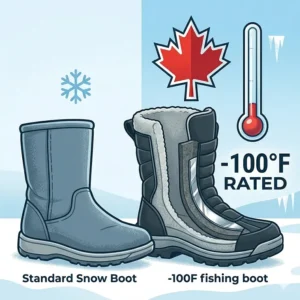
Boot manufacturers test temperature ratings under laboratory conditions with specific activity levels and sock combinations that rarely match real-world ice fishing. A boot “rated to -40°C” assumes moderate activity—not sitting stationary on a bucket for three hours. My rule: subtract 15-20 degrees from any published rating to get realistic stationary performance. If you fish in typical -25°C conditions, you need boots rated to at least -40°C to -45°C for comfort. Also verify whether ratings are Celsius or Fahrenheit: a boot rated to “-40” performs identically in both systems (since -40°C equals -40°F), but a boot rated “-100” could mean either -100°F (-73°C) or -100°C (-148°F)—a massive 75-degree difference.
2. Weigh Warmth vs. Weight vs. Walking Distance
The warmest boots are inevitably heavy: Baffin’s -100°C models weigh 3.4-3.6 kg compared to 1.1 kg for Sorel Caribou. That 2.5 kg difference feels negligible in the store but becomes significant when you’re pulling a sled 800 metres across rough ice to reach your fishing spot. Calculate your typical walking distance: under 300 metres, weight doesn’t matter much—prioritize warmth. Between 300-800 metres, lighter boots like Korkers or Muck make sense unless you’re in genuinely Arctic conditions. Over 800 metres, seriously consider lighter options or plan rest stops, because heavy boots dramatically increase fatigue and the resulting reduced circulation actually makes feet colder.
3. Match Insulation Type to Your Fishing Style
Synthetic insulation (Thinsulate, PrimaLoft) maintains warmth when wet and dries quickly—ideal for active anglers who drill many holes, move between spots, and generate sweat. Removable liner systems (Baffin’s multi-layer approach) offer maximum warmth and the ability to dry liners overnight—essential for multi-day trips or extreme cold. Neoprene (Muck boots) excels in wet, slushy late-season conditions and provides exceptional comfort but weighs more and offers less breathability. There’s no “best” insulation type: match it to your typical conditions and activity level. I fish early season (December-January) in Baffin boots when it’s cold and dry, then switch to Muck boots in March-April when overflow and slush dominate.
4. Factor Canadian-Specific Durability Requirements
Canadian ice fishing is harder on boots than American lake fishing due to our longer season, colder temperatures, and prevalence of Canadian Shield rock shorelines and pressure ridges. Look for abrasion-resistant materials: leather uppers, reinforced toe caps, and thick rubber in high-wear areas. Boots that seem fine after 20 days of Minnesota ice fishing often fail after 40-50 days of Canadian use. Prioritize brands offering replacement liners and repair services—Baffin sells replacement liners for $40-$60 CAD, effectively doubling boot lifespan. Check warranty terms: some manufacturers void warranties if boots are used “commercially” (guiding), which affects northern guides significantly.
5. Budget True Cost Including Accessories
A $150 pair of Sorel Caribou boots seems like great value until you add $40 for ice cleats, $30 for expedition socks (two pairs), and $20 for chemical toe warmers you’ll need every trip below -25°C. Suddenly your budget boots cost $240 plus $10-$15 per trip in warmers. Premium $280 Baffin Titan boots with sufficient warmth rating need only socks and occasional cleats, making them cheaper long-term. Calculate cost-per-day over expected boot life: $280 boots lasting five seasons of 30 days equals $1.87/day; $150 boots lasting two seasons of 20 days equals $3.75/day. The premium boots are actually the budget choice for regular anglers.
Common Mistakes When Buying Ice Fishing Boots (And How to Avoid Them)
Mistake #1: Believing “Waterproof” Means Invincible
Every boot in this guide claims waterproof construction, but there’s waterproof for snow and waterproof for standing in 5 cm of overflow for three hours. Seam-sealed fabric boots (even high-quality ones) eventually wet through in heavy slush or when kneeling repeatedly to tend tip-ups. The solution isn’t buying more expensive fabric boots—it’s understanding material limitations. Full rubber or neoprene boots (Muck, Baffin Titan) truly handle unlimited water exposure. Leather-rubber combos (Baffin Control Max, Sorel Caribou) need waterproofing maintenance and still struggle with extended wet conditions. If you fish areas prone to overflow (Great Slave Lake, Lake Winnipeg in spring) or late-season slush, full rubber construction is non-negotiable regardless of marketing claims.
Mistake #2: Over-Insulating with Too Many Socks
Logic suggests more socks equal warmer feet, but compression destroys insulation effectiveness. Three pairs of socks compress the air pockets in both your socks and your boots’ insulation layers, simultaneously restricting blood circulation to your feet—making them colder than wearing just two properly chosen pairs. I learned this the hard way during an early-season Lake Nipissing trip: three pairs of socks, frozen toes by hour two. The next weekend, one liner sock plus one expedition wool sock, comfortable all day in colder temperatures. The Canadian cold-weather standard is one thin wicking liner plus one thick insulation sock—trust it.
Mistake #3: Ignoring Break-In for “Ready to Wear” Boots
Modern boots use softer materials than old-school rubber boots, creating the illusion they don’t need break-in. Wrong. Even flexible neoprene boots have seams, pressure points, and shaping that needs to conform to your feet. The difference: old rubber boots announced pressure points immediately with painful rubbing, while modern boots feel fine for 2-3 hours then suddenly create hot spots or numbness. Always break in new boots with 6-8 hours of total wear (doesn’t need to be consecutive) before a serious fishing trip. Walk around the house, wear them running errands, just get your feet accustomed to the boot’s shape. This is especially critical with expensive boots—discovering fit issues after the return window closes is expensive.
Mistake #4: Storing Wet Boots Improperly Between Sessions
Most ice anglers arrive home exhausted, kick off boots in the garage or mudroom, and deal with them “tomorrow.” Those wet liners and moisture-filled shells breed mould and destroy insulation. Proper storage takes five minutes: remove liners immediately, stuff shells with newspaper, set both in a warm (not hot) dry location. Replace newspaper after 2-3 hours. By morning, your boots are dry and ready. This simple routine doubles liner lifespan—I’m on year four with Baffin Titan liners that typically last 2-3 years, entirely because I dry them properly every single use. In humid coastal climates, invest in a boot dryer (models from Peet or MaxxDry cost $40-$80 CAD and pay for themselves in extended boot life).
Mistake #5: Choosing Boots Based on Brand Loyalty Rather Than Application
Many anglers buy the same brand they’ve always used without considering whether it’s actually optimal for their current fishing style. I fished in Sorel Caribou boots for a decade—they were perfect when I ice fished 5-6 days per winter in southern Ontario. When I started guiding in northern Manitoba 30+ days per season, brand loyalty to Sorel nearly cost me frostbite during a -47°C cold snap. Different boots excel in different applications: Sorel for casual southern use, Muck for wet conditions, Korkers for active anglers, Baffin for extreme cold. Be willing to switch brands as your fishing evolves.
Long-Term Cost & Maintenance in Canada: True Ownership Analysis
When Canadian anglers compare a $150 pair of Sorel Caribou boots against $280 Baffin Titans, the upfront price difference seems significant—until you calculate total cost of ownership over five years of regular use:
Budget Boot (Sorel Caribou) Five-Year Cost:
- Initial purchase: $180 CAD
- Ice cleats (Yaktrax): $35 CAD
- Expedition socks (2 pairs): $40 CAD
- Waterproofing treatments (annual): $25 CAD × 5 = $125 CAD
- Replacement liners (year 3): $50 CAD
- Chemical toe warmers (15 trips/year at $2/pair): $150 CAD
- Total: $580 CAD over 5 years = $116/year
Premium Boot (Baffin Titan) Five-Year Cost:
- Initial purchase: $235 CAD
- Ice cleats (occasional use): $35 CAD
- Expedition socks (2 pairs): $40 CAD
- Waterproofing (none needed for full rubber): $0
- Replacement liners (year 4): $55 CAD
- Chemical warmers (none needed): $0
- Total: $365 CAD over 5 years = $73/year
The premium boots actually cost $43 per year less while delivering superior performance throughout their lifespan. This analysis assumes boots remain fully functional through year five—in reality, budget boots often fail around year 3-4 requiring replacement, while premium Baffin boots routinely last 7-10 years with proper care, further improving their cost-effectiveness.
Maintenance requirements vary dramatically by boot type. Full rubber boots (Baffin Titan, Muck Arctic Pro) need only basic cleaning and proper drying—scrub mud and salt residue with warm water and a stiff brush, rinse thoroughly, and air dry. Leather-rubber combination boots (Baffin Control Max, Sorel Caribou) require seasonal waterproofing treatments: clean thoroughly, apply quality conditioner like Nikwax or Sno-Seal, work it in with a heat gun or hair dryer, let cure overnight. This takes about 30 minutes per boot and should be done before season start and again mid-winter if you fish regularly. Skip this maintenance and leather wicks moisture straight to your feet, destroying insulation effectiveness.
The most important maintenance factor for Canadian ice fishing boots is liner care. Removable liner systems (all Baffin models, Sorel Caribou) give you control over this—pull liners after every use, air dry completely, and replace when compression or damage reduces warmth. Fixed-liner boots (many Muck models) eliminate this maintenance but lose the advantage of overnight drying, meaning moisture accumulation is inevitable during multi-day trips. For serious northern anglers doing 5-7 day trips, removable liners are essentially mandatory.
Frequently Asked Questions
❓ Can ice fishing boots rated to -100F handle Canadian spring ice fishing conditions?
❓ Do I need to size up ice fishing boots for thick socks in Canada?
❓ Are bunny boots legal for ice fishing in Canadian provinces?
❓ How long do extreme cold ice fishing boots last with regular use in Canada?
❓ Can I use ice fishing boots rated to -100F for snowmobiling in Canada?
Conclusion: Investing in Canadian Winter Protection
After testing dozens of extreme cold boots across five Canadian winters spanning from Lake Erie to Great Slave Lake, the pattern is clear: temperature ratings matter enormously, but only when matched correctly to your actual fishing conditions. An ice angler in southern Ontario purchasing -100°C rated Baffin Apex boots for weekend trips where temperatures rarely drop below -20°C is wasting $200+ that could buy quality electronics or better rods. Conversely, a northern Manitoba guide trying to make do with -40°F Sorel Caribou boots during January cold snaps is penny-wise and pound-foolish—frozen feet end the day early and risk serious cold injury.
The sweet spot for most Canadian ice anglers falls into one of three categories. Casual southern anglers (Toronto, Vancouver, Calgary) fishing 8-15 days per season in -10°C to -25°C conditions should invest in either Sorel Caribou ($140-$190 CAD) for budget-conscious buyers or Korkers Polar Vortex 1200 ($230-$290 CAD) for those valuing lightweight modern features. Serious central Canadian anglers (Winnipeg, Thunder Bay, northern Ontario/Quebec) fishing 20-40 days per season in -20°C to -40°C conditions need genuine polar-rated boots—Baffin Titan ($180-$250 CAD) delivers unbeatable value while Muck Arctic Pro ($200-$280 CAD) offers superior comfort in wet late-season conditions. Northern specialists and guides working in -30°C to -55°C temperatures should invest in Baffin Apex ($350-$450 CAD) and consider it essential safety equipment, not optional gear.
The boots you choose protect more than just comfort—they’re your primary defence against frostbite and hypothermia, conditions that remain serious risks across Canada according to Health Canada’s cold weather safety guidelines. Quality ice fishing boots rated to -100F (whether that’s Fahrenheit or the even more extreme Celsius equivalent) represent genuine insurance against the worst our winters can deliver, ensuring you return home safely after every trip regardless of how conditions deteriorate. Choose wisely based on your actual needs, maintain them properly, and they’ll serve you reliably for thousands of hours on Canadian ice.
Recommended for You
- 7 Best Baffin Ice Fishing Boots Canada 2026 (Tested to -60°C)
- 7 Warmest Ice Fishing Boots Canada: Expert Reviews 2026
- Best 7 Float Jackets Ice Fishing Canada 2026 | Safety Guide
Disclaimer: This article contains affiliate links. As an Amazon Associate, I earn from qualifying purchases. If you purchase products through these links, we may earn a small commission at no additional cost to you.
✨ Found this helpful? Share it with your friends! 💬🤗
