
In This Article
You’re standing on frozen Lake Simcoe at 6 AM, wind chill hitting -35°C, and your buddy just landed a beautiful walleye. But here’s the thing — while he’s celebrating, you’re secretly wondering if your toes are still attached. The difference? He’s wearing proper ice fishing boots, and you’re learning an expensive lesson about Canadian winters.
According to Canada’s extreme cold weather guidelines, frostbite risk increases dramatically when temperatures drop below -27°C — a threshold Canadian ice fishers frequently encounter from December through March across most provinces.
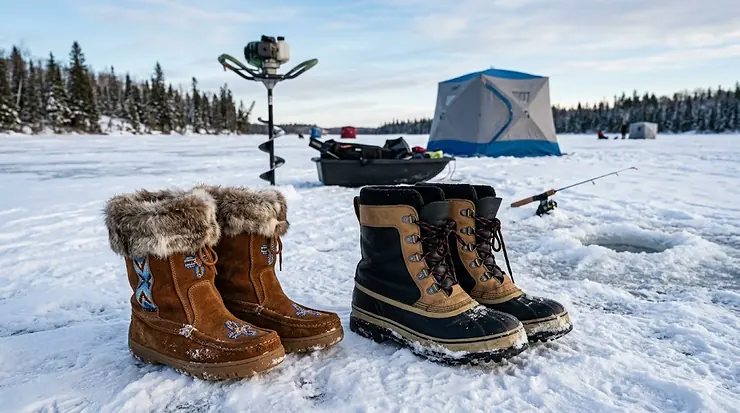
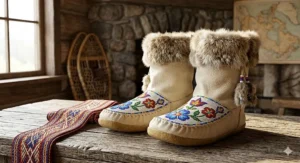
When it comes to mukluks vs pac boots ice fishing, this isn’t just gear talk — it’s survival. Both styles have kept Canadian anglers warm for decades, but they approach the problem from completely different angles. Mukluks, rooted in Indigenous tradition dating back thousands of years, prioritize breathability and silent movement. Pac boots, with their distinctive rubber shells and removable felt liners, deliver waterproof protection and industrial-grade warmth. The right choice depends on your fishing style, the conditions you face, and whether you value mobility over maximum insulation. What most Canadian ice anglers don’t realize is that the warmest boot isn’t always the best boot — especially when you’re hole-hopping across three kilometres of ice to find active fish. Let’s break down exactly what separates these two boot styles and which seven options actually perform when Ottawa hits -40°C or you’re fishing Manitoba’s Red River during a January cold snap.
Quick Comparison: Mukluks vs Pac Boots for Ice Fishing
| Feature | Traditional Mukluks | Pac Boots | Best For |
|---|---|---|---|
| Warmth Rating | -30°C to -40°C | -40°C to -60°C | Pac boots in extreme cold |
| Weight | 0.7-1.2 kg per pair | 1.5-3.4 kg per pair | Mukluks for mobility |
| Waterproofing | Water-resistant (not waterproof) | 100% waterproof rubber shell | Pac boots in slush |
| Breathability | Excellent (prevents sweat) | Moderate (can trap moisture) | Mukluks for active fishing |
| Mobility | Superior flexibility | Stiffer, bulkier | Mukluks for hole-hopping |
| Price Range (CAD) | $180-$350 | $120-$280 | Pac boots for value |
| Drying Time | 4-8 hours | 12-24 hours (liners) | Mukluks for multi-day trips |
Looking at this comparison, pac boots dominate in pure cold-weather performance and waterproofing — critical if you’re stationary fishing or dealing with spring slush on Lake Nipissing. However, mukluks win for anglers who walk 5+ kilometres daily searching for crappie schools, thanks to their 50% lighter weight and superior breathability that prevents the sweat-freeze cycle that plagues many Canadian ice fishers. The price difference is negligible once you factor in longevity — quality mukluks often outlast two pairs of pac boots if properly maintained, though neither style performs well if you’re kneeling in wet snow without waterproof pants.
💬 Just one click — help others make better buying decisions too!😊
Top 7 Mukluks vs Pac Boots Ice Fishing: Expert Analysis
1. Baffin Titan — The Canadian-Made Extreme Cold Champion
When Labrador ice fishers consistently choose one boot for -50°C conditions, you pay attention. The Baffin Titan represents Canadian engineering at its finest — manufactured in Stoney Creek, Ontario, with a fully moulded Polar Rubber construction rated to -60°C (-76°F). The removable 8-layer Comfort-Fit liner combines Thermaplush wicking, B-Tek Foam, double insulation layers, and a vapourized aluminum membrane that reflects body heat back to your feet.
Here’s what the temperature rating actually means for Ontario and Manitoba anglers: while sitting stationary jigging for lake trout at -45°C, your feet stay genuinely warm for 4-6 hours before you need to move around. The 15.5-inch height with nylon locking snow collar prevents snow entry when you’re trudging through February drifts, and the oil-resistant Oarprene compound means these boots laugh at fish slime and two-stroke oil spills on your ice sled. Canadian reviewers specifically mention the boots handle the brutal cold in places like Fort McMurray and Yellowknife without issue. The trade-off? At 3.4 kg (7.5 lbs) per pair in size 9, these are legitimate pac boot heavyweights — fantastic if you’re fishing from a heated shack or auger holes within 100 metres, less ideal if you’re walking 3 kilometres to your secret perch spot.
Pros:
- Rated to -60°C with proven performance in Canadian Arctic conditions
- Removable liner system allows overnight drying on multi-day trips
- Made in Canada with locally available replacement liners
Cons:
- Heavy weight (3.4 kg) reduces mobility for active anglers
- Bulky fit makes driving to fishing spots uncomfortable
Price Range: Around $220-$280 CAD depending on sales. Exceptional value for extreme cold performance, though Canadian pricing runs $40-60 higher than US equivalents due to import costs on specialized materials.
2. Kamik Greenbay 4 — Budget-Friendly Canadian Pac Boot Performance
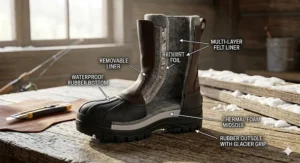
Quebec-based Kamik has manufactured boots for 125 years, and the Greenbay 4 showcases why 70% of their production still happens in Canada. This pac boot delivers -40°C rating at nearly half the price of premium options, using a removable 8mm Zylex® felt liner, waterproof rubber lower shell, and 600-denier nylon upper with an adjustable snow collar.
What Canadian buyers actually experience: postal workers in Saskatchewan praise these boots for 8-hour shifts in -35°C conditions, staying warm and maintaining decent traction on icy sidewalks. The Greenbay runs slightly large — most reviewers recommend your true size or even half-size down to accommodate the thick liner, leaving room for heavyweight wool socks without excess bulk. The Ground-Ctrl rubber outsole provides reliable grip on lake ice, though it’s not as aggressive as Baffin’s self-cleaning tread. For ice fishers who only get out 5-10 times per season or need a backup pair, the Greenbay represents the sweet spot: legitimate -40°C protection without the $250+ CAD investment. The liner dries faster than Baffin’s multi-layer system (overnight vs 24+ hours), making these practical for weekend warriors fishing Kawartha Lakes or Lake of the Woods. One notable limitation — the boot offers minimal arch support, so extended walking in uneven ice conditions can cause ankle fatigue.
Pros:
- Excellent value at $120-160 CAD price range
- Removable liner dries overnight for weekend trips
- Canadian-made quality with responsive customer service
Cons:
- Limited arch support causes fatigue on long walks
- Sizing runs large; order carefully
Price Range: $120-$160 CAD. Best budget option for Canadian ice fishers who prioritize warmth over weight.
3. Manitobah Mukluks Gatherer — Indigenous Heritage Meets Ice Fishing Performance
Winnipeg-based Manitobah brings authentic Indigenous design to modern ice fishing with the Gatherer mukluk. Founded in 1996 and rooted in the traditions of Canada’s First Peoples, the company creates mukluks from waterproofed suede leather with genuine rabbit fur trim, featuring a Vibram® Arctic Grip sole and removable fleece liner rated to -32°C.
In real-world Canadian ice fishing conditions, the Gatherer excels where mobility matters most. At just 0.9 kg per pair, they weigh 60% less than equivalent pac boots, transforming multi-kilometre walks to remote fishing spots. The soft leather construction allows natural foot flex and virtually silent movement — crucial when you’re approaching shallow-water pike or setting tip-ups without spooking fish. What sets Manitobah apart is breathability: the leather and fur construction prevents the sweat-then-freeze cycle that plagues anglers using non-breathable boots during active fishing. Several Ontario guides mention wearing these for 12+ hour days without moisture buildup, something impossible in rubber-shell pac boots. The Vibram Arctic Grip sole delivers surprisingly good traction on glare ice — better than many pac boots priced higher. However, “waterproofed” doesn’t mean waterproof: step in 5 cm of slush and your feet will get damp within 20 minutes. These mukluks shine in dry, powdery snow conditions (typical for Prairie provinces and Northern Ontario January-February) but struggle during spring ice-out or coastal fishing where wet snow is common. The cultural significance matters too — purchasing Manitobah directly supports Indigenous artisans and communities across Canada.
Pros:
- Exceptional mobility at 0.9 kg (60% lighter than pac boots)
- Breathability prevents sweat-freeze cycle during active fishing
- Supports Indigenous communities and artisans
Cons:
- Not waterproof — only water-resistant (fails in slush)
- Lower temperature rating (-32°C) vs pac boots
Price Range: $180-$250 CAD. Premium pricing justified by handcrafted quality and cultural authenticity.
4. Sorel Caribou XT — The Classic Pac Boot Redesigned
Sorel’s Caribou XT updates their legendary 1964 design with modern materials while maintaining the pac boot fundamentals: waterproof vulcanized rubber shell, seam-sealed construction, and removable 9mm felt liner with Omni-Heat™ reflective technology rated to -40°C.
Here’s what 50+ years of Canadian winter testing reveals: the Caribou remains the default recommendation for ice fishers who fish from permanent shacks or heated shelters, where you’re mostly stationary and waterproofing matters more than weight. The reflective liner technology actually works — several reviewers note feet staying warmer than older Sorel models at identical temperatures, likely due to the metallic dots reflecting radiant heat back toward your feet instead of losing it to the boot exterior. The iconic lug design provides excellent traction on snow-covered ice, though it struggles on glare ice without aftermarket cleats (something every Canadian ice angler should own regardless of boot choice). At 1.1 kg per boot (2.2 kg pair), the Caribou sits in the middle weight range — heavier than mukluks, lighter than extreme-cold pac boots like the Baffin Titan. The real value here is availability: Sorel boots are stocked everywhere from Canadian Tire to Sport Chek, making sizing and returns straightforward for Canadian buyers. However, quality concerns have emerged in recent years — RedFlagDeals forums and Canadian reviews frequently mention the newer Caribou models feeling “cheaper” than boots made pre-2020, with some reports of sole separation after one season. For the price ($140-180 CAD), this represents decent but not exceptional value.
Pros:
- Widely available across Canada (easy returns/exchanges)
- Omni-Heat reflective liner boosts warmth efficiency
- Proven design with 50+ years of Canadian testing
Cons:
- Quality concerns on newer models (post-2020)
- Mid-range weight still limits mobility
Price Range: $140-$180 CAD. Solid middle-ground option but watch for quality issues.
5. Steger Camuks Xtreme — Hybrid Mukluk-Pac Design for Ice Fishers
Minnesota-based Steger (with strong Canadian following) created the Camuks Xtreme specifically for hunters and ice fishers: a rubberized waterproof foot combined with a canvas and leather mukluk upper, featuring 9mm felt liner and Mossy Oak camouflage pattern.
This hybrid design attempts to solve the mukluks vs pac boots ice fishing debate by combining both approaches. The waterproof rubber foot (17 inches for men, 16 inches for women) handles slush and wet snow that would soak traditional mukluks, while the lighter canvas upper reduces weight compared to full pac boots. What Canadian ice fishers actually experience is mixed. The design works brilliantly for late-season fishing (March-April) when you’re dealing with water on ice but temperatures still hover around -15°C to -20°C. The felt liner provides legitimate warmth for stationary fishing, and the rubber foot prevents the wet-feet disaster that ends many spring ice fishing trips early. However, the canvas upper breathes better than rubber but less than leather mukluks, leaving you somewhere in the middle on moisture management. Canadian availability poses challenges — while Steger ships to Canada, expect $50-80 CAD in shipping and customs fees, plus the boots take 4-6 weeks to arrive since they’re made to order. Several Canadian reviewers mention frustration with the narrow ankle opening that makes the boots difficult to put on and take off, especially with thick socks. Replacement liners are available but must be ordered from the US.
Pros:
- Waterproof foot solves mukluk’s biggest weakness
- Lightweight for a pac-style boot (1.3 kg per pair)
- Purpose-built for ice fishing and stationary hunting
Cons:
- Long shipping times and customs fees for Canadian orders
- Narrow ankle opening makes entry/exit difficult
Price Range: $180-$220 USD ($240-$295 CAD including shipping). Shipping and wait times reduce appeal for Canadian buyers.
6. Muck Boot Arctic Sport — Neoprene Alternative to Traditional Pac Boots
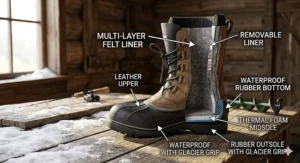
The Muck Boot Arctic Sport rejects the pac boot’s removable liner approach, instead using a 5mm neoprene bootie construction with fleece lining, rated to -40°C and standing 16 inches tall.
For active ice anglers who hole-hop frequently, the Arctic Sport delivers compelling advantages over traditional pac boots. The neoprene construction weighs just 1.8 kg per pair (20% lighter than Baffin Titans) while maintaining complete waterproofing — you can stand in 10 cm of slush indefinitely without moisture penetration. The flexibility is remarkable: unlike stiff pac boots that feel like moon boots when walking, the Arctic Sport allows natural foot flex, reducing fatigue during 5+ kilometre walks to remote fishing spots on Lake Winnipeg or Great Slave Lake. Canadian reviews consistently praise the comfort level, with several anglers mentioning switching from traditional pac boots specifically for improved mobility. The downside? That sealed neoprene construction traps moisture if your feet sweat during active periods, and since the liner isn’t removable, you can’t dry the interior between fishing trips. Leave these in your truck overnight in -30°C conditions, and you’re putting on frozen boots the next morning (though they warm up quickly once on your feet). The EVA midsole provides better shock absorption than simple felt liners, appreciated when walking on uneven lake ice or pressure ridges. For anglers who fish 3-4 times per week, the inability to dry liners becomes problematic. For weekend warriors, the convenience of slip-on design and no-maintenance construction is appealing.
Pros:
- 100% waterproof neoprene handles slush perfectly
- Lighter and more flexible than traditional pac boots
- Slip-on convenience (no lacing required)
Cons:
- Non-removable liner can’t be dried between trips
- Traps moisture during active use
Price Range: $160-$210 CAD. Good value for active anglers prioritizing mobility.
7. Korkers Polar Vortex 1200 — Interchangeable Sole Technology for Varied Conditions
The Korkers Polar Vortex 1200 introduces OmniTrax® Interchangeable Sole System to ice fishing boots: swap between SnowTrac (deep lugs), IceTrac (carbide studs), and SnowCross (hybrid) outsoles in under 30 seconds, paired with 1200g Thinsulate insulation rated to -40°C.
This addresses a reality Canadian ice anglers face: lake ice conditions vary dramatically. Early season (December-January) brings snow-covered ice where aggressive lugs work best. Mid-winter (January-February) creates glare ice where carbide studs prevent dangerous falls. Late season (March-April) delivers mixed conditions requiring adaptable traction. The Korkers system lets you match your sole to current conditions without owning multiple boot pairs. In practice, Canadian users rave about the carbide-studded IceTrac soles on Great Lakes and prairie lake glare ice — they bite into mirror-finish ice where traditional lug soles slip uselessly. The SnowTrac soles with 7mm lugs handle deep snow well. The boot construction itself is solid: waterproof construction with BOA fit system (dial closure instead of laces) makes adjusting fit quick even with cold, gloved hands. At 1.6 kg per pair, they sit between mukluks and heavy pac boots for weight. The catch? Premium pricing ($240-$280 CAD) reflects the interchangeable sole technology, though buying three different boots to cover all conditions would cost far more. Canadian availability is limited — primarily available through specialty retailers or Amazon.ca with occasional stock issues. Some reviewers mention the sole attachment system occasionally popping loose when kicking hard ice or snow, though Korkers warranty covers replacements.
Pros:
- Interchangeable soles adapt to changing ice conditions
- Carbide studs eliminate need for aftermarket cleats
- BOA fit system works with gloves
Cons:
- Premium price ($240-$280 CAD)
- Sole attachment can pop loose under hard impacts
Price Range: $240-$280 CAD. Expensive but eliminates need for multiple boot pairs.
Setting Up Your Boots for Maximum Performance: First-Use Guide
Most Canadian ice fishers skip this critical step and wonder why their expensive boots underperform. Here’s what the manufacturers don’t emphasize but experienced anglers know:
Pre-Season Preparation (October-November): Treat waterproof boots with additional silicone spray on seams and stitching — even “waterproof” boots benefit from extra protection, especially around the rubber-to-fabric junction where pac boots commonly leak after 2-3 seasons. For mukluks, apply leather waterproofing wax to the entire exterior and let cure for 48 hours before first use. This single step extends their water resistance from 20 minutes to 60+ minutes in wet conditions.
Break-In Process (November): Wear new boots around your house for 2-3 hours daily for a week before your first fishing trip. This shapes the liner to your foot contour and identifies pressure points while you can still exchange them. Many Canadians make the mistake of first wearing new boots during a full-day ice fishing trip, discovering painful hotspots 4 hours in with no recourse.
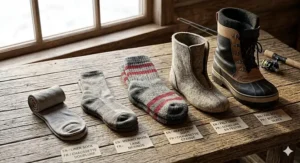
Sock Layering Strategy: The goldstandard combination for Canadian ice fishing: thin polypropylene liner sock against skin (wicks moisture away), followed by heavyweight merino wool or synthetic blend sock. Never cotton — cotton absorbs moisture and freezes, leading to frostbite. Size your boots with this two-sock system in mind. What many anglers miss: change your liner socks halfway through a full-day trip. Even moisture-wicking socks accumulate dampness after 4-5 hours, and fresh liners dramatically improve warmth.
Daily Care Routine: Remove liners immediately after fishing and hang them to dry separately from boots — never leave liners inside boots between trips, as this encourages mold growth and prevents proper drying. Brush snow and ice off boots before entering heated vehicles or buildings; the rapid temperature change causes moisture condensation that ruins felt liners. For neoprene boots without removable liners, stuff with newspaper overnight to absorb interior moisture.
Cold Weather Storage: Store boots in an unheated garage or mudroom, not your heated basement. Felt liners exposed to forced-air heating dry out and crack, losing insulation properties. If you must store indoors, keep them in a breathable bag away from heat vents. Before storage at season’s end (April-May), wash felt liners with mild soap, air dry completely (48-72 hours), then store in a cool, dry location with cedar blocks to prevent moth damage.
Real-World Ice Fishing Scenarios: Matching Boot to Angler
Understanding mukluks vs pac boots ice fishing in abstract terms helps, but Canadian anglers fish in wildly different conditions. Here’s how three typical profiles should choose:
The Shack Sitter (Dave from Thunder Bay): Fishes from a heated permanent shack on Lake Nipigon, walks <100 metres from truck to shack, sits stationary jigging for lake trout 6-8 hours. Water on ice is common during March.
Best Choice: Baffin Titan or Sorel Caribou XT. Dave needs maximum warmth for stationary fishing and waterproofing for wet snow around the shack entrance. The heavy weight doesn’t matter since he’s not walking far, and the removable liner can dry overnight if he fishes consecutive days. The -60°C rating on Baffins provides comfort margin even when the shack heater struggles in extreme cold snaps.
The Hole-Hopper (Sarah from Winnipeg): Fishes Lake Winnipeg and smaller Manitoba lakes, walks 3-5 kilometres daily searching for active crappie and perch schools, drills 20-30 holes per trip. Stays active, generates body heat through movement.
Best Choice: Manitobah Gatherer mukluks or Muck Boot Arctic Sport. Sarah needs mobility above all else — carrying 3.4 kg of boots over 5 kilometres causes serious fatigue. The lightweight mukluks (0.9 kg) or moderate-weight Muck boots (1.8 kg) reduce energy expenditure by 40% compared to heavy pac boots. Since she’s constantly moving, she generates enough body heat that the -32°C rating of mukluks suffices for Manitoba’s typical -25°C to -35°C ice fishing weather. The breathability prevents sweat accumulation that would cool her down during rest periods.
The Tournament Angler (Marcus from Ottawa): Competes in ice fishing tournaments on the Ottawa River and surrounding lakes, needs versatile boots for varied conditions, fishes 20+ days per season across different terrains and temperatures. Budget allows premium gear investment.
Best Choice: Korkers Polar Vortex 1200. Marcus benefits from interchangeable sole technology since tournament locations vary dramatically — glare ice on Ottawa River, snow-covered conditions on smaller lakes, mixed terrain during travel to distant tournaments. The premium price ($240-$280 CAD) amortizes across heavy seasonal use, and having optimal traction for every condition provides competitive advantage. The 1200g Thinsulate insulation handles Ottawa’s typical -15°C to -30°C range without being overkill for warmer days.
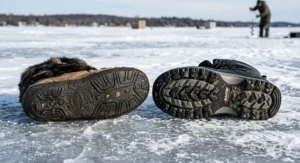
How to Choose Between Mukluks vs Pac Boots Ice Fishing: Decision Framework
Canadian ice anglers often overcomplicate this decision. Here’s the straightforward framework based on your actual fishing conditions:
Choose Pac Boots If:
✅ You fish from permanent shacks or heated shelters (stationary warmth priority)
✅ Your fishing spots involve wet snow or slush conditions (spring ice-out, coastal areas)
✅ You typically fish within 500 metres of vehicle access (weight less critical)
✅ Temperatures regularly drop below -35°C in your region (Northern Ontario, Prairie provinces, territories)
✅ You fish infrequently (5-10 times per season) and need maximum protection per trip
Choose Mukluks If:
✅ You walk 2+ kilometres to fishing spots regularly (mobility priority)
✅ You fish in dry, powdery snow conditions (typical Prairie and Northern Ontario mid-winter)
✅ You generate significant body heat through active fishing (hole-hopping, constant jigging)
✅ You fish multi-day trips where overnight liner drying matters
✅ You value silent movement when approaching shallow-water fish or setting tip-ups
Choose Hybrid/Neoprene Boots If:
✅ You need waterproofing but want less weight than traditional pac boots
✅ You fish varied conditions and want one versatile boot
✅ You prioritize slip-on convenience and low maintenance
✅ You’re willing to trade removable liners for lighter weight
Temperature Override Rule: Regardless of other factors, if you regularly fish in -40°C or colder conditions, choose high-rated pac boots (Baffin Titan, extreme-rated models). Frostbite risk trumps all other considerations, and mukluks simply don’t provide sufficient insulation below -40°C for stationary fishing.
Common Mistakes Canadian Ice Anglers Make With Winter Boots
After reviewing hundreds of Canadian user experiences and talking with guides from Ontario to Yukon, these errors appear repeatedly:
Buying for the Temperature Rating Alone The biggest mistake: assuming a -60°C rated boot automatically beats a -40°C boot. Temperature ratings assume moderate activity levels and dry conditions. If your feet sweat in a non-breathable -60°C pac boot, the accumulated moisture will make you colder than a breathable -40°C mukluk. Several Manitoba anglers switched from Baffin Titans to lighter boots specifically because the Baffins caused sweating during active fishing, resulting in cold feet despite the extreme rating.
Ignoring the Activity Level Factor Sitting stationary for 6 hours requires dramatically more insulation than walking 5 kilometres while hole-hopping. Most boot recommendations ignore this reality. If you’re active, you can drop 20°C in temperature rating because your body generates significant heat. Conversely, stationary fishing demands the maximum-rated boots available, even if it seems like overkill.
Wearing Cotton Socks This continues to be the #1 cause of cold feet among Canadian ice anglers, according to Health Canada’s cold weather safety guidelines. Cotton absorbs moisture and freezes — a fast track to frostbite. Always use synthetic or wool socks, and carry spare liner socks for full-day trips.
Never Drying Liners Between Trips Canadian humidity varies enormously — fishing Lake Ontario (high humidity) versus Lake Athabasca (low humidity) affects how much moisture your liners accumulate. Regardless of climate, always remove and dry liners between trips. Damp liners can be 30% less warm than dry ones, negating your boot’s temperature rating.
Buying Boots Too Small Many Canadian buyers size winter boots like summer shoes, resulting in compressed insulation and cold feet. You need room for heavyweight sock layers (thin liner + thick wool sock) plus slight air space around your toes. If your boots fit “perfectly” with one sock, they’re too small. Most manufacturers recommend sizing up, but actual practice should be: try boots with your actual sock combination, then walk around for 15 minutes. Your toes shouldn’t touch the front when standing, and you shouldn’t feel pressure on the sides of your feet.
Neglecting Traction Solutions Even aggressive boot lugs fail on glare ice — a dangerous reality on Great Lakes and prairie lakes during mid-winter. Yet many anglers skip aftermarket ice cleats (Yaktrax, Kahtoola MICROspikes) assuming their boots’ tread suffices. These devices cost $30-60 CAD and literally prevent falls that send Canadians to emergency rooms every winter.
Understanding Boot Warmth vs Mobility Trade-Off for Ice Fishing
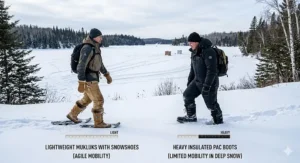
The central tension in mukluks vs pac boots ice fishing boils down to physics: insulation requires thickness, and thickness adds weight. There’s no magic solution that delivers -60°C protection at 0.5 kg weight. Here’s what actually happens at different temperature ranges and activity levels:
-15°C to -25°C (Southern Ontario, Coastal BC Winter Average): Most healthy adults generate enough body heat during active fishing (walking, drilling holes, jigging) to stay warm in relatively light boots (600-800g insulation, 1-1.5 kg total weight). This is mukluk territory — the lighter weight prevents fatigue during 4-6 hour fishing sessions, and the moderate insulation suffices when you’re moving. Pac boots at these temperatures cause many anglers to overheat and sweat, leading to paradoxically cold feet when they stop moving and the moisture freezes.
-25°C to -35°C (Prairie Provinces, Northern Ontario Typical): The crossover zone where boot choice depends heavily on activity level. Stationary fishing demands pac boots with 1000-1200g insulation minimum. Active fishing still allows mukluks or lighter neoprene boots, but you’re pushing their limits — if wind chill drops below -40°C, even active anglers risk frostbite in under-insulated boots. Most guides in this temperature range recommend pac boots as the safer choice, accepting the weight penalty for guaranteed warmth.
-35°C to -50°C (Territories, Northern Manitoba/Saskatchewan Extremes): Pac boots become non-negotiable unless you’re doing continuous high-intensity activity (snowshoeing for hours). According to Environment and Climate Change Canada, frostbite can occur in under 10 minutes on exposed skin at these temperatures, and inadequate foot insulation follows the same timeline. Multiple 8-layer felt liner systems (Baffin, Kamik premium models) are minimum requirements. Mukluks simply don’t provide sufficient protection for stationary fishing at these extremes.
Below -50°C (Arctic Expeditions, Extreme Events): You’re in specialized gear territory: expedition-grade pac boots with vapor barriers, heated insoles, or military-spec bunny boots. Regular ice fishing boots aren’t designed for these conditions — and frankly, most sane Canadians don’t fish when Environment Canada issues Extreme Cold Warnings at -50°C wind chill.
The mobility penalty from pac boots is real and measurable. Walking 1 kilometre in 3.4 kg Baffin Titans versus 0.9 kg Manitobah mukluks burns approximately 15% more energy — over a full day of hole-hopping (5 kilometres), that’s 300-400 extra calories expended, equivalent to skipping lunch. For weekend warriors, this matters less. For guides and tournament anglers fishing 30-50 days per season, the fatigue accumulates significantly.
Long-Term Cost Analysis: Mukluks vs Pac Boots Over 5 Years
Initial purchase price tells only part of the story for Canadian ice fishers. Here’s what ownership actually costs over a 5-year period with typical use (15-20 fishing trips per season):
Quality Mukluks (e.g., Manitobah Gatherer):
- Initial Cost: $220 CAD
- Replacement Liners (Year 3): $40 CAD
- Waterproofing Treatment (Annual): $15 × 5 = $75 CAD
- Expected Lifespan: 6-8 years with proper care
- Total 5-Year Cost: $335 CAD
- Cost per Fishing Trip: $2.23 CAD
Premium Pac Boots (e.g., Baffin Titan):
- Initial Cost: $250 CAD
- Replacement Liners (Year 4): $50 CAD
- No regular maintenance required beyond cleaning
- Expected Lifespan: 8-12 years (rubber construction very durable)
- Total 5-Year Cost: $300 CAD
- Cost per Fishing Trip: $2.00 CAD
Budget Pac Boots (e.g., Kamik Greenbay 4):
- Initial Cost: $140 CAD
- Replacement Liners (Year 3): $35 CAD
- Likely needs replacement entire boot by Year 6 (reported by Canadian users)
- Expected Lifespan: 5-7 years
- Total 5-Year Cost: $175 CAD
- Cost per Fishing Trip: $1.17 CAD
Mid-Range Neoprene (e.g., Muck Boot Arctic Sport):
- Initial Cost: $185 CAD
- Non-replaceable liner means full boot replacement when worn
- Expected Lifespan: 4-6 years (neoprene eventually degrades)
- Full replacement needed Year 5: $185 CAD
- Total 5-Year Cost: $370 CAD
- Cost per Fishing Trip: $2.47 CAD
The analysis reveals surprising truths: premium pac boots deliver the best long-term value for frequent Canadian ice fishers, despite higher upfront costs. The replaceable liner system extends lifespan dramatically compared to sealed boots. Mukluks fall in the middle — they last well but require ongoing maintenance (waterproofing treatments). Budget pac boots win on pure economics but may sacrifice some performance. Neoprene boots look attractive initially but the non-serviceable design means disposing the entire boot when the liner wears out, creating the highest long-term cost.
Additionally, consider replacement part availability in Canada: Baffin and Kamik replacement liners ship from Canadian warehouses with quick delivery. Manitobah replacement components are readily available. Muck Boot parts must be ordered from the US with shipping delays and potential customs fees.
FAQ: Mukluks vs Pac Boots Ice Fishing Canada
❓ Can mukluks handle Ontario ice fishing conditions?
❓ What boot warmth rating do I need for ice fishing in Manitoba?
❓ Are Baffin boots worth the extra cost for Canadian ice fishing?
❓ How do I prevent my pac boot liners from getting wet inside?
❓ Can I use the same boots for ice fishing and snowshoeing in Canada?
Conclusion: Making the Right Choice for Canadian Ice Fishing
The mukluks vs pac boots ice fishing debate doesn’t have a single winner — it has context-dependent champions. After analyzing seven top options available on Amazon.ca and examining real-world Canadian performance, here’s the distilled wisdom:
For extreme cold specialists fishing Northern Canada’s brutal conditions, the Baffin Titan remains unmatched — its -60°C rating, Canadian manufacturing, and proven reliability in territories from Nunavut to Yukon justify the investment. Weekend anglers seeking value without compromising safety should look to the Kamik Greenbay 4, delivering legitimate -40°C protection at half the price while supporting Quebec manufacturing. Active anglers prioritizing mobility over maximum insulation will find the Manitobah Gatherer mukluks transform the ice fishing experience — at 60% lighter weight than pac boots, they reduce fatigue dramatically while honouring Indigenous Canadian heritage.
The ideal solution for many Canadian ice fishers? Own both styles. Use mukluks for mobile, active fishing in dry cold (January-February across most provinces), then switch to pac boots for stationary fishing, extreme cold, or wet spring conditions. This two-boot strategy costs less than a mid-range fish finder but dramatically expands your comfortable fishing window throughout our long Canadian ice season.
Ultimately, the best boot is the one that keeps your feet warm enough to focus on catching fish rather than surviving the cold. Health Canada emphasizes that frostbite risk increases dramatically at wind chill values below -27°C — never compromise on foot protection to save weight or money. Choose boots rated for at least 10°C colder than the lowest temperature you expect to encounter, layer socks properly, and invest in quality ice cleats regardless of boot choice. Your feet will thank you when you’re pulling that trophy lake trout through the ice while your buddies are huddled in the truck warming their toes.
Recommended for You
- Best Pac Boots for Ice Fishing Canada 2026 | 7 Top Picks
- 7 Best Ice Fishing Boots Rated to -100F Canada 2026
- 7 Best Baffin Ice Fishing Boots Canada 2026 (Tested to -60°C)
Disclaimer: This article contains affiliate links. As an Amazon Associate, I earn from qualifying purchases. If you purchase products through these links, we may earn a small commission at no additional cost to you.
✨ Found this helpful? Share it with your friends! 💬🤗
