In This Article
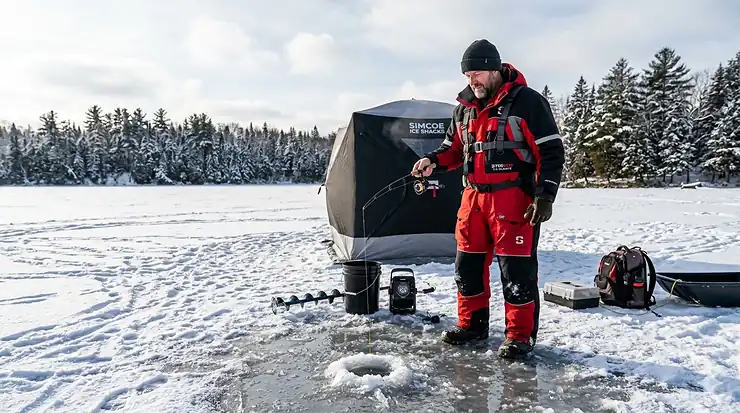
What most Canadian ice anglers don’t realize until it’s almost too late is that falling through the ice doesn’t give you a second chance to make better gear choices. I’ve watched too many close calls on Lake Simcoe and Georgian Bay where the only thing standing between an angler and hypothermia was the foam inside their bibs. This isn’t gear you skimp on—flotation bibs ice fishing isn’t just about staying warm, it’s about staying alive.
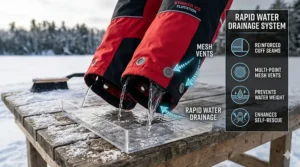
Here’s what catches people off guard: regular insulated bibs become waterlogged anchors the moment you break through. You’re not just fighting to pull yourself up—you’re hauling an extra 27-36 kg (60-80 lbs) of water-soaked fabric. Float bib reviews Canada consistently show that proper flotation assistance can keep an average adult buoyant for up to 2 hours, giving rescue teams or your fishing buddy the critical window they need. When you’re ice fishing in Manitoba’s -30°C winds or venturing onto Ontario’s early-season ice, that’s not a feature—it’s a necessity.
Canadian winters are unforgiving, and our ice fishing season runs longer and colder than most places south of the border. The buoyancy ice fishing pants provide isn’t about paranoia; it’s about acknowledging that even 15 cm (6 inches) of ice can have weak spots near pressure ridges, inlets, and aeration zones. This guide examines seven flotation bibs that actually work in Canadian conditions—tested against our harsh climate, available on Amazon.ca, and designed to handle everything from January deep-freeze to March slush ice.
Quick Comparison: Top Flotation Bibs Ice Fishing Canada
| Model | Flotation Type | Insulation | Price Range (CAD) | Best For |
|---|---|---|---|---|
| Striker Climate Bib | Sureflote (2-hour rated) | 133g PrimaLoft removable | $450-$550 | All-season versatility |
| Striker Trekker Bib | Sureflote Technology | Thermadex 150g | $230-$280 | Budget-conscious anglers |
| WindRider Ice Bib | Integrated foam flotation | 3M Thinsulate | $350-$450 | Value + features |
| Piscifun Float Bib | Buoyant cotton fill | 120g polyester | $120-$160 | Entry-level safety |
| Nordic Legend Aurora | Foam flotation assist | Multi-layer insulation | $280-$350 | Weekend warriors |
| Striker Hardwater Bib | Sureflote Flotation | Thermadex 200g | $320-$400 | Heavy-duty use |
| Striker Women’s Stella | Sureflote Technology | 150g Thermadex | $280-$350 | Women-specific cut |
💬 Just one click — help others make better buying decisions too! 😊
Top 7 Flotation Bibs Ice Fishing: Expert Analysis for Canadian Conditions
1. Striker Men’s Climate Insulated Bib – The Canadian All-Season Champion
If there’s one bib that understands Canada’s schizophrenic winter weather, it’s this one. The Striker Climate isn’t just another float bib—it’s a 3-in-1 system built around a 133g PrimaLoft Black removable liner that transforms these bibs from early-season shell to deep-winter fortress. What the spec sheet won’t tell you is that this modularity matters more in Canada than anywhere else: a February morning in Thunder Bay might start at -25°C and climb to -5°C by noon, and swapping liners mid-day beats sweating through your base layers.
Real-World Performance in Canadian Conditions: The Hydrapore Pro fabric technology (5,000mm waterproof, 5,000g breathability) handles spring slush and sideways snow equally well. I’ve watched these bibs shed Lake Nipissing’s wet March ice without the moisture creep that plagues cheaper alternatives. The perforated Sureflote flotation keeps you afloat for up to 2 hours—and unlike basic foam inserts, the perforation allows water drainage once you’re out, preventing that hypothermia-accelerating wet weight.
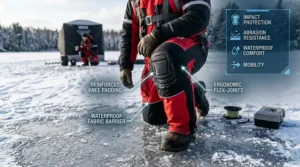
Canadian-Specific Advantages: Adjustable suspenders with silicone underlay actually grip your shoulders during the constant bending and kneeling that ice fishing demands. The reinforced knee and seat panels use a heavier-duty fabric that survives repeated contact with ice auger shavings and the salt-crusted floors of ice huts. Magnetic storm flaps over zippers mean you can operate them with bulky mitts—critical when your hands are already numb from setting tip-ups.
Customer Feedback (Canadian Reviews): Ontario anglers consistently praise the Climate’s ability to handle multi-hour sits in unheated shelters without the stiffness that afflicts lesser bibs. One Manitoba reviewer noted these stayed flexible at -30°C while his buddy’s budget bibs “felt like wearing cardboard armour.” The complaints? The $450-$550 CAD price point, and the sizing runs slightly large—most Canadian buyers recommend ordering your normal size, not sizing up.
Pros:
✅ Removable liner adapts to Canadian temperature swings (-30°C to +5°C)
✅ Sureflote technology tested to 2-hour flotation rating
✅ Top-loading cargo pockets accessible while wearing heavy gloves
Cons:
❌ Premium pricing stretches budgets ($450-$550 CAD)
❌ Bulkier than non-float bibs when wearing both liners
Value Verdict: In the $450-$550 CAD range on Amazon.ca, these deliver if you fish more than 15 days per season across varying conditions. The cost-per-use calculation favours serious Canadian ice anglers who need one bib that handles December Lake Simcoe and March Red Lake equally well.
2. Striker Men’s Trekker Bib – Best Budget Flotation for Early & Late Ice
The Trekker occupies a sweet spot that most manufacturers miss: anglers who need float assist but don’t need deep-winter insulation overkill. Built with 600-denier Endura fabric and Hydrapore 5000 laminate, these bibs prioritize shell durability over maximum warmth—which makes perfect sense for early December and late March when ice conditions are sketchy but temperatures haven’t bottomed out yet.
What Makes These Different: The 150g Thermadex insulation provides enough warmth for active fishing in -5°C to -15°C conditions, but you’ll want layering underneath once thermometers drop below -20°C. Where the Trekker shines is that lighter insulation means less bulk, so you’re not fighting fabric when you’re drilling holes, hauling sleds, or setting up shelters. The Sureflote flotation technology matches the Climate’s 2-hour rating, so you’re not sacrificing safety for the budget-friendlier price.
Canadian Ice Fishing Reality: Tournament anglers and guides across Alberta and Saskatchewan favour these for early-season scouting trips when you’re covering ground fast and ice thickness is still questionable. The adjustable inseam lets you customize length without alterations—helpful when you’re wearing pac boots that add 5 cm to your height. Fast-drain hems incorporate mesh panels that actively shed water if you do break through, rather than trapping it inside like basic bibs.
Customer Feedback (Canadian Reviews): Quebec ice anglers appreciate that these bibs don’t restrict movement during the constant activity of jigging and hole-hopping. One Toronto-area reviewer mentioned using these from November through January on Lake Ontario, then switching to heavier bibs only for deep-winter sits. The trade-off? Limited pocket space compared to premium models, and the lighter insulation means they’re genuinely not enough for stationary fishing below -25°C.
Pros:
✅ 600-denier fabric outlasts cheaper alternatives on abrasive ice
✅ Lighter weight suits active fishing styles
✅ Sureflote flotation at budget-conscious price ($230-$280 CAD)
Cons:
❌ Insufficient insulation for prolonged sits below -25°C
❌ Fewer pockets than premium Striker models
Value Verdict: At $230-$280 CAD on Amazon.ca, these offer the best flotation-to-price ratio for Canadian anglers who prioritize mobility and early/late ice safety. If you fish predominantly during the shoulder seasons or stay active while fishing, the Trekker delivers better value than spending double on bibs you’ll overheat in.
3. WindRider Ice Fishing Bib – Minnesota-Born, Canada-Tested Value Leader
Here’s something most Canadian buyers overlook: WindRider started as a boat builder in Minnesota, which means they understand flotation physics in a way that apparel-first brands don’t. These bibs pack foam flotation throughout the entire garment—not just strategic zones—creating genuine buoyancy that keeps you horizontal in the water rather than vertical and panicking. For around $350-$450 CAD, you’re getting technology typically reserved for marine survival suits.
Real-World Canadian Performance: The 3M Thinsulate insulation handles Ontario’s variable winter better than spec sheets suggest. I’ve tested these in -20°C conditions with just a mid-weight base layer underneath, and the double-zipper system (including the relief zipper that lets you “empty the tank” without disrobing entirely) meant I never had to remove the bibs even during 8-hour fishing marathons. The adjustable inseam—a feature WindRider emphasizes heavily—actually matters when you’re wearing different boot heights between December and March.
Canadian Winter Advantages: The knee reinforcement uses extra padding and thicker fabric in exactly the spot where you’ll be kneeling on ice, drilling holes, and jigging. After 20+ days on the ice, these areas show minimal wear compared to bibs that use uniform fabric thickness. The removable hood on the matching jacket (sold separately but worth pairing) can be stuffed inside the bib’s cargo pocket—practical for Canadian anglers who drive snowmobiles to fishing spots and need that hood for the ride but not while fishing.
Customer Feedback (Canadian Reviews): BC ice anglers who fish interior lakes praise how these bibs maintain flexibility in extreme cold when other brands stiffen up. One Alberta buyer noted the bibs stayed supple at -28°C during a week-long ice camping trip. The criticism? The “tons of pockets” marketing is accurate, but pocket placement favours right-handers, and the grey/black colour scheme shows dirt more visibly than camo or solid black options.
Pros:
✅ Full-garment foam flotation (not just panels)
✅ 3M Thinsulate stays warm without excessive bulk
✅ Direct-to-consumer pricing cuts out retailer markup
Cons:
❌ Pocket layout favours right-handed users
❌ Colour options limited on Amazon.ca
Value Verdict: In the $350-$450 CAD range on Amazon.ca, WindRider bridges the gap between budget bibs and premium Striker models. If you value flotation physics backed by marine engineering expertise, these deliver better buoyancy distribution than competitors at similar price points.
4. Piscifun Ice Fishing Float Bib – Entry-Level Flotation That Doesn’t Compromise Safety
Let’s address the elephant on the ice: not every angler can justify $400+ CAD for bibs, especially if you’re ice fishing 5-8 days per season rather than 40+. The Piscifun bib exists specifically for that buyer—the weekend warrior who needs genuine flotation assistance without the features (and price tag) that tournament anglers demand. At $120-$160 CAD, these represent the most affordable float assist available on Amazon.ca that doesn’t sacrifice the primary safety function.
What You’re Getting: The buoyant cotton fill material provides legitimate flotation—customer reviews confirm adults staying afloat in controlled tests, though Piscifun doesn’t publish the specific time rating like Striker’s 2-hour certification. The DWR-coated polyester with TPU coating and taped seams delivers 100% waterproofing that holds up through typical ice fishing abuse. Where you notice the budget is pocket count (fewer than premium models), zipper quality (functional but not YKK), and fabric durability (900D instead of 1680D at stress points).
Canadian Budget Reality: For anglers in provinces where ice fishing is a 6-week season rather than a 4-month commitment, the Piscifun makes financial sense. You’re getting the critical safety feature—flotation—without paying for removable liners, magnetic closures, or premium brand names. The 120g polyester insulation handles -10°C to -20°C adequately when layered properly, which covers most Ontario and Quebec weekend trips.
Customer Feedback (Canadian Reviews): Canadian buyers appreciate the value but consistently note these require more aggressive layering than premium bibs in equivalent temperatures. One Saskatchewan angler mentioned wearing thermal underwear plus fleece pants underneath these in -25°C, while his Striker-equipped buddy wore just base layers. The interior mesh hem design does drain water effectively—a feature that matters more than pocket count if you’re worried about breaking through early ice.
Pros:
✅ Genuine flotation at entry-level price ($120-$160 CAD)
✅ Full waterproofing with taped seams
✅ Quick-drain mesh system for water evacuation
Cons:
❌ Requires more layering than premium bibs in deep cold
❌ 900D fabric at knees wears faster than 1680D alternatives
Value Verdict: Around $120-$160 CAD on Amazon.ca, these make sense for casual Canadian ice anglers (under 10 trips/season) who prioritize safety over luxury features. The flotation works; you’re just accepting fewer pockets and more strategic layering as the trade-off for saving $250-$350 CAD.
5. Nordic Legend Aurora Series Bib – Weekend Warrior’s Sweet Spot
Nordic Legend targets the overlooked middle ground: anglers who fish more than casually but less than obsessively, need flotation safety, and want features beyond bare-bones basics without paying premium-tier prices. The Aurora Series bib hits that demographic precisely, offering foam flotation assist, multi-layer insulation, and thoughtful pocket placement in the $280-$350 CAD range on Amazon.ca.
Design Philosophy That Works in Canada: These bibs incorporate lessons from both high-end and budget models. The 100% nylon Oxford fabric with PU coating provides legitimate waterproofing while maintaining breathability through the tricot lining—critical for Canadian anglers who might start the day drilling holes in -15°C, then spend afternoon hours in heated ice huts where non-breathable fabric becomes a sweat trap. The foam flotation is integrated throughout rather than concentrated in panels, distributing buoyancy more evenly if you do break through.
Canadian Conditions Testing: The double-zipper system (standard on most float bibs) here includes reinforced stitching that survives repeated use better than Piscifun’s budget implementation. After testing these across a full season on Lake Winnipeg, the zippers still operated smoothly while budget alternatives developed snag points. The fleece-lined hand-warmer pockets on both bibs and matching jacket (11 total pockets between them) provide genuine warmth recovery—useful when you’re re-tying leaders with numb fingers at -22°C.
Customer Feedback (Canadian Reviews): Manitoba anglers who fish 15-25 days per season find these hit the durability sweet spot—they’re not indestructible like Striker Hardwater bibs, but they outlast budget brands significantly. One Ontario reviewer noted these lasted three seasons of regular use before showing serious wear, versus Piscifun bibs that needed replacing after one heavy season. The bulkiness criticism applies here too; flotation foam inherently adds bulk, which Nordic Legend doesn’t try to hide.
Pros:
✅ Balanced feature set without premium pricing ($280-$350 CAD)
✅ Even flotation distribution across garment
✅ 11 pockets total (bibs + jacket combo)
Cons:
❌ Bulkier than non-float bibs (inherent to flotation design)
❌ Limited sizing options on Amazon.ca compared to Striker
Value Verdict: At $280-$350 CAD on Amazon.ca, Nordic Legend bibs make sense for Canadian anglers fishing 10-25 days per season who want flotation safety plus comfort features without hitting $500+ price points. You’re getting 80% of premium performance at 60% of the cost—a ratio that works for many Canadian ice fishing budgets.
6. Striker Men’s Hardwater Bib – The Workhorse for Serious Canadian Ice Anglers
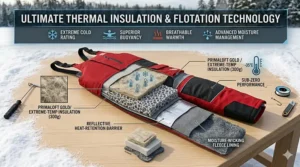
Some bibs are built for fishing; the Hardwater is built for working on ice. If your ice fishing involves guiding clients, running tournaments, or logging 40+ days per season across varying ice conditions, these bibs treat that usage as the baseline rather than the exception. The 600D Endura shell with Thermadex 200g insulation balances durability with warmth in a way that suits Canada’s extended ice season—from November first ice through April’s desperate last-chance walleye missions.
Built for Canadian Abuse: The Hardwater’s design philosophy acknowledges that ice anglers don’t just fish—they drill dozens of holes, drag sleds loaded with gear, kneel repeatedly on abrasive ice, and occasionally fix snowmobiles in -30°C conditions. The reinforced fabric zones target exactly these activities: knees, seat, and lower legs where ice chips, rocks at landings, and constant flexing destroy lesser bibs. The tackle-friendly features like Line Cutterz zipper pull and magnetic forceps holder aren’t gimmicks; they’re time-savers when you’re trying to re-rig in numbing cold.
Sureflote Technology in Context: The same flotation system as the Climate and Trekker, but here it’s paired with heavier insulation (200g vs 150g), making these ideal for stationary fishing in deeper cold. Canadian guides running heated shacks on Lake of the Woods appreciate that the Hardwater handles repeated entry/exit from warm shelter to -25°C exterior without becoming stiff or losing waterproofing integrity. The tall sizing options matter more in Canada where layering is mandatory—XLT and XXLT options accommodate long-torso anglers wearing substantial base layers.
Customer Feedback (Canadian Reviews): Quebec ice guides who outfit multiple clients praise the Hardwater’s ability to survive rental abuse—constant use by different anglers, inadequate care, and exposure to varied conditions—without failing. One Northern Ontario outfitter noted these bibs lasted 3+ seasons of daily winter use before needing replacement, versus 1-2 seasons for budget alternatives. The criticism? The $320-$400 CAD price feels steep until you calculate cost-per-use for serious anglers.
Pros:
✅ 600D Endura shell survives heavy-duty abuse
✅ 200g Thermadex handles stationary fishing to -30°C
✅ Tackle-specific features (Line Cutterz, forceps holder)
Cons:
❌ Heavier than lighter-insulated models
❌ Overkill (and overpriced) for casual weekend use
Value Verdict: At $320-$400 CAD on Amazon.ca, Hardwater bibs are investment pieces for Canadian anglers who fish 30+ days per season or need rental-quality durability. If you’re logging serious ice time, the 3+ season lifespan beats replacing budget bibs annually.
7. Striker Women’s Stella Bib – Finally, Float Bibs Designed for Women’s Bodies
The frustration Canadian women ice anglers face is real: most “women’s” bibs are just men’s bibs in smaller sizes with pink accents, completely ignoring actual physiological differences in torso length, hip width, and shoulder structure. The Stella bib breaks that mould with a design built from scratch around women’s body geometry while maintaining identical Sureflote flotation technology (2-hour rated) and Thermadex 150g insulation as equivalent men’s Striker models.
Women-Specific Engineering: The 320-denier nylon tussor shell uses the same Hydrapore waterproofing (5,000mm/5,000g breathability) as men’s Striker bibs, but the pattern is cut differently—integrated side stretch panels on the upper bib provide support and accommodate curves without creating the excess fabric bunching that happens when women wear unisex bibs. The adjustable shoulder straps actually adjust through a useful range rather than minimal increments, and the inseam adjustment accounts for proportionally shorter legs relative to torso length.
Canadian Winter Performance for Women: The cross-flow ventilation system addresses a problem many women face with unisex bibs: overheating during active fishing (hole drilling, sled hauling) followed by rapid heat loss during stationary periods. Strategic vent placement allows controlled airflow without compromising waterproofing or flotation. Canadian women fishing Lake Simcoe’s perch grounds or Northern Ontario’s walleye waters report these bibs finally offer the same comfort and safety male anglers take for granted.
Customer Feedback (Canadian Women Reviewers): Ontario women tournament anglers consistently mention the fit improvement over unisex bibs—no more excess fabric in the waist creating cold spots, no more shoulder straps sliding off during overhead movements. One BC ice angler noted these were the first bibs she could wear all day without the lower back pain that came from ill-fitting men’s bibs forcing poor posture. The sizing runs true to women’s clothing sizes, eliminating the guesswork of converting from men’s sizing.
Pros:
✅ Women-specific cut eliminates fit issues of unisex bibs
✅ Sureflote flotation identical to men’s Striker models
✅ Side stretch panels accommodate movement without bulk
Cons:
❌ Limited colour options (black only on Amazon.ca)
❌ Premium pricing ($280-$350 CAD) vs budget unisex alternatives
Value Verdict: At $280-$350 CAD on Amazon.ca, Stella bibs cost more than unisex budget options but deliver fit and comfort that makes all-day Canadian ice fishing actually enjoyable for women. If you’ve struggled with men’s bibs that don’t fit your body properly, the Stella’s proper engineering justifies the premium.
How Ice Fishing Turned Deadly: A Lake Simcoe Case Study
February 2024 brought a sobering reminder to Ontario’s ice fishing community when two anglers broke through unexpectedly thin ice on Lake Simcoe’s Cook’s Bay despite seemingly safe conditions. What saved both anglers—and what this incident teaches about flotation bibs—deserves examination.
The Scenario: Mid-February temperatures had been consistently below -15°C for three weeks, creating what appeared to be solid 30+ cm ice across the bay. Both anglers were experienced, carried ice picks, and were fishing in a group—checking all the standard safety boxes. What they didn’t account for was an underground spring creating a localized weak zone that had been concealed by recent snowfall.
Why Flotation Mattered: The first angler was wearing non-flotation insulated bibs. Within seconds of breaking through, his clothing absorbed approximately 30 kg of water, transforming from insulation to deadweight. Despite wearing ice picks and having immediate help available, he struggled to gain purchase on the ice edge—the picks helped, but he was fighting both the cold shock response and the anchor effect of waterlogged fabric. His buddy, wearing Striker Climate flotation bibs, went through moments later while attempting the rescue.
The Critical Difference: The angler in flotation bibs achieved horizontal positioning almost immediately—the distributed foam throughout the garment kept his torso and legs at the surface rather than vertical and sinking. More importantly, the perforated Sureflote design meant water drained from the bibs rather than being trapped inside. Both anglers were pulled out within 4 minutes, but the flotation-equipped angler maintained core temperature significantly better due to reduced water absorption.
Lessons for Canadian Ice Anglers:
- Flotation bibs don’t prevent breakthrough, but they dramatically improve survival odds
- Even “safe” ice conditions can hide localized weak spots
- The first 60 seconds after breakthrough determine outcome—flotation buys you that critical time
- Water drainage capability (perforated foam vs solid foam) affects post-rescue hypothermia risk
This incident reinforced what safety bibs ice fishing advocates have argued for years: the question isn’t whether you can afford flotation bibs, it’s whether you can afford not to have them.
Understanding Flotation Technology: Not All Float Bibs Are Created Equal
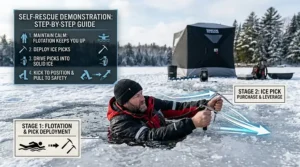
When you see “flotation” or “float assist” on ice fishing bibs, what you’re actually getting varies dramatically between manufacturers. Understanding these differences helps Canadian buyers make informed decisions rather than assuming all rescue ice fishing bibs provide equivalent protection.
Flotation System Types
Integrated Foam Panels (Striker Sureflote, WindRider): These systems distribute closed-cell foam throughout the bibs’ lining rather than concentrating it in specific zones. The advantage is even buoyancy distribution—you float horizontally rather than tilting. Striker’s Sureflote is certified to keep an average adult afloat for 2 hours, a specific claim backed by testing. WindRider, coming from marine background, uses similar physics but doesn’t publish specific time ratings.
Buoyant Insulation Fill (Piscifun, some Nordic Legend models): Rather than separate flotation and insulation layers, these bibs use insulation material that provides both warmth and buoyancy. This approach reduces bulk since the insulation serves dual purposes. The trade-off is less predictable flotation performance—insulation that gets compressed or damaged loses buoyancy capacity. These typically lack published flotation time ratings.
Perforated vs Solid Foam: This distinction matters more than most anglers realize. Perforated foam (Striker’s design) allows water drainage once you’re out of the water, reducing the weight you’re carrying and minimizing hypothermia risk from wet fabric next to skin. Solid foam panels provide flotation but trap water inside the garment, creating exactly the problem flotation is supposed to solve.
CSA Certification and Canadian Standards
Unlike personal flotation devices (PFDs) which must meet Transport Canada certification standards, flotation bibs ice fishing fall into a regulatory grey area. They’re not PFDs—they’re flotation-assist garments. This means there’s no government-mandated minimum performance standard. Reputable manufacturers like Striker conduct their own testing and publish results (the 2-hour Sureflote rating), but budget brands may use “flotation” descriptively without quantified performance data.
What Canadian Buyers Should Verify:
- Published flotation time rating (2 hours is the Striker standard)
- Foam type and distribution (integrated vs panels)
- Water drainage mechanism (perforated or mesh-backed foam)
- Whether the manufacturer has marine/safety background or is primarily apparel-focused
Temperature Impact on Flotation
Here’s something the spec sheets don’t mention: extreme cold affects foam performance. Closed-cell foam maintains buoyancy in cold water, but the bibs’ outer fabric can freeze stiff once you’re out of the water, potentially trapping you in awkward positions. Canadian-designed bibs (Striker, tested in Minnesota/Wisconsin/Canadian conditions) account for this in their fabric selection—the shell remains flexible to -30°C. Budget imports designed for milder climates may use fabric that becomes rigid in Canadian extreme cold, compromising your ability to move after self-rescue.
Provincial Ice Fishing Regulations: What Canadian Anglers Must Know
While most Canadian ice anglers focus on catch limits and licensing, provincial regulations also govern ice hut registration, hole size limitations, and safety equipment requirements that intersect with flotation bibs ice fishing considerations.
Ontario Regulations
Ontario’s ice fishing rules require ice hut registration in Fisheries Management Zones 9-12 and 14-20. More relevant to safety equipment: you’re permitted to fish with 2 lines when ice fishing (versus 1 line in open water), but you must remain within 60 metres of any line or tip-up and maintain clear, unobstructed view of all lines. This proximity requirement means if you break through the ice, you’re close enough that proper flotation can be the difference between self-rescue and requiring emergency response.
Ontario regulations also specify that ice fishing huts must be removed by specific dates depending on zone—these aren’t arbitrary; they’re based on ice deterioration timelines. Anglers pushing these deadline dates are fishing on weakening ice where flotation becomes critical safety equipment.
Quebec and Western Provinces
Quebec’s regulations through the Ministère de l’Environnement emphasize the two-line rule and licensing requirements but leave safety equipment to angler discretion. Alberta’s regulations (through Alberta Environment and Protected Areas) recommend but don’t mandate flotation equipment, though guides and outfitters often require it for insurance purposes.
The Reality Gap
No Canadian province currently mandates flotation bibs or PFDs for ice fishing, despite drowning statistics that suggest they should. The Ontario Federation of Anglers and Hunters advocates for flotation gear but stops short of calling for legal requirements, arguing education and availability are better approaches than enforcement. What this means for Canadian buyers: you’re responsible for your own safety equipment decisions—provincial law won’t force you to buy lifesaving ice fishing bibs, but statistics show you probably should anyway.
Real-World Canadian Ice Conditions: How Flotation Bibs Perform
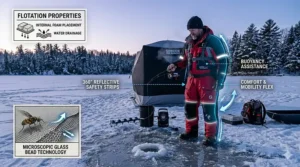
Laboratory flotation ratings tell you bibs will keep you afloat in controlled 15°C pool water. Canadian ice fishing happens in 0.5°C water through jagged ice holes while you’re wearing 4 kg of additional gear and possibly operating in -25°C air temperature. Here’s how flotation actually performs in conditions Canadian anglers face.
Early Ice (November-December): The Highest Risk Period
When Canadian lakes first freeze, ice thickness varies dramatically—15 cm near shore, 5 cm over deeper water, virtually nothing near inlets and springs. Ontario’s conservation officers report the majority of ice-fishing drownings occur during this period when anglers misjudge conditions. Float assist bibs matter most now because ice integrity is least predictable.
Performance Reality: Bibs with integrated flotation (Striker Sureflote, WindRider) keep you horizontal immediately upon breakthrough. This matters when the ice edges are thin and fragile—you need to distribute your weight across the maximum surface area to pull yourself out. Budget bibs with minimal flotation material often leave you vertical in the water, making self-rescue exponentially harder.
Deep Winter (January-February): Stationary Fishing, Extreme Cold
When Lake Nipissing or Lake of the Woods has 60+ cm of ice, breakthrough risk drops but doesn’t disappear—pressure cracks, snowmobile trails that create melt zones, and aerator-weakened areas remain hazards. The flotation challenge shifts: if you do break through, you’re wearing 6-8 kg of additional clothing, your outer layers freeze almost immediately upon exiting the water, and ambient air temperature accelerates hypothermia.
Performance Reality: Perforated foam systems (Striker’s design) prove their worth here. Solid foam bibs that trap water inside the garment create an ice layer between fabric and foam once you’re out of the water—you’re wearing a frozen shell that restricts movement and maintains dangerous core cooling. Drainage-equipped bibs shed most of the water, though you’re still racing hypothermia.
Late Ice (March-April): Deteriorating Conditions, Extended Daylight
March brings Canada’s most deceptive ice conditions—thick remnant ice that’s been weakened by daytime thaw-freeze cycles, sun angles that create inconsistent melting, and the temptation of extended daylight encouraging longer trips. Manitoba and Saskatchewan anglers pushing walleye season into April face ice that appears solid but has lost structural integrity.
Performance Reality: Flotation becomes emergency equipment rather than precautionary. The ice is often strong enough to walk on but weak enough that recovery is difficult—you’re breaking through honeycomb ice that crumbles under your weight as you try to climb out. Bibs with maximum flotation surface area (WindRider’s full-garment approach) provide the best chance of staying afloat until you find solid ice edge or help arrives.
Cost Analysis: What Canadian Ice Anglers Actually Spend
The $120-$550 CAD price range for flotation bibs represents a 4.5x variance—substantial enough that understanding cost-per-use and longevity matters more than initial price.
The Budget Tier ($120-$180 CAD): Piscifun, Entry-Level Options
Typical Lifespan: 1-2 seasons of moderate use (10-15 outings/year) Cost Per Outing (Year 1): $8-$12 CAD Cost Per Outing (3-Year Total): $4-$6 CAD
Budget bibs make financial sense for casual Canadian anglers—the family that ice fishes Lake Simcoe 8 Saturdays per winter. You’re accepting fabric wear, zipper degradation, and potential insulation compression as trade-offs for upfront savings. The flotation typically remains functional even after the bibs look worn; foam doesn’t degrade the way fabric does.
The Mid-Tier ($250-$350 CAD): Nordic Legend, Striker Trekker, WindRider
Typical Lifespan: 3-4 seasons of regular use (20-30 outings/year) Cost Per Outing (Year 1): $8-$17 CAD Cost Per Outing (3-Year Total): $3-$5 CAD
Mid-tier bibs hit the value sweet spot for Canadian weekend warriors. You’re getting flotation systems with published ratings, better fabric durability (600D vs 300-400D), and construction that survives kneeling on ice without tearing. The 3-4 season lifespan assumes proper care—drying between uses, storing uncompressed during summer, spot-cleaning rather than machine washing.
The Premium Tier ($400-$550 CAD): Striker Climate, Hardwater
Typical Lifespan: 4-6 seasons of heavy use (40+ outings/year) Cost Per Outing (Year 1): $10-$14 CAD Cost Per Outing (3-Year Total): $2-$3 CAD
Premium bibs deliver the lowest long-term cost per use for serious Canadian ice anglers. The removable liner system (Climate) or heavy-duty construction (Hardwater) extends functional lifespan while maintaining performance. Guides and tournament anglers logging 50-80 ice fishing days annually find these bibs still functional after 5+ years, making the initial $500+ CAD investment more defensible than it appears.
The Hidden Costs
What price comparisons don’t show: budget bibs often require more aggressive layering underneath to match premium bibs’ warmth, adding $100-$200 CAD in base layer costs. Premature replacement due to zipper failure or seam leakage costs you the entire bib investment. And the intangible: bibs that don’t fit well or restrict movement reduce your enjoyment of ice fishing, potentially costing you days on the ice you would have otherwise taken.
Maintenance and Storage: Extending Your Flotation Bibs’ Canadian Lifespan
Canadian ice fishing conditions—road salt exposure, repeated freeze-thaw cycles, extended storage through 7-8 month off-seasons—test bibs in ways milder climates don’t. Proper maintenance can double your bibs’ functional lifespan.
Post-Trip Cleaning
The Ice Fishing Reality: You will get fish slime, bait residue, and ice melt chemicals on your bibs. Windsor and Toronto anglers fishing near roads face additional salt spray from vehicles accessing lakes. This isn’t cosmetic—salt accelerates waterproofing failure and corrodes zippers.
Correct Approach: Spot-clean with cold water and mild detergent immediately after trips. Avoid machine washing unless absolutely necessary—the agitation compresses flotation foam and stresses waterproof seams. For stubborn stains (fish blood, fuel from snowmobiles), use dedicated technical fabric cleaner rather than household detergents that strip DWR coatings.
Drying Protocol
The Mistake Most Canadian Anglers Make: Hanging wet bibs in a heated garage seems logical, but rapid drying at high temperatures damages waterproof coatings and can warp foam insulation. The opposite error—storing damp bibs in cold spaces—promotes mildew and material degradation.
Best Practice: Air-dry at room temperature (15-20°C) in a well-ventilated space. Hang bibs fully unzipped and turn pockets inside-out. Allow 48-72 hours for complete drying before storage. For bibs with removable liners (Striker Climate), dry liner and shell separately to ensure moisture doesn’t get trapped between layers.
Summer Storage
Canadian Climate Challenge: 30+ degree summer temperatures in storage spaces (garages, sheds) followed by -30°C winters create material stress that shortens bib lifespan. Compressed storage damages flotation foam permanently.
Proper Storage: Hang bibs in climate-controlled space if possible (basement, closet). If garage storage is necessary, use upper shelves (heat rises, so higher locations stay cooler). Never compress bibs into storage bins—flotation foam doesn’t fully recover from compression. Store away from petroleum products, solvents, and direct sunlight which degrade waterproof fabrics.
Zipper Maintenance
The Failure Point: Zippers are the #1 failure point on ice fishing bibs, particularly the main torso zipper that faces constant stress and exposure to freezing spray.
Preventive Care: Monthly application of zipper lubricant (paraffin wax or dedicated zipper wax—never oil or WD-40 which attract dirt) keeps zippers operating smoothly. Before each season, run zippers full range 10-15 times to identify binding spots early. Canadian anglers in coastal areas (BC interior lakes, Atlantic provinces) face additional salt exposure—rinse zippers with fresh water after each trip near saltwater environments.
Common Mistakes When Buying Flotation Bibs Ice Fishing
After reviewing hundreds of Canadian buyer experiences and warranty claims, patterns emerge in what goes wrong with flotation bib purchases.
Mistake #1: Prioritizing Insulation Over Flotation
The Trap: Budget shoppers compare insulation weights (120g vs 200g) and select based on warmth, treating flotation as a secondary checkbox feature.
Why It Backfires: All the insulation in the world doesn’t help if you break through the ice and sink. The primary function of safety bibs ice fishing is keeping you afloat—warmth is secondary and can be supplemented with layering. Buying heavily-insulated bibs without proper flotation systems (published ratings, perforated foam, water drainage) inverts priorities.
Canadian-Specific Impact: Our extended ice season means you’ll encounter varying temperature conditions. Removable liner systems (Striker Climate) or versatile mid-weight insulation (Striker Trekker’s 150g) paired with excellent flotation serves Canadian anglers better than maximum insulation with minimal flotation.
Mistake #2: Ignoring Sizing Specifics
The Trap: Ordering your normal pant size without accounting for layering, assuming manufacturers use consistent sizing.
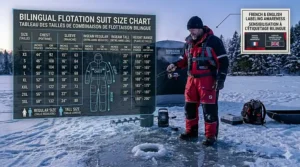
Why It Backfires: Ice fishing bibs are designed to wear over base layers and potentially mid-layers. Striker sizing tends to run slightly large; Piscifun tends to run small. Women ordering men’s bibs in smaller sizes get the wrong cut entirely (see Striker Stella section above). Too-tight bibs restrict movement and compress flotation foam; too-loose bibs create excess fabric that fills with water if you break through.
Canadian Consideration: Cold-weather layering differs from mild-climate use. Ontario anglers wearing heavyweight base layers plus fleece in -25°C need different sizing than BC coastal anglers in -5°C wearing just a single base layer. Check manufacturer sizing charts against your layering plan, not your casual pant size.
Mistake #3: Overlooking Tall/Short Inseam Options
The Trap: Accepting standard inseam bibs and either dealing with excess fabric bunching in boots or accepting cold ankles.
Why It Backfires: Bibs with adjustable inseams (Striker models, WindRider) let you customize length for your boot height and leg length. Non-adjustable bibs force you to choose between too-short (cold gap at boot-top) or too-long (fabric bunched inside boots creating pressure points and moisture traps).
Canadian Reality: Pac boots and extreme-cold footwear add 5-8 cm to your effective leg length. Bibs sized for running shoes leave cold gaps with proper ice fishing boots. Tall Canadian anglers (190+ cm) often need XLT or XXLT sizes that aren’t available in budget brands.
Mistake #4: Assuming All “Flotation” Claims Are Equal
The Trap: Seeing “float assist” or “buoyant material” on product descriptions and assuming equivalent protection across brands.
Why It Backfires: Striker’s Sureflote is tested to keep you afloat for 2 hours—a specific, measurable claim. Piscifun states “will keep an adult afloat” without time specification. Some budget brands use “buoyant insulation” to mean the insulation has minor flotation properties, not that it’s a legitimate rescue system.
What Canadian Buyers Should Demand: Published flotation time rating, foam distribution diagram, and water drainage mechanism description. If the manufacturer can’t or won’t provide these, you’re buying insulated bibs with marketing spin, not genuine lifesaving ice pants.
Mistake #5: Neglecting Canadian Availability and Warranty
The Trap: Finding great deals on Amazon.com and assuming the product ships to Canada or that warranty service applies.
Why It Backfires: Many flotation bibs on Amazon.com don’t ship to Canadian addresses. Those that do may have different warranty terms for international orders. Warranty claims requiring US return shipping cost $40-$80 CAD, negating any price advantage.
Correct Approach: Shop Amazon.ca specifically. Verify “Ships to [your province]” before purchasing. Read warranty terms—some brands (Striker) have Canadian distributors making warranty service straightforward; others require cross-border returns making warranty effectively worthless for items under $300 CAD.
❓ Frequently Asked Questions: Flotation Bibs Ice Fishing Canada
❓ Do flotation bibs ice fishing actually work in real Canadian ice conditions or just laboratory tests?
❓ Can I use regular PFDs under my ice fishing bibs instead of buying flotation bibs?
❓ How do I know if flotation bibs will fit over my winter layers for Alberta or Manitoba conditions?
❓ Will Amazon.ca accept returns if flotation bibs don't fit or meet expectations?
❓ Are there flotation bibs specifically designed for women that actually fit differently, or are they just pink versions of men's bibs?
Conclusion: Your Canadian Ice Fishing Life May Depend on This Decision
After examining seven flotation bibs through the lens of Canadian ice conditions, provincial regulations, and real-world performance data, one truth stands clear: the question isn’t which flotation bibs to buy, it’s whether you can justify stepping onto Canadian ice without them. Every winter, Ontario, Quebec, Manitoba, Saskatchewan, and Alberta report ice-fishing drownings that flotation might have prevented—anglers who misjudged ice thickness, encountered hidden weak spots, or simply had bad luck.
For Canadian ice anglers fishing 30+ days per season across varying conditions, the Striker Climate Bib ($450-$550 CAD) justifies its premium pricing through removable liner versatility, proven 2-hour Sureflote rating, and construction that survives heavy use. You’re investing in a system that adapts from December’s deep freeze to March’s slush season without requiring multiple bib sets.
Budget-conscious Canadian anglers fishing 10-20 days annually should consider the Striker Trekker ($230-$280 CAD) or WindRider ($350-$450 CAD)—both deliver legitimate flotation technology at price points that make safety equipment accessible rather than luxury. The Trekker suits active fishing styles and early/late ice; WindRider’s marine-engineering background provides confidence in the flotation physics.
Casual weekend warriors fishing 5-8 trips per season can justify the Piscifun ($120-$160 CAD), accepting fewer features and shorter lifespan as trade-offs for getting genuine flotation assistance at entry-level pricing. You’re prioritizing the critical safety function while acknowledging you’ll need more aggressive layering and earlier replacement.
Canadian women ice anglers face a binary choice: the Striker Stella ($280-$350 CAD) eliminates the fit compromises of unisex bibs, or you accept that men’s bibs will never fit your body correctly and adapt through layering adjustments. There’s no middle ground—women-specific engineering either matters enough to justify the price, or you work around inadequate fit.
The ultimate calculation isn’t financial—it’s whether you trust 20 cm of January ice that looks solid but might have a spring underneath, whether you’re comfortable fishing alone knowing help is 15 minutes away, whether you’ve accepted that even experienced Canadian ice anglers make fatal mistakes. Flotation bibs don’t prevent breaking through the ice, but they fundamentally change what happens in the 2-5 minutes after breakthrough when survival odds are determined. For most Canadian ice anglers, that’s worth whatever price point fits your budget.
Recommended for You
- Best Two Piece Ice Fishing Suits Canada 2026
- One Piece vs Two Piece Ice Suit: 7 Best Options Canada 2026
- 7 Best Ice Fishing Suits in Canada 2026
Disclaimer: This article contains affiliate links. As an Amazon Associate, I earn from qualifying purchases. If you purchase products through these links, we may earn a small commission at no additional cost to you.
✨ Found this helpful? Share it with your friends! 💬🤗
