
In This Article
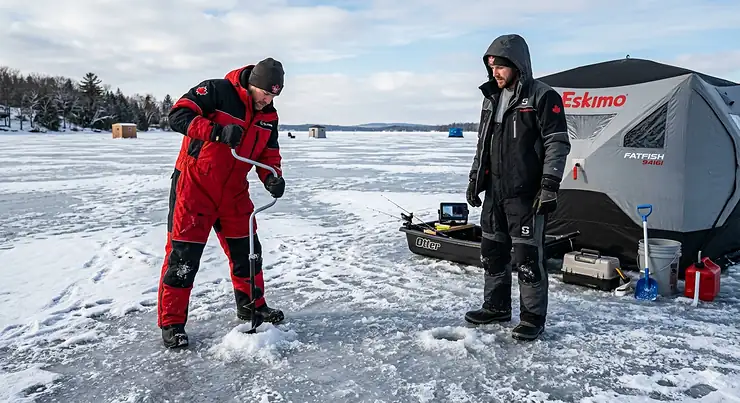
Have you ever stood at the edge of a frozen lake, watching your breath crystallize in the -25°C air, wondering if your gear will actually keep you safe? I remember my first ice fishing trip near Kenora, Ontario—I borrowed a friend’s old ice suit and spent more time shivering than fishing. That’s when I learned the truth: the one piece vs two piece ice suit debate isn’t just about comfort; it’s about survival on Canadian ice.
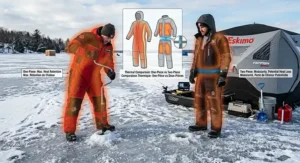
The decision between one piece and two piece ice suits dramatically affects your mobility, warmth, safety, and overall fishing experience. Two-piece systems (bib and jacket combinations) dominate the Canadian market, offering approximately 85% of available options, while one-piece coveralls represent a niche but growing segment. Ontario ice anglers typically favour two-piece setups for their versatility, while Quebec’s deep-cold enthusiasts increasingly turn to integrated one-piece designs for extreme temperature protection.
Flotation suits are essentially lifejackets for ice fishing, ensuring your head stays above the water if the worst-case scenario was to occur, making safety features non-negotiable regardless of which style you choose. Canadian winters demand gear that performs from early December through late March, handling temperature swings from -5°C shoulder-season days to bone-chilling -40°C deep freezes. This guide breaks down everything you need to know: real product comparisons, pricing in CAD, mobility differences, layering strategies, and safety considerations specific to Canadian ice conditions.
Quick Comparison Table
| Feature | One Piece Coveralls | Two Piece (Bib + Jacket) |
|---|---|---|
| Ease of Use | Quick on/off, full-body zipper | Requires separate dressing, more time |
| Temperature Control | Limited ventilation, all-or-nothing | Excellent – remove jacket when active |
| Mobility | Can feel restrictive, one-size movement | Superior range of motion |
| Bathroom Breaks | Often includes drop-seat zipper | Bib design with dual zippers |
| Layering Flexibility | Fixed insulation level | Customizable with removable liners |
| Price Range (CAD) | $300-$600 | $400-$900 (complete set) |
| Best For | Extreme cold, stationary fishing | Active hole-hopping, varied temps |
💬 Just one click – help others make better buying decisions too! 😊
Top 7 Ice Suits: Expert Analysis for Canadian Conditions
1. Striker Climate Jacket & Bib System (Two Piece)
The Striker Climate Jacket and Bib represents the flagship of Canadian ice fishing apparel, battle-tested across Ontario, Manitoba, and Saskatchewan hardwater. This 3-in-1 modular system features Sureflote flotation technology, Hydrapore waterproofing (5,000mm), and 150g insulation with a removable G2 Softshell liner.
Key Specifications:
- Shell: 320D Nylon Tussor with Hydrapore membrane
- Flotation: Sureflote perforated foam technology
- Insulation: 150g synthetic with removable liner option
Price in Canada: $330-$550 CAD (jacket), $495-$550 CAD (bibs) — Complete suit: $825-$1,100 CAD
Canadian Availability: Available at Canadian Tire, Bass Pro Shops Canada, Tackle Depot, and various specialty retailers. Ships within Canada in 3-7 business days.
The Climate Suit is the ultimate combination of quality and versatility, working from 40 degrees above zero to 40 below zero, according to verified Canadian buyers. Ontario anglers particularly appreciate the cross-flow venting system during active periods, while the removable liner extends usability from late-fall boat fishing through mid-winter ice conditions.
✅ Pros:
- Industry-leading 3-in-1 versatility for Canadian seasons
- Premium Sureflote flotation meets Canadian safety standards
- Extensive pocket system designed by professional anglers
❌ Cons:
- Premium pricing may exceed budget anglers’ limits
- Bulky when wearing all layers simultaneously
2. WindRider Boreas Floating Ice Suit (Two Piece)
The WindRider Boreas Floating Ice Fishing Suit delivers exceptional value at a mid-range price point, designed specifically for North American winters including Canadian conditions. This Minnesota-based company offers lifetime warranty coverage that Canadian buyers have successfully utilized.
Key Specifications:
- Waterproof rating: 5,000mm/5,000g breathability
- Flotation: Supports up to 136 kg (300 lbs) for 2+ hours
- Insulation: 120g 3M Thinsulate throughout
Price in Canada: $399-$450 USD (approx. $540-$610 CAD for complete suit)
Canadian Availability: Ships to Canada via ecofishingshop.com and anglers’ specialty stores. International shipping typically adds $30-50 CAD; customs/duty may apply depending on province.
Absolutely love the Boreas Ice Suit! It handles Ontario winters no problem. The added floatation is nice peace-of-mind for going out on early or late ice, reports a verified Canadian purchaser. The adjustable inseam feature accommodates height variations without hem alterations—critical for families sharing equipment or reselling.
✅ Pros:
- Lifetime warranty on workmanship (seams, zippers)
- Direct-to-consumer pricing eliminates retailer markup
- YKK zippers standard throughout
❌ Cons:
- Runs slightly tight in shoulders (size up if layering heavily)
- Limited Canadian retail presence (primarily online ordering)
3. Clam IceArmor Edge Jacket & Bib Combo (Two Piece)
The Clam IceArmor Edge series represents the budget-friendly entry point into quality flotation ice fishing apparel. Available at Canadian retailers including Bass Pro Shops and Cabela’s Canada, this system provides essential protection without premium-tier pricing.
Key Specifications:
- Shell: 300D polyester with waterproof coating
- Flotation: Standard foam assist technology
- Insulation: 100g throughout body and bibs
Price in Canada: $350-$450 CAD (complete two-piece system)
Canadian Availability: Widely available at Bass Pro Shops Canada, Cabela’s, Canadian Tire, and rapala.ca. Ships Canada-wide with free shipping on orders over $75.
Canadian buyers report solid performance in typical Ontario/Quebec ice conditions (-15°C to -25°C), though extreme cold days benefit from additional mid-layers. The straightforward design appeals to anglers who prioritize function over features.
✅ Pros:
- Most accessible price point for complete flotation system
- Wide Canadian retail availability
- Proven durability across multiple seasons
❌ Cons:
- Basic pocket configuration compared to premium options
- No removable liner system for temperature adaptation
4. Eskimo Keeper Jacket & Bibs (Two Piece)
The Eskimo Keeper Ice Fishing Suit brings Wisconsin-engineered durability to Canadian ice anglers seeking mid-range protection. Ardisam’s employee-owned company maintains quality control standards that have earned trust across the Great Lakes region and Prairie provinces.
Key Specifications:
- Waterproof/breathable Keeper Fabric technology
- Integrated Sureflote flotation assistance
- 150g Thermadex insulation
Price in Canada: $400-$550 CAD (jacket), $380-$500 CAD (bibs) — Complete: $780-$1,050 CAD
Canadian Availability: Available through geteskimo.com (ships to Canada), select Canadian retailers, and specialty ice fishing shops. Expect 5-10 day delivery to most Canadian locations.
Lake Simcoe and Lake Winnipeg anglers frequently choose Eskimo for its proven track record in high-wind environments. The reinforced knees and seat handle repeated kneeling over holes—a detail appreciated during long perch and whitefish sessions.
✅ Pros:
- Thermadex insulation maintains warmth in extreme wind
- Excellent durability on knees and high-wear areas
- Established reputation across Canadian ice belt
❌ Cons:
- Mid-premium pricing without removable liner versatility
- Heavier weight compared to newer competitors
5. Norfin Element Suit (Two Piece)
The Norfin Element Ice Fishing Suit brings European cold-weather engineering to North America, gaining popularity with competitive ice anglers including NAIFC tournament participants. Scandinavian design philosophy emphasizes lightweight mobility without sacrificing warmth.
Key Specifications:
- Shell: Lightweight ripstop with waterproof membrane
- Strategic flotation placement (85g less than comparable suits)
- PrimaLoft-style synthetic insulation
Price in Canada: $500-$700 CAD (estimated for complete system)
Canadian Availability: Limited Canadian distribution; primarily available through US retailers with Canadian shipping. Import duties may apply (approximately 13-18% depending on province).
The lightweight design is great, and it still offers floatation. It fits well. It’s not bulky or cumbersome like some floatation suits, and the pockets-design is great, according to professional angler testing. Manitoba tournament anglers who cover extensive ice on foot particularly value the reduced weight during long walking days.
✅ Pros:
- Lightest weight in flotation suit category
- European pocket design philosophy (organized, accessible)
- Premium materials and construction quality
❌ Cons:
- Limited Canadian availability
- Higher price point with import considerations
6. Frabill I3 Jacket and Bibs (Two Piece)
The Frabill I3 Ice Fishing Suit delivers proven performance across Great Lakes ice conditions, with particular strength in its i-Float Sureflote technology. Frabill’s focus on ice-specific features resonates with anglers from Thunder Bay to the Maritimes.
Key Specifications:
- i-Float Sureflote assistance technology
- Waterproof I-Zip waterproof zippers
- 100g Thermadex insulation
Price in Canada: $350-$500 CAD (jacket), $320-$450 CAD (bibs) — Complete: $670-$950 CAD
Canadian Availability: Good Canadian distribution through Sail, Bass Pro, and regional tackle shops. Regular stock levels across most provinces.
The Frabill I3 suit provides 35 minutes of floatation time—enough for self-rescue or buddy assistance, a critical safety margin in Canadian wilderness settings where help may be distant. Quebec backcountry anglers appreciate this extended buoyancy duration.
✅ Pros:
- Extended 35-minute flotation duration
- I-Zip waterproof zippers reduce failure points
- Good Canadian availability and support
❌ Cons:
- Mid-range insulation may require layering in extreme cold
- Styling less modern than newer competitors
7. Rothco Insulated Ski and Rescue Suit (One Piece)
The Rothco Insulated Ski and Rescue Suit represents the one-piece coverall approach, originally designed for ski patrol and rescue operations but increasingly adopted by stationary ice anglers. This jumpsuit-style option provides full-body coverage in a single garment.
Key Specifications:
- Water-resistant polyester shell
- Full-length insulation throughout
- Adjustable hood with memory wire
Price in Canada: $180-$280 CAD (varies by size)
Canadian Availability: Available on Amazon.ca with Prime shipping to most Canadian addresses. Regular stock across all standard sizes.
While not specifically designed for ice fishing, Canadian anglers fishing from heated huts or permanent shelters find this budget one-piece option adequate for stationary scenarios. The full-length dual zipper allows bathroom access without complete removal—addressing the primary one-piece complaint.
✅ Pros:
- Most affordable one-piece option
- Quick on/off for shelter-based fishing
- Readily available with fast Canadian shipping
❌ Cons:
- No integrated flotation (safety concern for mobile ice fishing)
- Limited breathability for active fishing styles
Understanding One Piece vs Two Piece Ice Suit Designs
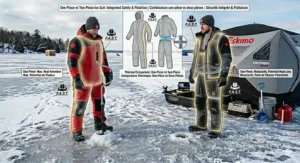
The fundamental architecture difference between one piece and two piece ice suits shapes every aspect of your ice fishing experience. One-piece coveralls create a sealed envelope around your entire body, eliminating the jacket-bib gap that can admit wind or snow. Two-piece systems sacrifice that complete seal for dramatically improved versatility and temperature control.
The Physics of Heat Retention
One piece designs theoretically provide superior heat retention by eliminating transition zones between garments. In practice, this advantage only materializes when you’re stationary. The moment you begin moving—drilling holes, hauling equipment, or walking between spots—that sealed envelope traps sweat and metabolic heat with nowhere to escape. Wearing multiple layers allows for removing articles of clothing while travelling, and then layering back up when stationary, which proves impossible with most one-piece configurations.
Two-piece systems excel at what engineers call “dynamic thermoregulation.” Remove the jacket during active periods, retain it during sitting. Unzip the bib legs when walking uphill with gear, seal them when kneeling at the hole. This adaptability directly translates to maintaining comfortable core temperature across varied activity levels—the difference between fishing all day comfortably versus cutting your trip short due to overheating or chilling.
Mobility and Range of Motion
Coverall-style one-piece suits constrain shoulder and hip movement to whatever the designer anticipated. Reaching forward to net a fish, kneeling at awkward angles while drilling, or stretching to access equipment behind you—all these movements fight against a fixed fabric envelope. Two-piece designs allow the jacket to move independently from the bibs, providing unrestricted upper-body rotation and reach.
Canadian ice conditions demand mobility. Chipping ice buildup from auger blades, clearing slush from holes, setting tip-ups across 100 meters of lake—these activities require full range of motion. Professional guides and tournament anglers universally prefer two-piece configurations specifically for this mobility advantage.
The Bathroom Break Reality
Let’s address the elephant on the ice: bathroom logistics. One-piece suits traditionally required near-complete disrobing, exposing you to cold while fumbling with layers. Modern one-piece designs incorporate drop-seat zippers or dual-zipper access points that mitigate this issue. Two-piece bibs, however, feature drop-front or side-access designs that simply work better in practice.
When you’re wearing three layers under your bibs, gloves on your hands, and standing in -30°C wind, every second of exposure matters. The two-piece advantage here isn’t just convenience—it’s meaningful cold-exposure reduction. Quebec backcountry anglers who fish all day away from heated shelters particularly value this practical distinction.
Layering Strategy Integration
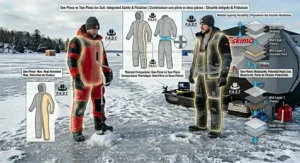
Effective ice fishing clothing operates on the three-layer principle: wicking base layer, insulating mid-layer, protective shell layer. One-piece suits force you to commit to a fixed insulation level. If conditions warm from -25°C to -10°C throughout the day, you’re stuck with that thick envelope. Two-piece systems with removable liners—like the Striker Climate series—transform from heavy-insulation winter suits to shoulder-season shells.
This adaptability extends the useful season dramatically. Manitoba anglers using two-piece modular systems fish the same suit from November first ice through April late ice, adjusting the liner configuration to match conditions. One-piece users typically need separate early-season and deep-winter options.
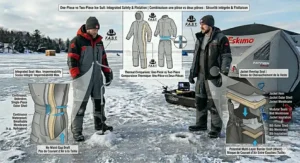
Flotation Safety: Canada’s Ice Fishing Reality
70% of ice fishing deaths are drowning incidents. Float suits prevent 90% of ice fishing drowning deaths, making flotation technology non-negotiable for Canadian ice anglers. Understanding how flotation works differently in one-piece versus two-piece designs directly impacts survival margins.
How Flotation Technology Functions
Ice fishing flotation suits incorporate closed-cell foam strategically placed throughout the garment. This foam serves dual purposes: insulation and buoyancy. When you break through ice, the foam instantly provides 35-150 minutes of flotation time depending on design, keeping your head above water while you execute self-rescue or wait for assistance.
One-piece flotation suits distribute foam evenly across the entire body envelope, typically providing 50-100 lbs of buoyant force. Two-piece systems split flotation between jacket and bibs, requiring both pieces to achieve full rated buoyancy. The critical question: will you always fish wearing both pieces?
Temperature Regulation and Flotation Coverage
Here’s the Canadian ice fishing paradox: you need flotation most during shoulder seasons (early December, late March) when ice is unstable. These same periods feature warmer temperatures that tempt anglers to shed jackets. If your flotation is split between jacket and bibs, removing the jacket for comfort eliminates 60-70% of your buoyant protection.
Some BWCA anglers prefer separate floating bibs and a floating jacket for temperature regulation flexibility—you can ventilate the jacket on a portage push without losing lower-body flotation. The tradeoff: a two-piece system requires discipline to ensure both pieces are on before you reach questionable ice. This discipline becomes critical in Canadian wilderness settings where help is distant.
Canadian Ice Conditions and Failure Patterns
Ontario’s varied ice conditions—from Great Lakes pressure cracks to Muskoka lake inlet areas—create unpredictable failure zones. Boundary Waters lakes are fed and drained by rivers that remain open water all winter. Inlets and outlets form thin ice that can persist into January even when the main body has 12 inches. Similar patterns occur across Canadian Shield lakes throughout Ontario and Quebec.
One-piece suits provide foolproof flotation: it’s either on or off. Two-piece systems demand situational awareness: am I in safe ice wearing just bibs, or do I need the jacket secured? For anglers fishing familiar local lakes, this calculation becomes routine. For those exploring new water or fishing in low-visibility conditions, the one-piece certainty offers meaningful peace of mind.
Meeting Canadian Safety Expectations
While Canada doesn’t mandate flotation suits for ice fishing, provincial safety organizations and conservation officers strongly recommend them. Consider a flotation suit. They’re like a full-bodied life jacket. A lot of Ontario ice fishers joke that they’re basically life-saving onesies. Whether one-piece or two-piece, verify your suit meets these Canadian-relevant specifications:
- Minimum 35 minutes flotation time (60+ preferred for remote fishing)
- Head flotation sufficient to keep airways clear while unconscious
- Insulated flotation that maintains warmth in water (preventing rapid hypothermia)
- Bright colours or reflective elements for visibility to rescuers
- Durability to withstand sharp ice edges during self-rescue
Both design approaches can meet these requirements. Choose based on how you’ll actually fish, not theoretical scenarios. If you’ll genuinely keep both pieces on all day, two-piece flexibility wins. If you know you’ll shed the jacket during active periods, consider whether you’re comfortable with reduced flotation or whether a one-piece design better matches your behaviour patterns.
Coverall vs Bib Jacket Comparison: Real-World Performance
Theoretical advantages matter less than practical performance across actual Canadian ice fishing scenarios. Let’s examine how one-piece coveralls and two-piece bib-jacket systems perform in real conditions from British Columbia interior lakes to Newfoundland coastal ice.
Active Hole-Hopping Scenarios
Manitoba jumbo perch fishing and Saskatchewan walleye tournaments demand constant movement. Drill 20-30 holes across 200 meters, fish each for 15 minutes, move to the next. This active style generates significant metabolic heat—you’ll be sweating despite -20°C temperatures.
Two-piece systems dominate this scenario. Remove the jacket while drilling and transporting, retain only the bibs. Your core stays warm from activity, your legs benefit from wind protection, and you avoid the sweat buildup that leads to chilling once you stop. One-piece coveralls trap that heat with limited venting options, forcing you to either overheat or completely unzip (exposing you to wind).
Quebec’s popular “perch circuit” along the St. Lawrence involves similar movement patterns. Anglers who switched from one-piece to two-piece configurations report staying out 2-3 hours longer before fatigue or temperature discomfort forces them off the ice.
Stationary Shelter Fishing
Now flip the scenario: you’re fishing from a heated portable shelter for lake trout in Northern Ontario or targeting pike through the ice in Alberta. You walk to the shelter once, set up, and fish 4-6 hours from the same position. Heat comes from a propane heater, not your metabolism.
One-piece coveralls actually work well here. You wear the suit for the walk in, unzip or partially remove once the shelter heats up, and re-seal when moving outside briefly. The complete body coverage prevents cold spots during those outside moments when you need to clear slush or reposition the shelter.
Two-piece systems still function but offer less advantage. You’ll likely keep both pieces on anyway since you’re not generating heat through activity. The jacket removal option matters less when you’re sitting stationary.
Wind Exposure and Storm Conditions
Saskatchewan and Manitoba ice often involves fishing across open prairie lake expanses with zero wind breaks. A 30 km/h west wind at -25°C creates brutal wind chill. Storm days when fish feed aggressively but conditions punish anglers.
One-piece coveralls create a complete barrier with zero gaps. No waist gap where jacket meets bibs, no potential for fabric separation during movement. This sealed approach provides measurably better wind protection. Two-piece systems, even when properly sized and worn, create a transition zone at the waist that wind can exploit, especially when you’re bending, kneeling, or reaching.
Experienced anglers using two-piece systems in extreme wind pair them with long base-layer shirts that tuck deep into bib pants, eliminating this gap. But the one-piece design makes this protection automatic and foolproof.
Multi-Day Trip Considerations
Consider a five-day ice fishing trip to Lake of the Woods or Lac-Saint-Jean. You’re fishing different spots daily, conditions vary, and laundry isn’t available. Two-piece systems let you rotate components: fish with jacket A and bibs B on day one, jacket B and bibs A on day two. This rotation extends fresh-feeling time and allows targeted drying of pieces that got wet.
One-piece suits offer no such flexibility. The entire garment goes on or comes off as a unit. If the chest area gets wet from spilled coffee but the legs remain dry, you still need to dry (or endure) the entire suit. For extended trips, this becomes a practical limitation.
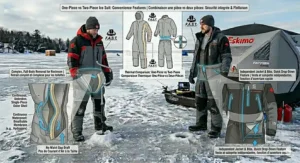
Ice Suit Style Guide: Matching Gear to Fishing Style
Canadian ice fishing encompasses wildly different approaches—from competitive tournament angling to family cottage weekends—and no single ice suit style serves all equally well. Let’s match designs to specific fishing profiles.
The Tournament Angler
You’re fishing NAIFC-style competitions: 6-8 hours of nearly continuous drilling, moving, setting lines, and checking multiple holes. Every minute counts, and comfort directly impacts endurance.
Optimal Choice: Two-piece system with removable liner (Striker Climate, Norfin Element)
Why it works: Remove the jacket and liner during active drilling periods. Retain bibs for leg protection and lower-body flotation. Shed layers strategically as you heat up, add them back during fish-fighting or slow periods. The weight reduction from removing layers (2-3 kg less) reduces fatigue over 6+ hour competitions.
The Weekend Warrior
You fish 4-6 times per winter, primarily on familiar local lakes. Trips last 3-4 hours, mixing some movement with stationary fishing from a portable flip-over shelter.
Optimal Choice: Mid-range two-piece system (WindRider Boreas, Clam IceArmor Edge)
Why it works: Versatility for varied conditions without premium pricing. Works equally well for the rare long day and typical short sessions. Good resale value if fishing interest wanes, and the two-piece format makes lending jacket or bibs to friends possible (one-piece suits rarely fit multiple people acceptably).
The Backcountry Explorer
You’re snowshoeing 2-5 km into remote Algonquin Park lakes or Quebec ZEC territory. Weight matters, and you’re self-reliant for safety since help is hours away.
Optimal Choice: One-piece integrated flotation suit OR lightweight two-piece where both components have flotation
Why it works: The hike in generates significant heat, but once at the lake, you need reliable flotation while fishing remote ice. One-piece design eliminates the temptation to shed flotation-containing layers. For portage travel, that consolidation is a real practical advantage. The single-garment simplicity also reduces pack volume during transport.
The Comfort-Focused Fisher
You fish exclusively from a heated ice shack on consistent lake locations. Priority is warmth and convenience over mobility or weight.
Optimal Choice: Budget one-piece coverall (Rothco) OR entry two-piece without flotation (supplement with PFD if needed)
Why it works: You’re walking 20 meters from your truck to a permanent shack. Flotation matters less (though still valuable for the walk). The one-piece coverall provides straightforward warmth, and the budget price point makes sense for limited-mobility fishing where premium features go unused.
The Guide or Professional
You’re on the ice 40-80 days per season, working with clients in varied conditions. Durability, versatility, and professional appearance matter.
Optimal Choice: Premium two-piece modular system (Striker Climate with multiple liners)
Why it works: The removable liner system lets you adjust to client comfort levels (they always run colder than you do). Professional appearance builds confidence, and the durability justifies the investment across extended seasonal use. Warranty service becomes critical with heavy use—Striker’s Canadian presence facilitates this.
Mobility Ice Fishing Suit: Movement and Performance
Mobility defines whether you’ll fish through the day comfortably or pack up early due to fatigue and frustration. The mechanical design differences between one-piece and two-piece suits create measurably different movement capabilities.
Articulated Knee Design
Premium two-piece bibs incorporate articulated knees—pre-shaped panels and gussets that match your leg’s natural bend position. When you kneel at a hole, these panels flex without pulling the fabric taut. One-piece coveralls must accommodate the same knee bend using the same fabric envelope that covers your shoulders, creating competing tension.
Kneel at 20 holes over four hours—which design keeps you comfortable? Articulated bib knees with reinforced padding win decisively. The Striker Climate and WindRider Boreas bibs both feature this enhancement. One-piece suits like the Rothco use straight-cut legs that pull and bind during repeated kneeling.
Shoulder and Arm Mobility
Ice fishing demands extensive reaching: extending the auger forward to drill, reaching down into holes to net fish, stretching back to grab equipment from your sled. Two-piece jacket designs cut shoulder panels independently, allowing full arm rotation without lifting the entire garment’s weight.
One-piece coveralls attach sleeves to a body section that extends down to your legs. Raise your arms, and you’re lifting extra fabric weight. Reach forward aggressively, and you’re fighting the fabric connection running down your back to your seat. This limitation becomes pronounced with heavier one-piece designs.
Bend and Twist Capability
Picture this sequence: you’re drilling a hole, bent forward at the waist, twisting your torso slightly to maintain pressure on the auger, while stepping around the ice to work the cutting angle. This complex multi-axis movement happens dozens of times each outing.
Two-piece systems let the jacket and bibs move independently. Your torso twists, your legs step, and each garment accommodates its portion of the movement. One-piece suits fight this with a single fabric envelope that wants to pull you back to a neutral standing position. The difference feels subtle on movement one, but multiplied across 30 holes, it becomes fatiguing.
Gusseted Crotch and Inseam Design
High-quality ice fishing bibs feature diamond gussets in the crotch and inseam—fabric panels that create extra volume and flexibility. This allows wide stances (essential when balancing on slippery ice), squatting positions, and leg extension without the bibs riding up or pulling uncomfortably.
One-piece coveralls face a design compromise: make the inseam loose enough for full leg movement, and the crotch hangs too low (catching on equipment, looking sloppy). Make it fitted, and leg movement becomes restricted. Two-piece bibs optimize solely for lower-body movement without worrying about upper-body fit.
Layering One Piece vs Two Piece: Building the Perfect System
Effective ice fishing layering creates microclimate management—wicking moisture, trapping warm air, and blocking wind while allowing strategic venting. How one-piece versus two-piece suits integrate with this layering system determines real-world comfort.
The Three-Layer Foundation
All serious cold-weather systems start with these layers:
Base Layer (Against Skin): Merino wool or synthetic (polypropylene, polyester) that wicks sweat away from skin. In -30°C, you still sweat during active periods—that moisture must evacuate, or it will chill you when you stop moving.
Mid Layer (Insulation): Fleece or synthetic insulated jacket/pants that trap warm air. This layer does the actual warming, creating dead air space that your body heat fills.
Shell Layer (Wind/Water Block): Your ice suit—either one-piece or two-piece—blocks wind and precipitation while ideally allowing moisture to escape via breathable membranes.
How Two-Piece Suits Enable Layer Customization
Two-piece designs let you build asymmetric layering—different insulation levels for upper and lower body based on activity. During active drilling, your upper body generates heat while your legs (minimally active) stay cooler. Remove the jacket shell, and you’re suddenly wearing: base layer + mid-layer (top) and base layer + mid-layer + bib shell (bottom).
This asymmetric approach matches metabolic heat generation to insulation. One-piece coveralls force symmetric layering—you either wear the full envelope or you don’t. No option exists to vent upper body while retaining lower body protection.
Removable Liner Systems
Premium two-piece suits like the Striker Climate feature removable insulated liners that function as standalone jackets. This creates genuinely modular temperature control:
- Deep Cold (-30°C+): All layers + shell + liner = maximum insulation
- Moderate (-15°C to -25°C): All layers + shell only = balanced protection
- Shoulder Season (-5°C to -15°C): Base + mid + shell only = adequate warmth without overheating
- Active Periods: Base + mid-layer only, shell completely removed = maximum cooling
One-piece suits with removable components exist but they’re rare and expensive. Most one-piece designs build insulation directly into the shell, eliminating customization.
Ventilation and Moisture Management
Wearing multiple layers allows for removing articles of clothing while travelling, and then layering back up when stationary—impossible with most one-piece configurations. But even when you can’t remove layers, ventilation becomes critical.
Two-piece jackets typically feature pit zips (underarm vents), chest vents, and adjustable hem vents. Bibs incorporate crotch zippers for ventilation. These allow moisture and heat escape without removing garments. One-piece coveralls have limited venting options—usually just a front chest zipper—because vents create more complexity in the interconnected design.
Poor moisture management leads to the “soaked base layer” problem: you sweat during active periods, that moisture has nowhere to go, and when you stop moving, the wet base layer chills you rapidly. Two-piece ventilation helps prevent this cycle.
Building Canada-Specific Layer Systems
Canadian temperature swings demand adaptable systems. A typical Ontario ice season sees:
- Early ice (December): -5°C to -15°C, unstable ice, cautious movement
- Peak season (January-February): -20°C to -40°C, stable ice, all-day outings
- Late ice (March-April): -10°C to +5°C, deteriorating ice, wet conditions
For Two-Piece Systems:
- Early ice: Light base + thin mid + shell only (no liner if available)
- Peak season: Thermal base + thick mid + shell + liner (if available)
- Late ice: Waterproof base + shell only (shed insulation as temps rise)
For One-Piece Systems:
- Early ice: Light base + mid-layer + lightweight coverall
- Peak season: Thermal base + thick mid + insulated one-piece
- Late ice: Shell-style one-piece with minimal underlayers OR switch to different one-piece
The two-piece approach uses one shell across all seasons; one-piece requires multiple suits or acceptance of compromised comfort at season extremes.
Comfort Comparison Ice Suits: Beyond Temperature
Comfort encompasses more than warmth—it’s freedom of movement, bathroom accessibility, gear organization, and subtle details that accumulate across a full fishing day.
Pocket Accessibility and Organization
You’re wearing thick gloves, your fingers are cold, and you need to access pliers, line nippers, or a strike indicator. How are the pockets?
Two-piece jackets position pockets at natural hand positions—fleece-lined hand-warmer pockets at waist level, chest pockets for frequently-accessed small items, inside pockets for valuables. Bibs add thigh pockets, back pockets, and tool loops. The Striker Climate system features 13+ pockets across jacket and bibs.
One-piece coveralls struggle with pocket placement. Chest pockets end up in awkward positions when you’re sitting, and thigh pockets may be inaccessible when you’re kneeling. Hip pockets don’t work because there’s no independent waistband. Limited pocket count also means you’re either carrying a separate bag or cramming tools into inadequate storage.
Bathroom Break Logistics (The Uncomfortable Reality)
Let’s be honest: if bathroom access is miserable, you’ll avoid drinking fluids, leading to dehydration and impaired cold tolerance. The suit design directly affects hydration habits.
Modern two-piece bibs feature drop-front panels with dual zippers or side-access designs. Keep your jacket on, unzip the bib front, do your business, zip back up. Total cold exposure: maybe 30 seconds. In -25°C with wind, this matters significantly.
One-piece coveralls with drop-seat zippers work better than old designs (which required near-complete undressing), but they still demand awkward contortions and expose your back to cold while you’re mid-process. The “convenience factor” of two-piece bibs isn’t just comfort—it’s health-related.
Weight Distribution and Fatigue
A complete ice suit with boots, base layers, and mid-layers adds 4-6 kg of weight. How that weight distributes affects end-of-day fatigue.
Two-piece bibs use suspenders to carry bib weight from your shoulders, distributing load across your frame. The jacket suspends independently from shoulders. This creates balanced weight distribution and reduces lower-back stress.
One-piece coveralls hang as a single unit, typically supported by shoulder-attached straps. All that weight—legs, torso, sleeves—loads your shoulders and upper back. After 6-8 hours of fishing, you’ll feel the difference as shoulder and neck fatigue.
Adjustment and Fine-Tuning
Bodies vary, and so do preferences. Can you adjust the suit to fit your specific needs?
Two-piece systems offer:
- Independent jacket and bib sizing (XL jacket with L bibs for different proportions)
- Adjustable bib length (many models feature fold-up hems or adjustable straps)
- Hood adjustments on jackets (removable hoods, cinch cords)
- Independent hem adjustments for each piece
One-piece coveralls offer:
- Single size selection (must fit both height and girth adequately)
- Limited adjustment points (typically just waist and hood)
- Hem modifications often require permanent alterations
The two-piece flexibility allows better body-shape matching and family hand-me-down potential (separate pieces fit different family members).
Durability and Repair Considerations
During a season, you’ll kneel on ice hundreds of times, brush against sharp edges, and stress zippers repeatedly. What fails first?
Two-piece systems concentrate wear on predictable points: bib knees, bib seat, jacket cuffs. When a bib knee wears through, you replace bibs ($300-400) while keeping the functional jacket. When a one-piece coverall develops knee wear, you’re replacing the entire unit ($400-600).
Additionally, quality two-piece suits use reinforced fabric panels at high-wear points. Manufacturers know exactly where stress occurs and engineer accordingly. One-piece designs must use uniform fabric across the entire garment or create complex multi-panel construction that increases cost.
The “Forgotten Comfort” Features
Small details accumulate:
- Fleece-lined collars: Two-piece jackets commonly include this; one-piece suits often skip it due to complexity
- Adjustable cuffs: Two-piece jackets seal wrists with velcro or elastic; coveralls compromise with fixed cuffs
- Reflective elements: Two-piece systems place reflective strips at chest and back (visible when walking); one-piece suits have limited placement options
- Snow skirts: Two-piece bibs include interior snow skirts that seal at the waist; coveralls don’t need them but also can’t prevent snow entry at zippers as effectively
These details might seem minor until you experience the absence of each across a full day on the ice.
Choosing Between One Piece and Two Piece: Decision Framework
After comparing features, safety, mobility, layering, and comfort, how do you actually decide? Use this evidence-based framework to match suit style to your specific fishing pattern.
Decision Factor 1: Typical Session Duration
Short sessions (1-3 hours): One-piece suits work adequately because you won’t encounter as many temperature swings or need bathroom breaks. The convenience of single-garment simplicity balances against reduced versatility.
Medium sessions (3-6 hours): Two-piece systems pull ahead. Temperature will likely shift, you’ll have bathroom needs, and comfort features accumulate value over the extended period.
Long sessions (6+ hours) or multi-day trips: Two-piece modular systems become nearly essential for comfort and hygiene across extended time periods.
Decision Factor 2: Fishing Mobility Level
Highly mobile (tournament, hole-hopping, exploration): Two-piece systems dominate through superior ventilation, weight reduction capability, and mobility features. One-piece suits impose measurable fatigue penalties.
Moderately mobile (mix of stationary and movement): Either style works, but two-piece offers better adaptability to changing activity levels throughout the day.
Stationary (permanent shack, heated shelter): One-piece coveralls actually work well here, providing straightforward warmth without unused features that increase cost.
Decision Factor 3: Ice Conditions and Safety Requirements
Unstable ice (early/late season, new water, thin ice): Prioritize flotation above all else. One-piece suits ensure you’ll never be caught without flotation. Two-piece suits require discipline to keep both pieces on.
Stable mid-winter ice: Both styles provide adequate safety if properly designed with flotation. Choose based on other factors.
Remote wilderness fishing: One-piece suits or two-piece systems where BOTH components contain flotation. If you go through the ice alone in the BWCA, a float suit is not gear—it is the margin between a story you tell later and one that gets told about you. This applies equally to Canadian backcountry.
Decision Factor 4: Temperature Range Expectations
Narrow range (primarily -15°C to -25°C): One-piece suits sized for this range work well. You’re not adapting to major temperature shifts.
Wide range (shoulder season through deep winter): Two-piece modular systems with removable liners span the full Canadian season effectively. One-piece approaches require multiple suits or acceptance of compromised comfort at extremes.
Extreme cold focus (-30°C and below): Either style works if properly insulated, though two-piece venting becomes valuable for regulating heat during even minimal activity.
Decision Factor 5: Budget Considerations
Budget-conscious ($300-500 CAD): Entry two-piece non-flotation OR one-piece coverall like Rothco. Add standalone PFD for flotation safety if needed. Clam IceArmor Edge complete two-piece ($350-450) offers best budget flotation value.
Mid-range ($500-700 CAD): WindRider Boreas two-piece ($540-610 CAD) delivers exceptional value with lifetime warranty. This price point makes the two-piece investment accessible.
Premium ($700+ CAD): Striker Climate system ($825-1,100 CAD) justifies cost through 3-in-1 modularity, extended warranty, and professional-grade features. One-piece suits rarely exist at this tier because two-piece versatility defines premium category.
The Tiebreaker: Resale and Hand-Me-Down Value
If you’re unsure, consider future flexibility. Two-piece suits:
- Separate components can be sold/donated individually
- Jacket fits different people than bibs (more potential buyers)
- Modular systems retain value better (liner can be sold separately)
- Can be split among family members (share jacket, keep own bibs)
One-piece suits:
- Must fit buyer precisely (height AND width)
- Can’t be split or shared
- Lower resale value due to limited market
For anglers uncertain about long-term commitment to ice fishing, two-piece systems provide better investment protection.
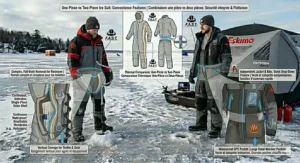
❓ Frequently Asked Questions About Ice Suits in Canada
❓ How thick should ice be for safe fishing in Canada?
❓ Can you wear a one piece ice suit for other winter activities?
❓ What is the best ice suit for extreme Canadian cold?
❓ Do ice fishing suits come in women's sizes for Canada?
❓ How do you wash and maintain flotation ice suits in Canada?
Conclusion: Making Your One Piece vs Two Piece Decision
Standing at the ice fishing crossroads between one piece vs two piece ice suit designs, you now hold the evidence: safety data, mobility analysis, real product comparisons, and pricing in CAD. The choice isn’t about finding the single “best” option—it’s about matching design philosophy to how you’ll actually fish Canadian ice.
Two-piece systems dominate the Canadian market for compelling reasons: temperature adaptability, superior mobility, practical bathroom access, and modular flexibility across the full season. If you fish in varied conditions, move actively between holes, or pursue multi-hour sessions, the WindRider Boreas ($540-610 CAD) delivers exceptional value with lifetime warranty protection. For premium performance with maximum versatility, the Striker Climate system ($825-1,100 CAD) justifies its cost through genuine 3-in-1 functionality and professional-grade engineering.
One-piece coveralls serve specific niches effectively: shelter-based fishing, extreme cold stationary scenarios, and anglers who prioritize simplicity over versatility. The Rothco Insulated Ski and Rescue Suit ($180-280 CAD) provides budget access to full-body coverage, though its lack of flotation demands supplementation with a PFD for mobile ice fishing safety.
Float suits prevent 90% of ice fishing drowning deaths and should be your first safety purchase. Whether one-piece or two-piece, integrated flotation transforms your ice suit from clothing into life-saving equipment. Canadian ice conditions—from Great Lakes pressure cracks to Prairie lake wind—demand this protection.
The final decision criteria simplify to three questions: (1) Will you fish actively or stationary? Active = two-piece. Stationary = either works. (2) Do you need season-long versatility? Yes = two-piece modular. No = optimized one-piece. (3) What’s your budget? Under $500 CAD = Clam IceArmor Edge two-piece or Rothco one-piece. Over $500 = WindRider or Striker two-piece systems.
Canadian winters reward preparation and punish shortcuts. Choose based on how you’ll genuinely fish, not aspirational scenarios. The right ice suit—matched to your actual patterns—means more hours comfortably on the ice, safer conditions across uncertain ice, and seasons of reliable service across our demanding northern winters.
✨ Don’t Miss These Exclusive Deals!
🔍 Take your ice fishing safety and comfort to the next level with these carefully selected products available in Canada. Click on any highlighted item to check current pricing and availability on Amazon.ca. These proven ice suits will help you fish safely and comfortably across Canadian winters!
Recommended for You
- 7 Best Ice Fishing Suits in Canada 2026
- 7 Best Ice Shelter Repair Kits Canada 2026
- 7 Best 2 Person Flip Over Ice Houses Canada 2026
Disclaimer: This article contains affiliate links to Amazon.ca. If you purchase products through these links, we may earn a small commission at no additional cost to you.
✨ Found this helpful? Share it with your friends! 💬🤗
