
In This Article
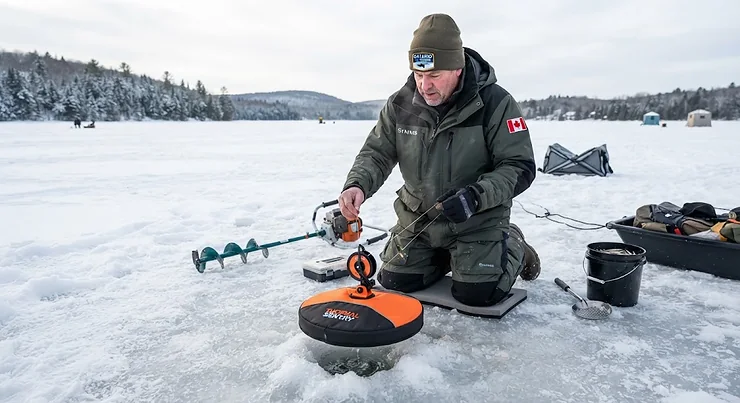
Somewhere around your third trip out to a frozen lake, you learn the hard way that a regular tip-up and a Canadian winter don’t get along. The hole slushes over, the flag freezes in place, and you spend more time chipping ice than watching for a strike. That’s the exact problem thermal tip ups were built to solve, and it’s why so many Canadian ice anglers eventually retire their old wooden rail setups for something insulated. A thermal tip-up uses a sealed, foam-lined, or air-gapped cover to trap a thin layer of warmer air over the hole, which keeps slush from forming and stops the line from freezing solid at the worst possible moment — right when a walleye finally decides to eat.
This guide breaks down seven real thermal tip ups sold in Canada, from budget-friendly nylon models to premium sealed-foam units, based on published specifications and aggregated customer feedback rather than guesswork. We’ll walk through what actually separates a good insulated design from a marketing buzzword, how these units perform once the mercury drops below minus 20°C, and which one fits your specific setup — whether you’re running two lines on a small pond or six holes across open lake ice. Ice fishing remains one of Ontario’s most popular winter pastimes, and gear that actually copes with the cold makes the difference between a productive afternoon and a frustrating one spent thawing your spool with bare hands.
Quick Comparison Table
| Tip-Up | Type | Price Range (CAD) | Best For |
|---|---|---|---|
| Frabill Pro Thermal Original Tip-Up | Insulated round | Around C$30-C$40 | Budget-conscious all-rounders |
| HT Enterprises Polar Therm Extreme | Insulated + tackle box | Around C$35-C$45 | Anglers who want built-in storage |
| CLAM Trophy Thermal Tip-Up | Sealed foam liner | C$45-C$60 range | Serious walleye and pike anglers |
| Frabill Pro Thermal Tip-Up With Light | Insulated + LED | C$45-C$60 range | Low-light and dusk fishing |
| Adnee 10.5″ Thermal Tip-Up | Budget insulated | Under C$25 | First-time buyers, backup units |
| Frabill Arctic Fire Tip-Up | Insulated + high-vis | C$35-C$50 range | Multi-species anglers wanting dual settings |
| SF Insulated Thermal Tip-Up (3-Pack) | Foldable multi-pack | C$55-C$85 range | Anglers running several lines at once |
Looking at the spread here, price alone doesn’t tell the whole story. The Adnee 10.5″ Thermal Tip-Up and the Frabill Pro Thermal Original Tip-Up both sit at the accessible end, but they solve slightly different problems — one prioritizes rock-bottom cost, the other trades on decades of brand reliability. Meanwhile, the CLAM Trophy Thermal Tip-Up justifies its higher price with a fully sealed foam liner and an upgraded bearing system, which matters most if you’re setting lines in minus 25°C conditions for hours at a stretch. If you’re buying more than two or three units, the SF Insulated Thermal Tip-Up 3-Pack often works out cheaper per unit than buying singles, which is worth factoring into your total cost of ownership.
💬 Just one click — help other Canadian parents make better buying decisions too!😊
Top 7 Thermal Tip Ups: Expert Analysis
Here’s where we get into the specifics — real specs, honest trade-offs, and who each one actually suits. None of these are ranked “best to worst”; they’re organized budget to premium so you can find your price point fast.
1. Frabill Pro Thermal Original Tip-Up — the reliable veteran of insulated design
Frabill has been building ice tackle since 1938, and the Pro Thermal Original is close to the company’s flagship thermal model. Its circular, fully insulating cover is rated to keep holes open in temperatures as low as -25°F (about -32°C), which is a genuinely useful spec if you fish anywhere north of the 49th parallel in January. The spool shaft comes pre-lubed with a sub-zero lubricant, so the drag doesn’t stiffen up and cost you a fish the moment temperatures crash.
What most buyers overlook about this model is how much the shaft-in-shaft design matters long-term — it’s re-greasable, meaning you’re not stuck buying a new tip-up every couple of seasons once the factory lubricant wears thin. It’s a strong fit for anyone who wants one dependable, no-frills thermal tip-up rather than a feature-loaded unit. Reviewers consistently report smooth performance out of the box, though a handful mention the guide bail doesn’t always respool the line perfectly evenly, which is a minor annoyance rather than a dealbreaker.
Pros:
- ✅ Freeze-rated to roughly -32°C in real-world use
- ✅ Re-greasable shaft extends the tip-up’s working life
- ✅ Folds flat and stacks inside a standard 5-gallon pail
Cons:
- ❌ Some users report uneven line respooling over time
- ❌ Fewer bonus features than pricier thermal models
At around C$30-C$40, this remains one of the better value-per-dollar picks in the thermal category — check current price before buying, as availability shifts by retailer.
2. HT Enterprises Polar Therm Extreme (PTE-200) — best for built-in tackle storage
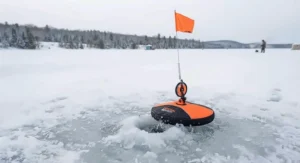
HT Enterprises has supplied ice tackle across Canada and the northern U.S. for decades, and the Polar Therm Extreme leans into that experience with a genuinely clever add-on: a built-in tackle compartment right in the base, so you’re not fumbling through a separate box with cold fingers. The insulated shell seals holes from 6 to 10 inches and works by trapping the thermal energy naturally radiating off the open water below — essentially using physics instead of batteries to keep things from icing over.
Based on the spec comparison against the Frabill models, the Polar Therm Extreme’s standout feature is the adjustable tension trip, which you can dial from light (panfish) to heavy (northern pike or lake trout) without swapping parts. At 1.4 lbs it’s genuinely light for how much it packs in, and the foam hook holder at the base of the spool does a solid job preventing the tangled-line mess that plagues cheaper models. What the spec sheet won’t tell you, but longtime users note, is that the trip mechanism holds up notably well in freeze-thaw cycles compared to metal-spring designs on older-style tip-ups.
Pros:
- ✅ Built-in tackle box saves fumbling with cold hands
- ✅ Adjustable tension trip for multiple species
- ✅ Compact 1.4 lb build fits any 5-gallon pail
Cons:
- ❌ Plastic housing feels less rugged than metal-hardware models
- ❌ No light or flag-visibility upgrade included
Priced around C$35-C$45 depending on retailer, it’s a smart middle-ground buy for anglers who hate carrying separate tackle boxes onto the ice.
3. CLAM Trophy Thermal Tip-Up — best sealed-foam design for serious cold
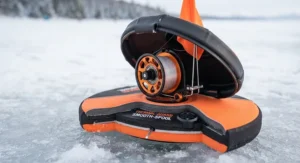
CLAM built its reputation on ice shelters, and that engineering pedigree shows in the Trophy Thermal’s construction. Instead of a hollow insulated shell, this one uses a fully sealed thermal foam liner — a meaningfully different approach that traps warmth more consistently and resists the wind better than an air-gap design. At 10.5 inches in diameter, it comfortably covers a standard 10-inch drilled hole with room to spare, and CLAM’s upgraded bearing-driven spool makes the line release noticeably smoother than older friction-based mechanisms.
Here’s what most buyers overlook about the higher price tag: the dual trip settings and adjustable shaft mean this single unit can handle everything from finicky panfish bites to a hard-charging pike run without needing to swap hardware. Aggregated customer sentiment is genuinely mixed here, which is worth being upfront about — many owners love the smooth bearing action and rigid, highly visible flag, but a notable subset of reviewers report the plastic spool wobbling on early units, with a few explicitly preferring steel-component competitors like Beaver Dam for that reason. That’s the kind of honest trade-off spec sheets never mention.
Pros:
- ✅ Fully sealed foam liner outperforms air-gap designs in wind
- ✅ Bearing-driven spool gives smoother line release
- ✅ Dual trip settings adapt to multiple species
Cons:
- ❌ Some reported spool wobble on individual units
- ❌ Among the pricier options in this roundup
Expect to pay in the C$45-C$60 range — a fair premium if the sealed-foam design and species flexibility matter to your trips.
4. Frabill Pro Thermal Tip-Up With Light — best for dusk and low-light sets
This is essentially the Pro Thermal Original with one meaningful upgrade: a built-in “Lil’ Shiner” LED light that flashes red when a fish trips the flag. If you fish late-afternoon sets that stretch into dusk, or you’re simply tired of squinting across a dark lake trying to spot an orange flag against snow glare, this solves a real, specific problem rather than adding a gimmick.
The insulated base carries over the same freeze-proof rating as the Original, so you’re not sacrificing cold-weather performance to get the visibility boost. What most buyers overlook is how much earlier you catch a strike with the flashing LED compared to a static flag — on a five-hole spread, that extra half-second of notice can be the difference between netting a pike before it spits the hook and coming up with just a bent line. Reviewers who’ve run this model alongside standard thermal tip-ups consistently note the light doesn’t drain quickly and holds up fine in sustained cold.
Pros:
- ✅ Flashing LED dramatically improves low-light bite detection
- ✅ Retains full thermal freeze-protection of the Original
- ✅ Ideal for late-afternoon and early-evening sets
Cons:
- ❌ Higher price than the standard Pro Thermal Original
- ❌ Light requires batteries, adding one more thing to check
Priced around C$45-C$60, it’s worth the upcharge specifically if your trips regularly run past sunset.
5. Adnee 10.5″ Thermal Tip-Up — best budget entry point
Not every angler needs a feature-loaded thermal tip-up, and the Adnee 10.5″ Thermal Tip-Up exists for exactly that reality. It’s a straightforward nylon-construction unit that covers a 10-inch hole, uses a freeze-proof build, and ships with a bright orange pole flag — no tackle box, no LED, just the core thermal function at a genuinely low price point.
Based on the spec comparison, what you’re trading for that low cost is mostly hardware durability rather than core performance — the freeze-resistant coverage still works as intended. Aggregated reviews describe it as delivering “surprising performance without breaking the bank,” and it consistently shows up on Amazon.ca best-seller lists for the category, which suggests real buyers are satisfied with what they’re getting for the price. This is the tip-up to buy if you’re testing whether thermal tip-ups are worth the switch from traditional models, or if you need a few backup units without doubling your gear budget.
Pros:
- ✅ Lowest price point in this roundup
- ✅ Still delivers genuine freeze-resistant hole coverage
- ✅ Lightweight nylon build is easy to transport in bulk
Cons:
- ❌ Lighter-duty hardware than premium competitors
- ❌ No tackle storage or visibility upgrades included
At under C$25, it’s an easy way to build out a multi-line spread without a big upfront investment.
6. Frabill Arctic Fire Tip-Up — best all-around visibility
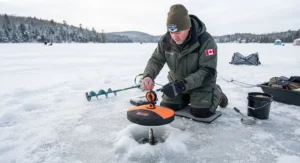
The Arctic Fire pairs Frabill’s thermal-insulated base with a distinctly bright, high-visibility flag system and dual trip settings that switch cleanly between light-biting walleye and aggressive pike. A molded-in ruler on the base is a small but genuinely handy touch — no more eyeballing whether that pike clears your local slot limit before you decide to keep it.
What stands out here, based on aggregated reviewer feedback, is how well the thermal insulation performs specifically in extreme cold: multiple users report going from constant hourly ice-chipping to essentially zero maintenance once they switched to this model. The one recurring complaint worth flagging honestly is that the flag mechanism can feel stiff out of the box, requiring a short break-in period before it trips smoothly — not a serious flaw, but worth knowing before your first trip so you’re not troubleshooting on the ice.
Pros:
- ✅ High-visibility flag easy to spot in snowstorms
- ✅ Dual trip settings switch between species easily
- ✅ Molded-in ruler for instant size checks
Cons:
- ❌ Flag mechanism can be stiff before break-in
- ❌ Mid-range price sits above true budget models
Typically priced in the C$35-C$50 range, this is a strong pick for anglers who fish for a mix of species through the season.
7. SF Insulated Thermal Tip-Up (3-Pack) — best for multi-line spreads
If you’re setting up several holes at once — which many provinces, including Ontario, allow up to two lines per angler for — buying thermal tip-ups as a set makes both logistical and financial sense. The SF Insulated Thermal Tip-Up comes as a 3-pack, each unit covering roughly a 10.6-inch hole with a freeze-proof thermal design, an orange pole flag, and a built-in storage compartment for hooks and swivels.
Here’s the practical math most single-unit shoppers miss: buying three individually priced thermal tip-ups from other brands often costs noticeably more than this bundled set, even before accounting for the convenience of matching hardware across your spread. The foldable design is a genuine space-saver in a gear sled, and the built-in storage means you’re not carrying a separate tackle box for each hole. Reviewers commonly cite this as a strong “best overall” starter set precisely because it solves the outfitting problem — three functional thermal tip-ups — in a single purchase.
Pros:
- ✅ Three thermal tip-ups for less than three separate purchases
- ✅ Built-in storage compartment on each unit
- ✅ Foldable design saves real space in a gear sled
Cons:
- ❌ Individual unit hardware feels lighter-duty than premium singles
- ❌ Less brand track record than Frabill or CLAM
Expect a bundle price in the C$55-C$85 range, which typically works out to strong per-unit value for anglers building out a full spread.
Cold Weather Tip Up Setup Guide: From Unboxing to First Bite
Getting a cold weather tip up performing at its best isn’t complicated, but a few setup habits make a real difference once temperatures drop. Start by re-lubricating the spool shaft with a sub-zero-rated grease before your first trip of the season, even on new units — factory lubricant thins out fast in extreme cold, and a sluggish spool is the single most common reason anglers miss a hookset on a light-biting fish. Drill your hole slightly smaller than the tip-up’s insulated cover diameter; a snug fit traps more warm air underneath and meaningfully improves freeze resistance compared to a hole that’s noticeably wider than the cover.
During your first 30 days with a new thermal tip-up, check the trip tension after every few sets — most units ship with a middle-ground factory setting that’s rarely ideal for your specific target species. A common mistake is leaving the tension set for panfish while targeting pike, which either misses light strikes or trips constantly on wind and current. Also budget a few minutes at day’s end to wipe down and dry the insulated cover before storage; trapped moisture that refreezes overnight is the fastest way to crack foam liners on units like the CLAM Trophy Thermal Tip-Up. Finally, mark your line at standard depth intervals with a permanent marker — it sounds basic, but it saves real time when you’re resetting six holes with numb fingers.
Real-World Scenarios: Which Angler Needs Which Tip-Up
Picture a college student in Kingston, Ontario, commuting to a nearby conservation lake most weekends on a tight budget. For that angler, the Adnee 10.5″ Thermal Tip-Up or a couple of Frabill Pro Thermal Original units make the most sense — low upfront cost, proven freeze resistance, and no unnecessary extras eating into a limited gear fund.
Now consider a family running a weekend ice hut on a Northern Ontario lake, setting four to six lines across a wide spread and fishing well past dusk on Saturday afternoons. That situation calls for something like the SF Insulated Thermal Tip-Up 3-Pack paired with a couple of Frabill Pro Thermal Tip-Up With Light units near the edges of the spread, so the flashing LEDs catch attention even as the sun drops.
Finally, picture a dedicated trophy-pike hunter fishing remote, wind-exposed lakes in temperatures regularly below -20°C. That angler’s priorities are sealed insulation and mechanical reliability over price, which points squarely at the CLAM Trophy Thermal Tip-Up or the Frabill Arctic Fire Tip-Up — both built to hold up to sustained extreme cold and larger, harder-fighting fish without the trip mechanism failing at the worst moment.
Problem → Solution: Fixing the Most Common Tip-Up Headaches
Problem: The hole keeps slushing over despite an insulated cover. This usually means the hole was drilled too wide relative to the cover, letting cold air sneak in around the edges. Solution: drill a hole that’s slightly undersized relative to your unit’s rated diameter, or pack a thin ring of snow around the base to seal any gap.
Problem: The spool freezes stiff by midday. Factory lubricant on budget units like the base-model Adnee 10.5″ Thermal Tip-Up isn’t always rated for extended sub-zero exposure. Solution: re-grease with a dedicated sub-zero lubricant before the season starts, and reapply every few outings in extreme cold.
Problem: You’re missing strikes on light-biting species. Nine times out of ten, this comes down to trip tension set too heavy for the fish you’re targeting. Solution: dial tension down on adjustable models like the HT Enterprises Polar Therm Extreme or the Frabill Arctic Fire Tip-Up, and test the trip by hand before setting your line.
Problem: You can’t spot flags in a snowstorm or at dusk. Standard orange flags lose contrast fast against blowing snow and fading light. Solution: switch at least a couple of units in your spread to a lit model like the Frabill Pro Thermal Tip-Up With Light, positioned at the edges of your spread where visibility matters most.
✨ Don’t Miss These Exclusive Deals!
🔍 Take your ice fishing setup to the next level with these thermal tip ups. Click on any highlighted pick above to check current pricing and availability. The right gear turns a cold, frustrating afternoon into the kind of trip your family actually looks forward to.
How to Choose a Thermal Tip Up
Picking the right thermal tip up comes down to matching a handful of practical criteria to how you actually fish, rather than chasing the flashiest feature list.
- Hole coverage size — Match the tip-up’s rated diameter to the hole size you typically drill; a mismatch undermines the entire thermal benefit.
- Insulation type — Sealed foam liners (like CLAM’s) generally outperform hollow air-gap shells in sustained wind and extreme cold, though they cost more.
- Trip sensitivity range — If you target multiple species, prioritize models with adjustable or dual trip settings rather than a single fixed tension.
- Cold rating — Look for a stated freeze-resistance temperature; -25°F to -32°C is a solid benchmark for genuinely brutal Canadian winters.
- Storage and portability — Built-in tackle compartments and foldable designs matter more the farther you’re hauling gear across the ice.
- Total cost across your spread — Multi-packs like the SF 3-pack often beat buying singles once you need three or more lines.
- Brand track record — Long-established names like Frabill and HT Enterprises carry decades of freeze-cycle testing behind their designs, which shows up in long-term durability.
Insulated Tip Up Review: Foam Liner vs Air-Gap Design
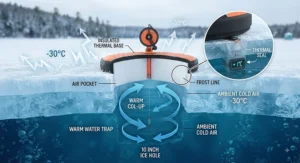
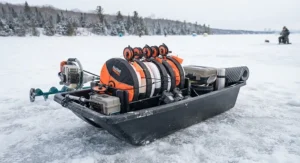
Not all insulation is built the same, and this is genuinely the most misunderstood part of shopping for a thermal tip-up. Air-gap designs, like the standard Frabill Pro Thermal Original, work by trapping a pocket of relatively still air between an outer shell and the hole itself — a straightforward application of basic thermal insulation principles where trapped air resists heat transfer better than open exposure. It’s effective, proven over decades, and generally lighter than sealed-foam alternatives.
Sealed foam liner designs, like the one in the CLAM Trophy Thermal Tip-Up, go a step further by embedding closed-cell foam directly into the cover itself. This resists wind infiltration more effectively than an air-gap shell, since there’s no cavity for gusts to disturb, and it holds its insulating properties more consistently across a full day on exposed lake ice. The trade-off is weight and price — a foam insulated tip up typically costs more upfront than an equivalent air-gap model, and the sealed construction is slightly harder to inspect or repair if it’s ever damaged. For most weekend anglers fishing moderately sheltered lakes, an air-gap design covers the need fine; for anglers regularly exposed to open wind on big water, the extra cost of sealed foam tends to pay off in fewer re-checked holes per trip.
Freeze-Resistant Tip-Ups vs Traditional Tip-Ups
The core difference between freeze resistant tip ups and traditional wood or plastic rail models comes down to one thing: whether the design actively fights hole freeze-up or simply ignores the problem. Traditional tip-ups — the classic vertical-flag rail style — are simple, durable, and often less expensive, but they leave the hole itself completely exposed to the elements. In moderate conditions that’s rarely an issue; in a hard cold snap, that exposed hole can skin over with a layer of ice within 20 to 30 minutes, silently defeating your trip mechanism without you noticing until you check the line.
Thermal models solve that specific failure point by physically covering the hole, but they generally sacrifice some of the mechanical simplicity and bare-bones durability that make traditional rail tip-ups so beloved among long-time anglers — many of whom still swear by classic wood-frame designs for their toughness and repairability on the ice. In practice, the choice often comes down to your typical fishing temperature: if you rarely fish below -10°C, a traditional tip-up performs fine and costs less. Once you’re regularly setting lines below -20°C, the freeze protection on a thermal model like the HT Enterprises Polar Therm Extreme stops being a luxury and starts being the difference between an actively fishable hole and one you’re constantly re-drilling.
Extreme Cold Tip Ups: Real-World Performance at -20°C and Below
Specs on a box only tell part of the story, so here’s what actually happens when extreme cold tip ups meet a genuinely brutal Canadian cold snap. In the -20°C to -30°C range, uninsulated holes typically start skinning over with a thin ice layer within 15 to 30 minutes, depending on wind. A well-sealed thermal unit, like the CLAM Trophy Thermal Tip-Up or Frabill Arctic Fire Tip-Up, can meaningfully extend that window to several hours or longer, based on the aggregated experience anglers report after extended cold-weather use — though no design claims to keep a hole permanently ice-free indefinitely in truly extreme conditions.
What the spec sheet won’t tell you is how much wind interacts with cold to accelerate freeze-up; a -15°C day with a stiff wind can freeze a hole faster than a dead-calm -25°C day. This is exactly why sealed foam designs tend to outperform air-gap shells specifically in extreme, wind-exposed conditions — there’s simply less opportunity for moving air to strip away the trapped warmth. Practically speaking, plan to check even your best thermal tip-ups every 45 to 90 minutes on genuinely extreme days, rather than assuming “insulated” means “maintenance-free.”
Common Mistakes When Buying a Thermal Tip Up
The most common mistake is buying based on price alone without checking the stated cold rating — a tip-up rated for moderate winter use will underperform badly once temperatures drop into genuinely extreme territory, no matter how the packaging markets it. A close second is ignoring hole-to-cover size matching; buyers regularly drill oversized holes for their tip-up’s rated coverage, which lets cold air sneak around the edges and defeats much of the insulation’s purpose.
Another frequent misstep is skipping the pre-season re-lubrication step, assuming factory grease will perform the same in February as it did in the store in October — it won’t, particularly on budget models. Finally, many first-time buyers purchase a single premium unit instead of two or three budget-to-mid-range models, which actually limits their ability to cover water and increases their odds of missing fish altogether, regardless of how well-insulated that one unit happens to be.
Long-Term Cost & Maintenance
A quality thermal tip-up isn’t a one-season purchase if you take care of it, which changes the real cost-per-use math considerably. A Frabill Pro Thermal Original bought for around C$35 and re-greased annually can realistically last five to eight seasons of regular use, working out to under C$7 per season — a strong return compared to replacing a cheaper, non-serviceable unit every year or two. Sealed-foam models like the CLAM Trophy Thermal Tip-Up cost more upfront but typically show less wear on the insulation itself over time, since there’s no exposed cavity to accumulate moisture damage.
Ongoing maintenance costs are minimal either way: a tube of sub-zero grease runs a few dollars and services multiple units for a full season, and replacement flags or line spools are inexpensive when sold separately. The real long-term cost differentiator is hardware quality — models with reported spool wobble or stiff mechanisms, as some reviewers noted on certain units, may need earlier replacement parts, which is worth weighing against the lower sticker price of budget options.
Ice Fishing Safety & Regulations in Canada
Thermal tip-ups solve a comfort and performance problem, but they don’t change the safety and legal framework around ice fishing itself. In Ontario, for example, anglers can generally use up to two lines while ice fishing, provided they stay within 60 metres of each line and maintain a clear, unobstructed view of it at all times — rules that apply just as much to a thermal tip-up as to a traditional rod and reel. Requirements vary by province and even by specific fisheries management zone, so it’s worth checking your local regulations before setting more than one or two lines.
Ice safety matters just as much as gear choice. The Canadian Red Cross recommends a minimum of 15 centimetres of clear, solid ice to support an individual on foot, with a safer margin closer to 20 centimetres when fishing in a group — and no thermal tip-up, however well-insulated, changes that math. Blue or clear ice is generally the strongest, while white, opaque, or recently thawed-and-refrozen ice should be treated as unreliable. Always check thickness with an auger or spud bar as you move away from shore, fish with a partner where possible, and never assume last week’s safe ice is still safe today — temperature swings common across a Canadian winter can change conditions fast.
FAQ
❓ What is a thermal tip up?
❓ Do foam insulated tip up models work better than plastic ones?
❓ How cold can an ice free tip up hole stay before it needs checking?
❓ Are cold weather tip up prices higher than regular tip-ups?
❓ How many tip-ups can I legally run at once in Canada?
Conclusion
Choosing the right thermal tip ups comes down to being honest about how cold your typical trips actually get, how many lines you want to run, and how much you’re willing to spend upfront versus over several seasons. Budget picks like the Adnee 10.5″ Thermal Tip-Up and Frabill Pro Thermal Original cover the fundamentals well for moderate conditions, while the sealed-foam construction on the CLAM Trophy Thermal Tip-Up earns its higher price tag once temperatures drop into genuinely extreme territory. Anglers running multi-line spreads should take a hard look at the SF Insulated Thermal Tip-Up 3-Pack for the per-unit value, and anyone fishing past dusk owes it to themselves to try the Frabill Pro Thermal Tip-Up With Light.
None of these are magic — they’re insulated tools that reduce maintenance and protect your line in weather that would otherwise defeat a traditional setup. Pair the right thermal tip-up with sound ice safety habits, and you’ll spend a lot more of your winter watching for flags than chipping ice.
Recommended for You
- Wooden Tip Up vs Plastic: 7 Best Options Ranked for 2026
- Rail Tip Ups for Ice Fishing: 7 Trusted Picks for Canada in 2026
- Braided Line for Ice Fishing: 7 Top Picks That Won’t Freeze (2026)
Disclaimer: This article contains affiliate links. As an Amazon Associate, I earn from qualifying purchases. If you purchase products through these links, we may earn a small commission at no additional cost to you.
✨ Found this helpful? Share it with your friends! 💬🤗
