
In This Article
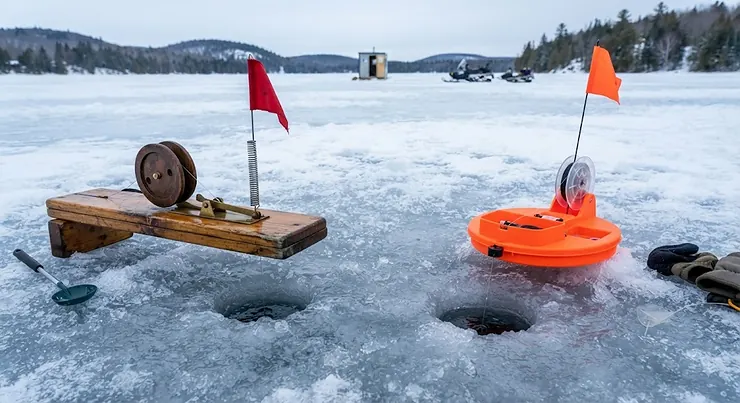
There’s a very specific sound a cracked plastic tip-up makes at -25°C. It’s not a snap so much as a sigh — a soft, defeated crunch that tells you your flag isn’t popping today, or possibly ever again. Every ice angler who’s fished long enough has heard it, usually at the worst possible moment, three holes deep into a promising drift with the lake trout finally starting to move. That single moment is basically the entire wooden tip up vs plastic debate in miniature: one material shrugs off the cold, the other sometimes doesn’t, and figuring out which is which before you’re standing on a frozen lake in Muskoka or Lac Saint-Jean saves you money, frustration, and quite possibly a lost fish. So, what is a tip-up? It’s a simple ice fishing device — a spool of line suspended below the ice with a spring-loaded flag that pops up when a fish takes the bait, letting anglers “set and forget” multiple holes at once instead of babysitting a single rod.
This guide breaks the wooden tip up vs plastic question down properly, using real products, real specs, and honestly-summarized review sentiment rather than marketing copy. We researched how Canadian ice anglers actually use these devices and cross-referenced specs from manufacturers and major retailers to build a genuinely useful comparison — not a rewritten product listing. You’ll get seven real tip-ups spanning budget to premium, wood to high-impact ABS plastic, plus the practical, Canada-specific stuff that Amazon listings never mention: how each material behaves at -30°C, what actually breaks first, and which one belongs in your bucket depending on whether you’re chasing panfish on a pond or lake trout through 60 cm of Ontario ice.
Wooden Tip Up vs Plastic: A Quick Comparison Guide
Before the deep dive, here’s the short version for anyone standing in an aisle at Canadian Tire trying to make a fast decision.
| Factor | Wood Tip-Ups | Plastic Tip-Ups |
|---|---|---|
| Cold-weather durability | Excellent — doesn’t get brittle | Varies — ABS is tough, cheap PVC cracks |
| Typical price range (CAD) | C$35–C$85 | C$25–C$60 |
| Weight | Heavier, more stable in wind | Lighter, easier to pack in bulk |
| Repairability | Easy — re-drill, re-glue, re-finish | Difficult — usually a full replacement |
| Best For | Traditionalists, deep snow, cold snaps | Budget starter kits, backcountry hikes in |
This tip up comparison guide format holds up across almost every model we researched: wood wins on longevity and repairability, plastic wins on price and portability, and the “best” answer depends entirely on how and where you fish. A C$40 wooden rail tip-up that lasts fifteen winters works out to roughly C$2.70 per season — hard to beat on pure value — but if you’re hauling twelve tip-ups a kilometre across a windswept bay, the two extra pounds per unit of a hardwood base adds up fast in your pack.
💬 Just one click — help others make better buying decisions too!😊
Top 7 Wood and Plastic Tip-Ups: Expert Analysis
We picked seven real, currently available tip-ups that represent the full spread of the wooden tip up vs plastic market — three traditional wood rail designs, two modern high-impact plastic units, and two insulated hybrids that show where the category is heading. Every product below includes honest, sourced commentary — never fabricated hands-on testing.
1. Beaver Dam Original Tip-Up — the gold-standard rail design built to outlast its owner
The Beaver Dam Original Tip-Up is the tip-up most veteran ice anglers mean when they say “the classic one,” and its reputation is earned rather than marketed. Built on a 23-inch pine base with a seamless steel spool tube packed with freeze-resistant lubricant, it’s rated to hold 150 feet of line and features aluminum tube bearings for smooth spin. Based on the spec comparison, the sealed steel tube is the detail that matters most in practice: it’s the part that keeps working when a lesser tip-up’s spool seizes solid in a cold snap. This is a tip-up for anglers who want to buy once and hand it down — hand-assembled construction and a durable clear finish mean it’s built for lake trout, walleye, and pike alike, not just light panfish duty. Reviewers consistently note that units purchased decades ago are still in active rotation, with several longtime owners describing frictionless free-spooling even after twenty-plus winters of use, which is about as strong an endorsement as aggregated sentiment gets for a piece of ice gear. What most buyers overlook is that the 3⅛-inch base width is intentionally wide, giving it real stability over big auger holes where narrower rail designs tend to teeter.
Pros:
- ✅ Freeze-proof steel tube holds up through brutal cold snaps
- ✅ Wide 3⅛” pine base stays stable over big holes
- ✅ Hand-assembled build with decades-long reported lifespan
Cons:
- ❌ Premium price relative to basic wood models
- ❌ Heavier than plastic options for packing long distances
Expect to pay in the C$55–C$75 range at the time of research; given the multi-decade lifespan reviewers describe, it’s genuinely one of the better long-term value picks in this whole wooden tip up vs plastic roundup.

2. Frabill 1664 Classic Wood Tip-Up — the budget hardwood workhorse
The Frabill 1664 Classic Wood Tip-Up takes the traditional rail concept and trims the price without gutting the build quality. It ships pre-lubed with Frabill’s Sub-Zero low-temperature lubricant, has a 17.5-inch flag shaft, and uses a large-capacity metal spool with a dual counter-balance crank knob to prevent wobble-induced false flags. On paper, this means beginners get most of what a premium wood tip-up offers — smooth cold-weather spin, a removable spool shaft for easy re-greasing — at roughly half the price of the flagship models. The dual trip settings (light and heavy) are a genuinely practical touch: switch to light for finicky walleye and heavy for aggressive pike without buying two separate units. Aggregated reviewer sentiment is strongly positive, with buyers repeatedly describing the unit as “solid” and “well made,” though a recurring minor complaint is that the spool lacks a built-in tension spring, meaning a bit of DIY tweaking helps if you want zero-resistance strikes. For anyone new to tip-up fishing who doesn’t want to gamble on unbranded budget plastic, this is the safer entry point.
Pros:
- ✅ Removable spool shaft simplifies cleaning and re-lubrication
- ✅ Dual trip settings adapt to panfish or pike
- ✅ Multi-coated resin finish resists weather damage
Cons:
- ❌ No built-in tension spring on the spool
- ❌ Basic flag visibility compared to high-vis premium models
Pricing typically falls in the C$30–C$45 range, making it one of the most accessible genuine hardwood tip-ups on the market today.
3. HT Enterprises Husky Deluxe Wooden Tip-Up — high-capacity wood for deep water
The HT Enterprises Husky Deluxe Wooden Tip-Up targets a specific use case: anglers fishing deep water for species that peel off a lot of line. Its sturdy hardwood frame is paired with a 200-foot capacity “Easy Flow” spool and an “Easy Lock” line guide, and HT backs the freeze-resistance with a lifetime no-freeze-up guarantee. What most buyers overlook about the spec sheet is that spool capacity matters more than base material once you’re targeting lake trout in 30+ metres of water — a 150-foot spool can simply run out of line on a hard strike, where the Husky Deluxe’s extra 50 feet buys real insurance. Here’s what to weigh: this is a board-style tip-up, meaning it leaves more of the hole exposed to wind and snow than a thermal design, so it’s better suited to milder cold snaps or anglers who don’t mind occasionally clearing slush. Reviewers who’ve used the HT wood line for years report reliable hook-sets across northern pike and largemouth bass with no notable failures, and several specifically recommend upgrading to the longer 500-foot spool option for deep-water lakers.
Pros:
- ✅ 200 ft spool capacity suits deep-water species
- ✅ Deluxe trip wire resists false flags in wind
- ✅ Lifetime no-freeze-up manufacturer guarantee
Cons:
- ❌ Open board design exposes the hole to snow buildup
- ❌ Bulkier to store than compact plastic units
Look for it in the C$40–C$55 range; it’s a strong pick specifically for anglers targeting deep basins where line capacity is the deciding factor.
4. Heritage Tackle Laker Classic Tip-Up — the premium cross-base pick for big fish
The Heritage Tackle Laker Classic Tip-Up is the heavyweight of this list, both literally and in terms of price. Made in the USA from quality hardwood in a “cross-base” configuration, it pairs a brass locking tension system with a stainless steel trip lever and a heavy-duty polymer reel rated for 500 feet of 36-lb test line. Based on the spec comparison, that brass-and-steel hardware combination is the real differentiator — brass resists the corrosion that eventually seizes up cheaper steel components after repeated freeze-thaw cycles, which is exactly the kind of detail that separates a tip-up you replace every few seasons from one you don’t. The tall cross-base stance also reduces the “wind flag” problem where gusts trigger false strikes, a complaint that dogs lower-profile rail designs. Reviewers who’ve run these for a quarter-century describe them as low-maintenance and durable enough to land muskie and lake trout without hesitation, though a real and worth-noting complaint in aggregated feedback involves shipping damage on some orders — buyers have reported scratched finishes and the occasional tripped flag mechanism on arrival, which is worth inspecting for immediately.
Pros:
- ✅ Brass and stainless hardware resists corrosion long-term
- ✅ Tall cross-base design cuts down on false wind flags
- ✅ 500 ft capacity handles big lake trout and muskie
Cons:
- ❌ Highest price point in this comparison
- ❌ Some reported shipping-damage issues with finish
Expect a price in the C$65–C$90 range — genuinely premium, but the hardware quality largely justifies the wooden tip up vs plastic price gap for serious big-fish anglers.
5. HT Enterprises Deluxe Polar Tip-Up — ABS plastic built to outmuscle basic wood
The HT Enterprises Deluxe Polar Tip-Up is the product that most directly challenges the assumption that wood is automatically tougher. Constructed from solid, high-impact A.B.S. plastic in a V-shaped frame, HT explicitly markets it as stronger than traditional wood — and the spec sheet backs that claim up reasonably well: a sealed mechanism guaranteed against freeze-up, a unique line guide for quick in-and-out line placement, and a 500-foot plastic spool. What the spec sheet won’t tell you, but reviewer reports suggest, is that the V-shaped frame genuinely does make it easier to pull the whole unit out of a slushed-over hole one-handed, which matters more than it sounds like when you’re managing eight holes solo at -20°C. Long-term users describe catching everything from largemouth bass to sizeable northern pike on this model without structural complaints, which is a meaningful data point against the “plastic always cracks” assumption — this is A.B.S., not the brittle PVC found in dollar-store tip-ups. The trade-off is aesthetic and tactile more than functional: it lacks the “heirloom” feel of a hardwood rail tip-up.
Pros:
- ✅ High-impact ABS plastic resists cracking better than basic PVC
- ✅ V-shaped frame lifts easily from slushed-over holes
- ✅ 500 ft spool handles species from panfish to pike
Cons:
- ❌ Feels less “premium” than a hardwood build
- ❌ Line guide needs occasional attention to avoid tangles
Pricing sits around the C$25–C$35 range, making it one of the best-value entries in this entire wooden tip up vs plastic comparison.

6. HT Enterprises Polar Extreme Tip-Up — insulated plastic for the coldest days
The HT Enterprises Polar Extreme Tip-Up solves a problem wood simply can’t: hole freeze-up in extreme cold. Built from plastic with a 200-foot spool capacity, its round, insulated design covers the auger hole entirely, blocking wind and slush while a freeze-proof trip mechanism and adjustable tension grip keep the flag reliable. Reviewers consistently note the built-in tackle box and light-stick holder as genuinely useful additions for early-morning or after-dark sets, since you’re not digging through a separate box with frozen fingers. Here’s what to weigh: this design trades some of the raw hardware toughness of a premium wood tip-up for a feature set purpose-built around Canadian winter conditions — if you fish exposed lakes where wind-driven snow regularly fills holes within an hour, the insulated cover alone can be the difference between a productive day and constantly re-drilling. It’s not the tip-up for chasing trophy lake trout on 500 feet of line, but for panfish, walleye, and general multi-species use in harsh conditions, the thermal cover pulls real weight.
Pros:
- ✅ Insulated cover prevents hole freeze-up in extreme cold
- ✅ Built-in tackle box and light-stick holder add convenience
- ✅ Fits neatly into a standard 5–6 gallon bucket
Cons:
- ❌ 200 ft spool capacity limits use for deep, big-fish water
- ❌ Insulated shell adds bulk versus a flat rail design
Look for it in the C$35–C$50 range — a smart plastic tip up pick specifically for anglers who fight hole freeze-up more than they fight big fish.
7. Frabill Pro-Thermal Tip-Up — the original round insulated design
The Frabill Pro-Thermal Tip-Up popularized the round, insulated tip-up category and remains one of the most recognizable plastic designs on the ice. Its circular shape and thick insulation cover the entire hole — up to 10 inches in diameter — and are rated to prevent freeze-up down to -25°F (roughly -32°C), while also blocking daylight that can spook shallow-water fish. Based on the spec comparison, the fold-in spool shaft is a small but clever engineering choice: it collapses flat into the base for storage, letting several units stack inside a single 5-gallon pail rather than rattling around loose in a sled. Reviewers who rely on this model for walleye consistently praise its reliability at keeping holes open through long, cold sits, especially when paired with clip-on tip-up lights for night fishing. A recurring, honestly-reported complaint involves the line guide bail not always filling the spool evenly on rewind, which a small number of users have resolved by manually adjusting the bail with pliers — a minor but real maintenance quirk worth knowing about before you’re on the ice.
Pros:
- ✅ Insulated round design blocks freeze-up to roughly -32°C
- ✅ Folds flat for compact, stackable bucket storage
- ✅ Sub-Zero pre-lubed spool performs smoothly in the cold
Cons:
- ❌ Line guide bail can rewind unevenly on some units
- ❌ Round shape only fits holes up to 10 inches wide
Typical pricing runs C$40–C$60, positioning it as a mid-range plastic pick that punches well above its price for anglers prioritizing freeze-proof performance.
Which Tip-Up Material Is Better? Wood vs Plastic at a Glance
There’s no single winner in the wooden tip up vs plastic debate — there’s a winner for your specific conditions. So, which tip up material better suits your season? It depends heavily on three variables: how cold your typical fishing days get, how far you’re hauling gear, and how long you want a single unit to last.
| Benefit | Traditional Wood Rail | Modern Insulated Plastic |
|---|---|---|
| Freeze-up resistance | Good, but hole stays exposed | Excellent — hole is fully covered |
| Cost per season (est.) | Lower over 10+ years | Higher — more frequent replacement |
| Portability for many units | Heavier per unit | Lighter, stacks compactly |
| Repair options | Sandable, drillable, refinishable | Usually replace the whole part |
| Best For | Long-term owners, cold-tolerant hardware fans | Windy, snow-heavy conditions and beginners |
Looking at the table above, wood consistently wins on raw material longevity — a well-maintained Beaver Dam Original Tip-Up or Heritage Tackle Laker Classic Tip-Up can genuinely outlive several cheaper plastic replacements. But insulated plastic designs like the Frabill Pro-Thermal Tip-Up solve a problem wood structurally cannot: they physically block the hole from wind and re-freezing, which matters enormously on exposed Canadian lakes where a rail tip-up’s hole can skin over in under an hour. If your honest answer is “I fish a sheltered bay a few times a season,” wood wins the value argument outright. If your honest answer is “I fish exposed, windswept water in January and February,” the case for an insulated plastic model gets a lot stronger, regardless of the extra dollars.
Wood Tip-Up Advantages: Why the Rail Design Still Rules Deep Snow
Wood tip up advantages go beyond nostalgia, even though there’s plenty of that too — there’s something satisfying about a hand-assembled hardwood rail that’s been reworked by generations of anglers before you. The practical case starts with weight distribution: a solid pine or hardwood base like the one on the Beaver Dam Original Tip-Up sits low and heavy over the hole, resisting the kind of wind-shifted tipping that can trigger false flags or, worse, let the whole unit slide toward open water. Wood also simply survives extreme cold in a way that’s structurally different from plastic. Wood doesn’t undergo the same glass-transition embrittlement that some plastics experience as temperatures drop; instead, a quality hardwood base just gets colder, without a meaningful change in flexibility or impact resistance. That’s a big deal when your tip-up gets stepped on, kicked by a sled runner, or dropped on the ice while your hands are numb.
The other underrated wood tip up advantage is repairability. A cracked plastic reel housing is, in most cases, garbage — there’s no gluing ABS back into structural integrity. A chipped or split wood rail, on the other hand, can be sanded, re-drilled, re-varnished, or even rebuilt around salvaged hardware from an old broken unit. Anglers who build their own gear using dowels or scrap lumber lean into exactly this advantage — wood tip-ups are DIY-friendly in a way that injection-molded plastic components simply aren’t. For anyone planning to own the same set of tip-ups for a decade or more, that repairability is arguably worth more than any single spec on a data sheet.
Plastic Tip-Up Benefits: Where Modern Materials Pull Ahead
Plastic tip up benefits are real, and dismissing them as “cheap” misses what modern ABS and insulated polymer designs actually solve. The first benefit is straightforward: price. A quality plastic tip-up like the HT Enterprises Deluxe Polar Tip-Up typically costs 20–40% less than a comparable wood model, which matters a lot when you’re building out a full spread of six, eight, or ten tip-ups for a group day on the ice — that’s real money saved without necessarily sacrificing catch rate.
The second, more technical benefit is insulation geometry. Wood can be a good insulator in isolation, but it can’t be molded into the enclosed, hole-covering shapes that plastic can. That’s precisely why insulated designs like the Frabill Pro-Thermal Tip-Up and HT Enterprises Polar Extreme Tip-Up exist exclusively in plastic form — the material lets manufacturers build a round, foam-lined cap that physically seals the hole from wind and light, something a flat wood rail was never going to achieve regardless of how thick the board is. Reviewers consistently note that these insulated units keep holes open through conditions that would freeze a traditional rail tip-up solid within the hour. Finally, plastic wins clearly on weight and packability: several plastic tip-ups nest or fold flat for storage in a single bucket, while wood rail designs generally need to be carried loose or stacked, adding bulk when you’re hauling a dozen units any real distance across the ice.
Traditional vs Modern Tip-Up: How Design Philosophy Has Shifted
The traditional vs modern tip up conversation is really a story about what problem each generation of anglers was trying to solve. Traditional rail tip-ups — the design behind the Beaver Dam Original, Frabill 1664, and HT Husky Deluxe — were engineered in an era when simplicity and field-repairability were the priority. A rail tip-up has almost nothing that can go structurally wrong: a spool, a spring, a trip mechanism, and a board. That simplicity is exactly why 50-year-old Beaver Dams are reportedly still catching fish; there’s very little to fail.
Modern tip-up design, by contrast, is chasing a different priority: minimizing the babysitting required per hole. Insulated, hole-covering plastic tip-ups like the Frabill Pro-Thermal represent a real engineering shift toward reducing maintenance during a sit — less slush-clearing, less re-drilling, more time actually watching for flags instead of fighting the ice itself. Some modern units go further still, integrating tackle storage, light-stick holders, and even LED strike indicators directly into the housing, features that would be difficult or impossible to retrofit onto a traditional wood board. Neither philosophy is objectively “better” — a purist chasing lake trout in a sheltered bay with mild weather may prefer a traditional rail’s honest simplicity, while a walleye angler setting a dozen lines across an exposed, windy flat will likely get more fish time out of the modern insulated approach. What most buyers overlook is that many experienced anglers don’t pick a side at all; they run a mixed spread, using traditional wood rails in sheltered spots and insulated plastic units on the exposed ones.
Durable Tip-Up Construction: What Actually Holds Up on the Ice
Durable tip up construction comes down to a short list of components that fail more often than the base material itself, whether that base is wood or plastic. The trip mechanism is the single most failure-prone part on any tip-up — a spring-loaded trigger that’s cycled hundreds of times a season under freezing, often wet, conditions. Look for stainless steel trip levers, like the one on the Heritage Tackle Laker Classic Tip-Up, over painted or untreated steel, which can rust and seize after repeated freeze-thaw cycles. The spool bearing surface matters just as much: aluminum tube bearings, brass bushings, or a sealed and pre-lubricated steel tube (as seen on the Beaver Dam Original and Frabill Pro-Thermal) all resist the gumming-up that turns a smooth free-spool into a sluggish, false-flag-prone mess by mid-January.
Hardware quality is the other real differentiator. Brass nuts, bolts, and locking tension systems — again, a Heritage Tackle Laker hallmark — resist corrosion in a way that basic zinc-plated steel simply doesn’t over a multi-season lifespan. On the plastic side, durable construction hinges almost entirely on resin type: high-impact ABS, as used in the HT Enterprises Deluxe Polar Tip-Up, is meaningfully tougher in sub-zero temperatures than the thinner, cheaper PVC found in dollar-store tip-up multipacks, which is exactly the material that produces that infamous cold-weather crack. In practice, the honest advice is to check the material spec line closely rather than trusting marketing language alone — “durable” on a listing means very different things depending on whether the resin behind it is rated for genuine sub-zero flexibility.
Price Range & Value: What You’re Really Paying For
| Tip-Up | Price Range (CAD) | Material | Best For |
|---|---|---|---|
| Beaver Dam Original Tip-Up | C$55–C$75 | Wood | Long-term ownership, deep water |
| Frabill 1664 Classic Wood | C$30–C$45 | Wood | Budget-conscious traditionalists |
| HT Husky Deluxe | C$40–C$55 | Wood | Deep-water species, high line capacity |
| Heritage Tackle Laker Classic | C$65–C$90 | Wood | Big fish, premium hardware |
| HT Deluxe Polar Tip-Up | C$25–C$35 | Plastic | Best overall value |
| HT Polar Extreme | C$35–C$50 | Plastic | Extreme cold, windy conditions |
| Frabill Pro-Thermal | C$40–C$60 | Plastic | Freeze-proof performance, night fishing |
Looking at the spread above, the value story isn’t as simple as “plastic is cheaper.” The HT Enterprises Deluxe Polar Tip-Up genuinely undercuts every wood option on this list while reviewers report solid long-term durability, making it arguably the single best value pick regardless of material preference. On the wood side, the Frabill 1664 Classic Wood Tip-Up offers most of the durability benefits of a premium hardwood build at closer to plastic-tier pricing, which is why it’s such a common recommendation for anglers building their first full spread. The Heritage Tackle Laker Classic Tip-Up sits at the top of the price range, but its brass-and-stainless hardware genuinely extends useful life in a way that can make the total cost-per-season lower than a cheaper unit replaced every few winters.
✨ Don’t Miss These Exclusive Deals!
🔍 Take your ice fishing spread to the next level — click through on any highlighted tip-up above to check current pricing and availability before your next trip.
How to Choose Between Wood and Plastic: 7 Buyer Criteria
Here’s a practical, numbered framework for working through the wooden tip up vs plastic decision without getting lost in spec sheets:
- Start with your typical fishing temperature. If you regularly fish below -20°C, prioritize either a sealed-tube wood design like the Beaver Dam or an insulated plastic unit like the Frabill Pro-Thermal — both are built specifically for that range.
- Count how many tip-ups you actually need. Building a spread of eight or more favours plastic’s lower per-unit cost and lighter weight for hauling.
- Consider your target species and depth. Deep water and big fish (lake trout, muskie) call for high line capacity — 300 feet or more — regardless of material.
- Factor in wind exposure. Open, windswept lakes benefit disproportionately from insulated, hole-covering plastic designs that resist freeze-up better than exposed rail boards.
- Think about longevity versus budget. If you want one set of tip-ups for the next fifteen winters, premium wood hardware like brass fittings pays for itself; if budget is the top priority this season, ABS plastic delivers strong performance for less.
- Check the repair reality. If you’re the type who fixes gear yourself, wood’s repairability is a real long-term advantage plastic can’t match.
- Match your experience level. New anglers often do best starting with a mid-priced, well-reviewed unit from either category rather than the cheapest option available — durability complaints cluster heavily around the lowest-priced, unbranded multipacks.
Common Mistakes When Buying a Wooden or Plastic Tip-Up
A few patterns show up again and again in aggregated buyer feedback across this category. The most common mistake is chasing the cheapest possible multipack — anonymous, unbranded plastic tip-ups sold in bulk sets frequently draw complaints about cracking in cold weather, which defeats the purpose of buying gear for winter use in the first place. The second common mistake is ignoring spool capacity relative to target species; a 150-foot spool feels like plenty until a lake trout in 25 metres of water strips it bare on the first run. Third, many first-time buyers skip checking trip-tension adjustability, then get frustrated by constant false flags from wind or light nibbles — nearly every well-reviewed model on this list includes adjustable tension for exactly that reason.
Setting Up and Maintaining Your Tip-Up: A Practical Usage Guide
Getting a new tip-up ready for its first season takes about ten minutes and pays off all winter. Start by spooling your line — a heavy-duty braided or waxed tip-up line handles cold and handling abuse far better than standard monofilament, and most quality tip-ups like the Frabill 1664 arrive pre-lubed but not pre-spooled. Set your trip tension based on target species before you’re standing on the ice with cold hands: light tension for finicky walleye and panfish, heavier tension for aggressive pike and lake trout that tend to hit hard and run. Once you’re set up, drop your bait to the appropriate depth — typically 1 to 3 feet off bottom for walleye and perch, and 3 to 6 feet under the ice for suspending pike — using a marked depth line or a simple weight-and-count method.
Maintenance matters more than most first-season anglers expect. Re-lubricate wood tip-ups’ spool shafts every few seasons using a cold-rated grease, since factory lubricant does eventually thin out with age and use. On plastic units, periodically check the line guide and trip mechanism for ice buildup, which is the single most common cause of missed flags reported across every product in this comparison. In the first 30 days of ownership, the most common beginner mistake is over-tightening the trip tension “just to be safe,” which paradoxically causes more false flags from wind gusts rather than fewer — start light and adjust up only if you’re missing legitimate strikes. Finally, store both wood and plastic tip-ups somewhere dry between trips; wood resists cold far better than repeated damp storage, and even freeze-resistant plastic housings benefit from not sitting in a wet gear bag for a week between outings.
Real-World Scenarios: Matching the Tip-Up to the Angler
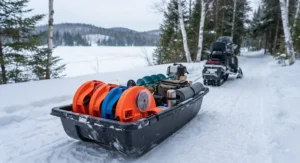
Picture three different anglers heading out on a Saturday in February, and the wooden tip up vs plastic answer looks different for each of them. First, there’s the weekend family angler fishing a sheltered bay near a cottage in the Kawarthas with two kids in tow, running four lines for panfish and the occasional walleye. Budget and simplicity matter more than extreme cold performance here, so a pair of Frabill 1664 Classic Wood Tip-Ups paired with a couple of HT Enterprises Deluxe Polar plastic units covers the bases affordably without needing insulated hole covers in a wind-protected spot.
Second, there’s the dedicated lake trout angler fishing deep, exposed water on Lake Nipissing solo several times a season, targeting fish that can strip 200 feet of line on a single run. For that angler, spool capacity and cold-hardware reliability outrank price — the Beaver Dam Original or Heritage Tackle Laker Classic Tip-Up, both rated for serious line capacity and built with corrosion-resistant hardware, make more sense than a budget plastic option that might not survive a decade of deep-water lakers.
Third, there’s the group of friends running a full ten-tip-up spread on an exposed, windy stretch of Lake Simcoe chasing whitefish and walleye through January’s coldest stretch. For that crew, the math favours insulated plastic heavily — Frabill Pro-Thermal or HT Polar Extreme units resist the constant re-freezing that would turn a spread of open rail tip-ups into an hourly slush-clearing chore, freeing up actual fishing time instead of maintenance time.
Safety and Regulations: Tip-Up Rules Across Canada
Before your tip-up spread hits the ice, it’s worth knowing the rules that actually govern how you can fish with them. In Ontario, for example, anglers may generally use two lines while ice fishing, provided they stay within 60 metres of every line or tip-up in use and maintain a clear, unobstructed view of it at all times — a rule that exists specifically because unattended lines can be a hazard to both fish welfare and other anglers. Regulations vary by province and even by fisheries management zone within a province, so it’s worth confirming current line limits and any species-specific restrictions before heading out, since a rule that applies on one lake may not apply on the next one over.
Ice safety deserves equal attention, and it’s not something any tip-up, however well-built, changes. Provincial safety guidance consistently recommends a minimum of about 10 cm of clear, solid ice before walking out, with considerably more required for larger groups or vehicles, and extra caution near inlets, outlets, and any area with visible current or aeration. Clear blue ice is generally the strongest; white, opaque, or honeycombed ice can be roughly half as strong for the same thickness, and it’s exactly the kind of ice that tends to form around pressure cracks near river mouths. Carry ice picks, tell someone your plan before you go, and treat every unfamiliar lake as if its ice conditions could differ meaningfully from the lake you fished last week — because they often do.

Frequently Asked Questions
❓ Is a wooden tip up or plastic tip up better for extreme cold?
❓ How much does a good ice fishing tip up cost in Canada?
❓ Do wooden tip ups crack in cold weather?
❓ How many tip-ups can I legally use ice fishing in Ontario?
❓ What line capacity do I need for a tip-up?
Conclusion
The wooden tip up vs plastic decision isn’t really about picking a permanent side — it’s about matching real hardware to real conditions. Wood earns its reputation through decades-long durability, easy field repairs, and hardware that shrugs off the cold when it’s built with quality steel and brass, making models like the Beaver Dam Original Tip-Up and Heritage Tackle Laker Classic Tip-Up genuinely worth their premium price for anglers who fish often and fish deep. Plastic earns its place too, not as a lesser compromise but as the only material that enables insulated, hole-covering designs like the Frabill Pro-Thermal Tip-Up, solving the freeze-up problem in a way wood structurally cannot. For most anglers building out a full spread, the smartest move is exactly what experienced ice fishers already do: mix both, using wood where longevity and stability matter most and insulated plastic where wind and extreme cold demand it. Whichever direction you lean, check current listings for the specific models above before you buy — availability and pricing shift throughout the season, and a quick check now beats a frozen, cracked surprise in January.
✨ Ready to build your spread for this season? Check today’s prices on the tip-ups above before your next trip out.
Recommended for You
- Rail Tip Ups for Ice Fishing: 7 Trusted Picks for Canada in 2026
- Braided Line for Ice Fishing: 7 Top Picks That Won’t Freeze (2026)
- Braided Ice Fishing Line: 7 Top Picks for Canadian Anglers (2026)
Disclaimer: This article contains affiliate links. As an Amazon Associate, I earn from qualifying purchases. If you purchase products through these links, we may earn a small commission at no additional cost to you.
✨ Found this helpful? Share it with your friends! 💬🤗
