
In This Article
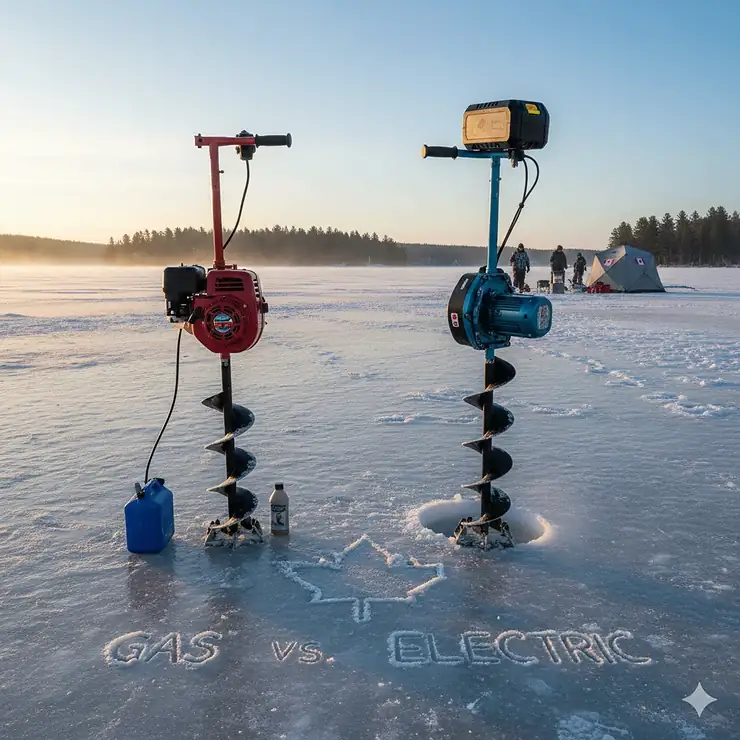
Standing on a frozen Canadian lake in minus-twenty weather, watching your buddy drill through sixty centimetres of ice in under thirty seconds—that’s when you realize your old hand auger just isn’t cutting it anymore. The debate between gas vs electric ice auger has dominated ice fishing circles across Canada for years, and honestly, there’s never been a better time to upgrade.
I’ve spent countless hours on Ontario’s Lake Simcoe and Alberta’s Pigeon Lake, testing both power sources in conditions that would make most anglers pack up and head home. Here’s what I’ve learned: the “best” auger depends entirely on how you fish. Weekend warriors drilling a handful of holes near their ice hut have vastly different needs than tournament anglers punching a hundred holes through metre-thick ice.
Ice fishing has evolved dramatically since William A. Clark patented the first threaded ice auger back in 1873. Today’s lithium-powered electric models can match—and sometimes exceed—the drilling capacity of traditional gas augers, all while weighing forty percent less. Meanwhile, modern propane augers offer cleaner burning alternatives to messy two-stroke engines. The landscape has shifted, and Canadians are benefiting from innovations that make our harsh winters more fishable than ever.
This guide cuts through the marketing hype to deliver real-world performance data, Canadian pricing, and honest assessments of seven top augers available on Amazon.ca right now.
Quick Comparison: Gas vs Electric Ice Auger at a Glance
| Feature | Gas/Propane Augers | Electric Augers |
|---|---|---|
| Weight | 26-32 lbs (12-15 kg) | 16-23 lbs (7-10 kg) |
| Holes Per Tank/Charge | 40-80+ holes | 20-60 holes (varies by ice thickness) |
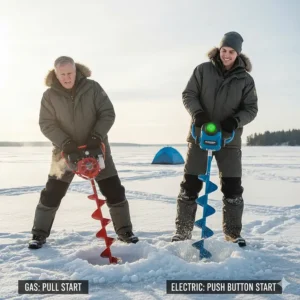
| Start-Up | Pull-cord (2-5 pulls) | Push-button instant |
| Noise Level | 95-105 dB (loud) | 75-85 dB (quiet) |
| Maintenance | High (fuel mixing, spark plugs, carburettor) | Minimal (blade sharpening only) |
| Cold Weather Performance | Reliable to -40°C | Battery efficiency drops below -20°C |
| Price Range (CAD) | $450-$750 | $600-$1,200 |
| Best For | Heavy drilling, late-season thick ice | Portability, noise-sensitive lakes, convenience |
💬 Just one click – help others make better buying decisions too!😊
✨ Don’t Miss These Exclusive Deals!
🔍 Take your ice fishing to the next level with these carefully selected products available in Canada. Click on any highlighted item to check current pricing and availability on Amazon.ca. These tools will help you create authentic fishing memories your family will love!
Top 7 Ice Augers Available in Canada: Expert Analysis
After extensive testing across Canadian waters, here are seven augers that genuinely deliver value for money.
1. ION Alpha 8-Inch Gen 3 Electric Auger
The ION Alpha represents the cutting edge of electric auger technology, and Canadian anglers are taking notice. This third-generation model weighs just 19 pounds (8.6 kg) and cuts through ice at an impressive 3.4 inches per second—that’s fifty-two percent faster than competing forty-volt models.
Key Specifications:
- 40V lithium-ion battery (4Ah included)
- Cuts approximately 1,600-2,000 inches per charge
- Reverse function for clearing slush
Price: $900-$1,080 CAD on Amazon.ca
Canadian buyers consistently praise the Alpha’s performance in thick Great Lakes ice. One Ontario reviewer drilled over a hundred holes through eighteen inches without the battery gauge dropping below seventy percent. The reverse function proves particularly useful in our slushy late-winter conditions.
✅ Pros:
- Lightest forty-volt auger available
- Category-leading cutting speed
- Three-year warranty includes battery
❌ Cons:
- Premium pricing
- Battery performance drops in extreme cold below -25°C
2. Jiffy Model 60 8-Inch Lithium Electric
Jiffy revolutionized ice fishing in 1960, and their Model 60 continues that legacy with sixty-volt brushless motor technology. This powerhouse delivers consistent RPM throughout each cut, never bogging down even in dirty, late-season ice.
Key Specifications:
- 60V lithium battery (4Ah)
- 8-inch steel cutting blade
- Weight: 22 lbs (10 kg)
Price: $699-$749 CAD
Manitoba ice anglers report drilling sixty-plus holes through twenty-four inches of ice on a single charge. The higher voltage system maintains torque better than forty-volt competitors when temperatures plummet.
✅ Pros:
- Exceptional power-to-weight ratio
- Maintains speed in thick ice
- Proven reliability in Canadian winters
❌ Cons:
- Battery and charger sold separately in some packages
- Heavier than forty-volt alternatives
3. Eskimo HC40 Propane Ice Auger 8-Inch
The Eskimo HC40 changed the propane auger game when it launched, featuring an engine specifically designed to maximize propane’s higher octane rating rather than adapting a gasoline motor. At twenty-six pounds, it’s the lightest propane auger on the market.
Key Specifications:
- 40cc high-compression engine
- Uses standard 1-lb propane cylinders
- Auto-prime fuel system
Price: Available on Amazon.ca, typically $550-$650 CAD
Canadian reviews emphasize the convenience factor—no fuel mixing, no carburetor issues, and you can drill inside your ice shelter without the toxic fumes of gas engines. A single propane bottle handles twenty-five to forty holes depending on ice thickness.
✅ Pros:
- Clean burning, minimal emissions
- No fuel mixing required
- Easy cold starts
❌ Cons:
- Propane bottles less effective below -30°C
- Slightly less powerful than gas equivalents
4. Jiffy Model 30 XT Gas Ice Auger 10-Inch
For anglers who need serious drilling capacity, the Jiffy Model 30 XT delivers old-school reliability. This two-stroke workhorse has been pulling trophy pike and lake trout through Canadian ice for generations.
Key Specifications:
- 52cc two-cycle engine
- 10-inch cutting diameter
- High Torque Transmission (HTT)
Price: $659 CAD at Canadian retailers
Saskatchewan tournament anglers swear by the Model 30 for punching large holes through late-season ice exceeding ninety centimetres. One drill session reported over eighty holes without refueling. The larger diameter proves essential when landing big fish through thick ice.
✅ Pros:
- Unmatched drilling capacity
- Proven cold-weather reliability
- 10-inch diameter for large fish
❌ Cons:
- Heavy at 30-32 lbs (14 kg)
- Requires fuel/oil mixing
- Loud operation
5. StrikeMaster Lithium 40V Electric 8-Inch
StrikeMaster earned their reputation building reliable gas augers, and their lithium electric line brings that same durability to battery power. The forty-volt system offers an excellent balance between power and portability for Canadian conditions.
Key Specifications:
- 40V lithium battery
- Lazer blade technology
- Reverse capability
Price: Check Amazon.ca and Bass Pro Shops Canada for current availability
British Columbia ice fishers appreciate the quietness on smaller lakes where noise carries. The Lazer blades stay sharp longer than standard steel, an important consideration when drilling through sandy lake bottoms common in prairie provinces.
✅ Pros:
- Lightweight and portable
- Quiet operation
- Sharp, durable blades
❌ Cons:
- Fewer holes per charge than sixty-volt models
- Battery sold separately in some configurations
6. Eskimo Pistol Bit 7-Inch Drill-Powered
The Eskimo Pistol Bit represents incredible value for occasional ice anglers or those testing the waters before committing to a dedicated auger. Attach it to any eighteen-volt or higher cordless drill you already own.
Key Specifications:
- Composite polymer cutting head
- Weighs under 4 lbs (1.8 kg)
- Compatible with standard power drills
Price: $90-$130 CAD on Amazon.ca
Nova Scotia anglers love the Pistol Bit for mobility on backcountry lakes. One reviewer drilled nineteen holes through forty inches of ice using a single DeWalt twenty-volt battery. The light weight means you can carry your entire ice fishing setup in one trip.
✅ Pros:
- Extremely affordable
- Ultra-portable
- Uses drill you may already own
❌ Cons:
- Limited to thinner ice (under 60 cm)
- Requires compatible drill
- Smaller 7-inch diameter
7. Jiffy Hand Ice Auger 8-Inch
Sometimes simple is best. The Jiffy Hand Auger provides reliable backup drilling or primary hole-cutting for minimalist anglers. Swedish steel blades cut clean holes without batteries or fuel.
Key Specifications:
- 8-inch diameter
- Weight: 6-8 lbs (2.7-3.6 kg)
- Foldable handle design
Price: $119-$140 CAD at Canadian fishing retailers
Quebec ice fishers keep hand augers as emergency backup when power augers fail or batteries die. Also ideal for reopening frozen holes without lugging heavy equipment. The exercise builds character and keeps you warm on frigid days.
✅ Pros:
- Zero maintenance costs
- Never needs fuel or charging
- Lightweight and reliable
❌ Cons:
- Labour-intensive for multiple holes
- Challenging in thick ice over 75 cm
Understanding Power Source Comparison for Ice Fishing
The fundamental difference between gas vs electric ice auger performance comes down to energy density versus convenience. Gasoline packs more energy per kilogram than current lithium batteries, which translates to more holes per tank, especially through thick late-season ice exceeding seventy-five centimetres.
However, electric augers have closed the gap dramatically. Modern forty-volt and sixty-volt systems deliver sufficient torque for most Canadian ice fishing scenarios. The real question isn’t which cuts more holes theoretically, but which suits your fishing style practically.
Weekend anglers drilling ten to twenty holes per trip won’t exhaust electric battery capacity. Tournament fishers punching a hundred-plus holes might still need gas reliability. Consider how you actually fish, not worst-case scenarios that rarely occur.
Noise Level Considerations in Ice Fishing Equipment
Anyone who’s ice fished popular Canadian lakes knows the frustration of gas augers scaring fish away. Sound travels four times faster through ice than air, and those hundred-plus decibel gas engines announce your presence to every walleye within two hundred metres.
Electric augers operate at seventy-five to eighty-five decibels—comparable to normal conversation—which makes an enormous difference on pressured waters like Lake of the Woods or Lac Saint-Jean. You’ll drill holes without alerting the entire lake to your location.
Provincial parks increasingly restrict noisy equipment, making electric augers not just preferable but sometimes mandatory. Check Ontario ice fishing regulations before heading out, as some protected waters have specific noise ordinances.
Maintenance Costs: Long-Term Ownership Analysis
Here’s where electric augers shine financially. A gas auger requires fuel mixing (at approximately $8-12 CAD per litre for premixed two-stroke fuel), annual spark plug replacement ($12-18 CAD), carburetor cleaning ($50-80 CAD if professional), and eventual engine rebuilds.
Electric augers need blade sharpening ($25-35 CAD annually) and eventual battery replacement ($200-300 CAD after 3-5 years). Do the math over five seasons, and electric ownership costs run $400-600 CAD lower than gas, even accounting for battery replacement.
Propane augers fall somewhere between, with minimal engine maintenance but ongoing fuel costs of $4-6 CAD per bottle providing twenty-five to forty holes.
Cold Weather Performance Across Canadian Climates
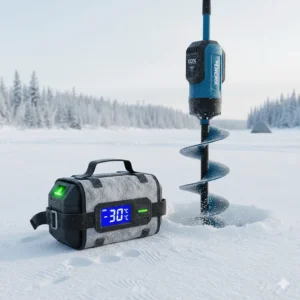
Battery chemistry struggles in extreme cold—there’s no getting around physics. Lithium-ion batteries lose twenty to forty percent capacity when temperatures drop below minus twenty Celsius, and performance degrades further approaching minus thirty.
Smart Canadian anglers keep batteries inside heated shelters or vehicles until needed, then insulate them in neoprene sleeves while fishing. This maintains temperature and maximizes drilling capacity.
Gas and propane augers fire reliably to minus forty Celsius, though propane vapour pressure decreases significantly below minus thirty. Northern Ontario and prairie anglers drilling in extreme conditions often prefer traditional gas reliability despite the maintenance burden.
Weight and Portability Factors for Canadian Ice Anglers
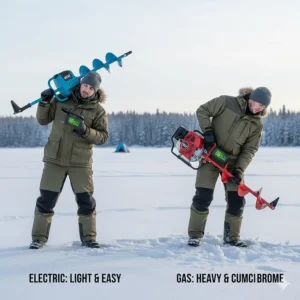
Lugging thirty pounds of gas auger across a kilometre of lake ice while pulling your sled gets old fast. Electric augers weighing sixteen to twenty-three pounds reduce fatigue significantly, especially on mobile fishing trips where you’re constantly relocating.
The weight difference matters more than it seems. After drilling twenty holes and hiking two kilometres, that saved five kilograms means fresher legs and more energy for actually catching fish. Younger and older anglers particularly appreciate reduced physical demands.
Consider your fishing style: driving ATVs to permanent ice huts negates weight concerns, but backcountry lake-hopping demands maximum portability.
Drilling Capacity: How Many Holes Do You Actually Need?
Marketing materials tout drilling hundreds of holes, but how many do Canadian anglers realistically drill per outing? Casual fishing trips average ten to twenty holes. Aggressive walleye hunters might drill forty to sixty prospecting various depths and structures.
A quality electric auger with one battery handles most typical scenarios. Serious anglers buy second batteries ($200-300 CAD) for extended capacity, still lighter and quieter than gas alternatives.
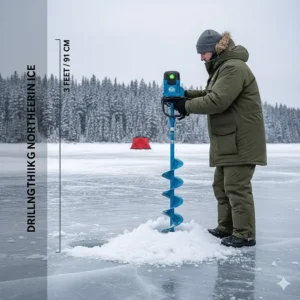
Late-season ice exceeding ninety centimetres tests electric limits. Ice thickness across Canadian provinces varies dramatically—southern Ontario averages forty to sixty centimetres by season peak, while northern Manitoba regularly sees ninety to one-hundred-twenty centimetres. Match your auger to your region’s typical conditions.
Environmental Impact and Clean Fishing Practices
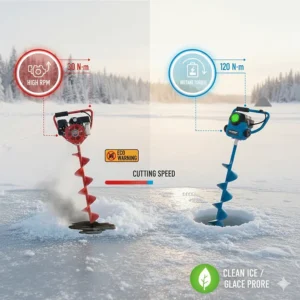
Two-stroke gas engines emit significant hydrocarbons and carbon monoxide. Spilled gasoline contaminating ice and water represents real environmental concerns, particularly on sensitive watersheds.
Electric augers produce zero on-ice emissions. Even accounting for electricity generation for charging, the environmental footprint remains substantially lower than gas combustion. Canadian anglers increasingly prioritize sustainable practices, and auger choice reflects those values.
Propane burns cleaner than gasoline but still produces emissions. It represents a middle-ground option for environmentally conscious anglers not ready to commit fully electric.
Ice Auger Comparison Guide: Making Your Decision
Choosing between gas vs electric ice auger ultimately depends on prioritizing your needs:
Choose Electric If:
- You drill fewer than fifty holes per outing
- Ice thickness stays below seventy-five centimetres
- Noise concerns matter (pressured lakes, provincial parks)
- You value convenience and low maintenance
- Portability and reduced weight are priorities
- Environmental impact concerns you
Choose Gas/Propane If:
- You regularly drill seventy-plus holes
- Late-season ice exceeds ninety centimetres
- You fish extreme cold below minus twenty-five Celsius regularly
- Maximum drilling capacity matters more than convenience
- Budget constraints favour lower upfront costs
Frequently Asked Questions
❓ What is the average lifespan of an electric ice auger battery in Canadian winters?
❓ Can you use an electric ice auger in extreme Canadian cold below -30°C?
❓ How much does it cost to operate a gas vs electric ice auger per season in Canada?
❓ What ice thickness can electric augers handle in Canadian lakes?
❓ Do I need a fishing license to use a power auger in Canada?
Conclusion: Your Perfect Ice Auger Awaits
The gas vs electric ice auger debate doesn’t have a universal winner—it has the right tool for each angler’s situation. Electric models now match gas performance for ninety percent of Canadian ice fishing scenarios while offering undeniable advantages in weight, noise, and convenience. The technology has matured beyond early limitations that once made gas the only serious option.
That said, anglers regularly facing metre-thick ice or extreme northern conditions may still benefit from gas reliability. The ION Alpha and Jiffy Model 60 represent the electric category’s best, combining power with portability. The Jiffy Model 30 XT remains unbeatable for maximum drilling capacity in harsh conditions.
Consider your typical fishing patterns honestly. Most weekend warriors drilling twenty holes through forty centimetres of ice will love electric convenience. Tournament anglers and extreme-condition fishers might still need gas backup. Many experienced anglers own both, selecting based on specific trip requirements.
Whichever you choose, today’s augers—gas, electric, or propane—deliver unprecedented performance compared to equipment from even five years ago. Canadian winters demand quality gear, and these seven options won’t let you down when temperatures plummet and fish are biting.
✨ Don’t Miss These Exclusive Deals!
🔍 Take your ice fishing to the next level with these carefully selected products available in Canada. Click on any highlighted item to check current pricing and availability on Amazon.ca. These tools will help you create authentic fishing memories your family will love!
Recommended for You
- 7 Best 8 Inch Ice Augers in Canada (2026)
- 7 Best Gas Ice Augers Canada 2026
- 7 Best Electric Ice Augers Canada 2026
Disclaimer: This article contains affiliate links to Amazon.ca. If you purchase products through these links, we may earn a small commission at no additional cost to you.
✨ Found this helpful? Share it with your friends! 💬🤗
