
In This Article
There’s a specific kind of silence that settles over a frozen lake around 3 p.m. on a grey January afternoon — the kind where you start questioning every life choice that led you to a five-gallon bucket over eight feet of water. That’s usually when a good rattle spoons ice fishing setup earns its keep. When jigs go quiet and flash alone isn’t cutting it, sound becomes the last lever you can pull, and it’s often the one that flips a sluggish fish into a biter.
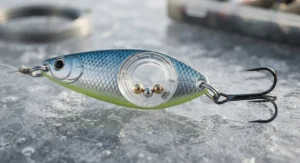
Rattle spoons ice fishing lures work on a simple premise: fish “hear” long before they see. Stuffed with BBs, glass beads, or stainless steel bearings inside a hollow chamber, these spoons throw out a percussive click-clack every time you snap your rod tip, layering sound and vibration on top of the usual flutter and flash. In stained water, at last light, or under thick snow cover that blocks light penetration, that extra sensory signal can be the difference between a dead rod and a bent one.
This guide breaks down seven real, currently available rattle spoons — from budget glow options under C$10 to premium tungsten builds — with honest analysis of what each one actually does well, who it’s built for, and where the aggregated review sentiment lines up (or doesn’t) with the marketing copy. We’ll cover sound chamber spoons, BB rattle ice lures, vibrating rattle spoons, and where aggressive rattle spoons genuinely outperform quieter presentations, all with Canadian shopping details: metric sizing, CAD price ranges, and links to check current availability on amazon.ca.
Quick Comparison Table: Rattle Spoons Ice Fishing at a Glance
Before diving into the full breakdown, here’s a fast-reference table for anyone who wants the short version. Weight classes are listed in ounces (the industry standard, even in Canada) alongside a rough metric conversion, since most tackle catalogues still print in imperial.
| Spoon | Rattle Type | Sizes Available | Price Range (CAD) | Best For |
|---|---|---|---|---|
| Northland Buck-Shot Rattle Spoon | Brass chamber, steel shot | 1/16–1/2 oz (1.8–14 g) | C$6–C$10 | All-round walleye/perch workhorse |
| VMC Rattle Spoon | Brass chamber, multi-bead | 4 sizes | C$5–C$9 | Sharp, loud resonance in clear water |
| Clam Rattlin’ Blade Spoon | Pyrex glass, stainless bearings | 3 sizes | C$6–C$9 | Loudest option for stained water |
| Clam Rattlin’ PT Spoon | Pyrex glass, dual bearings | 1/16–1/4 oz (1.8–7 g) | C$5–C$8 | Panfish finesse with rattle upgrade |
| Lindy Rattl’n Flyer Spoon | Internal rattle, winged body | 1/16–1/4 oz (1.8–7 g) | C$5–C$8 | Aggressive, roaming fish |
| PK Lures Rattle Spoon | Oversized brass chamber | 1/4–3/8 oz (7–10.6 g) | C$8–C$13 | Deep water, swappable blades |
| Moonshine Shaker Spoon | Compact rattle, super glow | 1/8–1/4 oz (3.5–7 g) | C$4–C$7 | Budget-friendly low-light bite |
A quick read on that table: the price spread isn’t just about brand markup — it tracks pretty closely with build complexity. The PK Lures Rattle Spoon‘s oversized chamber and swappable blade system justify sitting at the top of the range, while the Moonshine Shaker Spoon keeps costs down by sticking to a simpler, smaller rattle housing. If you’re outfitting a full tackle box for multiple species, mixing a couple of loud options like the Clam Rattlin’ Blade Spoon with a quieter finesse piece like the Clam Rattlin’ PT Spoon covers more scenarios than betting everything on one style.
💬 Just one click — help others make better buying decisions too!😊
Top 7 Rattle Spoons Ice Fishing: Expert Analysis
Every spoon below is a real, currently produced lure — no invented models, no fictional brands. Specs come from manufacturer listings and retailer product pages; sentiment notes are drawn from aggregated public reviews across major tackle retailers, always flagged as such rather than presented as firsthand testing.
1. Northland Buck-Shot Rattle Spoon — the benchmark rattle spoon
If there’s a spoon that basically defined this category, it’s this one. The Northland Buck-Shot Rattle Spoon has been on the ice since the 1980s, and it hasn’t needed to change much because the core idea — a brass chamber packed with loose shot inside a stamped, fish-shaped body — still works.
The chamber produces a sharp “click” on the lift and a softer rattle on the fall, which matters more than it sounds: most fish encounter your spoon during the drop, not the jig stroke, so a spoon that stays audible on both phases gets noticed twice per cycle instead of once. It’s available in roughly a dozen sizes from 1/16 oz up to a full ounce, and in both standard lead-alloy and a newer tungsten build that sinks noticeably faster in deep water — useful when you’re punching through 30-plus feet to reach suspended walleye.
Reviewers consistently cite it as a confidence bait for walleye, perch, and lake trout, with a recurring theme that the stock treble hooks are serviceable but not premium — several anglers mention swapping to a sharper aftermarket hook before their first trip. Based on the spec comparison with other brass-chamber spoons, the Northland Buck-Shot Rattle Spoon‘s wide size range is its real advantage: you can match a 1/16 oz version to finicky panfish or jump to a 1/2 oz for aggressive lake trout without switching brands or rattle character.
Pros:
- ✅ Widest size range of any spoon on this list
- ✅ Tungsten option available for faster sink rates
- ✅ Long track record across walleye, perch, and trout
Cons:
- ❌ Stock treble hooks often get swapped for sharper ones
- ❌ Standard lead-alloy version sinks slower than tungsten rivals
Price sits around C$6–C$10 depending on size and finish (glow patterns run slightly higher), and at that range it delivers strong value as a first rattle spoon for anyone building out a box.

2. VMC Rattle Spoon — sharpest resonance in the lineup
Where the Northland Buck-Shot Rattle Spoon goes for a broad, familiar click, the VMC Rattle Spoon aims for something crisper. Its brass sound chamber holds multiple small beads rather than a single mass of shot, which produces a higher-pitched, more staccato rattle that reviewers describe as noticeably different from other rattle spoons in a side-by-side box.
That distinct tone matters more than it might seem. Fish that have been pounded by the same two or three popular rattle patterns on a pressured lake can develop a wariness to the “usual” sound; a spoon with a genuinely different acoustic signature sometimes triggers strikes precisely because it doesn’t match what the fish has learned to associate with danger. The VMC Rattle Spoon comes in four sizes and a broad colour range spanning natural, UV, and glow finishes — the glow versions hold their charge for roughly 15 minutes after exposure to a flashlight or UV torch, which is enough for a full ice-out window at dawn or dusk.
What most buyers overlook about this model is that VMC builds it on the same hook-quality standard the brand is known for in open-water tackle — the factory trebles here are a genuine step up from many budget spoons, meaning less time re-rigging and more time jigging. Aggregated feedback skews positive for multi-species use, with particular praise for perch and crappie response in clear to moderately stained water.
Pros:
- ✅ Distinct, sharp rattle tone stands out on pressured lakes
- ✅ Factory hooks are sharper than most competitors
- ✅ Glow finishes hold charge for roughly 15 minutes
Cons:
- ❌ Smaller size range than the Buck-Shot lineup
- ❌ Premium hook quality nudges the price slightly higher
Expect to pay in the C$5–C$9 range, with UV and glow finishes toward the top of that band.
3. Clam Rattlin’ Blade Spoon — the loudest option here
The Clam Rattlin’ Blade Spoon takes the brand’s original knife-profile Blade Spoon and stuffs it with two stainless steel bearings inside a pyrex-glass housing. The result, per Clam’s own product description and echoed across retailer listings, is one of the loudest spoons currently sold for ice fishing — the glass housing actually resonates differently than metal chambers, projecting sound further through the water column.
Here’s what the spec sheet won’t tell you outright, but reviewers note: that extra volume is genuinely a double-edged tool. In stained water, under a foot of fresh snow, or on an overcast day with poor light penetration, the Clam Rattlin’ Blade Spoon‘s aggressive rattle calls fish in from farther away than a quieter presentation could manage. But on ultra-clear lakes with heavy fishing pressure, some anglers report needing to dial back their jig cadence, since a spoon this loud can occasionally spook fish that are already keyed into subtler cues.
The knife-like, rhombic-triangle profile also produces a wide, erratic flutter on the fall, which pairs the sound with visual chaos — a combination that’s particularly effective on aggressive perch and crappie. It comes in three main sizes, giving decent coverage from panfish to mid-size walleye.
Pros:
- ✅ Loudest chamber design in this comparison
- ✅ Wide, erratic flutter adds visual triggers to the sound
- ✅ Pyrex housing resists the dulling that metal chambers show over time
Cons:
- ❌ Can be too aggressive for pressured, ultra-clear water
- ❌ Fewer size options than the Buck-Shot or VMC lines
Priced around C$6–C$9, it’s a strong pick specifically for stained water and low-light stretches of the day.
4. Clam Rattlin’ PT Spoon — the finesse upgrade
Think of the Clam Rattlin’ PT Spoon as the Blade Spoon’s more refined sibling. It keeps the same slicing, fluttering action and the pyrex-glass rattle chamber with stainless steel bearings, but wraps it in a lifelike baitfish body with a painted treble hook, a 3D eyeball, and gill flash detailing — small visual cues that matter more than you’d guess when panfish are inspecting a bait at close range before committing.
Constructed from zinc alloy rather than lead, it’s also a genuinely more environmentally considerate build, which matters on Canadian lakes where lead tackle bans are expanding provincially. Available in three sizes — 1/16 oz, 1/8 oz, and 1/4 oz — it’s sized specifically for perch, crappie, walleye, and pike rather than trying to stretch up into trophy lake trout territory.
Based on the spec comparison with its sibling, the trade-off here is subtlety versus volume: the Clam Rattlin’ PT Spoon carries the same core rattle mechanism as the Blade Spoon but in a smaller, more finesse-oriented package, making it the better call when you want the acoustic edge without the Blade Spoon’s more aggressive presence. Reviewers frequently pair it specifically with panfish presentations, citing the painted treble as an upgrade over unpainted stock hooks on comparable spoons.
Pros:
- ✅ Zinc alloy build is a more eco-conscious lead-free option
- ✅ Painted treble and lifelike detailing add visual triggers
- ✅ Sized specifically for panfish-to-walleye targets
Cons:
- ❌ Doesn’t scale up to larger sizes for lake trout or big pike
- ❌ Slightly less volume than the standard Blade Spoon
Expect to find it in the C$5–C$8 range, making it one of the better value plays on this list for panfish specialists.
5. Lindy Rattl’n Flyer Spoon — built for aggressive rattle spoons fans
When fish are actively roaming and hunting rather than holding tight and sulking, the Lindy Rattl’n Flyer Spoon is purpose-built for exactly that mood. Its winged body pushes more water than a standard flat spoon, and combined with an internal rattle, it produces a wide, erratic wobble on the fall that can swing outside the diameter of your ice hole — a detail that matters because it means the lure is actively searching for fish rather than waiting for them to happen by.
This is arguably the most literal interpretation of aggressive rattle spoons on the market: shake it and it rattles loudly even before you start jigging, and jigged, it throbs hard on the lift. The winged sides move enough water to appeal to lateral-line feeding in stained conditions or low light, essentially giving fish two separate sensory pathways — sound and displaced water — to zero in on. It spans four sizes from 1/16 oz up to 1/4 oz, covering everything from bluegill to modest pike, and its strong action tolerates being tipped with multiple waxworms, a minnow head, or even a whole minnow without killing the flutter.
Aggregated angler sentiment consistently frames it as the go-to when a bite has gone cold and a more subdued presentation isn’t drawing looks — the working theory being that an obviously aggressive, noisy target can trigger a reaction strike even from fish that aren’t actively feeding.
Pros:
- ✅ Widest, most erratic wobble of any spoon in this comparison
- ✅ Handles heavy bait tipping without losing action
- ✅ Purpose-built for roaming, actively feeding fish
Cons:
- ❌ Can be too much movement for neutral or negative fish
- ❌ Winged profile is more prone to occasional line twist
Pricing lands around C$5–C$8, and it’s worth having at least one size rigged and ready as your “reaction strike” rod.
6. PK Lures Rattle Spoon — the deep-water, swap-blade specialist
PK Lures built a reputation on its original PK Spoon, and the PK Lures Rattle Spoon takes that proven body and adds the largest brass rattle chamber the company could physically fit into the 1/4 oz and 3/8 oz sizes. That’s a meaningfully bigger chamber than most competitors run at comparable weights, and a bigger chamber generally means more resonant volume and a lower-pitched, more far-carrying rattle — useful in deep basin water where sound has to travel further to matter.
One side carries a nickel hologram finish tuned for flash under midday sun penetration, while the other is finished in a strong glow paint, which owners describe as genuinely bright rather than the faint glow some budget spoons offer. The standout feature, though, is the swappable #2 PK Wyoming Blade — available in nickel, brass, or gold — that clips onto the spoon and can be moved to other lures in your box. That modularity is a real point of difference: instead of buying three separate spoons to test three blade colours, you own one spoon body and three interchangeable blades.
It’s also a lead-free build, aligning with the broader shift toward zinc-alloy and tungsten construction across the category. Given its size range tops out larger than most of this list, it’s best suited to anglers targeting bigger predators — walleye, lake trout, and pike — rather than finesse panfish work.
Pros:
- ✅ Largest rattle chamber-to-size ratio in this comparison
- ✅ Swappable Wyoming Blade adds real versatility
- ✅ Strong glow paint performs well after dark
Cons:
- ❌ Only available in larger 1/4 oz and 3/8 oz sizes
- ❌ Premium components push it to the top of the price range
At C$8–C$13, it’s the most expensive spoon here, but the swap-blade system offsets some of that by reducing how many separate lures you need to carry.
7. Moonshine Shaker Spoon — budget entry with a genuine glow edge
Not every rattle spoons ice fishing box needs a C$10 spoon in every slot, and the Moonshine Shaker Spoon is proof of that. It comes in just two sizes — a 1/8 oz #1 and a 1/4 oz #2 — and keeps the build simple: a compact internal rattle housed in a smaller, straightforward spoon body, available in five Super Glow colour options.
What it lacks in size variety, it partly makes up for with the glow finish, which multiple retailers and owner comments describe as notably bright and long-lasting relative to the low price point — a detail that matters most in the dawn and dusk windows when panfish and walleye activity often spikes. Because it’s a smaller, lighter build, it also has a slower fall rate than heavier chamber spoons, keeping it in the strike zone a beat longer on the drop, which matters for suspended fish that won’t chase something falling too fast.
Honest framing here: this isn’t a spoon built for trophy lake trout or deep-basin walleye. It’s a budget-conscious, glow-forward option that punches above its price for panfish and light walleye work, and it’s a sensible way to test whether rattle spoons ice fishing tactics work on your home lake before investing in the pricier chambers further up this list.
Pros:
- ✅ Lowest price point in this comparison
- ✅ Bright, long-lasting Super Glow finish
- ✅ Slower fall rate suits suspended, cautious fish
Cons:
- ❌ Only two sizes limits species range
- ❌ Simpler rattle chamber than premium options
Priced around C$4–C$7, it’s the easiest entry point on this list and a smart first purchase for anyone new to the category.
Practical Usage Guide: Setting Up Rattle Spoons for Ice Fishing
Buying the right spoon is only half the job — how you rig, fish, and maintain it decides whether it actually earns its keep on the ice.
First-trip setup: Tie rattle spoons directly to a fluorocarbon leader (6–10 lb test is a solid all-around range) rather than straight to braid; fluorocarbon’s lower visibility matters more with a bait that’s already calling attention to itself acoustically. A small barrel swivel a foot or so above the spoon prevents line twist, which is a real issue with winged or erratically fluttering models like the Lindy Rattl’n Flyer Spoon.
Jig cadence: Start with a sharp 6–12 inch lift followed by a controlled drop on a semi-slack line, pausing 3–5 seconds at the bottom of the stroke. The rattle does most of its work on the initial lift and the first half-second of the fall — that’s when the internal beads or bearings are moving fastest and loudest.
Maintenance schedule: Rinse spoons in fresh water after every trip to prevent corrosion on hooks and split rings, especially on brass-chamber models where saltwater-adjacent conditions (like coastal Atlantic ice fishing) can accelerate wear. Check hook points every second or third outing with a fingernail test — if it doesn’t catch on a nail, it needs sharpening or swapping. Inspect split rings for hairline cracks every few trips; a chamber that rattles fine but has a compromised ring is a lost-fish waiting to happen.
Common first-30-days mistakes: New rattle spoon users tend to over-jig, treating the loud rattle as a signal to work the rod aggressively at all times. In practice, most strikes come during the pause, not the motion — the rattle’s job is to call fish in, and the pause is what convinces them to commit. The second common mistake is fishing one spoon all day regardless of results; if 30–45 minutes on a spot with a loud rattle spoon produces nothing, that’s the signal to switch to something quieter or vice versa, not to keep grinding the same presentation.
Real-World Scenarios: Matching Rattle Spoons to Your Ice Fishing Trip
The weekend panfish angler: Fishing 8–15 feet of water on a suburban lake most Saturdays, targeting perch and crappie with a couple of kids in tow who want steady action more than trophy fish. The Clam Rattlin’ PT Spoon or Moonshine Shaker Spoon fit this profile well — smaller sizes, budget-friendly, and the glow or lifelike detailing keeps things interesting for younger anglers watching the rod tip.
The deep-basin walleye chaser: Punching through 25–40 feet of water on a Canadian Shield lake, often fishing the last hour of light when walleye move up to feed. The PK Lures Rattle Spoon or tungsten-weighted Northland Buck-Shot Rattle Spoon make sense here — faster sink rates get you back in the zone quickly after missed strikes, and the larger chamber volume carries further in deep, often stained water.
The pressured-lake regular: Fishing the same access-friendly lake three or four times a week during peak season, where fish see dozens of anglers’ presentations daily. Rotating between the sharp, distinct tone of the VMC Rattle Spoon and the aggressive, roaming action of the Lindy Rattl’n Flyer Spoon gives two genuinely different acoustic and visual signatures to work with when the “usual” spoons stop producing.
How to Choose Rattle Spoons for Ice Fishing
Picking the right spoon comes down to matching a handful of practical factors to your specific water and target species:
- Match chamber volume to water clarity. Louder, glass-chamber spoons like the Clam Rattlin’ Blade Spoon shine in stained or dark water; dial back to subtler options like the Clam Rattlin’ PT Spoon on gin-clear lakes.
- Size to species, not to ambition. A 1/16 oz spoon out-produces a 1/2 oz spoon on finicky panfish nearly every time — oversized bait is a common reason for a slow day.
- Consider fall rate for suspended fish. Lighter, slower-sinking spoons like the Moonshine Shaker Spoon keep bait in a suspended fish’s strike zone longer than a fast-sinking tungsten model.
- Check hook quality before you buy. Factory trebles vary widely; the VMC Rattle Spoon‘s hooks are a genuine step above several competitors, saving a swap-out step.
- Factor in depth and sink speed. In 30-plus feet of water, a tungsten build like the upgraded Northland Buck-Shot Rattle Spoon saves real time versus a standard lead-alloy spoon.
- Think about lead-free options where it matters. Zinc-alloy builds like the Clam Rattlin’ PT Spoon and PK Lures Rattle Spoon matter more on lakes with expanding provincial lead restrictions.
- Build a small rotation, not one spoon. Even a box with three contrasting rattle tones outperforms a box with five spoons that all sound the same.

Best Rattling Ice Spoons vs. Silent Flutter Spoons
The best rattling ice spoons and traditional silent flutter spoons aren’t rivals so much as tools for different moods. A silent flutter spoon — something like a standard Northland Thumper or a classic Swedish Pimple — relies entirely on flash and a wobbling fall to trigger interest. That subtlety is an advantage on heavily pressured, gin-clear lakes where a loud presentation can spook wary fish that have already been caught and released once or twice that season.
Rattle spoons flip that trade-off. They sacrifice some of that subtlety in exchange for a sensory signal that works even when visibility is poor — under fresh snow cover, in stained runoff water, or in the last murky light of dusk. According to the science behind why this works, fish rely on a sensory system called the lateral line to detect vibration and pressure changes in water, a sense that functions independently of eyesight and often responds to lower frequencies than a fish’s inner ear alone can pick up (see the Wikipedia overview of the lateral line for the underlying biology). That’s precisely the channel a rattle chamber is designed to trigger.
In practice, the smartest approach is carrying both. Start a session with a silent or subtle spoon if the water’s clear and the bite’s been steady; switch to one of the best rattling ice spoons from this list the moment light drops, water clouds up, or the bite goes cold. Several of the anglers whose aggregated feedback informed this guide specifically mention keeping one rod rigged with each style for exactly that reason.
Noisy Ice Fishing Lures for Different Water Clarity
Not all noisy ice fishing lures are created equal, and matching rattle intensity to water conditions is one of the more overlooked skills in this category.
Clear water (visibility beyond 3–4 metres): Favour subtler rattle tones — the VMC Rattle Spoon‘s sharp, higher-pitched chamber or the Clam Rattlin’ PT Spoon‘s finesse build tend to outperform louder options, since fish in clear water are relying heavily on sight and can be spooked by an overly aggressive acoustic signal at close range.
Stained or tannic water (visibility under 2 metres): This is where the loudest noisy ice fishing lures earn their reputation. The Clam Rattlin’ Blade Spoon and the oversized-chamber PK Lures Rattle Spoon are built for exactly this scenario — maximum acoustic range compensates for minimal visual range.
Under heavy snow cover: Even on a normally clear lake, a thick blanket of fresh snow on the ice can cut light penetration dramatically, effectively simulating stained-water conditions from the fish’s perspective. This is an easy trigger to miss — anglers often keep fishing a subtle spoon out of habit even after conditions have shifted underfoot.
Low light (dawn, dusk, overcast days): Pair a rattle chamber with a glow finish for a doubled sensory cue. The Moonshine Shaker Spoon‘s Super Glow colours and the VMC Rattle Spoon‘s glow patterns both hold their charge long enough to cover a typical low-light feeding window.
Sound Chamber Spoons: BB, Glass, and Tungsten Compared
Not all sound chamber spoons rattle the same way, and the material inside the chamber changes the tone more than most anglers realize.
| Chamber Type | Sound Character | Example | Best Water |
|---|---|---|---|
| BB / steel shot (brass housing) | Sharp, bright click | Northland Buck-Shot Rattle Spoon, VMC Rattle Spoon | Clear to moderately stained |
| Glass housing, steel bearings | Deep, resonant, far-carrying | Clam Rattlin’ Blade Spoon, Clam Rattlin’ PT Spoon | Stained, low light |
| Oversized brass chamber | Low-pitched, high volume | PK Lures Rattle Spoon | Deep basin, stained |
Reading across that table, the material and housing shape matter almost as much as the number of beads inside. Glass chambers, per Clam’s own product descriptions, resonate differently than metal housings and tend to project sound further through the water column — which explains why BB rattle ice lures built with glass housings consistently earn a reputation as the loudest category overall. Brass-housed spoons, by contrast, tend to produce a brighter, higher-pitched click that carries less distance but reads as more distinct against ambient lake noise, which is partly why vibrating rattle spoons with brass chambers often get credited with drawing strikes from fish that have grown wary of the “usual” loud spoon on a pressured lake.
✨ Ready to build a chamber-type rotation of your own? Tap any spoon above to check current availability!
Aggressive Rattle Spoons for the Toughest Bite Windows
There’s a specific kind of day every ice angler knows — sonar screen full of marks, rod tip dead still, nothing committing. That’s the moment to reach for aggressive rattle spoons rather than continue finessing a presentation that clearly isn’t working.
The Lindy Rattl’n Flyer Spoon is the standout here, purpose-built with a winged body that pushes water in a wide, erratic pattern well beyond a typical spoon’s footprint, layered with an internal rattle that’s audible even before you start jigging it. The Clam Rattlin’ Blade Spoon‘s pyrex-glass chamber and wide, knife-blade flutter belong in the same category — both are designed to demand attention rather than politely suggest it.
What’s happening biologically is a reaction-strike trigger rather than a feeding response. Aggressive rattle spoons don’t necessarily convince a neutral or negative fish that food is present in the traditional sense; instead, the combination of erratic movement and unmistakable sound can provoke an instinctive, almost territorial strike, similar to how a sudden loud noise makes a person flinch before conscious thought catches up. That’s a meaningfully different mechanism than a subtle, “natural” presentation, and it’s why swapping to an aggressive rattle spoon after 20–30 unproductive minutes on a marked fish is one of the more reliable pattern-breakers in an ice angler’s toolkit.
This tactic works best as a change-up rather than a default. Running an aggressive rattle spoon all day on fish that are actively feeding and responsive to subtler baits can be counterproductive — save it specifically for the stretches where nothing else is drawing a look.
Common Mistakes When Buying Rattle Spoons
Even experienced anglers fall into a few predictable traps when stocking up on rattle spoons ice fishing gear:
Buying one size for every species. A single 1/4 oz spoon can’t cover panfish and lake trout equally well — the Northland Buck-Shot Rattle Spoon‘s broad size range exists precisely because one spoon body doesn’t scale across that range effectively.
Ignoring hook quality at checkout. It’s easy to compare spoons purely on rattle volume and price, but factory hook sharpness varies enough between brands that it’s worth checking reviews specifically for hook comments — the VMC Rattle Spoon stands out here for a reason.
Overbuying loud spoons and underbuying subtle ones. A box full of only the loudest, most aggressive rattle spoons leaves you with nothing to offer wary fish on a clear, pressured lake. Balance matters more than maximizing any single trait.
Skipping the glow-charge step. Glow finishes need a genuine flashlight or UV torch charge before dropping down the hole — ambient daylight through an ice shanty window usually isn’t strong enough, and an uncharged glow spoon is functionally just a duller version of the standard finish.
Not budgeting for split ring and hook replacements. The spoon body on most of these lures easily outlasts the hardware. Factoring a few dollars per season for replacement trebles and rings is more realistic than expecting the factory hardware to last indefinitely.
Long-Term Cost and Maintenance of Rattle Spoons
Thinking in terms of total cost of ownership rather than sticker price changes the calculus on several of these spoons. A C$4 Moonshine Shaker Spoon looks like the obvious budget winner at checkout, but if it needs a hook swap after a handful of trips due to a simpler stock treble, the real cost-per-season narrows the gap with pricier options that ship with better hardware from the start.
The PK Lures Rattle Spoon‘s swappable Wyoming Blade system is worth revisiting here specifically through a cost lens: instead of buying three separate spoons to test three blade finishes, one spoon body plus interchangeable blades covers that ground for less total spend over a season. Similarly, the zinc-alloy build on the Clam Rattlin’ PT Spoon resists the pitting and corrosion that can shorten a cheaper lead-alloy spoon’s usable life, particularly if you’re not rinsing gear after every trip (which, honestly, most of us skip more often than we should).
A realistic seasonal budget for a rotation of five to seven rattle spoons across the styles covered in this guide lands somewhere in the C$35–C$65 range before hook and ring replacements — a modest investment relative to an auger, shelter, or electronics setup, but one that pays off disproportionately on the days when sound is the only thing separating a bite from a blank.
Safety and Regulations for Rattle Spoons Ice Fishing in Canada
Gear only matters if you’re fishing legally and safely, and both vary meaningfully by province.
Licensing: Most Canadian provinces require a valid fishing licence for ice anglers aged 18 to 64, with some age-based exemptions. In Ontario, for example, anglers need a valid Outdoors Card and licence, and current provincial rules permit two lines for ice fishing on most waters, with exceptions on specific bodies of water — always confirm the exact rules for your zone through Ontario’s official fishing regulations summary or the equivalent provincial resource before heading out, since limits and exceptions shift from lake to lake.
Tackle restrictions: Several provinces are phasing in restrictions on lead tackle in specific sizes, particularly on lakes with loon populations, since ingested lead sinkers and jig heads are a documented cause of loon mortality. This is part of why zinc-alloy and tungsten spoons — several of which appear in this guide — are worth prioritizing even outside of restricted zones.
Ice safety: No amount of gear matters if the ice itself isn’t sound. The Canadian Red Cross recommends a minimum of 15 cm of clear, solid ice for an individual walking or fishing alone, scaling up for groups and any vehicle use — full guidance is available through the Canadian Red Cross ice safety resources. Always check ice thickness at your specific fishing hole rather than assuming uniform conditions across a lake, and never fish alone on unfamiliar ice.
Buyer’s Decision Framework: Rattle Spoons Ice Fishing Quick Picks
If you want a fast decision without reading the full breakdown again, use this simple framework:
- If you’re new to rattle spoons and want a low-risk entry point → choose the Moonshine Shaker Spoon for its low price and genuine glow performance.
- If you’re fishing stained or heavily snow-covered water → choose the Clam Rattlin’ Blade Spoon for maximum acoustic range.
- If you’re targeting deep-basin walleye or lake trout → choose the PK Lures Rattle Spoon or tungsten Northland Buck-Shot Rattle Spoon for faster sink rates.
- If the bite has gone cold and nothing else is working → choose the Lindy Rattl’n Flyer Spoon for its aggressive, reaction-strike profile.
- If you’re fishing pressured, clear water → choose the VMC Rattle Spoon for a distinct tone without overwhelming volume.
- If you’re targeting panfish specifically → choose the Clam Rattlin’ PT Spoon for its finesse-oriented sizing and lifelike detailing.
🔍 Not sure which fits your lake? Scroll back to the comparison table for a side-by-side refresher.
What to Expect: Real-World Performance on the Ice
Specs on a package only tell part of the story, so here’s what the numbers translate to once a spoon actually hits the water. A brass BB chamber like the one in the Northland Buck-Shot Rattle Spoon produces an audible click that a person standing at the edge of the hole can often hear faintly through the ice on a calm day — a rough proxy for how far that sound is likely carrying underwater, where sound actually travels roughly four times faster than in air.
A glass-chambered spoon like the Clam Rattlin’ Blade Spoon feels different in-hand even before it hits water — the bearings shift with a heavier, more deliberate motion than loose BB shot, which translates underwater into that deeper, more resonant tone anglers consistently describe. The practical upshot: on a 20-foot drop, a loud glass-chamber spoon is realistically pulling attention from fish considerably outside your immediate hole, while a subtler brass or BB chamber reads as more of a close-range trigger.
Fall rate differences matter just as much in practice as on paper. The lightweight Moonshine Shaker Spoon noticeably hangs in the water column longer on a controlled drop than a comparably sized tungsten spoon, which is exactly the behaviour that keeps a suspended, non-committal fish interested rather than watching bait blow past too quickly to react to.

Frequently Asked Questions
❓ Do rattle spoons actually work better than regular ice fishing spoons?
❓ What size rattle spoon should I use for panfish?
❓ How loud should a rattle spoon be for deep water ice fishing?
❓ Are BB rattle ice lures better than glass rattle spoons?
❓ Can I use rattle spoons ice fishing gear for open-water fishing too?
Conclusion
Sound is one of the few tools left when flash and scent aren’t closing the deal, and rattle spoons ice fishing gear gives you a genuine, science-backed way to reach fish that can’t see your bait clearly. The seven spoons covered here — from the budget-friendly Moonshine Shaker Spoon to the deep-water-focused PK Lures Rattle Spoon — cover a realistic range of conditions, price points, and target species rather than pushing a single “best” option that ignores how differently lakes, light, and water clarity actually behave.
The real takeaway isn’t which single spoon to buy; it’s building a small rotation that covers both ends of the volume spectrum. A subtle brass-chamber spoon like the VMC Rattle Spoon for clear, pressured water, paired with an aggressive glass-chambered option like the Clam Rattlin’ Blade Spoon for stained water and tough bites, covers more real-world scenarios than betting everything on one style. Match chamber type and size to your target species and water conditions using the decision framework above, keep prices in mind as ranges rather than fixed numbers since they shift with season and retailer, and always check current availability and pricing directly on amazon.ca before you buy.
Recommended for You
- 7 Best Flutter Spoons for Ice Fishing in Canada
- 7 Best Jigging Spoons for Ice Fishing in 2026
- Pike Jigs for Ice Fishing: 7 Proven Picks to Dominate 2026
Disclaimer: This article contains affiliate links. As an Amazon Associate, I earn from qualifying purchases. If you purchase products through these links, we may earn a small commission at no additional cost to you.
✨ Found this helpful? Share it with your friends! 💬🤗
