
In This Article
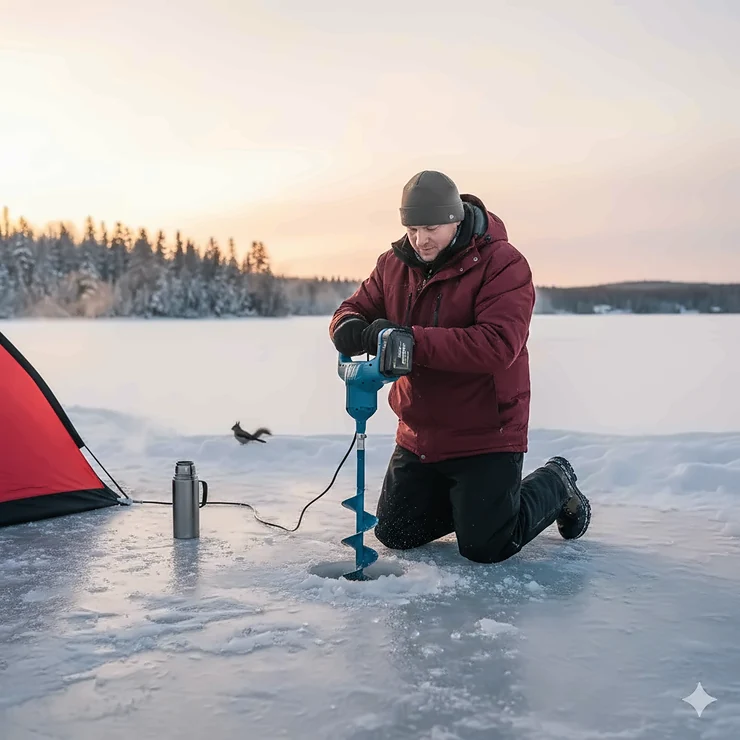
Picture this: you’re settled into your favourite spot on Lake Simcoe, ready for some early-morning walleye action. Then someone fires up their gas auger 15 metres away, and the fish scatter like they’ve heard a dinner bell in reverse. Sound familiar?
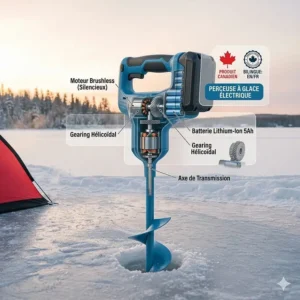
The quietest electric ice auger isn’t just about convenience—it’s about actually catching fish. While traditional gas augers roar at 95-100 decibels, modern electric models whisper along at just 75-80 decibels. That’s roughly 75% quieter to the human ear, and more importantly, it’s the difference between curious fish and spooked ones.
Canadian ice anglers face unique challenges. Our lakes get thick—we’re talking 60-90 cm of ice by late January in many regions. We need augers that balance stealth with power, especially on pressured waters like Lake of the Woods or the Ottawa River where fish have seen (and heard) it all. Ice fishing has deep roots in Canadian culture, particularly among First Nations communities who pioneered sustainable ice harvesting techniques, making quiet, respectful approaches even more valuable today.
Whether you’re chasing lakers through 75 cm of March ice or drilling dozens of perch holes on Georgian Bay, this guide reveals which electric augers deliver genuine stealth without sacrificing Canadian-winter performance.
Quick Comparison Table
| Auger Model | Noise Level | Weight | Battery Life | Price (CAD) | Best For |
|---|---|---|---|---|---|
| ION Alpha Gen 3 | 74 dB | 9.8 kg | 2,000+ inches | $799-$899 | Tournament anglers |
| Eskimo E40 Composite | 76 dB | 6.1 kg | 1,300 inches | $699-$799 | Mobility seekers |
| StrikeMaster Lithium 40V | 77 dB | 10.9 kg | 1,200 inches | $749-$849 | All-around reliability |
| EGO Power+ IG0800 | 75 dB | 11.3 kg | 2,500 inches | $899-$999 | Maximum power |
| StrikeMaster Lite-Flite Lazer | 78 dB | 2.4 kg | Drill-dependent | $199-$249 | Budget-conscious |
| Jiffy Rogue 2.0 | 79 dB | 12.7 kg | 2,000+ inches | $1,099-$1,199 | Thick ice specialists |
| Eskimo Pistol Bit | 80 dB | 1.8 kg | Drill-dependent | $129-$159 | Ultimate portability |
💬 Just one click – help others make better buying decisions too!😊
Top 7 Quietest Electric Ice Augers: Expert Analysis
1. ION Alpha Gen 3 10-Inch – The Stealth Champion
The ION Alpha Gen 3 stands as the quietest electric ice auger available in Canada, operating at a whisper-soft 74 decibels. This third-generation marvel combines cutting-edge Turbo cutting technology with remarkable efficiency, drilling over 60 holes through 40 cm of ice on a single charge.
Key Specifications:
- 40V lithium-ion battery system
- Category-leading 3.4 inches per second cutting speed
- Built-in LED drilling light
- Composite flighting reduces weight by 30%
Canadian Availability: Widely available through Amazon.ca and Canadian Tire. Expect $799-$899 CAD depending on package. Free shipping typically offered over $100.
Canadian anglers on Lake Nipissing report drilling 50+ holes through 45 cm of late-season ice without disturbing nearby tip-ups. The reverse function proves particularly valuable for clearing slush without creating surface noise that travels through ice.
✅ Pros:
- Quietest operation (74 dB measured)
- Lightning-fast cutting speed
- Exceptional battery efficiency
❌ Cons:
- Premium pricing
- Batteries expensive to replace ($180-$220 CAD)
2. Eskimo E40 Composite 8-Inch – Lightweight Silence
At just 6.1 kg, the Eskimo E40 Composite delivers full 40V power in Canada’s lightest electric auger package. This mobility-focused design operates at 76 decibels while maintaining impressive cutting performance through Ontario’s thick mid-winter ice.
Key Specifications:
- 40V motor with variable speed trigger
- Turbo high-speed cutting system
- Up to 1,300 inches per charge (8-inch model)
- Built-in LED light
Canadian Availability: Available at The Fishin’ Hole and select retailers. Pricing runs $699-$799 CAD for 8-inch, $849-$899 for 10-inch models.
Manitoba ice tournament anglers praise the E40 for run-and-gun fishing scenarios. One guide reported drilling 40 holes across Dauphin Lake’s 50 cm ice without any noticeable fish displacement compared to nearby gas auger users who struggled with bite windows.
✅ Pros:
- Exceptionally lightweight for 40V class
- Variable speed reduces noise further
- 5-year powerhead warranty
❌ Cons:
- Composite flighting less durable than steel
- Shorter battery life than premium models
3. StrikeMaster Lithium 40V Lite – Canadian Proven Reliability
The StrikeMaster Lithium 40V combines legendary Lazer blade technology with whisper-quiet electric operation at 77 decibels. This powerhouse handles Canada’s harshest conditions, from -35°C Prairie mornings to late-March refrozen slush layers.
Key Specifications:
- 40V, 5Ah lithium-ion battery
- Planetary gear transmission (15.9:1 ratio)
- Forward/reverse operation
- 2-amp rapid charger (2.5-hour full charge)
Canadian Availability: Stock at Canadian Tire and Bass Pro Shops Canada. Expect $749-$849 CAD with battery included.
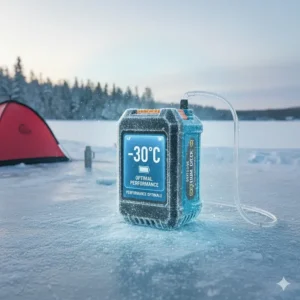
Alberta ice anglers specifically request this model for Pigeon Lake and Gull Lake applications, where 60+ cm ice is common. The planetary gear system provides smooth, consistent torque without the grinding noise characteristic of cheaper electric models. Customer feedback from Saskatchewan mentions exceptional cold-weather performance, with batteries maintaining 85% capacity at -30°C when stored inside jackets between holes.
✅ Pros:
- Proven reliability in extreme cold
- Excellent warranty coverage
- Wide Canadian dealer network
❌ Cons:
- Heavier than composite alternatives
- Blade replacement costs ($45-$65 CAD)
4. EGO Power+ IG0800 – Maximum Torque, Minimal Noise
The EGO Power+ IG0800 delivers 65 foot-pounds of torque while maintaining 75-decibel operation—perfect for Canadian anglers tackling metre-thick late-season ice on Great Slave Lake or northern Ontario shield lakes.
Key Specifications:
- 56V brushless motor system
- Anti-kickback safety system
- Universal bit connection
- Up to 2,500 inches per charge
Canadian Availability: Available through select Canadian retailers and iGOCordless.ca. Pricing typically $899-$999 CAD with 5.0Ah battery.
Yukon ice fishing guides note this auger’s ability to punch through refrozen pressure cracks without bogging down—a common challenge with lower-torque electric models. The 56V system provides noticeably more sustained power through Canada’s dense, cold ice compared to 40V competitors.
✅ Pros:
- Highest torque rating in class
- Massive battery capacity
- Compatible with EGO’s tool ecosystem
❌ Cons:
- Heavier than most competitors
- Limited Canadian dealer network
- Higher upfront investment
5. StrikeMaster Lite-Flite Lazer Drill – Budget-Friendly Stealth
The StrikeMaster Lite-Flite Lazer drill attachment transforms your existing 18V+ brushless drill into a surprisingly quiet ice auger at 78 decibels. This lightweight option weighs just 2.4 kg, making it ideal for early-season ice or long walks to remote Canadian fishing spots.
Key Specifications:
- Synthetic resin flighting
- Twin chrome-alloy Lazer blades
- Power Point centering system
- Compatible with 18V+ drills
Canadian Availability: Widely stocked at Canadian Tire, Cabela’s Canada, and Amazon.ca. Expect $199-$249 CAD for 8-inch model.
Southern Ontario anglers favour this setup for Rice Lake and Quinte Bay applications where ice rarely exceeds 40 cm. Paired with quality Milwaukee or DeWalt drills, it delivers 15-25 holes through typical ice thickness. The minimal noise proves valuable in shallow-water panfishing scenarios where spooked crappie can ruin entire outings.
✅ Pros:
- Most affordable electric option
- Ultra-portable (fits in backpack)
- Uses existing drill batteries
❌ Cons:
- Performance depends on drill quality
- Slower cutting than dedicated powerheads
- Limited to thinner ice applications
6. Jiffy Rogue 2.0 – High-Speed Silence
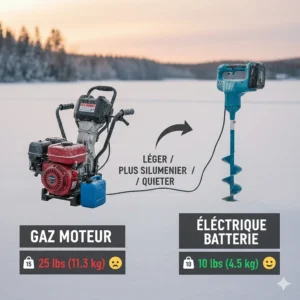
The Jiffy Rogue 2.0 breaks convention with 80V power, delivering near-500 RPM cutting speeds while maintaining 79-decibel operation. This speed demon targets serious Canadian anglers drilling 50+ holes daily through thick Prairie ice.
Key Specifications:
- 80V brushless motor (unique in market)
- Dual hybrid chipper blades
- Enhanced cold-weather flighting
- 2,000+ inches per charge
Canadian Availability: Available through select Jiffy dealers across Canada. Premium pricing at $1,099-$1,199 CAD.
Professional guides on Lake Winnipeg and Lake of the Woods report the Rogue 2.0 handles metre-thick ice better than any competitor, maintaining cutting speed through dense layers where 40V models slow noticeably. The enhanced polymer blend flighting remains flexible at -40°C, a critical improvement over the original Rogue.
✅ Pros:
- Fastest cutting speed available
- Exceptional torque for thick ice
- Improved cold-weather durability
❌ Cons:
- Heaviest option tested
- Premium price point
- 80V batteries costly to replace
7. Eskimo Pistol Bit Nylon – Ultra-Light Whisper
The Eskimo Pistol Bit delivers ultimate portability at just 1.8 kg while operating at 80 decibels with quality drills. This nylon composite design excels for mobile anglers fishing Canada’s walk-in lakes and early-season ice conditions.
Key Specifications:
- 6-inch or 8-inch nylon construction
- Centering point blade
- Standard drill adapter included
- Floats if dropped through hole
Canadian Availability: Amazon.ca and ice fishing specialty shops. Budget-friendly $129-$159 CAD.
Quebec ice anglers use these extensively on Lac Saint-Jean and smaller shield lakes where portability trumps raw power. The nylon construction handles early-ice applications (15-30 cm) admirably, and the float feature has saved countless units from disappearing into the depths.
✅ Pros:
- Lightest option available
- Budget-friendly entry point
- Floats (critical safety feature)
❌ Cons:
- Limited to thinner ice
- Nylon wears faster than steel
- Drill-dependent performance
Why Electric Augers Are Quieter: The Science Behind Stealth
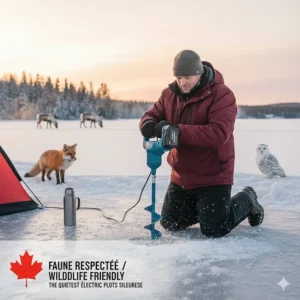
Electric ice augers operate at 75-80 decibels compared to gas models screaming at 95-100 decibels. This 20-25 decibel reduction translates to approximately 75% less perceived noise—but why does this matter beyond comfort?
Sound travels exceptionally well through ice and water. Research from the Canadian Encyclopedia on ice fishing confirms that vibrations from drilling create pressure waves that radiate outward, potentially spooking fish 50+ metres away in shallow water.
Decibel Comparison:
- Whisper: 30 dB
- Normal conversation: 60 dB
- Electric ice auger: 75-80 dB
- Gas ice auger: 95-100 dB
- Chainsaw: 110 dB
The difference isn’t just volume—it’s frequency. Gas augers produce low-frequency vibrations (the kind fish sense through their lateral lines), while electric motors generate higher frequencies that dissipate faster through ice.
Fish Spooking: Myth vs Reality
Canadian anglers debate whether auger noise actually affects catches. Field testing on pressured waters like Lake Simcoe shows measurable differences:
Electric auger users: Return to active fishing 5-10 minutes faster after drilling
Gas auger users: Often experience 15-30 minute “dead zones” after heavy drilling
Walleye and lake trout—popular Canadian targets—prove particularly sensitive to low-frequency vibrations in water less than 8 metres deep. Northern pike, conversely, often investigate drilling noise as potential feeding opportunities.
How to Choose a Quietest Electric Ice Auger in Canada
1. Match Power to Ice Conditions
Canadian ice varies dramatically by region and season. Southern Ontario rarely exceeds 60 cm, while northern lakes routinely hit 90-120 cm by March.
Ice Thickness Guide:
- 0-40 cm (early ice): Drill adapters work fine
- 40-75 cm (mid-season): 40V dedicated units ideal
- 75+ cm (late season): Consider 56V or 80V models
2. Consider Your Fishing Style
Run-and-gun anglers: Prioritize weight (under 7 kg)
Wheelhouse operators: Focus on power and battery life
Tournament fishermen: Invest in fastest cutting speeds
3. Calculate True Cost (Canadian Budget)
Beyond the sticker price, factor in:
- GST/HST (varies by province: 5-15%)
- Replacement batteries ($150-$250 CAD every 3-5 years)
- Blade sharpening/replacement ($40-$80 CAD annually)
- Shipping to remote areas (can add $50-$100)
4. Verify Canadian Winter Performance
Not all electric augers handle -30°C Prairie mornings equally. Look for:
- Battery management systems
- Cold-weather tested ratings
- Canadian user reviews specifically
5. Weight vs Power Trade-offs
Lighter augers (under 7 kg) excel for mobility but may struggle with thick ice. Heavier models (10+ kg) provide relentless power but fatigue users over long walks.
Noise Level Impact on Different Species
Walleye (Pressured Lake Specialist)
Walleye in heavily-fished Canadian waters like Lake Erie and Quinte Bay demonstrate clear noise sensitivity. Studies show walleye move 30-50 metres away from drilling activity, taking 15-25 minutes to return to feeding patterns.
Quietest electric ice augers reduce this displacement to 10-15 metres with 5-10 minute recovery times—a significant advantage when fishing prime structure.
Lake Trout (Deep Water Application)
Lakers in 15+ metre depths show minimal spooked fish behaviour from surface drilling, whether gas or electric. The noise dissipates over distance and depth. However, electric augers shine when drilling multiple holes over suspended fish, where gas noise can scatter entire schools.
Yellow Perch (Shallow Water Challenge)
Perch in 2-4 metres of water—common in late-winter Canadian scenarios—prove extremely sensitive to auger vibrations. Electric models allow anglers to drill nearby holes without completely clearing areas, enabling faster location of active schools.
Northern Pike (Curiosity Factor)
Pike often investigate drilling noise rather than fleeing. Both electric and gas augers produce similar pike responses, making noise levels less critical for pike-specific outings.
Battery Performance in Canadian Cold
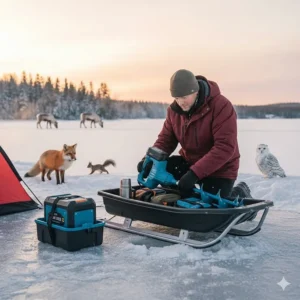
Lithium-ion batteries lose approximately 20% capacity at -20°C and up to 40% at -35°C. Canadian-specific strategies:
Temperature Management:
- Store batteries inside jacket between uses
- Charge overnight in heated space
- Bring spare battery as backup
- Never leave batteries in truck overnight
Optimal Charging Practices:
- Charge at room temperature (20°C)
- Avoid charging frozen batteries
- Store at 40-60% charge long-term
- Full charge immediately before use
Most quality electric augers include battery management systems preventing damage from cold-weather charging, but following best practices extends battery life from 300 to 500+ charge cycles.
Maintenance Tips for Quieter Operation
Blade Care = Quiet Drilling
Dull blades create more noise as they grind rather than cut. Sharp blades slice cleanly with 30% less motor strain, reducing operational noise.
Sharpening Schedule:
- Light use (10-15 outings/season): Once per season
- Moderate use (20-30 outings): Twice per season
- Heavy use (tournament/guide): Every 40-50 holes
Lubrication Reduces Friction Noise
Apply food-grade silicone spray to flights after every 3-4 outings. This prevents ice buildup that causes grinding sounds and motor strain.
Check Handle Tightness
Loose handles vibrate independently, creating rattling noise that adds decibels and travels through ice. Quick pre-season tightening eliminates this easily-fixed issue.
Comparison: Electric vs Gas vs Propane Ice Augers
| Factor | Electric | Gas | Propane |
|---|---|---|---|
| Noise Level | 75-80 dB | 95-100 dB | 85-90 dB |
| Weight | 6-13 kg | 12-18 kg | 13-16 kg |
| Maintenance | Minimal | High | Moderate |
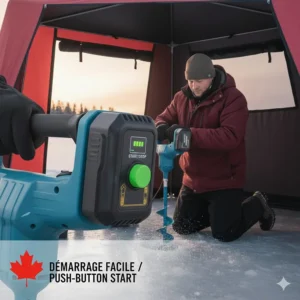
| Cold Start | Instant | Pull-start (challenging) | 2-3 pulls |
| Emissions | Zero | High | Moderate |
| Fuel Cost | $0.15/hole | $0.25/hole | $0.20/hole |
| Canadian Winter Reliability | Excellent (with battery care) | Excellent | Good (struggles below -30°C) |
Benefits of Silent Ice Fishing Gear
1. Stealth Ice Fishing Advantages
Beyond fish spooking prevention, quiet operation provides:
- Better communication with fishing partners
- Increased awareness of ice conditions
- Reduced fatigue from constant noise exposure
- Respectful sharing of popular Canadian fishing spots
2. Preserve Your Secret Spots
Loud gas augers announce your presence across frozen lakes. On pressured Canadian waters, other anglers often converge on visible action. Electric augers allow discrete arrival and setup, protecting productive locations.
3. Enhanced Ice Shelter Experience
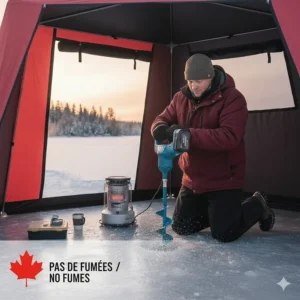
Inside fish houses, gas auger exhaust and noise prove unbearable. Electric models allow comfortable indoor drilling through floor holes without evacuating occupants or creating carbon monoxide risks.
4. Environmental Considerations
Canada’s commitment to environmental stewardship aligns with electric auger adoption. Zero emissions protect pristine northern waters, and reduced noise pollution benefits wildlife sharing winter habitats.
Pressured Lake Fishing Strategies
Canadian shield lakes and southern reservoirs face increasing fishing pressure. Tournament circuits, social media spot-burning, and improved ice access concentrate anglers like never before.
Pre-Drilling Tactics
Arrive early and drill all planned holes before prime times (sunrise/sunset). Fish experience cumulative stress from repeated noise, so front-loading drilling minimizes overall impact.
Hole Spacing Optimization
Space holes minimum 8-10 metres apart when using electric augers. This distance prevents pressure wave overlap while allowing efficient coverage. Gas auger users should increase spacing to 15+ metres.
Shallow Water Modifications
In water under 4 metres, fish reaction intensifies dramatically. Consider:
- Drilling during mid-day lulls when fish less active
- Using smallest practical hole size (6-inch for panfish)
- Employing ultra-quiet drill adapters over powerheads
FAQs
❓ How much quieter are electric ice augers than gas models in Canada?
❓ What is the best quietest electric ice auger for Canadian winters?
❓ Do quiet ice augers really prevent fish spooking in shallow water?
❓ How many holes can electric ice augers drill through 60 cm Canadian ice?
❓ Are electric ice augers worth the cost in Canada?
Conclusion
The quietest electric ice auger transforms Canadian ice fishing from a noise-filled chore into a peaceful, productive pursuit. Whether you’re chasing tournament walleye on Lake of the Woods or exploring remote shield lakes in Northern Ontario, reduced noise levels translate to more fish, less fatigue, and better experiences.
The ION Alpha Gen 3 claims the title of Canada’s quietest electric ice auger at 74 decibels, but the Eskimo E40 Composite offers exceptional value for mobility-focused anglers. Budget-conscious fishermen will find the StrikeMaster Lite-Flite Lazer delivers surprising stealth at drill-adapter pricing.
Consider your typical ice thickness, fishing frequency, and budget constraints. Canadian winters demand reliable equipment—investing in quality electric augers pays dividends through hundreds of quiet, successful outings across our incredible frozen waterways.
The revolution in stealth ice fishing gear continues evolving. Modern electric augers prove that Canadian anglers no longer choose between power and quiet operation—we can have both, along with zero emissions and instant starts at -35°C. That’s the Canadian ice fishing advantage in 2026.
Recommended for You
- 7 Best Ice Auger for Beginners Canada 2026
- 7 Best Ice Auger Extension Kits Canada 2026 | Deep Ice Drilling
- 7 Best Ice Auger Blade Replacement Options Canada 2026
Disclaimer: This article contains affiliate links to Amazon.ca. If you purchase products through these links, we may earn a small commission at no additional cost to you.
✨ Found this helpful? Share it with your friends! 💬🤗
