
In This Article
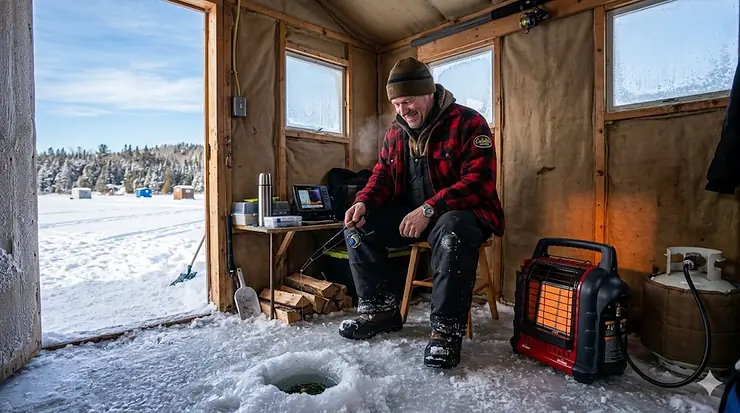
There’s something almost meditative about sitting over a freshly drilled hole on a frozen Ontario lake at -25°C — until you can’t feel your fingers. That’s the moment every Canadian ice angler learns the same lesson: no amount of layering replaces a quality propane heater for ice fishing. It’s not a luxury. On our winters, it’s survival equipment.
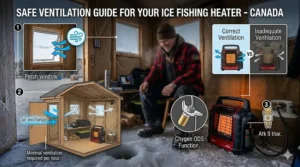
A propane heater for ice fishing is a portable, fuel-burning unit designed to produce radiant or convective heat inside a confined ice shelter or shanty. The best models push between 3,800 and 18,000 BTU, connect directly to a 1 lb. propane cylinder or a 20 lb. tank via hose, and — critically — include safety systems like an Oxygen Depletion Sensor (ODS) and tip-over shutoff. Think of BTU output as the “engine size” for heat: 4,000 BTU is enough to take the edge off a small flip-over shelter, while 18,000 BTU will warm a four-person hub shelter even when it’s -35°C outside in Saskatchewan.
What most Canadian buyers overlook when shopping for an ice fishing heater is the difference between “outdoor-rated” and “indoor-safe.” An outdoor propane heater may technically work inside an ice shanty, but without an ODS system, it won’t shut off as oxygen depletes — a silent, potentially fatal flaw. Always prioritize models with both ODS and a tip-over safety switch.
Canadian shoppers should also note: propane heaters are restricted from indoor use in many Canadian provinces under applicable fire and gas codes. However, ice fishing shelters, as temporary outdoor structures, occupy a grey zone — and models specifically rated as “Massachusetts/Canada approved” are widely accepted for this use. We’ll clarify this in detail further on.
In this guide, we’ve researched the top models available on Amazon.ca (all prices in CAD), covering budget-friendly solo options right up to heavy-duty shelter heaters for extended winter sessions from Yukon to Nova Scotia.
Quick Comparison Table: Top 7 Propane Heaters for Ice Fishing in Canada
| Product | BTU Output | Coverage | Best For | Price Range (CAD) | Safety Features |
|---|---|---|---|---|---|
| Mr. Heater MH4B Little Buddy | 3,800 BTU | ~9 m² (100 sq. ft.) | Solo flip-over shelter | $50–$70 | ODS, tip-over shutoff |
| Mr. Heater MH9BX Portable Buddy | 4,000–9,000 BTU | ~21 m² (225 sq. ft.) | 2–3 person shelter | $80–$110 | ODS, tip-over shutoff |
| Mr. Heater MH18B Big Buddy | 4,000–18,000 BTU | ~42 m² (450 sq. ft.) | Large hub shelter | $130–$170 | ODS, tip-over, fan option |
| Heat Hog 9,000 BTU | 9,000 BTU | ~21 m² (225 sq. ft.) | 2–3 person, versatile | $90–$120 | ODS, tip-over, tilt design |
| Mr. Heater MH12B Hunting Buddy | 6,000–12,000 BTU | ~28 m² (300 sq. ft.) | Mid-size shelter, camo lovers | $110–$145 | ODS, tip-over shutoff |
| Mr. Heater MH11BFLEX Buddy Flex | 8,000–11,000 BTU | ~26 m² (275 sq. ft.) | Outdoor/open-air, windy spots | $110–$140 | Omni-directional burner, self-extinguishing |
| Mr. Heater MH15C Cook & Heat | 10,000–15,000 BTU | ~37 m² (400 sq. ft.) | Cooking + heating combo | $100–$140 | ODS, tip-over shutoff |
Note: All products researched on Amazon.ca. Prices in CAD reflect typical ranges and may vary. Check current pricing on Amazon.ca before purchasing.
Looking at the table above, the Portable Buddy (MH9BX) hits the sweet spot for the majority of Canadian ice anglers — enough heat for a standard 2–3 person shelter without the bulk and weight of the Big Buddy. The Little Buddy is the clear winner for minimalist solo anglers who fish light flip-overs and move frequently. If you run a large hub shelter with multiple anglers on Alberta prairie lakes where -30°C is routine, the Big Buddy’s 18,000 BTU output isn’t overkill — it’s necessary.
💬 Just one click — help others make better buying decisions too! 😊
✨ Don’t Miss These Exclusive Deals!
🔍 Take your ice fishing setup to the next level with these carefully selected heaters. Click on any highlighted item to check current pricing and availability on Amazon.ca. These tools will help you fish in real warmth and comfort all winter long!
Top 7 Propane Heaters for Ice Fishing: Expert Analysis
1. Mr. Heater MH4B Little Buddy — Best for the Solo Angler
The Little Buddy is the entry point to the Buddy family and, for a one-person flip-over shelter, it’s arguably all you need. At 3,800 BTU, it’s a single-output unit — no high/low setting — which actually makes it dead simple to operate with cold gloves on. It screws directly onto a 1 lb. propane cylinder and has zero setup fuss, which matters when you’re rigging up at 5 a.m. in the dark at Lake Simcoe.
The spec that matters most here isn’t BTU — it’s weight. Coming in at around 1.4 kg (3 lbs.) without the cylinder, this is the easiest heater to carry on your sled or pack across the ice without sacrificing a disc. For Canadian anglers who hike distances to reach productive water, that weight saving is real money.
Canadian note: The Little Buddy is approved for outdoor and sheltered use, but in most Canadian provinces it still requires adequate ventilation in any enclosed space. Since a flip-over shelter has natural ventilation gaps, it pairs well with this model.
Customer feedback from Canadian buyers consistently praises the Little Buddy for its reliability in extreme cold, though some note it can struggle to light cleanly below -20°C — keep the cylinder warm in your jacket pocket before connecting.
✅ Extremely lightweight and portable
✅ Dead-simple single-knob operation
✅ Affordable entry point in the $50–$70 CAD range
❌ Single heat setting — no fine-tuning
❌ Not powerful enough for shelters over 9 m² (100 sq. ft.)
Price range: $50–$70 CAD. Best value per BTU for solo fishing.
2. Mr. Heater MH9BX Portable Buddy (Canada/Massachusetts Version) — The Canadian Ice Fishing Standard
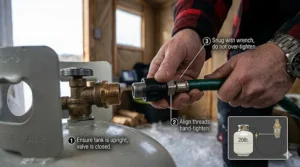
If you see one heater on the ice in Canada more than any other, it’s the Portable Buddy. The MH9BX is the Canada/Massachusetts-approved version, which means it meets the specific safety requirements for use in enclosed spaces in Canadian provinces. That’s not just a sticker — it’s a real engineering difference worth paying attention to.
At 4,000 BTU on low and 9,000 BTU on high, this unit heats up to 21 m² (225 sq. ft.) for up to 5.4 hours on a single 1 lb. cylinder on low. In practice, for a two-person Eskimo ice shelter on a windless -15°C day on Ontario’s Kawartha Lakes, most anglers run it on low for the majority of the session and barely crack through one cylinder. That’s an efficient heater.
The two-setting design gives you meaningful control — something the Little Buddy lacks. Low for maintaining temperature, high for warming up fast when you first set up in a cold shelter. The fold-down handle and compact form factor (fits easily in most gear bags) make transport a non-issue even on remote northern lakes.
For the vast majority of Canadian ice anglers — solo or with one partner, in shelters under 20 m² — this is the one I’d recommend without hesitation. It’s the Goldilocks of the Buddy family.
Canadian buyers frequently note the MH9BX ships well to most provinces on Amazon.ca, and Prime members typically receive it within 2–4 days even in northern Ontario.
✅ Canada/Massachusetts-approved — meets Canadian safety standards
✅ Two heat settings for real temperature control
✅ Compatible with 1 lb. and (via hose) 20 lb. tanks
❌ Runs 3–4 hours on high on a 1 lb. cylinder — bring extras for a full day
❌ Can struggle to light in extreme cold (-25°C or below) without pre-warming the cylinder
Price range: $80–$110 CAD. The single best all-around value for Canadian ice anglers.
3. Mr. Heater MH18B Big Buddy — For the Serious Hub Shelter Angler
The Big Buddy is what happens when a three-person crew decides to set up a hub shelter on Reindeer Lake in northern Saskatchewan for four days and nobody wants to be cold. At up to 18,000 BTU across three heat settings (4,000 / 9,000 / 18,000), it heats up to 42 m² (450 sq. ft.) — enough to keep a large Eskimo or Clam hub shelter at shirt-sleeve temperatures even when the wind howls outside.
What sets the Big Buddy apart technically is its ability to run off two 1 lb. cylinders simultaneously via dual swivel regulators, or from a single 20 lb. tank with an optional hose and filter. On a 20 lb. tank running at medium output, you’re looking at a full 24+ hours of heat — practical for multi-day outings in remote locations where resupplying propane isn’t an option.
The optional built-in fan (powered by D-cell batteries) is underrated. In a large hub shelter, passive radiant heat creates warm zones near the heater and cold pockets at the far end. The fan distributes warmth more evenly, which your fishing partners will genuinely appreciate on a -30°C morning in Manitoba.
Canadian buyers note the Big Buddy is heavier — around 3.6 kg (8 lbs.) — which means it’s more of a sled-transport unit than a carry-in-your-backpack heater. For permanent or semi-permanent ice houses, it’s the de facto standard.
✅ Three heat settings up to 18,000 BTU — unmatched output in this class
✅ Runs on dual 1 lb. tanks or 20 lb. tank for extended sessions
✅ Optional fan for even heat distribution
❌ Heavier and bulkier than other Buddy models
❌ Pricier — expect $130–$170 CAD range
Price range: $130–$170 CAD. Worth every dollar for multi-person or multi-day trips.
4. Heat Hog 9,000 BTU Portable Propane Heater — The Underdog Worth Knowing
The Heat Hog 9,000 BTU (available on Amazon.ca) isn’t as well-known as the Buddy line in Canada, but it earns its place here on genuine merit. The headline feature is the patent-pending tiltable design — the heater pivots on its base, so you can direct radiant heat precisely where it’s needed. This sounds gimmicky until you’re sharing a shelter with someone who runs cold and needs direct heat on their feet while you fish.
The “curved plaque technology” delivers a 33-degree wider heating area than standard flat-panel heaters, which translates to noticeably better warmth distribution in a small shelter without having to crank the BTU output. The built-in fuel dock keeps the propane cylinder warmer than ambient temperature — a meaningful detail for Canadian winters, since propane pressure drops significantly below -10°C, causing some heaters to underperform. The Heat Hog mitigates this by design.
One important note for Canadian buyers: the Heat Hog’s manufacturer notes that in Canada and Massachusetts, unvented heaters are prohibited from use indoors by law. For ice fishing shelters — which are technically temporary outdoor structures — this heater functions well outdoors and in well-ventilated shelters. Ensure adequate airflow.
Canadian anglers who’ve used both report the Heat Hog runs slightly quieter than Buddy heaters and produces a more spread-out heat pattern. It’s an excellent choice for those who fish in open-sided flip-overs or two-person soft shelters with ventilation.
✅ Tiltable design directs heat precisely
✅ Fuel dock improves propane efficiency in cold temps
✅ Wider heat coverage than standard flat-panel heaters
❌ Not rated for fully enclosed indoor use in Canada
❌ Less brand recognition means fewer Canadian service options
Price range: $90–$120 CAD on Amazon.ca.
5. Mr. Heater MH12B Hunting Buddy — Mid-Range Power in Camo
The Hunting Buddy MH12B sits between the Portable Buddy and Big Buddy in both power and price, putting out 6,000 to 12,000 BTU and covering up to 28 m² (300 sq. ft.). For Canadian anglers who fish medium-size hub shelters — think a two-door Otter or mid-size Clam — this is the appropriately-sized heater that the product line doesn’t market loudly enough.
The camo finish is more than aesthetic. If you’re an angler who also hunts, or simply doesn’t want your gear to look like a hardware store accident, the Hunting Buddy fits seamlessly into a waterfowl or deer hunting kit as well. Multi-use gear matters when you’re packing a truck or sled.
Practically speaking, the 12,000 BTU maximum output runs 2–3 hours on a 1 lb. cylinder on high — so for a full Canadian winter day on the ice, plan on either multiple cylinders or hooking up to a 20 lb. tank. The ODS and tip-over safety systems are present and functioning, as expected from the Buddy line.
Canadian buyers note this model is occasionally harder to source on Amazon.ca than the flagship Portable and Big Buddy models — if stock is low, the Big Buddy is a worthy upgrade.
✅ Mid-range output perfect for medium hub shelters
✅ Dual-purpose — fishing and hunting use
✅ Compact enough to transport easily on a sled
❌ Stock can be inconsistent on Amazon.ca
❌ Per-BTU cost is slightly higher than the Big Buddy
Price range: $110–$145 CAD. Good value if you need more than a Portable Buddy but don’t need the full Big Buddy.
6. Mr. Heater MH11BFLEX Buddy Flex — For Windy Outdoor and Open Conditions
The Buddy Flex MH11BFLEX is the odd duck in the lineup — and intentionally so. Rather than the standard flat ceramic burner, it uses an omni-directional fiber mesh burner that produces heat in a 360-degree pattern and is built to resist wind. Conventional Buddy heaters flame out in breezy conditions; the Flex continues burning.
At 8,000–11,000 BTU and covering up to 26 m² (275 sq. ft.), it’s well-powered for its class. The self-extinguishing materials add a layer of safety around dry combustibles. For Canadian anglers who fish from open-sided shelters, windswept lake surfaces, or who set up outside on mild late-winter days, the Flex’s wind resistance makes it more practical than the standard Buddy in those specific conditions.
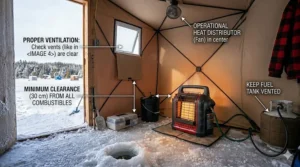
Worth noting: the Buddy Flex is explicitly rated for outdoor use — it’s not the choice for a well-sealed hub shelter where you want focused radiant heat directed at occupants. Think of it as the Portable Buddy’s outdoor-specialist cousin. For the shanty, stick with the MH9BX. For the open ice or partially ventilated flip-overs on a gusty day, the Flex is exceptional.
✅ Wind-resistant omni-directional burner — unique in the Buddy line
✅ 360-degree heat output for open-air use
✅ Self-extinguishing materials add safety around dry gear
❌ Not optimal for fully enclosed shelters — radiant heat disperses in all directions
❌ Slightly pricier than the Portable Buddy for comparable BTU
Price range: $110–$140 CAD. Specialist choice for open-air and breezy conditions.
7. Mr. Heater MH15C Cook & Heat Combination Heater — The Multi-Tasker
The Cook & Heat MH15C solves a real Canadian ice fishing problem: you want heat AND hot food without carrying two separate propane appliances. This unit functions as both a 10,000–15,000 BTU radiant heater and a two-burner stove top, running from a standard 1 lb. cylinder or a 20 lb. tank via hose.
The practical upside is real. On a full-day trip on Lake Winnipeg in January, the ability to boil water for coffee, cook a hot meal, and heat your shelter from one compact propane unit simplifies your kit considerably. You carry one fuel source, one appliance, and you save meaningful space in your sled or gear bag.
The trade-off? The Cook & Heat is wider and less space-efficient than a standalone heater when it’s functioning as a heater only. If you primarily want a heater and cooking is a bonus, the Big Buddy plus a separate camp stove is arguably a more elegant setup. If cooking is a genuine priority alongside heating, the MH15C earns its place.
Canadian buyers appreciate this unit for extended fishing weekends and remote fishing camps in northern provinces where resupply isn’t easy — one efficient propane setup handles two core needs.
✅ Heats and cooks from one propane unit — reduces gear load
✅ Strong 15,000 BTU max output for shelter heating
✅ Works with 1 lb. and 20 lb. tanks
❌ Bulkier footprint than dedicated heaters
❌ Less commonly available on Amazon.ca — check stock before relying on it
Price range: $100–$140 CAD. Best value for multi-day trips where cooking and heating matter equally.
How to Set Up and Use Your Propane Heater Safely in a Canadian Ice Shanty
Getting the most from your ice fishing heater isn’t just about flicking it on and pointing it at yourself. Here’s a practical setup guide built for Canadian conditions.
Step 1: Choose the Right Size for Your Shelter
Match BTU to shelter size before you buy. A rough Canadian guide: multiply your shelter’s square metres by approximately 430 BTU. A 5 m² flip-over shelter needs around 3,800–4,500 BTU (Little Buddy). An 11 m² hub shelter needs 9,000–11,000 BTU (Portable Buddy or Buddy Flex). A 20+ m² permanent shelter needs 15,000–18,000 BTU (Big Buddy or Cook & Heat).
Step 2: Establish Proper Ventilation
This is non-negotiable. Even ODS-equipped heaters rated for enclosed spaces produce carbon monoxide. Maintain two ventilation openings — one near floor level (30 cm or 12 inches from ground) and one near the ceiling. Don’t bank snow completely around your shelter skirts; you’ll block airflow and create dangerous CO accumulation. A small battery-operated CO alarm at breathing height (90–120 cm from floor) is inexpensive insurance. Forensic toxicologists note that CO poisoning symptoms — headache, drowsiness, mild nausea — are easily confused with the fatigue of a long cold day on the ice, which makes a CO detector a genuinely life-saving item.
Step 3: Cold-Weather Propane Performance
Propane pressure drops in cold temperatures. Below -15°C, you’ll notice output decline and possible difficulty lighting. Practical fix: keep your spare 1 lb. cylinders inside your shelter or jacket before use. If you’re running a 20 lb. tank outside, insulate it with a tank blanket and keep it partially shaded from direct wind. Canadian anglers fishing in Manitoba or Saskatchewan in February deal with this routinely — plan for it.
Step 4: Light Correctly in Cold Weather
Hold the control valve depressed for 30 seconds before attempting ignition — this purges air from the line and lets gas reach the burner properly. Most failed cold-weather ignitions are from skipping this step. Use the piezo igniter for first attempts; if it fails, a long-reach lighter works reliably.
Step 5: Maintenance Between Sessions
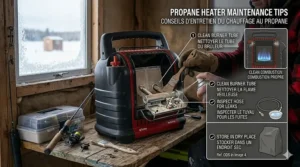
At season’s end, run the heater briefly on an empty cylinder to burn off residual fuel. Store it dry, out of direct sunlight, and away from moisture. The ceramic burner elements are fragile — transport your heater in a padded bag or its original box to avoid cracking them, which will degrade performance noticeably.
Real Canadian Angler Profiles: Which Heater Is Right for You?
Every Canadian ice angler is different. Here are three real-world scenarios to help you match heater to use case.
Profile 1: The Weekend Minimalist — Northern Ontario
Jake from Sudbury drives out to Lake Nipissing every other weekend, fishes solo from a Clam flip-over shelter, and hikes 600 metres across the ice carrying everything on a sled. He’s budget-conscious and values simplicity over power.
Best pick: Mr. Heater MH4B Little Buddy. At around 1.4 kg and under $70 CAD, it fits in his pack without complaint, heats his one-person shelter adequately down to -20°C, and screws directly onto a 1 lb. cylinder he picks up at Canadian Tire. Two cylinders in his pack covers a full 8-hour day.
Profile 2: The Dedicated Crew — Southern Manitoba
The Kowalski family — two adults, one teenager — heads out to Lake Manitoba every January weekend. They run a mid-size hub shelter and fish 6-hour sessions starting at dawn. Temperature regularly hits -28°C with wind chill.
Best pick: Mr. Heater MH18B Big Buddy connected to a 20 lb. propane tank via hose. The 18,000 BTU maximum keeps their shelter warm even on brutal Manitoba days, the built-in fan option circulates heat evenly for three occupants, and the 20 lb. tank eliminates mid-session refuelling. Their total investment for heater, hose, and filter runs $200–$230 CAD — a worthwhile family comfort investment.
Profile 3: The Remote Expeditioner — Northern Québec
Marie-Claire and her partner guide multi-day ice fishing trips near Val-d’Or, Québec, sleeping in portable shelters and cooking all meals on-ice. Weight management matters, but so does warmth at -35°C overnight.
Best pick: Mr. Heater MH15C Cook & Heat. By combining heating and cooking into one unit, they reduce their propane appliance count and simplify their kit. Paired with a 20 lb. bulk tank, one setup handles dinner, hot drinks, and overnight warmth with manageable fuel consumption.
How to Choose a Propane Heater for Ice Fishing in Canada: 7 Expert Criteria
Choosing the right portable propane heater is less about finding the biggest output and more about matching the heater to your specific Canadian conditions. Here are seven criteria I use when evaluating any heater for the ice.
- Indoor Safety Rating (ODS + Tip-Over Switch): Never compromise here. Only consider heaters with a functioning Oxygen Depletion Sensor and automatic tip-over shutoff. Both systems are critical for life safety in enclosed shelters.
- BTU Match to Shelter Size: Bigger isn’t always better. An 18,000 BTU heater in a flip-over shelter wastes fuel, runs hot, and burns through cylinders fast. Match output to your actual shelter size.
- Canada/Massachusetts Approval: Look for this specific designation on the product label or listing. It indicates the heater meets the more stringent safety standards required for enclosed/sheltered use in Canada.
- Tank Compatibility: Can it run from a 1 lb. cylinder and a 20 lb. tank (via hose)? Dual compatibility gives you flexibility for day trips (1 lb.) and extended sessions (20 lb.).
- Cold-Weather Performance: Some heaters underperform below -20°C due to propane pressure drops. The Heat Hog’s fuel dock and warm-cylinder practices mitigate this. Ask specifically about performance at Canadian winter temperatures.
- Weight and Portability: If you carry your gear across ice rather than driving onto it, every kilogram matters. The Little Buddy (1.4 kg) and Portable Buddy (2.4 kg) are carry-in units; the Big Buddy (3.6 kg) is a sled unit.
- Fuel Efficiency: Calculate hours-per-cylinder at typical heat settings. In Canadian winter conditions, running a 9,000 BTU heater on low (4,000 BTU) is usually sufficient in a well-insulated shelter, dramatically extending your fuel supply.
Common Mistakes Canadian Ice Anglers Make When Buying a Propane Heater
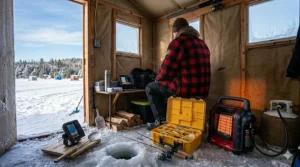
Even experienced anglers make these errors. Avoid them and you’ll be better prepared.
Mistake 1: Buying an outdoor-only heater for an enclosed shelter. The most dangerous mistake on this list. Products like the Texsport portable sunflower-style heater or patio-style propane units are outdoor appliances — using them in an enclosed ice shanty without adequate ventilation can produce lethal CO concentrations in under 30 minutes, as safety data consistently shows. Only use heaters with ODS systems in enclosed or semi-enclosed spaces.
Mistake 2: Ignoring propane performance in extreme cold. Propane becomes less efficient as temperatures drop, with output degrading noticeably below -15°C. Canadian anglers fishing in Saskatchewan or northern Ontario in February need to account for this in their fuel planning — or choose heaters with insulated fuel docks that mitigate the problem.
Mistake 3: Assuming Amazon.ca has the same stock as Amazon.com. Several popular US ice fishing heater brands — including some Texsport models — are not consistently available on Amazon.ca or ship only to certain provinces. Always verify Amazon.ca availability, not just .com availability, before planning a purchase around a specific model.
Mistake 4: Skipping the CO detector. Canadian fire services and Health Canada consistently recommend CO alarms for any enclosed space with combustion appliances. On the ice, your shelter is that space. A CO detector costs $20–$40 CAD on Amazon.ca — it’s inexpensive insurance for a genuine risk.
Mistake 5: Banking snow around the shelter skirt. This well-intentioned draft-blocking move can inadvertently seal your shelter and restrict the ventilation your ODS relies on. Always maintain at least two open ventilation points regardless of wind conditions.
Propane Heaters vs. Alternative Ice Shelter Heating Options in Canada
A common question among newer Canadian ice anglers is whether propane is still the best option in 2026, or whether electric alternatives have closed the gap.
| Heating Type | Heat Output | Fuel Cost | Weight | Safety | Best Use Case |
|---|---|---|---|---|---|
| Propane Radiant (Buddy line) | 3,800–18,000 BTU | Low (1 lb. ~$3–5 CAD) | 1.4–3.6 kg | ODS/tip-over | All shelter types |
| Catalytic Propane | 3,000–6,000 BTU | Low | ~1.5 kg | Flameless, safer | Small shelters, close proximity |
| Electric (12V from truck) | 1,200–1,800 BTU | Free (vehicle) | ~1 kg | Excellent | Drive-on lakes with vehicle access |
| Electric (battery-powered) | 500–1,200 BTU | Battery cost | ~1.5 kg | Excellent | Light use, supplement only |
| Wood/charcoal stove | 20,000+ BTU | Low | 5–10 kg | High CO risk | Permanent ice houses only |
The analysis here is clear: propane radiant heaters remain dominant for portable Canadian ice fishing applications due to their unmatched BTU-to-weight ratio and fuel independence. Electric alternatives are improving but remain limited by battery capacity and output in extreme cold. For shelters more than 500 metres from a vehicle, propane is still the practical choice in 2026.
Catalytic propane heaters — which produce flameless infrared heat from a catalytic reaction rather than an open flame — are worth mentioning as a niche option. They produce lower CO output than radiant heaters and are genuinely safer in very confined spaces. The trade-off is lower maximum heat output; most catalytic units top out at 6,000 BTU, making them better suited as supplemental heaters than primary heat sources in severe Canadian winters. They’re also more expensive per BTU than equivalent radiant heaters.
The table above clearly shows propane radiant heating dominates the portability-to-output balance for Canadian conditions. Electric options are excellent supplements when vehicle power is available but remain impractical as standalone solutions in remote or truly cold conditions.
Canadian Regulations & Safety Standards for Propane Heaters on the Ice
This section matters to every Canadian ice angler and is often completely overlooked in gear guides.
CSA Certification: In Canada, gas appliances must be certified to CSA Group standards — primarily CSA B149.1, the Natural Gas and Propane Installation Code. When shopping on Amazon.ca, look for CSA certification marks on the product listing or packaging. Mr. Heater’s Canada/Massachusetts-approved models (MH9BX, etc.) specifically address the additional requirements that standard US models don’t meet.
Provincial Regulations: Rules on propane heater use vary by province. Under the regulatory framework administered by bodies such as Technical Safety BC and equivalent provincial authorities, unvented propane heaters are generally restricted from permanent indoor use. Ice fishing shelters, being temporary outdoor structures, typically fall outside strict residential indoor use regulations — but this varies by province. Quebec in particular has distinct fire safety regulations that may affect portable heater use in enclosed structures.
Health Canada and CO Safety: Health Canada recommends CO alarms in any space with combustion appliances, and Canadian provincial fire codes mandate them in permanent dwellings. For ice shelters, a portable CO alarm is strongly advisable — it’s not mandated but is endorsed by virtually every Canadian fire department.
Carbon Monoxide Risk Context: Canadian fire safety experts note that a small propane heater running in a sealed 7–8 m² shelter can produce dangerous CO concentrations in under 30 minutes if ventilation is inadequate. The “indoor-safe” rating on Mr. Heater units assumes adequate ventilation — it does not mean you can seal every gap and run it at full output. Two deliberate ventilation openings (floor level and ceiling level) are the minimum safe standard, regardless of temperature outside.
A practical note on the Mr. Heater Canada/Massachusetts designation: Some provinces previously restricted unvented heaters from any enclosed use. The Canada/Massachusetts-approved models were specifically engineered with more sensitive ODS systems to address these requirements. If you’re ever in doubt about legality in your province, contact your local fire marshal’s office — but for practical purposes, the MH9BX is the safe, widely accepted choice for Canadian ice shelters.
FAQ: Propane Heaters for Ice Fishing in Canada
❓ What is the safest propane heater for an ice fishing shanty in Canada?
❓ Can I use a propane heater inside an ice fishing shelter in Canada?
❓ How much propane does an ice fishing heater use per day in Canada?
❓ Do propane heaters work in extreme cold temperatures like -30°C in Canadian winters?
❓ Are propane heaters available for free shipping on Amazon.ca in Canada?
Conclusion: Don’t Let the Cold Decide When You Stop Fishing
The right propane heater for ice fishing doesn’t just make you more comfortable — it extends your season, improves your focus, and genuinely keeps you safer on Canadian ice. Cold hands miss bites. Cold anglers make poor decisions about ice conditions. A quality, safe, properly sized heater removes both problems.
For most Canadian ice anglers, the Mr. Heater MH9BX Portable Buddy (Canada/Massachusetts version) is the correct starting point — proven, safe, widely available on Amazon.ca in the $80–$110 CAD range, and genuinely effective from -15°C to -35°C with proper cylinder management. Solo anglers who travel light can drop to the Little Buddy; serious hub-shelter crews should look at the Big Buddy.
Whatever model you choose, pair it with a CO alarm, maintain two ventilation points in your shelter, and keep spare cylinders warm. These three habits cost almost nothing and protect everything.
Canadian winters are long, ice conditions are variable, and fishing days are precious. Don’t waste a single one to the cold.
✨ Ready to Stay Warm on the Ice?
🔍 Click on any highlighted product in this guide to check current pricing and availability on Amazon.ca. Whether you fish solo on a Québec lake or run a crew on Lake Winnipeg, there’s a propane heater for ice fishing on this list that fits your kit perfectly!
Recommended for You
- Best Merino Wool Neck Gaiter in Canada 2026: 7 Top Picks
- Warmest Balaclava for Ice Fishing: 7 Best Picks for Canada (2026)
- Best Insulated Ice Fishing Hat 2026: 7 Warmest Picks for Canadian Winters
Disclaimer: This article contains affiliate links. As an Amazon Associate, I earn from qualifying purchases. If you purchase products through these links, we may earn a small commission at no additional cost to you.
✨ Found this helpful? Share it with your ice fishing crew! 💬🤗
