
In This Article
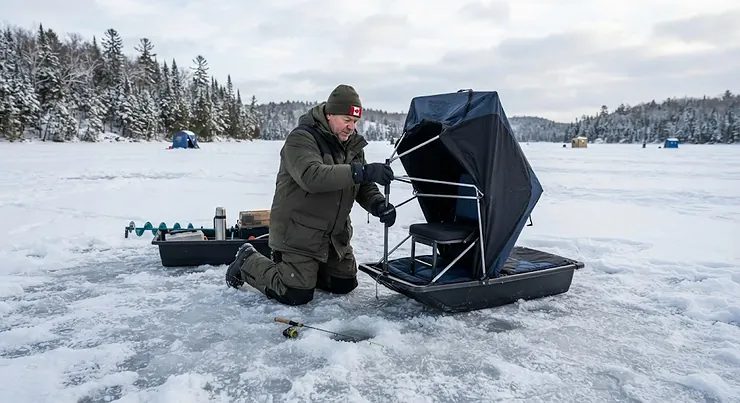
There’s a very specific kind of misery that comes from sitting on an overturned bucket at -20°C, wondering why your tailbone hates you and your jig hand won’t stop shaking. If you’ve ever spent four hours perched on a milk crate over a hole in the ice, you already understand why flip over seat ice fishing setups exist, and why so many Canadian anglers eventually upgrade. A flip-over shelter with a real seat built into the sled isn’t a luxury add-on — it’s the difference between a short, cranky outing and a full day on the lake that actually feels good.
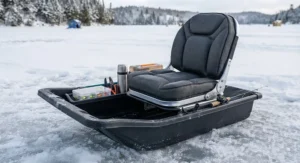
As Wikipedia’s overview of ice fishing notes, portable shelters towed onto the ice have long been central to the sport, evolving from simple windbreaks into today’s engineered flip-over systems. The concept is simple. A flip-over shelter sits on a plastic sled base, its fabric shell and pole frame folded flat for towing. Flip the frame up and over, and the shelter pops into place in seconds — no stakes, no fumbling with poles in mitts. What separates a great one from a mediocre one, though, is almost always the seat. A thin bench that leaves your knees jammed under the console for six hours isn’t the same experience as a padded, adjustable perch with proper back support.
Across this guide, we’ve researched seven real, currently available shelters that Canadian ice anglers can find through amazon.ca and specialty retailers, spanning budget one-person rigs to premium two-angler lodges. We’ll break down the seat systems, the fabric and insulation choices, and the trade-offs nobody prints on the box — plus how to choose, common mistakes, and a few scenario-based recommendations so you land on the right shelter for your ice, not someone else’s.
Quick Comparison Table
| Shelter | Seat Style | Best For |
|---|---|---|
| Clam X100 Thermal | Single padded flip seat | Solo hole-hoppers on a budget |
| Frabill Bro Flip-Over Shelter | Modular flip seat system | Anglers who carry lots of gear |
| Eskimo Wide 1 XR Thermal | Mesh-and-steel frame seat | Tall anglers needing legroom |
| Clam Nanook Thermal | Two padded folding swivel seats | Budget-conscious fishing duos |
| Clam Voyager XT Thermal | Two adjustable swivel seats | Anglers wanting a customizable fit |
| Otter XT Pro Lodge | Deluxe cushioned bench seat | Long, comfort-first sessions |
| Eskimo Wide 2 XR Thermal | Integrated shelter seat, two-up | Value-minded two-person crews |
Reading this table, a pattern jumps out fast: price generally tracks seat sophistication, not just fabric thickness. The Clam X100 Thermal and Eskimo Wide 2 XR Thermal prove you don’t need to spend premium money to get a genuinely comfortable flip seat, while the Otter XT Pro Lodge and Clam Voyager XT Thermal justify their higher price tags with seats that actually adjust to your body rather than the other way around. If you fish solo and move often, lean toward the single-seat models; if you’re usually out with a partner, the two-seat shelters earn back their extra weight in shared warmth and conversation.
💬 Just one click — help other golf parents make better buying decisions too!😊
Top 7 Flip Over Seat Ice Fishing Shelters: Expert Analysis
1. Clam X100 Thermal — lightest true one-person flip seat for hole-hopping
The Clam X100 Thermal is built for the angler who treats a lake like a buffet, moving from hole to hole chasing biters rather than parking in one spot all day. Its single-pole flip mechanism and compact sled mean one person can tow, flip, and be fishing inside a minute.
Under the hood, the shelter uses Clam’s signature 1.25-inch pole system and a 900-denier thermal skin, which in practical terms means the fabric resists tearing on rough, wind-scoured ice while trapping enough body heat that a small heater can actually keep pace with a Prairie or Northern Ontario cold snap. The padded flip seat sits low and centred over the hole, which keeps your centre of gravity stable when you lean in to net a fish.
Based on the spec comparison against other one-person shelters, this is the pick for anglers prioritizing weight over square footage — you’re trading elbow room for something you can genuinely carry solo across uneven shoreline ice. Reviewers on major retail sites consistently mention that the seat, while basic, holds up well over multiple seasons without the foam flattening prematurely, which isn’t something every budget shelter can claim.
Pros:
- ✅ Sets up solo in under a minute on the ice
- ✅ Thermal skin holds heat well for its price class
- ✅ Padded seat resists flattening after repeated seasons
Cons:
- ❌ Tight for anglers over 6 feet tall
- ❌ No second seat option if a friend joins
Expect to pay in the C$400-C$500 range at the time of research, making the Clam X100 Thermal one of the most accessible true flip over seat ice fishing shelters on this list — a strong value if solo mobility matters more than space.
2. Frabill Bro Flip-Over Shelter — smartest modular seat for gear-heavy days
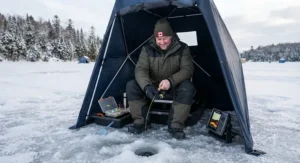
The Frabill Bro Flip-Over Shelter stands out immediately for its SideStep entry, a door design that lets you climb in and out without stepping over your rods, auger, or tackle bag every single time — a small thing that becomes a genuinely big deal by your third hour on the ice.
Frabill’s patented modular seating system is the real headline here: the seat and interior layout can be reconfigured depending on whether you’re fishing solo with a pile of gear or squeezing in a second angler for an afternoon. The vertical front wall adds standing headroom for hook-sets, something flatter-fronted shelters can’t match, and the water-resistant shell handles light snow and slush without soaking through.
What most buyers overlook about this model is that the modular seat isn’t just about comfort — it’s about storage logic. Because the bench shifts and the underseat space opens up, you can keep your auger, bait bucket, and spare rods within arm’s reach instead of piled against the wall. Aggregated feedback across retailer listings points to praise for the roomy interior and general durability, with occasional notes that the shelter runs heavier than its “compact” framing might suggest.
Pros:
- ✅ SideStep entry avoids stepping over gear
- ✅ Modular seat reconfigures for one or two anglers
- ✅ Vertical front wall adds real hook-setting headroom
Cons:
- ❌ Heavier than its footprint implies at roughly 140 lb
- ❌ Not a full thermal shell, so cold-snap performance is average
Priced around C$450-C$550 in the mid-range bracket, the Frabill Bro Flip-Over Shelter earns its keep for anglers who haul a full tackle arsenal and don’t want to choose between comfort and organization.
3. Eskimo Wide 1 XR Thermal — most legroom for tall anglers
If you’ve ever unfolded yourself out of a cramped shelter feeling like a cartoon character stepping out of a tiny car, the Eskimo Wide 1 XR Thermal was built with you in mind. A single bottom pole expands the frame at the push of a button, opening roughly 17.5 square feet of fishable floor — enough for three holes at once, which is a genuinely rare feature in a one-person shelter.
The seat itself uses a mesh-and-steel frame rather than dense foam, and here’s what the spec sheet won’t tell you: mesh seating actually breathes better during active jigging sessions, reducing the sweaty-then-freezing cycle that heavier padded seats can cause once you start moving around. Combined with the gray interior fabric, which reflects more ambient light than black liners, tying on small jigs in low winter light gets noticeably easier.
Reviewers frequently single out this model’s warmth-to-weight ratio, noting it holds heat impressively well under a modest heater without feeling like hauling a shed across the lake. On paper, this makes it a strong middle ground between the ultralight Clam X100 Thermal and the bulkier two-person options further down this list.
Pros:
- ✅ 17.5 sq ft interior fits three holes comfortably
- ✅ Mesh-steel seat frame reduces sweat-then-chill cycles
- ✅ Gray interior brightens the space for tying jigs
Cons:
- ❌ Mesh seat offers less cushioning than foam-padded rivals
- ❌ Single-pole expansion mechanism needs occasional lubrication in deep cold
Look for the Eskimo Wide 1 XR Thermal in the C$550-C$700 range, a fair ask given the unusually generous floor space for a solo shelter.
4. Clam Nanook Thermal Fish Trap — best budget-friendly two-seat setup
Ice fishing is better with a buddy, and the Clam Nanook Thermal Fish Trap is built around exactly that idea without demanding a premium-tier budget. Its Rapid Pole Slide Extreme system snaps the frame up in seconds, even with two people’s worth of gear already piled inside the tub.
Both seats are padded, folding, and swivel independently, sliding front-to-back and side-to-side so each angler can square up to their own hole without elbowing their fishing partner. Underneath each seat sits a hammock-style storage pouch, which in real terms means your gloves, pliers, and extra jigs stop disappearing into the tub’s corners. The 900-denier full thermal skin and black interior fabric combine to hold heat aggressively, which matters more with two bodies’ worth of cold air constantly cycling through the door.
Here’s what most comparison charts miss: because the seats are removable, you can strip the shelter down to a lighter solo rig on days your fishing partner bails, which very few two-person shelters in this price bracket allow. Aggregated review sentiment across outdoor retailers routinely praises the seat swivel range, with the most common criticism being that the hammock storage compresses if you overload it with heavy tackle boxes.
Pros:
- ✅ Two padded seats swivel and slide independently
- ✅ Seats are fully removable for solo-mode trips
- ✅ Underseat hammocks keep small gear organized
Cons:
- ❌ Hammock storage sags under heavy tackle loads
- ❌ Interior feels snug once winter layers are added
Expect a price around C$650-C$800, positioning the Clam Nanook Thermal Fish Trap as arguably the smartest two-person value pick on this entire list.
5. Clam Voyager XT Thermal — most adjustable seat system for two
For anglers who’ve sat in a shelter seat that just didn’t fit right — too far forward, too low, angled wrong for your hole — the Clam Voyager XT Thermal is the direct answer. Its deluxe seat system moves front-to-back and left-to-right independently for each angler, making this the most genuinely adjustable flip seat on this list rather than a seat that merely claims adjustability on the box.
The shelter runs on Clam’s Extreme 1.25-inch pole system with RPSX for fast setup, and its 900 total denier fabric with a full thermal skin (roughly 90 grams of insulation per square meter) keeps interior temperatures noticeably steadier than non-thermal competitors during sustained cold snaps. Dual side doors mean you and a fishing partner can each come and go without climbing over one another’s rod cases — a small design choice that saves real friction on a long day.
What the spec sheet undersells is how much the adjustable shelter seat changes your actual fishing posture. Being able to slide your seat six inches closer to your hole, rather than hunching forward for hours, measurably reduces the lower-back fatigue that ends most all-day ice sessions early. Aggregated buyer feedback echoes this, with repeated mentions of the seat comfort holding up across multi-hour sits, alongside occasional notes that the co-extruded gray tub, while easier to spot gear in, shows scuffs faster than darker tubs.
Pros:
- ✅ Seats adjust independently front-to-back and side-to-side
- ✅ Dual side doors ease entry for two anglers
- ✅ Thermal skin holds heat through extended cold snaps
Cons:
- ❌ Premium adjustability comes at a premium price
- ❌ Gray tub shows scuffs more visibly than black tubs
Priced roughly C$800-C$1,000, the Clam Voyager XT Thermal is built for anglers who’ve decided comfort is not negotiable on a long day of ice fishing.
6. Otter XT Pro Lodge — most comfortable premium seat on the ice
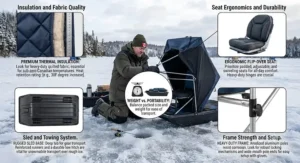
At the top of this list sits the Otter XT Pro Lodge, a flip-over shelter that borrows its unique pole structure and EZ Lock assembly from Otter’s well-regarded Pro line, letting you convert side access in seconds while keeping front-door entry intact — a clever bit of engineering most competitors haven’t matched.
With roughly 16.8 square feet of interior space, it comfortably seats two, and Otter’s deluxe cushioned bench seat is noticeably thicker and firmer than the padding found on the mid-range shelters in this guide — the kind of seat that doesn’t go numb by hour three. The ultra-glide pole system also cuts assembly time meaningfully compared to older flip designs, which matters when you’re setting up in a stiff wind with cold fingers.
Here’s the honest trade-off, based on the spec comparison: at roughly 82 pounds, this is not a shelter you’ll casually sling over one shoulder, and a second matching seat is typically sold as a separate accessory rather than included — worth budgeting for if two of you plan to fish regularly. Reviewers consistently note the insulation and space as genuine standouts, with the added weight and accessory seat cost as the most commonly cited drawbacks.
Pros:
- ✅ Thick cushioned bench seat resists numbness on long sits
- ✅ EZ Lock assembly speeds up cold-weather setup
- ✅ Side and front access both remain usable
Cons:
- ❌ At roughly 82 lb, it’s the heaviest shelter here
- ❌ Second seat is often sold separately
At around C$900-C$1,150, the Otter XT Pro Lodge sits at the premium end, but for anglers who measure trips in full days rather than hours, the seat comfort alone can justify the spend.
7. Eskimo Wide 2 XR Thermal — best value two-person alternative
Rounding out the list is the two-person sibling to our third pick, the Eskimo Wide 2 XR Thermal, which brings the same push-button pole expansion to a wider tub built for two anglers who don’t want to pay Voyager or Otter-level prices.
The integrated shelter seat here uses a similar mesh-and-steel design to its one-person counterpart, which continues to earn its keep by staying breathable during active jigging while still supporting your weight comfortably across a multi-hour sit. The wider tub base improves stability when both anglers lean toward the same side to net a fish, a real concern in narrower two-person shelters that can tip awkwardly under uneven weight.
Based on the spec comparison, this shelter occupies a genuine gap in the market: it’s noticeably cheaper than the Clam Voyager XT Thermal or Otter XT Pro Lodge, yet still delivers a built in flip seat setup sturdier than most budget two-person alternatives. Aggregated review commentary tends to highlight the stable tub and reasonable warmth as strengths, with the trade-off being less seat cushioning than the foam-padded premium models.
Pros:
- ✅ Wide tub base resists tipping when both anglers lean
- ✅ Mesh-steel seats stay breathable during active jigging
- ✅ Noticeably cheaper than comparable two-person premium shelters
Cons:
- ❌ Less plush padding than foam-seat competitors
- ❌ Larger footprint makes solo towing more tiring
Priced around C$600-C$750, the Eskimo Wide 2 XR Thermal is the shelter we’d point budget-conscious fishing pairs toward first.
Top 7 Shelters: Specs & Value Comparison
| Shelter | Capacity | Fabric | Approx. Price (CAD) | Best For |
|---|---|---|---|---|
| Clam X100 Thermal | 1 person | 900-denier thermal | C$400-C$500 | Budget solo anglers |
| Frabill Bro Flip-Over Shelter | 1-2 people | Water-resistant | C$450-C$550 | Gear-heavy trips |
| Eskimo Wide 1 XR Thermal | 1 person | Thermal skin | C$550-C$700 | Tall anglers |
| Clam Nanook Thermal | 2 people | 900-denier thermal | C$650-C$800 | Budget duos |
| Clam Voyager XT Thermal | 2 people | 900-denier thermal | C$800-C$1,000 | Custom-fit comfort |
| Otter XT Pro Lodge | 2 people | Insulated thermal | C$900-C$1,150 | All-day comfort |
| Eskimo Wide 2 XR Thermal | 2 people | Thermal skin | C$600-C$750 | Value-focused duos |
Lined up side by side, the value gap becomes obvious: the Eskimo Wide 2 XR Thermal delivers roughly 80% of the comfort of the Clam Voyager XT Thermal for around 25% less money, which is exactly why we call it the best value two-person pick rather than the best two-person pick outright. Meanwhile, the jump from the Clam X100 Thermal to the Eskimo Wide 1 XR Thermal buys you significantly more floor space for a modest price increase, which matters most if you fish with a dog, a sled full of tackle, or simply have long legs.
Benefits of a Built-In Flip Seat vs. Traditional Bucket Seating
| Feature | Built-In Flip Seat | Bucket or Milk Crate |
|---|---|---|
| Back support | Yes, contoured | None |
| Insulation from cold sled floor | Yes | Minimal |
| Storage integration | Often (hammocks, consoles) | None |
| Weight added to setup | Moderate | Negligible |
The comfort difference here isn’t subtle. A bucket transmits cold straight up through your jeans within twenty minutes, while a padded shelter seat keeps a layer of insulation between you and a frozen sled floor for the entire session. The trade-off, fairly stated, is that a built-in flip seat does add bulk and weight to your setup — but for anyone fishing longer than an hour or two, that weight buys back hours of usable comfort.
Practical Usage Guide: Setting Up Your Flip Over Seat Right
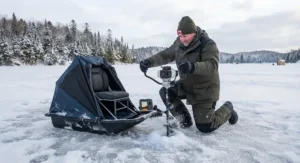
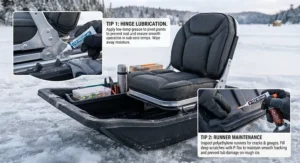
Getting the most out of any flip over seat ice fishing shelter starts before you ever hit the lake. On first use, unfold the shelter fully at home and check that every pole locks securely — cold hands on the ice are the worst time to discover a stuck hinge. Lightly wax metal slide points with a silicone-based lubricant; Clam, Eskimo, and Otter poles all benefit from this, and it prevents the sticking that occurs when factory grease thickens in sub-zero temperatures.
Once on the ice, position the sled so the seat faces your intended hole before you flip the frame up, since repositioning a fully assembled shelter is far more work than a quick pre-flip adjustment. In the first 30 days of ownership, most anglers make one common mistake: over-tightening seat swivel bolts to stop minor wobble, which actually accelerates wear on the swivel mechanism. A slight bit of play is normal and by design.
For maintenance, wipe down seat padding after every trip with a dry cloth before folding the shelter flat — trapped moisture against foam padding is the single biggest cause of premature seat breakdown between seasons. Store the shelter flipped down in a dry space, ideally with the seat cover on if your model included one, and inspect fabric seams for salt or slush residue each spring before summer storage.
Real-World Scenarios: Matching Shelters to Your Situation
Picture three different anglers heading out this winter. The first is a university student in Thunder Bay who fishes alone after class, on a tight budget, and needs to carry gear across a parking lot before reaching the ice — for them, the lightweight Clam X100 Thermal and its simple padded flip seat make the most sense, since portability outweighs interior space.
The second is a retired couple in rural Manitoba who fish together most weekends and value a warm, stable shelter over raw speed — the Clam Nanook Thermal Fish Trap, with its two padded, removable seats and generous thermal insulation, fits their pattern of longer, slower sessions far better than a solo shelter ever could.
The third is a serious weekend tournament angler in Northern Ontario who tows with a snowmobile, fishes six-hour blocks in extreme cold, and prioritizes comfort above almost everything else — for that profile, the Otter XT Pro Lodge‘s thick cushioned bench and superior insulation justify both the weight and the price tag that would be overkill for a casual outing.
Problem → Solution: Fixing Common Flip Over Seat Complaints
A surprising number of ice fishing complaints trace back to the seat rather than the shelter itself. If your seat feels too low relative to your hole, the fix is usually a supplementary seat cushion rather than a whole new shelter — several manufacturers, including Clam, sell deluxe seat cover accessories specifically for this. If the padding has gone flat after a couple of seasons, replacing the cushion insert is typically far cheaper than replacing the entire seat assembly, and most flip-over brands sell these as standalone parts.
Cold transferring up through the seat despite decent padding usually means the insulation has compressed with use; adding a thin foam pad or heated seat cushion underneath solves this without any tools required. Finally, if a seat swivels too freely and feels unstable when you lean to net a fish, a light retightening of the mounting bolts — not the seat’s own swivel joint — usually restores stability without introducing the over-tightening problem discussed above.
How to Choose a Flip Over Seat Ice Fishing Shelter
Choosing the right shelter comes down to matching a handful of criteria to how you actually fish, not to whichever model has the flashiest marketing copy.
- Group size. Decide honestly whether you fish solo most of the time or usually bring a partner — a two-seat shelter you rarely fill with two people is just extra weight to tow.
- Seat adjustability. If you have back or knee issues, prioritize shelters like the Clam Voyager XT Thermal with independently sliding seats over fixed-position benches.
- Insulation level. Anglers fishing below -15°C regularly should lean toward full thermal skins rather than standard fabric shells.
- Weight versus towing method. Snowmobile or ATV towing tolerates heavier shelters like the Otter XT Pro Lodge; hand-towing favours lighter options like the Clam X100 Thermal. If you’re towing with a vehicle at all, review your province’s ice fishing hut rules, since registration and removal-date requirements vary by region.
- Storage integration. Underseat hammocks and consoles genuinely reduce clutter on longer trips and are worth a small price premium.
- Entry design. SideStep or dual-door access, as seen on the Frabill Bro Flip-Over Shelter, matters more than it seems once you’re climbing in and out repeatedly.
- Budget realism. Set a ceiling first, then choose the best seat comfort available within it — comfort scales with price, but not linearly, and the mid-range often delivers the best return.
Common Mistakes When Buying a Flip-Over Shelter
The most frequent mistake anglers make is buying based on advertised capacity alone. A shelter listed for two often fits two adults in bulky winter gear far more snugly than the marketing photos suggest, so if you’re between sizes, sizing up is usually the safer bet.
A second common error is ignoring seat material entirely and focusing purely on shell insulation. A cold, unpadded seat inside a warm shelter still leaves you shifting uncomfortably within an hour, which defeats much of the point of upgrading from a bucket. Finally, many first-time buyers skip checking pole diameter and lock mechanism reviews, only to discover in deep cold that thinner poles are more prone to sticking — a detail the Clam Voyager XT Thermal‘s 1.25-inch Extreme pole system specifically addresses.
Flip-Over vs Pop-Up Shelters: Which Seat Style Wins
Pop-up hub shelters have surged in popularity because they collapse into a duffel bag and set up in under two minutes, but they typically ask you to bring your own seat or chair. Flip-over shelters like every model on this list trade some of that packability for a built-in flip seat that’s matched to the shelter’s dimensions from the factory, which usually means better ergonomic fit and integrated storage underneath.
For anglers who move spots multiple times per outing, a pop-up’s speed advantage can outweigh seat comfort. But for anglers who set up once and stay put for hours — the more common pattern for family trips and tournament fishing alike — the integrated shelter seat of a flip-over consistently wins on comfort, warmth retention near the floor, and the simple convenience of not hauling a separate chair across the ice.
What to Expect: Real-World Performance
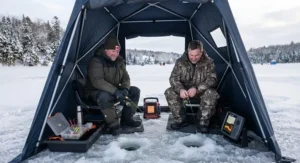
On paper, thermal denier ratings and seat dimensions are just numbers. In practice, a 900-denier thermal shelter with a padded seat means you can realistically fish two to three hours longer before the cold forces you off the ice, compared to a non-insulated shelter with a bare bench. Anglers moving from a bucket to any of the shelters on this list typically describe the biggest single improvement as reduced lower-back and hip discomfort, not warmth — which makes sense, since a stable, supported sitting position changes your whole posture over a multi-hour session.
Expect a short adjustment period with swivel seats specifically; the first few times you lean to net a fish, the range of motion can feel unfamiliar if you’re used to a fixed bucket. Most anglers report this feeling natural within one or two trips.
Long-Term Cost & Maintenance
A flip-over shelter with a quality seat is a multi-season investment, and the total cost of ownership looks better than the sticker price suggests once you factor in replaced gear it eliminates — no more separate folding stool, seat cushion, or milk crate to buy and haul. Budget roughly C$30-C$60 every few seasons for a replacement seat cushion or cover as padding compresses with use, and inspect pole joints annually for wear, since a $15 replacement pin is far cheaper than a cracked frame mid-season.
Shelters stored properly — dry, flat, out of direct sun in the off-season — routinely last five to eight years before major components need replacing, which spreads that initial C$400-C$1,150 purchase price down to well under C$150 per season for most owners. It’s also worth noting that most provinces require shelters to be removed from the ice before the spring thaw, so factor an annual on-time teardown into your maintenance routine rather than leaving a shelter to be damaged by melting ice.
Built-In Flip Seat vs Integrated Shelter Seat: What’s the Real Difference?
These two terms get used almost interchangeably in product listings, but there’s a subtle distinction worth knowing. A built in flip seat generally refers to any seat permanently mounted to the shelter’s sled or frame — it doesn’t detach, and it flips into position along with the shelter itself, as seen on the Clam X100 Thermal. An integrated shelter seat, by contrast, usually describes a seat that’s designed as part of the overall interior layout, often with matching storage or console features built around it, like the seat-and-hammock combination on the Clam Nanook Thermal Fish Trap.
In practice, both terms point to the same core benefit over aftermarket seating: the seat height, angle, and position have been engineered specifically for that shelter’s hole placement and interior dimensions, rather than bolted on as an afterthought. If you’re comparing listings and see either phrase, treat it as a signal that you won’t need to buy or rig a separate seat — a detail worth confirming before checkout, since a small number of budget shelters still ship seat-free.
What Makes the Best Flip Over Seat? Padding, Adjustability, and Comfort
Ask ten anglers what the best flip over seat looks like and you’ll get ten slightly different answers, but three factors show up consistently across real buyer feedback: padding density, adjustability, and swivel range. A comfortable flip seat needs enough foam density to resist compressing flat within a season — thin padding might feel fine in the store but disappoints by your fifth outing.
Adjustability matters nearly as much. An adjustable flip seat that slides front-to-back, like the system on the Clam Voyager XT Thermal, lets taller and shorter anglers both find a natural distance from their hole rather than compromising. Finally, a padded shelter seat with some swivel range — even 45 degrees in either direction — makes netting a fish or reaching gear behind you dramatically easier without standing up, which matters more on rough ice than most first-time buyers expect. Weigh these three factors against your budget, and you’ll land on the right seat far more reliably than chasing brand names alone.
Frequently Asked Questions
❓ What is the best flip over seat ice fishing shelter for beginners?
❓ How do I make my flip over ice fishing seat more comfortable?
❓ Can you add a padded seat to any flip over shelter?
❓ Are flip over shelters with built in seats worth the extra cost?
❓ How much does a good flip over ice fishing shelter cost in Canada?
Conclusion
Choosing among these seven shelters really comes down to two honest questions: how many people usually fish with you, and how long you actually stay out. Solo anglers chasing bites across a lake will get more value from the Clam X100 Thermal‘s simplicity or the Eskimo Wide 1 XR Thermal‘s extra floor space than from anything built for two. Fishing duos, meanwhile, have real options at every price point — the Eskimo Wide 2 XR Thermal for value, the Clam Nanook Thermal Fish Trap for balanced comfort, and the Clam Voyager XT Thermal or Otter XT Pro Lodge when adjustability and all-day comfort matter more than the price tag.
What ties every recommendation here together is that the seat, not the shell fabric or the pole system, tends to be the deciding factor in how long you actually enjoy being out on the ice. According to the Canadian Red Cross, cold-weather activities on frozen water carry real risks that no shelter comfort can offset, so pair whichever shelter you choose with sound ice thickness safety guidelines before heading out this season.
✨ Don’t Miss These Exclusive Deals! 🎣
Take your ice fishing setup to the next level with the shelters compared above. Click through to check current pricing and availability, and get ready for a season of warmer, more comfortable days on the ice!
Recommended for You
- 7 Best Insulated Ice Fishing Buckets in Canada 2026
- Best Ice Fishing Bucket 2026: 7 Top Picks Compared
- Flip Over Sled Ice Fishing: 7 Winning Picks for Canada in 2026
Disclaimer: This article contains affiliate links. As an Amazon Associate, I earn from qualifying purchases. If you purchase products through these links, we may earn a small commission at no additional cost to you.
✨ Found this helpful? Share it with your friends! 💬🤗
