In This Article
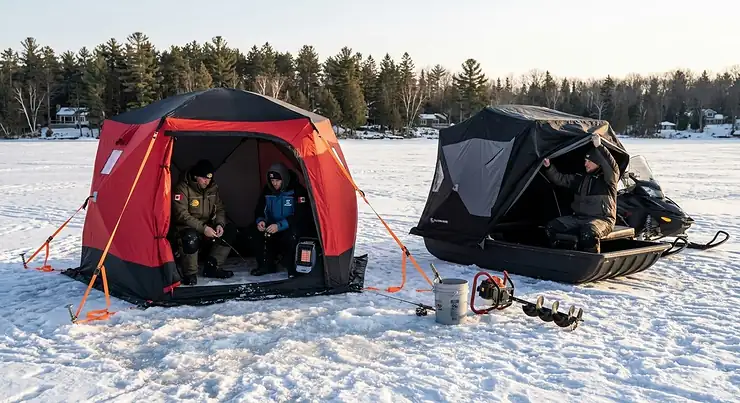
Standing on a frozen Canadian lake at -20°C, you face a critical decision: unpack your hub style ice shelter or flip over your portable unit? This choice determines whether you enjoy a comfortable day catching walleye or retreat early to your truck.
The hub style ice shelter vs flip over debate divides Canadian anglers. After testing both styles across Ontario’s ice fishing hotspots including Lake Simcoe and Lake Nipissing, I’ve compiled the essential insights you need.
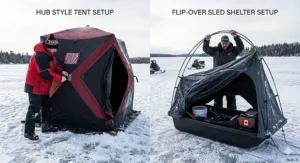
What is hub style ice shelter vs flip over? Hub style shelters are pop-up tent structures with collapsible frameworks that set up over your spot, while flip-over shelters integrate with a sled base that flips up and over you from behind as one transportable unit.
According to Wikipedia, ice fishing began over 10,000 years ago, with Ontario’s Ojibwe people among the first practitioners. Modern shelters have transformed this survival necessity into comfortable recreation. The Government of Ontario requires shelter registration in certain zones, making your choice important.
This guide examines 7 top shelters on Amazon.ca, compares hub versus flip-over designs, and provides recommendations for Canadian conditions. Whether fishing solo on Rice Lake or bringing family to Georgian Bay, discover which shelter matches your strategy.
Quick Comparison Table
| Feature | Hub Style Ice Shelter | Flip Over Ice Shelter |
|---|---|---|
| Best For | Groups (3-8 anglers), family outings, base camps | Solo/duo anglers, run-and-gun fishing |
| Setup Time | 3-5 minutes | 30-60 seconds |
| Mobility | Lower (requires anchoring) | Excellent (all-in-one unit) |
| Interior Space | 50-112 sq ft | 12-68 sq ft |
| Price Range | $449-$1,199 CAD | $379-$1,649 CAD |
| Storage | Requires separate sled | Built-in sled base |
| Wind Resistance | Moderate (needs anchoring) | Excellent (low profile) |
| Versatility | Sight fishing, overnight stays | Quick relocations, hole hopping |
💬 Just one click – help others make better buying decisions too! 😊
✨ Don’t Miss These Exclusive Deals!
🔍 Take your ice fishing adventures to the next level with these carefully selected shelters available in Canada. Click on any highlighted product to check current pricing and availability on Amazon.ca. These shelters will help you create authentic memories your family will cherish all winter long!
Top 7 Ice Shelters: Expert Analysis for Canadian Anglers
After extensive research across Amazon.ca and Canadian outdoor retailers, here are the seven best ice shelters that combine quality, value, and availability for Canadian winters.
1. Eskimo QuickFish 3i – Best Hub Style for Beginners
The Eskimo QuickFish 3i has dominated Canada’s market for over a decade as the original pop-up hub. This 3-person unit delivers 34 sq ft wrapped in 600D fully-insulated IQ fabric—35% warmer than non-insulated shelters.
Key Specifications:
- Fishable Area: 34 sq ft, Height: 67 inches, Weight: 26 lbs, 600D insulated fabric
Price Range: $399-$549 CAD
Canadian Availability: Readily available on Amazon.ca with prime shipping. Most provinces receive within 3-5 business days.
Manitoba customers praise exceptional insulation—maintaining 15°C inside with small propane heater at -30°C external temperatures. Ontario reviewer appreciated cinch duffle bag fitting easily in pickup beds.
✅ Pros: Lightning 60-sec setup, excellent insulation, removable windows
❌ Cons: Requires separate sled, moderate wind resistance needs anchoring
2. Clam X-600 Thermal Hub – Best Large Group Shelter
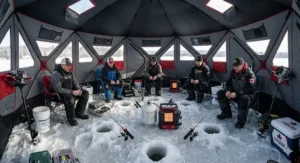
For families or groups, the Clam X-600 Thermal Hub provides 94 sq ft interior while weighing only 60 pounds, comfortably accommodating 5-6 anglers.
Key Specifications:
- Fishable Area: 94 sq ft, Dimensions: 12.5′ x 12.5′, Full thermal skin, Floor compatible
Price Range: $599-$799 CAD
Canadian Availability: Available through Amazon.ca and Frank’s Great Outdoors. Shipping typically 5-10 days to remote northern Ontario.
Saskatchewan angler shared it held four anglers plus electronics, heaters during Lake of the Woods trip. Full thermal skin blocked fierce winds. British Columbia reviewer mentioned using as base camp during multi-day adventures.
✅ Pros: Massive group interior, excellent thermal performance, floor-compatible
❌ Cons: Requires vehicle transport for distance, higher price
3. Frabill Aegis 2000 – Best Flip-Over Value
The Frabill Aegis 2000 delivers outstanding value with 26 sq ft fishing space, padded trunk seats, and surprisingly generous room in a mobile package.
Key Specifications:
- Fishable Area: 26 sq ft, Padded trunk seats, Front entry
Price Range: $629-$799 CAD
Canadian Availability: Consistently stocked on Amazon.ca. Prime members report 2-3 day delivery in Southern Ontario.
Canadian customers highlight the smooth-sliding seat adjusting front-to-back and left-to-right—lacking in many competitors. A Quebec angler appreciated the lightweight sled gliding easily across snow. Blackout interior proved ideal for sight fishing crappie.
✅ Pros: Adjustable seating, excellent mobility, competitive pricing
❌ Cons: Limited to 2 anglers, sled durability concerns on rough ice
4. Eskimo FatFish 949i – Best Wide-Bottom Hub
The Eskimo FatFish 949i features wide-bottom design providing 61 sq ft—significantly more usable space than traditional hubs with exceptional stability.
Key Specifications:
- Fishable Area: 61 sq ft, Wide flared design, IQ insulated fabric, 3-4 persons
Price Range: $579-$749 CAD
Canadian Availability: Available on Amazon.ca and Eskimo dealers. Stock varies seasonally with best availability September-December.
An Alberta customer praised stability during chinook winds. Wide footprint meant less crowding with three adults and electronics. A Nova Scotia angler noted improved headroom allowed comfortable standing.
✅ Pros: Exceptional stability, more usable space, excellent for electronics
❌ Cons: Larger footprint less ideal for crowded lakes, slightly heavier
5. Clam X-400 Thermal XT – Best Premium Flip-Over
The Clam X-400 Thermal XT represents flip-over engineering pinnacle with 68 sq ft—the largest available. This 4-person premium shelter includes full thermal skin, deluxe seats, and rugged RSPX pole system.
Key Specifications:
- Fishable Area: 68 sq ft, 1¼” RSPX poles, Thermal Trap Technology, 4 persons
Price Range: $1,299-$1,499 CAD
Canadian Availability: Limited stock through premium dealers and Amazon.ca. Expect 2-3 week wait during peak season.
Canadian reviewers rave about comfortably fishing four anglers—rare in flip-overs. Manitoba guide notes superior insulation reduces propane consumption 40%. Rugged tub survived pressure ridges on Lake Winnipeg.
✅ Pros: Largest flip-over, superior insulation, professional durability
❌ Cons: Premium price, requires substantial towing capacity
6. ThunderBay Ice Cube 3 – Best Budget Hub Option
The ThunderBay Ice Cube 3 delivers remarkable value at 50 sq ft for 2-3 anglers at fraction of premium costs.
Key Specifications:
- Fishable Area: 50 sq ft, Quick hub setup, Extra-wide skirting, Quality anchors included
Price Range: $299-$429 CAD
Canadian Availability: Excellent availability on Amazon.ca with consistent stock, quick shipping.
Budget anglers appreciate performance-to-price ratio. Newfoundland customer noted it withstood coastal winds when properly anchored. Wide skirting blocked drafts during Lake Simcoe perch outings. While not thermal-insulated, body heat plus small heater maintains comfort.
✅ Pros: Outstanding value, quick setup, decent wind resistance
❌ Cons: No thermal insulation, basic features
7. Otter Vortex Pro Cabin – Best Premium Hub Experience
According to veteran guide Brian “Bro” Brosdahl, the Otter Vortex Pro Cabin represents “incredibly high-quality at reasonable price” with THERMALTEC 600D triple-layer fabric.
Key Specifications:
- THERMALTEC 600D triple-layer, Combination removable windows, Overhead storage net, Propane access
Price Range: $899-$1,099 CAD
Canadian Availability: Available through specialty dealers and Amazon.ca. Stock varies seasonally.
Canadians highlight exceptional condensation control—critical during extreme Prairie temperature differentials. Ontario angler appreciated thoughtful rod holders accommodating modern techniques. Overhead storage kept gloves and jackets warm.
✅ Pros: Superior fabric technology, excellent condensation control, professional features
❌ Cons: Higher price tier, may be overkill for casual anglers
Understanding Hub Style Ice Shelters: Pros and Cons
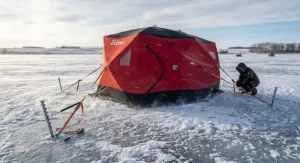
Hub style shelters revolutionized ice fishing, transforming cold-weather pursuits into comfortable family activities. These pop-up structures use collapsible hub frameworks similar to camping tents, expanding from compact packages into spacious fishing sanctuaries in 3-5 minutes.
Space: The Hub Shelter’s Biggest Advantage
Hub shelters dominate in fishable area. Modest 2-3 person models offer 50-70 square feet, while units like the Clam X-600 provide nearly 100 square feet—room for six anglers, electronics, heaters, and even overnight cots.
This space transforms family outings. Kids move without tangling lines. Multiple anglers fish different techniques simultaneously. Portable heaters warm everyone safely. You can sight-fish comfortably in blackout interiors with proper gear organization.
Thermal Performance
Modern hubs feature thermal fabrics with 80-90 grams insulation per square meter. With modest propane heaters, interior temperatures reach 10-15°C even when external temperatures hit -30°C—typical for Canadian winters. The Ontario government notes registered huts can remain until specific removal dates, ideal for base camp anglers.
The Mobility Tradeoff
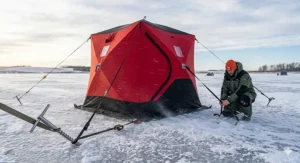
Hub shelters sacrifice mobility for comfort. Setup requires positioning precisely, expanding all corners, anchoring with 6-8 ice screws, and tensioning guy lines. Most anglers don’t relocate hubs more than twice per outing. If you drill 20 holes searching for fish, hubs become restrictive.
✅ Hub Advantages: Maximum space for groups, comfortable extended sessions, ideal for sight fishing, overnight capable, accommodates multiple techniques, family-friendly, serves as base camp
❌ Hub Disadvantages: Longer setup (3-5 min), requires separate sled, less mobile, challenging in high winds, more storage space needed, needs proper anchoring
Understanding Flip Over Ice Shelters: Pros and Cons
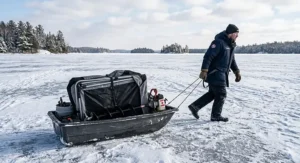
Flip-over shelters represent a different philosophy: mobility, speed, and efficiency. These units integrate shelter with sled base, creating all-in-one fishing systems that transform how anglers pursue Canadian gamefish. Setup takes 30-60 seconds—lock poles, flip shelter over, and you’re fishing.
Mobility: The Flip-Over’s Killer Feature
Flip-overs dominate in mobility. Packing takes under a minute—flip back, collapse poles, go. No anchors, stakes, or complicated folding. Walleye moved? Pack and relocate in minutes. This run-and-gun approach lets you cover water efficiently across expansive Canadian lakes.
The Space Compromise
Flip-overs offer less space than hubs. Even the massive Clam X-400 Thermal XT (68 sq ft) feels cramped versus mid-sized hubs. Most accommodate 1-2 anglers comfortably. This intimate space heats quickly though—two anglers’ body heat alone raises temperatures noticeably. Low profiles also offer superior wind resistance.
Storage and Transport Benefits
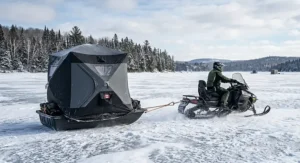
Every flip-over includes built-in sled storage. Rods, tackle, electronics, heater, and auger travel together. No separate sleds, forgotten gear, or multiple trips. Canadian anglers using snowmobiles particularly appreciate this consolidated design—hook the tow rope and go.
✅ Flip-Over Advantages: Lightning setup (30-60 sec), exceptional mobility, all-in-one storage, superior wind resistance, heats quickly, ideal for solo fishing
❌ Flip-Over Disadvantages: Limited space, less comfortable long sessions, accommodates fewer anglers, sled limits hole placement, not ideal for sight fishing, premium models expensive
Key Factors When Choosing Your Ice Shelter
Number of Anglers & Fishing Style
This drives your entire selection. Solo or duo? Flip-overs excel. Family outings with 3-6 people? Hub shelters. Always size up when uncertain—cramped fishing ruins outings.
Do you chase fish or wait? Run-and-gun anglers drilling dozens of holes need flip-over mobility. Patient anglers establishing base camps over productive structure benefit from hub comfort. Electronics like forward-facing sonar and underwater cameras demand hub space—flip-overs make cable management frustrating.
Canadian Climate & Transportation
Our winters demand serious gear. Prairie anglers face -40°C and howling winds. Maritime anglers battle wet snow. Thermal insulation matters tremendously—non-insulated shelters work in Southern Ontario but prove inadequate for Manitoba or Northern Saskatchewan winters.
Consider transportation: walking anglers need lightweight options under 40 pounds. Snowmobile users handle heavier units. Check garage space too—does that 12-foot hub fit?
Budget Reality
Quality shelters require investment. Budget hubs start around $300 CAD, premium models reach $1,200. Flip-overs range $400-$1,500+. Don’t false economy—cheap gear that tears or blows away wastes money. Better to save longer and buy quality. Canadian winters demand reliable equipment.
How to Choose Hub Style Ice Shelter vs Flip Over in Canada
Choose a Hub Style Ice Shelter If You:
- Regularly fish with 3+ people
- Plan extended sessions (4+ hours)
- Use multiple techniques simultaneously
- Want to sight fish or spear
- Value comfort over mobility
- Fish established productive spots
Choose a Flip-Over Ice Shelter If You:
- Fish solo or with one partner
- Employ run-and-gun tactics
- Cover substantial water searching for fish
- Need quick setup/teardown
- Value mobility over space
- Tow behind snowmobile/ATV
The Canadian Perspective
Remember that ice fishing regulations vary by province. The Government of Ontario requires ice hut registration in zones 9-12 and 14-20. Registered huts must display numbers prominently.
Safety remains paramount. Never venture onto ice less than 10 cm thick for walking or 30 cm for vehicles. Ice varies dramatically—fast-moving rivers, springs, and inlets create thin pockets. Always test thickness as you travel and fish with partners.
Many experienced anglers own both shelter types: flip-overs for early season and active fishing, hubs for family outings and late-season base camps. This maximizes versatility while doubling investment and storage needs.
Space Comparison: Real Numbers That Matter
| Shelter Model | Type | Fishable Area | Capacity | Space per Angler |
|---|---|---|---|---|
| Eskimo QuickFish 3i | Hub | 34 sq ft | 3 | 11.3 sq ft |
| Clam X-600 Thermal | Hub | 94 sq ft | 5-6 | 15.7-18.8 sq ft |
| Eskimo FatFish 949i | Hub | 61 sq ft | 3-4 | 15.3-20.3 sq ft |
| Frabill Aegis 2000 | Flip | 26 sq ft | 2 | 13 sq ft |
| Clam X-400 XT | Flip | 68 sq ft | 4 | 17 sq ft |
In a 26-square-foot flip-over, two anglers sit shoulder-to-shoulder with basic gear. The 94-square-foot Clam X-600 Hub fits six anglers comfortably with ample gear space—you can stand, move around, and spread out. Hub shelters typically offer 72-84 inches center height; flip-overs range 60-67 inches, requiring most anglers to remain seated.
Portability vs Room: The Fundamental Tradeoff
Flip-over mobility enables aggressive tactics. Lake Simcoe perch anglers relocate 8-10 times mornings, staying on active schools. Hub space transforms ice fishing from survival to recreation—kids have room to move, gear stays organized, spouses don’t dread trips.
Canadian ice fishing often involves substantial travel. On Lake of the Woods, you might travel 5+ kilometres to prime walleye grounds—favouring flip-over portability. Conversely, established communities like Lake Simcoe feature concentrated anglers where setting up hubs and staying put makes sense.
Comparison of Benefits: Hub Style vs Traditional Flip-Over Design
| Benefit Category | Hub Style Advantages | Flip-Over Advantages |
|---|---|---|
| Setup Speed | Reasonable (3-5 min) | Excellent (30-60 sec) |
| Breakdown Speed | Moderate (4-6 min) | Excellent (30-60 sec) |
| Interior Space | Superior (50-100+ sq ft) | Limited (12-68 sq ft) |
| Thermal Efficiency | Good (large volume) | Excellent (small volume) |
| Wind Resistance | Moderate (needs anchoring) | Superior (low profile) |
| Transport | Requires separate sled | Integrated sled design |
| Storage | Bulkier when packed | More compact |
| Versatility | Excellent (multiple uses) | Limited (fishing only) |
| Cost Range | $300-$1,200 CAD | $400-$1,650 CAD |
Price Range & Value Analysis for Canadian Buyers
Budget Tier ($300-$500 CAD)
Entry-level shelters like ThunderBay Ice Cube 3 ($299-$429) provide basic protection. Expect non-insulated 300-400 denier fabric, basic mechanisms, minimal accessories. Adequate for Southern Ontario, 1-2 season durability with moderate use.
Mid-Range Tier ($500-$900 CAD)
Sweet spot includes Eskimo QuickFish 3i ($399-$549) and Clam X-600 ($599-$799). Features thermal insulation (600-900 denier), quality hardware, better wind resistance, reliable components, 3-5 season durability. Most recreational anglers should shop here—improved comfort justifies moderate price increase.
Premium Tier ($900-$1,650 CAD)
Top-shelf options like Clam X-400 Thermal XT ($1,299-$1,499) and Otter Vortex Pro ($899-$1,099) feature professional-grade construction, advanced thermal technologies, reinforced frameworks, extended warranties, 5-10 season durability. Worth it for guides, serious enthusiasts, and extreme conditions.
Don’t obsess over lowest price—focus on cost per use. An $800 shelter used 40 times annually for 5 years costs $4 per outing. A $400 shelter lasting 2 seasons with 20 annual outings costs $10 per trip. Canadian winters punish cheap gear—invest properly upfront.
❓ Frequently Asked Questions
❓ Which ice shelter is better for solo Canadian anglers?
❓ How much does a quality ice fishing shelter cost in Canada in 2026?
❓ Do I need to register my ice fishing shelter in Canada?
❓ Can flip-over ice shelters accommodate 3-4 people comfortably?
❓ What's the minimum ice thickness needed to safely use an ice shelter in Canada?
Conclusion: Making Your Final Choice
Choosing between hub style ice shelter vs flip over depends on how you fish, who you fish with, and what you value. There’s no universally “better” option—only the better choice for your situation.
Go with a flip-over if mobility, speed, and solo fishing dominate. Run-and-gun approaches improve catch rates when searching for fish. Canadian anglers covering large lakes or chasing active schools benefit from flip-over efficiency.
Choose a hub if comfort, space, and group fishing matter most. Family outings, sight fishing, overnight adventures, and base camp fishing favour hub designs. Extra space transforms ice fishing from endurance to enjoyable recreation.
For serious anglers, consider a two-shelter system over time. Start with whichever matches your primary approach, then add the opposite style as budget allows. This versatility lets you match shelter to conditions rather than compromising.
Remember that Canada’s diverse ice fishing landscape varies dramatically. Lake Simcoe’s crowded perch spots differ from remote northern walleye lakes. Your shelter needs reflect local realities. Research what successful local anglers use, then adapt insights to your preferences and budget.
Prioritize quality construction, adequate insulation for your region, and proven Canadian availability through Amazon.ca. Our winters don’t forgive cheap gear. Invest properly, maintain equipment, and enjoy comfortable fishing for seasons to come.
The ice is calling—will you answer with hub comfort or flip-over mobility?
Recommended for You
- 7 Best Pop Up Ice Shelters Canada 2026: Fast Setup Guide
- 7 Best Pop Up Ice Fishing Shelters 2026
- 7 Best Ice Auger for Thick Ice Canada 2026
Disclaimer: This article contains affiliate links to Amazon.ca. If you purchase products through these links, we may earn a small commission at no additional cost to you.
✨ Found this helpful? Share it with your friends! 💬🤗
