
In This Article
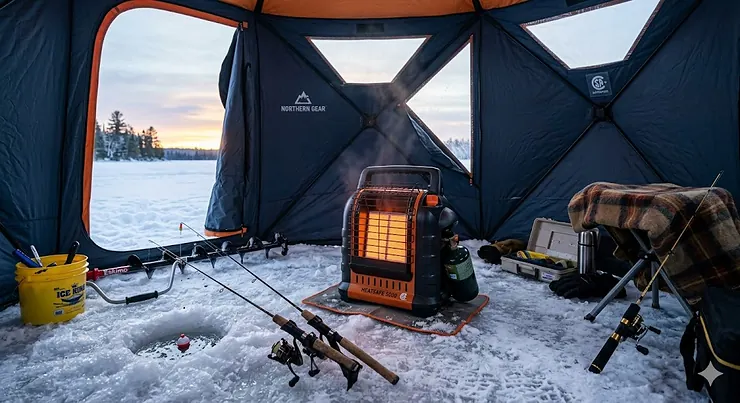
There’s a certain magic to sitting over a freshly drilled hole on a frozen Ontario lake, watching your tip-up and sipping coffee while the wind howls outside your shelter. But that cosy picture comes with a danger that too many Canadian anglers underestimate: carbon monoxide. Choosing a safe heater for ice fishing tent use isn’t just about staying comfortable — it’s about making it home after a day on the ice.
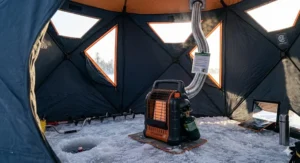
Every Canadian winter, emergency rooms across the country treat ice anglers for CO exposure from portable heaters used in enclosed shelters. The tragedy is that nearly every incident is preventable. A good heater for your ice shanty does far more than push out BTUs. It monitors the oxygen level inside your shelter, shuts itself off the moment it tips over, and gives you the peace of mind to focus on what actually matters — catching walleye.
So, what exactly is a safe heater for ice fishing tent environments? Simply put, it’s a portable heating unit equipped with an Oxygen Depletion Sensor (ODS), automatic tip-over protection, and ideally CSA certification for indoor and enclosed-space use. It produces sufficient heat output for your shelter size without overwhelming the available oxygen supply — and it pairs with a working carbon monoxide detector and proper ventilation.
In this guide, I’ve researched seven real products available to Canadian buyers, verified their key safety features, and matched each one to a specific ice angler profile — from the solo weekend warrior in Manitoba to the group of four fishing buddies renting a cabin shack in northern Quebec. Whether you fish a pop-up flip-over or a spacious hub shelter, there’s a safe and effective heater here for you.
All prices are in Canadian dollars (CAD). Let’s keep you warm and safe out there. 🇨🇦
Quick Comparison Table: Top 7 Safe Heaters for Ice Fishing Tents in Canada (2026)
| Product | BTU Output | Coverage Area | ODS | Tip-Over Shutoff | CSA Certified | Best For |
|---|---|---|---|---|---|---|
| Mr. Heater MH9BX Portable Buddy (Canada) | 4,000–9,000 | Up to 21 m² (225 sq. ft.) | ✅ | ✅ | ✅ | Solo/duo shelter, beginner anglers |
| Mr. Heater MH18B Big Buddy (Canada) | 4,000–18,000 | Up to 42 m² (450 sq. ft.) | ✅ | ✅ | ✅ | Large group shelters |
| Mr. Heater Little Buddy MH3HVF | 3,800 | Up to 9 m² (95 sq. ft.) | ✅ | ✅ | ✅ | Solo pop-up, ultra-compact |
| Camco Olympian Wave 3 (57331) | 1,600–3,000 | Up to 12 m² (130 sq. ft.) | ✅ | N/A (catalytic) | ✅ | Small shelters, silent operation |
| Camco Olympian Wave 6 (57341) | 3,200–6,000 | Up to 19 m² (200 sq. ft.) | ✅ | N/A (catalytic) | ✅ | Mid-size shelters, all-day sessions |
| Clam CH-10000vh Portable Propane Heater | Up to 10,000 | Up to 37 m² (400 sq. ft.) | ✅ | ✅ | ✅ | Serious ice anglers, hub shelters |
| Texsport Portable Outdoor Propane Heater | 3,000–8,000 | Up to 14 m² (150 sq. ft.) | ❌ | ✅ | ❌ | Budget, well-ventilated shelters only |
Prices vary — always check current pricing on Amazon.ca. Ranges in CAD provided in individual product sections below.
Looking at this table, it’s immediately clear that the Mr. Heater Buddy series dominates the market for good reason: they offer the best combination of ODS, tip-over protection, and verified Amazon.ca availability at competitive CAD price points. The Camco Wave models earn their place as the safest option for ultra-enclosed, poorly-vented shelters since catalytic technology produces virtually zero open flame. The Texsport appears at the bottom of the safety ranking — if you choose it, you’re accepting more responsibility for managing ventilation yourself.
✨ Don’t Miss These Exclusive Deals!
🔍 Take your ice fishing comfort to the next level with these carefully selected products. Click on any highlighted item to check current pricing and availability on Amazon.ca. These heaters will help you stay safe and warm all season long!
Top 7 Safe Heaters for Ice Fishing Tents in Canada: Expert Analysis
1. Mr. Heater MH9BX Portable Buddy Heater (Massachusetts/Canada Version)
The Portable Buddy is arguably the most trusted name in Canadian ice fishing shelter heating, and for good reason. The MH9BX outputs 4,000 or 9,000 BTUs on a 1 lb propane cylinder and heats spaces up to 21 m² (225 sq. ft.) — enough for most two-person flip-over or pop-up shelters.
What sets this model apart from generic propane heaters is the dual safety system: the Oxygen Depletion Sensor (ODS) automatically kills the flame when oxygen levels drop to dangerous levels, and the tip-over shut-off activates the moment the unit loses an upright position. For ice anglers, both features matter enormously. You’re fishing in cramped spaces, often on uneven ice, and the last thing you want is a heater that keeps burning if it topples onto your shelter floor.
The “Massachusetts/Canada” designation is important — this specific model is configured to comply with stricter North American safety regulations. At medium setting (9,000 BTU), you can expect roughly 3 hours of run time on a single 1 lb cylinder, or connect it to a 20 lb tank via an optional hose adapter for all-day sessions. In my experience, Canadian anglers fishing in shelters under about 4.6 m x 2.4 m (15 ft x 8 ft) will find this perfectly sized.
Canadian reviews consistently highlight reliability in temperatures as low as -30°C (-22°F) — essential for our northern Ontario and Saskatchewan winters.
✅ ODS and tip-over protection standard
✅ Compact and easy to transport on a sled
✅ Compatible with 20 lb remote tank via adapter
❌ Output may be insufficient for larger hub shelters
❌ Cycling off in very cold temps can occur if propane canisters get too cold — keep a spare warm inside your jacket
Price range: Around $90–$120 CAD. Excellent value for what is genuinely one of the safest options available on Amazon.ca.
2. Mr. Heater MH18B Big Buddy Portable Heater (Canada Version)
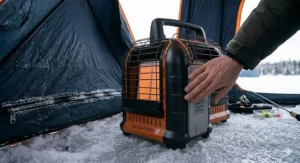
If the Portable Buddy is the standard for solo and duo sessions, the Big Buddy is the answer when your shelter is packed. Outputting between 4,000 and 18,000 BTUs across three settings, it heats up to 42 m² (450 sq. ft.) — making it appropriate for 4–6 person hub shelters, large flip-overs, or even a small ice cabin.
The Big Buddy connects to two 1 lb propane cylinders simultaneously and runs up to 11 hours on low heat. Its two swivel regulators also allow easy connection to a 20 lb remote tank, which most serious Canadian ice anglers prefer for full-day or multi-day outings. The Canada-specific version lacks a fan (as noted by Mr. Heater due to recent import tariff-related changes), which is worth knowing — but the radiant heat output remains unchanged.
The triple heat settings (4,000/9,000/18,000 BTU) give you genuine flexibility. Running it on low in a well-insulated shelter often maintains a comfortable 15–18°C (60–65°F) even when it’s -25°C outside — something smaller heaters simply cannot achieve. With the same ODS and tip-over safety system as the Portable Buddy, this remains a CSA-compliant, indoor-safe choice when proper ventilation is maintained.
✅ Three heat settings handle everything from mild to brutal Canadian cold
✅ Long run time on dual tanks — great for full-day fishing
✅ Same proven safety systems as the smaller Buddy models
❌ Heavier than the MH9BX — adds weight to your gear haul across ice
❌ Fan-free Canada version means slightly less directional heat distribution
Price range: Around $180–$230 CAD. Well worth the investment for groups or anglers who spend long days on the ice.
3. Mr. Heater Little Buddy MH3HVF Propane Heater
Don’t let the “Little” fool you — this compact 3,800 BTU heater punches well above its weight class for solo ice anglers fishing in small pop-up shelters or flip-over units. It’s the smallest member of the Buddy family, weighing under 2 kg (about 4 lbs), and slots into a backpack or gear bag without complaint.
The Little Buddy runs on a single 1 lb propane cylinder for up to 5.6 hours, which covers most half-day ice fishing sessions. It heats up to 9 m² (95 sq. ft.) — tight quarters, but exactly what most one-person shelters measure. Where this model truly shines is when space and weight are your primary constraints. If you’re snowshoeing or snowmobiling to a remote lake in northern Quebec or Algonquin Park, the Little Buddy’s footprint makes it the most packable indoor-safe propane heater on the market.
It carries the same ODS and tip-over protection found in the larger Buddy models, making it equally safe for enclosed shelter use. What most Canadian buyers overlook: this heater’s low output is actually an advantage in small enclosures. Running 9,000 BTUs in a one-person shelter is overkill and burns oxygen faster — the Little Buddy’s 3,800 BTU ceiling means it stays more safely within your shelter’s oxygen budget.
✅ Ultra-compact — best portability of any propane shelter heater
✅ Full ODS and tip-over protection despite compact size
✅ Runs up to 5.6 hours — perfect for half-day ice fishing
❌ Not suitable for shelters larger than about 9 m²
❌ No option to connect to a larger remote propane tank
Price range: Around $60–$90 CAD. The most affordable full-safety option on Amazon.ca.
4. Camco Olympian Wave 3 Catalytic Safety Heater (Model 57331)
The Camco Olympian Wave 3 represents a completely different heating approach — catalytic combustion rather than open-flame radiant heat. Adjustable from 1,600 to 3,000 BTUs, it heats up to 12 m² (130 sq. ft.) with no open flame, no flue, and no chimney. The catalytic element achieves 99.98% combustion efficiency, which is the key safety advantage: far less CO is produced per unit of propane burned compared to open-flame heaters.
For Canadian ice anglers who run particularly tight, well-insulated shelters — think permanent-frame ice huts or heavily-lined pop-ups — the Wave 3 is the safest propane heating option available. The absence of an open flame means zero risk of catching shelter fabric alight, and the near-complete combustion means you’re generating significantly less CO than a standard radiant heater at the same BTU level.
The Wave 3 runs silently (no fan, no blower), which experienced anglers actually appreciate — no mechanical noise to disturb the fish below. It operates on low-pressure LP gas via a 1 lb tank or wall-mount connection, and the self-generating piezo starter is rated for 20,000 starts. This heater is available through Canadian RV and outdoor suppliers and ships to Canada through Amazon.ca sellers. Note that you still need some ventilation — catalytic heaters still consume oxygen, just at a much lower rate.
✅ Near-zero open flame — dramatically lower CO production
✅ Silent operation — no fan noise
✅ 20,000-start piezo ignition for reliable Canadian winter use
❌ Lower BTU ceiling — may struggle in shelters larger than 12 m² at extreme cold
❌ Availability on Amazon.ca can be inconsistent — check stock before ordering
Price range: Around $120–$180 CAD depending on availability and shipping.
5. Camco Olympian Wave 6 Catalytic Safety Heater (Model 57341)
The Wave 6 is the larger sibling to the Wave 3 and the step up you need when your shelter runs 2–4 people and you want the safety benefits of catalytic heating at higher output. Adjustable from 3,200 to 6,000 BTUs, it heats up to 19 m² (200 sq. ft.) — covering most two- to three-person hub shelters comfortably.
What makes the Wave 6 special for Canadian buyers is its all-day endurance. Running it at medium output through a full February day on Lake Simcoe or Lac Saint-Jean is entirely realistic on a standard 20 lb tank connection, and the catalytic technology means you’re doing so with the lowest CO risk of any propane option in this size class.
The Wave 6 can be used as a portable unit (with optional leg stands), permanently wall-mounted in a fixed ice hut, or taken outdoors. This flexibility matters for Canadian anglers who use different shelter configurations across a season — pop-up tent one weekend, permanent hut rental the next. The piezo starter, identical to the Wave 3, lasts for 20,000 starts and functions reliably even after being stored through a Canadian summer in a garage. Pair this with a CSA 6.19-certified carbon monoxide detector (more on that below) and you have one of the safest ice shelter heating setups available.
✅ Higher BTU ceiling than Wave 3 — suitable for 2–3 person shelters
✅ Versatile mounting options — portable or wall-mount for fixed ice huts
✅ Near-complete combustion means lower CO risk than open-flame heaters
❌ Requires dedicated propane line — less convenient than 1 lb cylinder heaters
❌ Bulkier than Buddy-style heaters for transport across ice
Price range: Around $180–$250 CAD. Available through Amazon.ca marketplace sellers and Canadian RV supply retailers.
6. Clam CH-10000vh Portable Propane Radiant Heater
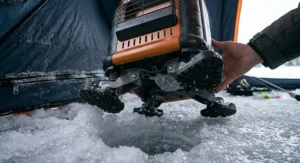
Clam Outdoors has been building ice fishing gear for decades, and when they entered the heater market, they designed something specifically for the demands of ice anglers rather than adapting an RV or camping product. The CH-10000vh pushes up to 10,000 BTUs and heats spaces up to 37 m² (400 sq. ft.), making it ideal for larger Clam hub shelters and group fishing setups.
Every Clam heater ships with ODS and tip-over protection as standard, and — critically for Canadian buyers — the entire line is CSA-certified for both indoor and outdoor use. This isn’t just a marketing claim: CSA certification means the unit has been independently tested and verified to meet Canadian safety standards. If you’re fishing in Ontario, Manitoba, or anywhere that takes winter safety seriously (which is everywhere north of 50°N), that certification matters.
The CH-10000vh features vertical burner orientation that delivers even heat distribution across a hub shelter interior — the design difference that separates it from cheaper alternatives. Clam heaters are available through specialty fishing retailers in Canada and ship to most provinces via Amazon.ca marketplace. For a serious ice angler who wants purpose-built Canadian-conditions gear rather than a repurposed camping heater, the Clam line deserves serious consideration.
✅ Designed specifically for ice fishing shelter use
✅ CSA-certified — verified for enclosed Canadian-conditions use
✅ Higher BTU ceiling for larger hub shelters
❌ Premium price point compared to Mr. Heater alternatives
❌ May require special order in some remote Canadian provinces
Price range: Around $150–$200 CAD. Available through Fishing World Canada and Amazon.ca marketplace.
7. Texsport Portable Outdoor Propane Heater
I’ll be upfront here: the Texsport is the one heater on this list that requires additional caveats before recommending it. It outputs 3,000–8,000 BTUs and heats up to 14 m² (150 sq. ft.), which is a reasonable spec range — but it lacks an ODS system and is not certified for enclosed indoor use. So why is it here?
Because it’s the most affordable propane option available on Amazon.ca in this category, and plenty of experienced Canadian ice anglers use it successfully in well-ventilated shelters. The key phrase is well-ventilated. If you keep your shelter’s top and bottom vents open, run a CSA-certified CO detector at breathing height, and stick to the low BTU setting, the Texsport can work safely. But compared to every other heater on this list, it demands more vigilance from the operator.
Who is this for? Budget-conscious anglers who fish in shack-style shelters with built-in wood stove jacks or structural ventilation, and who already own a quality CO detector. If you’re new to ice fishing or fishing in a tightly-sealed pop-up tent, I’d steer you toward the Mr. Heater Little Buddy instead — the extra $30–$40 CAD is worth the ODS protection.
✅ Lowest price point on Amazon.ca for this BTU range
✅ Tip-over protection included despite budget price
✅ Suitable for experienced anglers in well-ventilated setups
❌ No ODS — requires operator vigilance and mandatory CO detector
❌ Not recommended for sealed pop-up shelters or beginners
❌ Not CSA-certified for enclosed space use
Price range: Around $50–$80 CAD. Budget option only — pair with a mandatory CO detector.
The Silent Killer: Understanding Carbon Monoxide Risk in Ice Fishing Shelters
Let’s talk about the risk that doesn’t get enough attention in heater marketing materials. Carbon monoxide is a colourless, odourless gas that kills. It cannot be detected by smell, sight, or taste — and its early symptoms (headache, fatigue, mild nausea) feel exactly like what any angler expects after a long cold day on the ice. That overlap is what makes it so dangerous.
When a propane heater burns fuel in an enclosed space, two things happen simultaneously: oxygen is consumed, and CO is produced as a byproduct. In a sealed 2.4 m x 2.4 m (8 ft x 8 ft) ice shelter, dangerous CO concentrations can build in under 30 minutes with an improperly vented heater. According to research cited by the Minnesota Department of Natural Resources, this deadly combination catches anglers off guard precisely because the environment feels comfortable — warm and enclosed — right up until CO levels become dangerous.
The Canadian safety standard for CO detectors is CSA 6.19, governed by the Canadian Standards Association. When shopping for a CO detector to pair with your shelter heater, look for the CSA, ULC, or ETL mark on the packaging — these marks confirm the unit has been tested to respond accurately at low CO concentrations and extreme temperatures, both of which are realities of Canadian winter ice fishing. A standard household CO detector from a hardware store may not respond quickly enough at the low-level CO concentrations that build slowly in ice shelters.
The North Bay Fire Department and other Ontario fire services have issued repeated public advisories urging ice anglers to carry a CO detector into every heated shelter. Treat it like your life jacket — non-negotiable, every trip.
The Three Rules of Ice Shelter Heating Safety
🔴 Rule 1 — Always ventilate. Keep at least two openings in your shelter: one within 30 cm (12 inches) of the floor for fresh air intake, one near the roof for exhaust. Never seal every vent just to retain heat.
🔴 Rule 2 — Always run a CO detector. Mount it at breathing height — between 90 cm and 120 cm (36–48 inches) off the floor. Test the batteries before every outing. Replace batteries at the start of each ice season.
🔴 Rule 3 — Know your symptoms. Headache, dizziness, fatigue, or confusion while fishing in a heated shelter means one thing: get out immediately and get fresh air. Don’t try to investigate the heater first.
How to Choose a Safe Heater for Ice Fishing Tent in Canada: 6-Step Framework
Choosing a heater isn’t just about BTUs. Canadian ice anglers need to weigh six criteria simultaneously:
1. Verify ODS is included. An Oxygen Depletion Sensor is the most important safety feature for enclosed-shelter use. If the product description doesn’t explicitly mention ODS, assume it doesn’t have one. Never use a non-ODS heater in a sealed shelter.
2. Match BTU output to shelter size. A common mistake is over-speccing — buying a powerful heater and running it on high burns oxygen faster. As a rough guide: under 9 m² (100 sq. ft.) — stay under 4,000 BTU; 9–21 m² (100–225 sq. ft.) — 4,000–9,000 BTU; 21–42 m² (225–450 sq. ft.) — up to 18,000 BTU with excellent ventilation.
3. Look for CSA or ULC certification. These marks confirm the unit has been independently tested to Canadian standards. For ice fishing shelters specifically, look for “indoor safe” or “enclosed space safe” in the product listing.
4. Check Amazon.ca availability and shipping. Some heaters listed on Amazon.ca ship only to southern provinces, with extended delivery to remote northern areas. If you’re in northern Saskatchewan, Yukon, or rural Newfoundland, confirm shipping before ordering. Amazon Prime members typically get free shipping on eligible heaters; non-Prime buyers should verify whether the order meets the $35 CAD free shipping threshold.
5. Budget for propane and accessories. A 1 lb propane cylinder in Canada typically runs $5–$8 CAD at a gas station or hardware store. For all-day ice fishing, plan on 2–3 cylinders or invest in a 20 lb tank with a compatible hose adapter — far more economical at under $1 CAD per hour of heat versus $2–$3 per hour with disposable cylinders.
6. Always pair with a CSA-certified CO detector. This is non-negotiable regardless of which heater you choose. Budget $30–$60 CAD for a quality low-level CO detector and check the battery at the start of every ice season.
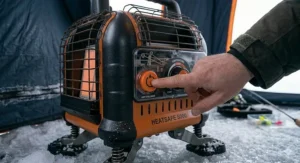
Real Canadian Ice Angler Profiles: Which Heater Is Right for You?
Understanding which heater suits you comes down to how, where, and with whom you fish. Here are three Canadian angler profiles and my recommended match for each.
Profile A: The Solo Weekend Warrior (Ontario or Manitoba)
Marco is a 34-year-old from Thunder Bay who ice fishes 15–20 weekends per season out of a Clam pop-up flip-over. His shelter is compact — roughly 1.5 m x 1.5 m (5 ft x 5 ft) — and he snowmobiles to his spots, so weight and pack size matter. He wants reliable indoor-safe heat without hauling a generator.
Best match: Mr. Heater Little Buddy MH3HVF. At under 2 kg with a fold-down handle, it’s the most packable ODS-equipped heater available. The 3,800 BTU output is perfectly calibrated for his shelter size, and he won’t be burning through oxygen dangerously fast. Price range: $60–$90 CAD on Amazon.ca.
Profile B: The Duo/Family Angler (Quebec or Saskatchewan)
Sophie and her teenage son fish out of a 2.4 m x 3 m (8 ft x 10 ft) hub shelter on Lac Saint-Jean, Quebec. They fish full-day Saturday sessions and need a heater that can keep pace with sustained -25°C (-13°F) weather. Sophie prioritizes safety above all else because her son is with her.
Best match: Mr. Heater MH9BX Portable Buddy (Canada version) or the Camco Olympian Wave 6. The MH9BX gives her familiar ODS + tip-over protection at 9,000 BTU, more than enough for their shelter. If she’s willing to manage a propane line, the Wave 6’s catalytic technology offers the lowest CO risk of any propane option in this BTU range.
Price range: $90–$120 CAD (MH9BX) or $180–$250 CAD (Wave 6).
Profile C: The Group Fishing Crew (Alberta or Northern Ontario)
Brendan and three friends rent ice time on a local fishing association’s 4.5 m x 4.5 m (15 ft x 15 ft) permanent hut near Red Deer, Alberta every January. They need serious heat output, all-day run time, and gear that won’t let them down at altitude (Red Deer sits at about 905 m/2,970 ft above sea level, where propane performance can be slightly affected by air density).
Best match: Mr. Heater MH18B Big Buddy (Canada version). At 18,000 BTU on high and 11-hour run time on low with dual tanks, it handles their space reliably. The Canada-specific model’s ODS and tip-over protection remain fully functional at Red Deer’s elevation.
Price range: $180–$230 CAD.
Ventilation in Ice Fishing Shelters: What Most Canadian Anglers Get Wrong
Here’s the uncomfortable truth: most CO incidents in Canadian ice shelters happen not because of faulty heaters, but because anglers seal every available gap to conserve heat. It’s a completely understandable impulse when it’s -30°C outside, but it’s also how the oxygen budget inside your shelter collapses.
Proper ventilation for a heated ice shelter follows a simple two-vent principle, backed by guidance from the Minnesota DNR (whose ice fishing conditions closely mirror those in Ontario, Manitoba, and Saskatchewan): keep one opening within 30 cm (12 inches) of the floor for fresh air intake, and one near the shelter’s peak for warm, CO-rich air to escape. These two vents work as a convective system — cool fresh air flows in at floor level, displaces warm spent air upward and out.
The mistake most anglers make is relying on a single door crack, which provides airflow in only one direction and creates CO pooling at breathing height. For pop-up tents, most modern shelters include top and bottom ventilation zippers — use both simultaneously, even if it means slightly lower interior temperature.
Ventilation Tip for Canadian Winter Conditions 🇨🇦
In extreme cold (below -25°C/-13°F), condensation on vent edges can cause partial icing and restrict airflow. Check your shelter vents every 45–60 minutes during extended sessions and clear any ice buildup with a gloved hand. This is especially relevant in humid lake-effect weather zones like Lake Superior’s north shore or the Great Lakes region of Ontario.
Propane Heater Safety Tips for Ice Fishing: A Field-Ready Checklist
These are the propane heater safety tips for ice fishing that experienced Canadian anglers follow on every outing — the practices that separate safe sessions from emergencies:
☑️ Before leaving home: Test your CO detector, confirm it has fresh batteries (change annually at minimum), and verify propane connections are snug with no smell of gas.
☑️ On the ice, before lighting: Place your heater on a flat, stable surface at least 30 cm (12 inches) from shelter walls. Open top and bottom vents. Never light a heater near propane cylinders.
☑️ During your session: Check vents every hour for ice buildup. Watch for early CO poisoning symptoms (headache, drowsiness) in yourself and your fishing partners. If you feel unwell, step outside immediately — never try to troubleshoot from inside a sealed shelter.
☑️ Propane cylinder cold-weather tip: At -20°C and below, propane pressure in 1 lb cylinders drops significantly, which can cause heaters to cycle off or flicker. Keep a spare cylinder inside your jacket or gear bag to maintain temperature — cold cylinders deliver noticeably less pressure than room-temperature ones.
☑️ Shut-down procedure: Turn the heater off before closing shelter vents. Never leave a running heater unattended. When packing up, allow the heater to cool for at least 5 minutes before placing it in a bag.
☑️ Storage between outings: Store propane heaters in a cool, dry location — not inside your vehicle overnight in a garage. Bilingual product labels (required under Canadian law for consumer goods) will include storage instructions in both English and French; follow them carefully.
✨ Don’t Miss These Exclusive Deals!
🔍 Ready to gear up for safe ice fishing this season? Click any highlighted product name in this article to check current pricing and availability on Amazon.ca. Products are sorted by safety rating, shelter compatibility, and Canadian angler feedback — start with the model that matches your shelter size and you won’t go wrong.
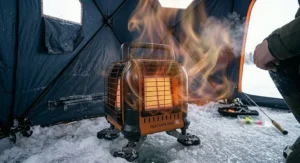
Common Mistakes When Buying a Safe Heater for Ice Fishing Tent in Canada
Even experienced anglers make purchasing mistakes when it comes to shelter heaters. Here are the ones I see most often — including a few that are specifically Canadian in nature:
Mistake 1: Confusing “outdoor use” with “safe for enclosed shelters.” Many propane heaters marketed for camping are rated for outdoor use only — meaning open-air patios or campsites with full airflow. Using them inside a sealed ice tent is dangerous regardless of BTU output. Always check for explicit “indoor safe” language and ODS confirmation.
Mistake 2: Skipping the CO detector because “I have an ODS.” An ODS shuts off the heater when oxygen drops below a threshold — but CO can still accumulate at hazardous levels before the ODS triggers, especially in larger shelters or when ventilation is partially restricted. ODS and CO detector serve different functions. You need both.
Mistake 3: Ordering from Amazon.com instead of Amazon.ca. Some heater models (especially certain Mr. Heater configurations) differ between US and Canadian versions. The Canadian/Massachusetts version of Mr. Heater Buddy models is configured specifically for our regulatory environment. Ordering the US version and importing it may void your warranty and could involve customs delays and duties — not worth the hassle when the Canadian version ships from Amazon.ca with Prime eligibility.
Mistake 4: Over-speccing BTU output for the shelter size. Running an 18,000 BTU heater in a two-person pop-up tent at maximum output burns oxygen fast and creates excess moisture condensation — both unpleasant and dangerous. Match BTU range to your actual shelter size and run on a lower setting rather than buying down to a smaller heater.
Mistake 5: Ignoring the bilingual label requirement. Under Canadian consumer product regulations, goods sold in Canada must carry bilingual (English/French) product information. This matters because the usage and safety instructions on the label apply to Canadian operating conditions — if you’re purchasing a US-market heater without bilingual labelling, you may be getting a product not configured for Canadian use.
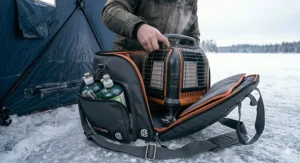
FAQ: Safe Heater for Ice Fishing Tent in Canada
❓ What is the safest heater to use inside an ice fishing tent in Canada?
❓ Do I need a carbon monoxide detector in my ice shanty if my heater has an ODS?
❓ Can I use a propane heater in a sealed ice fishing pop-up tent in Canada?
❓ Are Mr. Heater products available on Amazon.ca and do they ship across Canada?
❓ What Canadian certifications should I look for when buying an ice fishing heater?
Conclusion: Warm Ice, Safe Angler — Making the Right Choice
Choosing a safe heater for ice fishing tent use in Canada is one of the most important gear decisions you’ll make this season. The products I’ve covered here — from the ultra-packable Little Buddy to the heavy-duty Big Buddy and the catalytic safety of the Camco Wave series — all offer genuine protection when used correctly. But “used correctly” always means the same three things: ventilation, a CSA-certified CO detector, and matching your heater’s output to your actual shelter size.
Canadian winters are spectacular, harsh, and unforgiving all at once. The lakes of Ontario, Quebec, Manitoba, Alberta, and Saskatchewan freeze into natural fishing grounds that millions of us love — but they demand respect and preparation. A $90 CAD heater and a $40 CO detector aren’t luxuries; they’re the baseline safety kit for every heated shelter session.
My top overall recommendation: for most Canadian ice anglers, the Mr. Heater MH9BX Portable Buddy (Canada version) offers the best combination of safety certification, proven performance in -30°C Canadian conditions, and value in CAD. Pair it with a CSA 6.19-certified CO detector, keep your shelter vented, and focus on what matters — catching fish and making memories on the ice.
✨ Don’t Miss These Exclusive Deals!
🔍 Ready to gear up safely? Click any highlighted product in this guide to check current pricing and availability on Amazon.ca. Stay warm, stay safe, and tight lines this season! 🇨🇦🎣
Recommended for You
- Best Propane Heater for Ice Fishing Canada 2026 – Top 7 Picks
- Best Merino Wool Neck Gaiter in Canada 2026: 7 Top Picks
- Warmest Balaclava for Ice Fishing: 7 Best Picks for Canada (2026)
Disclaimer: This article contains affiliate links. As an Amazon Associate, I earn from qualifying purchases. If you purchase products through these links, we may earn a small commission at no additional cost to you.
✨ Found this helpful? Share it with your friends! 💬🤗
