
In This Article
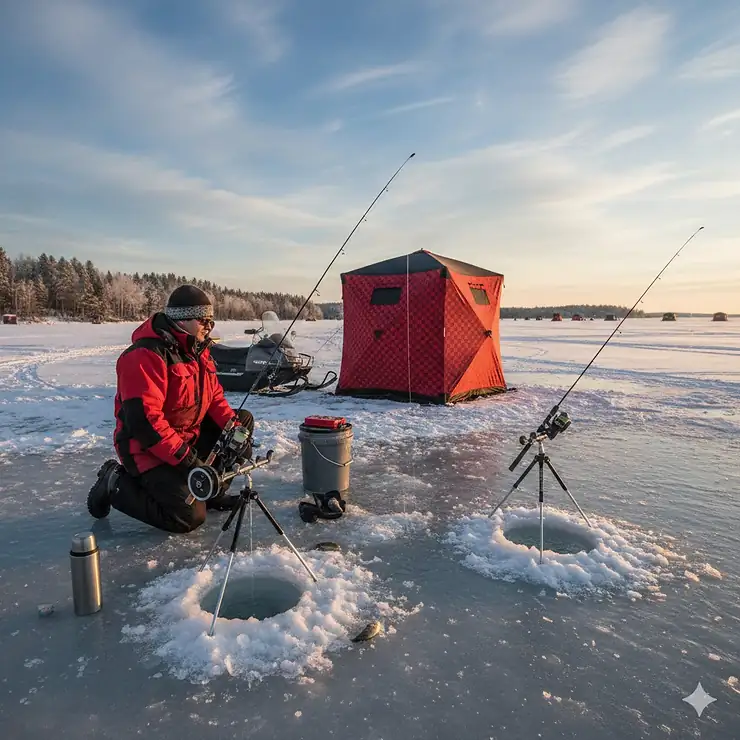
Standing over a frozen lake in the heart of a Canadian winter, you’re about to drill your first hole of the season. But here’s the question that stumps even experienced anglers: should you spool up an inline reel or stick with a traditional spinning setup? The debate between inline vs spinning reel ice fishing isn’t just about personal preference—it’s about matching your gear to the species you’re targeting and the conditions you’ll face across Canada’s diverse fishing landscape.
Ice fishing was originally a matter of survival for Indigenous communities, with archaeological findings showing sophisticated ice fishing practices dating back over 10,000 years. Today, an estimated 2.3 million Canadians participate in ice fishing annually, contributing over $440 million to the economy. As this winter tradition continues to evolve, understanding the nuances between these two reel types can dramatically improve your success rate on the ice.
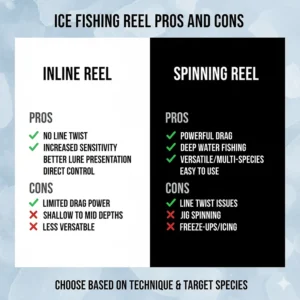
The inline vs spinning reel ice fishing choice comes down to several critical factors: target species, water depth, lure presentation style, and your comfort level with different mechanisms. Inline reels excel at preventing line twist and offering precise vertical presentations—perfect for panfish and shallow-water walleye. Spinning reels, conversely, provide versatility and raw power for larger fish in deeper water. Whether you’re jigging for perch on Lake Simcoe or targeting trophy lake trout in the Northwest Territories, your reel selection matters more than you might think.
Quick Comparison Table
| Feature | Inline Reels | Spinning Reels |
|---|---|---|
| Line Twist | Minimal to none | Moderate (requires swivels) |
| Best Depth Range | 1.5-15 metres (5-50 feet) | All depths, especially 15+ metres |
| Ideal Species | Panfish, crappie, perch, small walleye | Walleye, pike, lake trout, larger fish |
| Gear Ratio | 2.5:1 to 3.6:1 | 5.2:1 to 6.2:1 |
| Price Range (CAD) | $45-$190 | $30-$150 |
| Glove Operation | Easy (trigger system) | Moderate difficulty |
| Learning Curve | Steep for beginners | Familiar to most anglers |
| Retrieve Speed | Slower, more controlled | Faster line retrieval |
💬 Just one click – help others make better buying decisions too!😊
✨ Don’t Miss These Exclusive Deals!
🔍 Take your ice fishing setup to the next level with these carefully selected products available in Canada. Click on any highlighted item to check current pricing and availability on Amazon.ca. These reels will help you create authentic winter fishing memories your family will love!
Top 7 Ice Fishing Reels: Expert Analysis
1. 13 Fishing Black Betty 6061 Inline Ice Reel
The 13 Fishing Black Betty 6061 remains the gold standard in inline ice fishing technology, and for good reason. With its CNC-machined 6061 aluminum construction, this reel delivers exceptional durability while maintaining a surprisingly lightweight profile that won’t fatigue your wrist during all-day sessions.
Key Specifications:
- Gear ratio: 2.7:1
- Weight: 6.2 ounces (176 grams)
- Ball bearings: 4+1 stainless steel system
- Line capacity: 4 lb test holds 213 yards
Price Range: $135-$165 CAD
Canadian Availability: Readily available through Tackle Depot, The Fishin’ Hole, and Amazon.ca with free shipping on qualifying orders.
Canadian ice anglers consistently praise the Black Betty’s revolutionary frame design that accommodates both “pistol” and “pencil” grip styles without hand interference with the spool rim. The smooth carbon drag system provides precise control when fighting fish, whilst the instant anti-reverse prevents any backplay that could cost you that trophy perch. One Ontario angler noted: “The line management on this reel is phenomenal—I’ve fished it through three seasons without a single tangle.”
Pros:
✅ Zero line twist for natural bait presentation
✅ Works flawlessly in temperatures down to -35°C
✅ Premium build quality justifies the investment
Cons:
❌ Higher price point than entry-level options
❌ Steeper learning curve for spinning reel users
2. Shimano Sienna 500 Spinning Reel
For Canadian anglers seeking exceptional value without sacrificing performance, the Shimano Sienna 500 has earned legendary status in ice fishing circles. This compact spinning reel punches well above its weight class, offering features typically found on reels costing twice as much.
Key Specifications:
- Gear ratio: 5.0:1
- Weight: 6.5 ounces (184 grams)
- Ball bearings: 3+1 shielded system
- Line capacity: 4 lb/140 yards
Price Range: $28-$35 CAD
Canadian Availability: Widely stocked at Canadian Tire, The Fishin’ Hole, and Amazon.ca with excellent year-round availability.
The Sienna 500’s Propulsion Line Management System significantly reduces line twist—a common complaint with budget spinning reels—whilst the Super Stopper II provides immediate anti-reverse engagement. Multiple Canadian reviewers highlight its cold-weather reliability, with one Saskatchewan angler reporting: “I’ve put 20 of these on my ice rods over five years. Not a single failure, even fishing in -40°C windchills.” The graphite frame and rotor keep weight minimal whilst maintaining structural integrity when battling larger walleye or northern pike.
Pros:
✅ Unbeatable price-to-performance ratio
✅ Familiar operation for all skill levels
✅ Excellent cold-weather durability
Cons:
❌ Felt drag washers wear faster than carbon
❌ Smaller line capacity limits deep-water applications
3. Pflueger President Inline Ice Reel
The Pflueger President Inline represents a fascinating hybrid approach to ice fishing, combining inline benefits with spinning reel familiarity. This versatile reel appeals to anglers who want to explore inline advantages without completely abandoning their spinning reel comfort zone.
Key Specifications:
- Gear ratio: 2.8:1
- Weight: 7.6 ounces (216 grams)
- Ball bearings: 4+1 precision system
- Magnetic brake: 8-button adjustable system
Price Range: $70-$95 CAD
Canadian Availability: Available through Angling Sports, LOTWSHQ, and specialty tackle shops across Ontario and Quebec.
What distinguishes the President Inline is its push-button free-spool release coupled with an adjustable drop rate system. This allows precise depth control—critical when targeting suspended crappie or walleye relating to specific structure. The CNC-machined aluminum construction ensures long-term reliability, whilst the star drag provides smooth, consistent pressure during fights. Canadian customer feedback emphasises its versatility, with one Manitoba angler stating: “Perfect middle ground between pure inline and spinning—I use it for everything from perch to 10-pound walleye.”
Pros:
✅ Versatile design suits multiple techniques
✅ Magnetic brake system prevents overruns
✅ Comfortable ergonomics for extended use
Cons:
❌ Heavier than pure inline alternatives
❌ Mid-range pricing without flagship features
4. Clam Gravity Elite Inline Hybrid Reel
The Clam Gravity Elite has quickly become a favourite among serious Canadian panfish specialists who demand ultra-lightweight performance without compromising functionality. At just 7 ounces, this reel virtually disappears in your hand, allowing you to fish all day without fatigue.
Key Specifications:
- Gear ratio: 3.6:1
- Weight: 7 ounces (198 grams)
- Construction: CNC/graphite hybrid
- Drag: Smooth carbon with anti-drag trigger
Price Range: $125-$145 CAD (converted from USD pricing)
Canadian Availability: Available through Cabela’s Canada, select tackle shops, with shipping from US retailers to Canada.
The Gravity Elite’s standout feature is its exceptionally sensitive anti-drag trigger that adjusts free-spool tension to accommodate everything from 1/64-ounce tungsten jigs to heavier 1/4-ounce walleye presentations. The ergonomic design fits naturally in either gloved or bare hands, whilst the smooth main drag system inspires confidence when battling larger-than-expected fish. Ice fishing forums across Canada consistently rank this reel among the best for finesse presentations, with users praising its tangle-free performance even with ultra-light fluorocarbon lines.
Pros:
✅ Featherweight design reduces wrist fatigue
✅ Exceptional line management system
✅ Adjustable tension suits all jig weights
Cons:
❌ Limited Canadian retail distribution
❌ Single handle can swing when setting down
5. Daiwa QR750 Ultralight Spinning Reel
The Daiwa QR750 brings Japanese precision engineering to Canadian ice fishing at an approachable price point. This ultralight spinning reel combines refined performance with practical features specifically designed for harsh winter conditions.
Key Specifications:
- Gear ratio: 5.1:1
- Weight: 5.3 ounces (150 grams)
- Ball bearings: 3+1 corrosion-resistant
- Special feature: Fold-down handle
Price Range: $55-$65 CAD
Canadian Availability: Stocked at Tackle Depot and select independent tackle shops, with consistent availability throughout ice season.
The QR750’s fold-down handle is a game-changer for rod storage and transport—particularly valuable when packing multiple setups into your sled or snowmobile. The lightweight graphite construction doesn’t sacrifice strength, whilst the multi-disc drag system provides smooth, progressive pressure even when using light lines. Canadian anglers appreciate its compact size for tight quarters inside portable shelters, with one Alberta reviewer noting: “Perfect for my ultralight perch setup—fits easily in my pocket when moving between holes.”
Pros:
✅ Fold-down handle ideal for transport
✅ Extremely lightweight for all-day comfort
✅ Excellent value in mid-price category
Cons:
❌ Smaller spool limits line capacity
❌ Less durable than premium alternatives
6. Pflueger President XT Spinning Reel
The Pflueger President XT represents the premium evolution of Pflueger’s beloved President line, incorporating advanced materials and refined engineering for anglers who refuse to compromise on quality.
Key Specifications:
- Gear ratio: 5.2:1 (size 20)
- Weight: 6.9 ounces (196 grams)
- Ball bearings: 9+1 sealed system
- Drag: Carbon fiber multi-disc
Price Range: $110-$145 CAD
Canadian Availability: Available through Tackle Depot, Angling Sports, and premium tackle retailers nationwide.
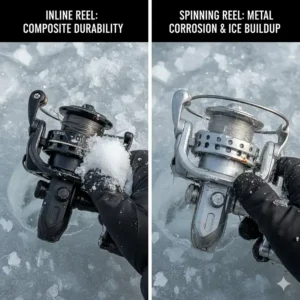
This reel elevates ice fishing performance with its sealed bearing system that prevents moisture and debris intrusion—critical for Canadian winter conditions where slush and spray freeze instantly. The President XT’s Total Line Control system minimises line twist more effectively than standard designs, whilst the braid-ready spool eliminates backing requirements. The carbon fiber drag provides exceptional smoothness across its entire range, inspiring confidence whether you’re finessing 12-inch perch or battling 8-pound walleye. Canadian reviews consistently highlight its reliability in extreme cold, with several anglers reporting flawless operation in -30°C temperatures.
Pros:
✅ Sealed bearings prevent freeze-ups
✅ Superior drag system for all applications
✅ Premium build quality ensures longevity
Cons:
❌ Higher cost may deter budget-conscious anglers
❌ Slightly heavier than ultralight alternatives
7. Camekoon Snow Storm 600 Inline Ice Reel
The Camekoon Snow Storm 600 offers an intriguing budget-friendly entry into inline ice fishing technology, delivering impressive features at a price point that won’t break the bank for anglers building their first dedicated ice arsenal.
Key Specifications:
- Gear ratio: 3.0:1
- Weight: 6.2 ounces (176 grams)
- Ball bearings: 3+1 stainless steel
- Magnetic brake: 8-button speed control
Price Range: $50-$70 CAD
Canadian Availability: Primarily through Amazon.ca with Prime shipping to most Canadian addresses.
The Snow Storm 600 features a free-spool release trigger system that enables one-handed operation—pull the trigger for free spool mode, release for instant re-engagement. The large 2.56-inch diameter CNC-machined aluminum spool provides excellent line capacity (4 lb holds 213 yards), whilst the 8-button magnetic brake system allows fine-tuned drop speed adjustment. Whilst it lacks the premium materials of higher-priced alternatives, Canadian budget-conscious anglers report solid performance for panfish and light walleye applications, with one Quebec reviewer noting: “For the price, this reel performs admirably—my go-to for introducing friends to ice fishing without a huge investment.”
Pros:
✅ Affordable entry into inline technology
✅ One-handed trigger operation
✅ Adjustable magnetic brake system
Cons:
❌ Graphite frame less durable than aluminum
❌ Fewer bearings than premium alternatives
Understanding Reel Mechanism Differences
The fundamental distinction between inline and spinning reel mechanics shapes every aspect of their performance on the ice. Understanding these reel mechanism differences helps you make informed decisions about which system suits your fishing style.
How Inline Reels Work
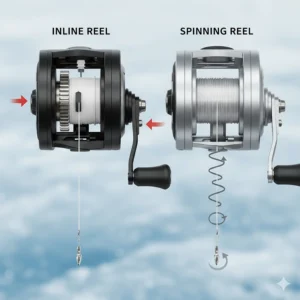
Inline reels function like oversized fly reels mounted beneath your rod. The spool sits perpendicular to the rod blank, with line peeling directly off the spool’s face during descent. The line falls directly off the spool without twisting, unlike spinning reels where line comes off at an angle. This straight-line feed eliminates the spiral memory that plagues spinning setups, particularly when using lighter monofilament or fluorocarbon lines.
Most modern inline reels incorporate a trigger mechanism that disengages the spool for free-fall drops. Simply pull the trigger, your bait plummets to depth, then release the trigger to instantly re-engage the anti-reverse. This one-handed operation proves invaluable when fishing in gloves or managing multiple rods simultaneously—common scenarios in Canadian ice fishing.
The gear ratios on inline reels typically range from 2.5:1 to 3.6:1, providing slower but more controlled retrieves. This deliberate pace suits finesse presentations where maintaining constant lure action proves critical for triggering bites from pressured fish.
How Spinning Reels Work
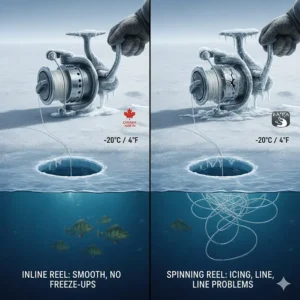
Spinning reels employ a bail system that wraps line around a fixed spool in a spiral pattern. The rotor rotates around the spool whilst the bail guides line onto it with each handle turn. This design creates the characteristic line twist associated with spinning reels—though modern innovations like Shimano’s Propulsion system have dramatically reduced this issue.
Spinning reels typically feature higher gear ratios of 5.2:1, making it easier to land larger fish quickly. This faster retrieve speed proves advantageous when fighting aggressive pike or lake trout that make powerful runs, allowing you to quickly regain line and maintain pressure.
The spinning reel’s bail system provides more versatile line management than inline triggers, accommodating various fishing techniques from aggressive jigging to delicate presentations. However, this complexity comes with added weight and more components that can potentially freeze in extreme conditions.
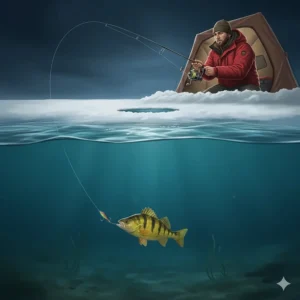
Inline Ice Fishing Reel Advantages
Selecting the best inline ice fishing reel unlocks specific benefits that directly address common ice fishing challenges faced by Canadian anglers.
Zero Line Twist
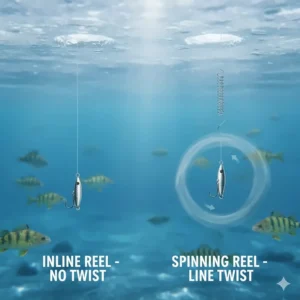
The primary advantage of inline reels is their elimination of line twist. Since the line falls directly off the spool, it does not have the line twist typically associated with ice fishing spinning reels. This becomes particularly important when using small jigs and light lines for panfish—species that spook easily from unnatural bait movement caused by twisted line.
When fishing ultra-light 2-3 pound fluorocarbon, even minor line twist causes your presentation to spin as it descends, creating an unnatural appearance that wary perch or crappie will refuse. Inline reels maintain your line’s integrity throughout the entire fishing session, ensuring your bait looks natural from the first drop to the last.
Superior Glove Operation
Canadian winters demand glove use, yet traditional spinning reels require finger dexterity that thick gloves compromise. The spooler reel is easier to operate with gloves on, allowing you to release the line with the trigger, stop it, and start jigging with one hand.
This one-handed operation proves invaluable when managing multiple rods inside a portable shelter or when fishing exposed to bitter winds. You can keep one hand tucked in your pocket for warmth whilst the other operates your rod and reel seamlessly. The trigger release is large enough to operate even with heavy mitts, unlike the delicate bail mechanisms on spinning reels.
Precise Depth Control
The trigger system on inline reels provides exceptional depth control that spinning reels cannot match. The trigger allows precise control over depth, letting you stop the bait exactly where you want it. This precision matters enormously when targeting walleye suspended at specific depths or when fishing structure with narrow strike zones.
You can watch your flasher, identify fish at 8.2 metres, and stop your bait within centimetres of that depth by releasing the trigger at precisely the right moment. This level of control significantly increases your hookup ratio, particularly with finicky fish that won’t chase baits more than 30 centimetres from their holding depth.
Spinning Reel Advantages Ice Fishing
Whilst inline reels excel in specific applications, spinning reels offer distinct spinning reel advantages ice fishing that make them indispensable for many Canadian scenarios.
Versatility Across All Depths
The primary use of an ice fishing spinning reel is to pursue larger fish in deeper water with a diverse set of lures or bait. When targeting lake trout at 30 metres or fishing offshore humps for walleye at 20+ metres, spinning reels’ higher line capacity and faster retrieve speeds prove essential.
The 5.2:1 to 6.2:1 gear ratios common in spinning reels allow you to quickly retrieve from depth, re-bait, and return to the strike zone efficiently. This speed advantage becomes critical during short feeding windows when fish are actively biting—you want maximum time with your bait in front of fish, not wasted on retrieval.
Superior Drag Systems
The typical ice fishing spinning reel has a better drag system, including multiple carbon fiber washers, compared to cork or felt-based systems. This enhanced drag performance proves crucial when battling trophy-sized fish that make powerful runs.
A smooth, progressive drag prevents line breakage when a 15-pound northern pike surges under the ice, whilst also providing enough pressure to tire fish efficiently. The multiple carbon fiber washers dissipate heat better than simpler systems, maintaining consistent drag pressure throughout extended fights.
No Learning Curve
Most anglers already know how to operate a spinning reel, eliminating the learning curve. This familiarity allows you to focus on reading your electronics, understanding fish behaviour, and perfecting your jigging cadence rather than wrestling with unfamiliar equipment.
For occasional ice anglers or those introducing family members to ice fishing, spinning reels remove one significant barrier to entry. Everyone understands how to cast, retrieve, and fight fish with spinning gear from summer fishing experiences.
Line Twist Prevention Strategies
Managing line twist remains a critical concern regardless of which reel type you choose, particularly when fishing Manitoba’s stained waters or Ontario’s clear shield lakes where line visibility impacts success.
For Spinning Reels
Even the best spinning reels introduce some line twist due to their spiral line lay. Implement these line twist prevention tactics:
Use Quality Swivels: Install a small barrel swivel 30-45 centimetres above your lure to allow line rotation without transferring twist up your main line. Choose black or dark swivels that blend with your line colour.
Regular Line Maintenance: Strip all line from your reel every 3-4 outings and re-spool in reverse to redistribute twist. This simple maintenance prevents accumulated twist from causing tangles and backlashes.
Premium Line Selection: Invest in quality monofilament or fluorocarbon designed specifically for spinning reels. Brands like Sufix Ice Magic or Berkley Trilene Cold Weather feature memory-resistant formulas that minimise twist accumulation.
Avoid Overspooling: Fill your spool to within 1-2 millimetres of the rim, but no more. Overfilled spools shed line in larger loops that twist more severely, whilst underfilled spools reduce casting distance and increase twist.
For Inline Reels
Whilst inline reels eliminate twist during descent, improper technique can still introduce problems:
Maintain Spool Tension: Adjust your magnetic brake or friction system to prevent overspool during free fall. Loose spools create bird’s nests that require cutting line and re-rigging.
Even Line Lay: When retrieving, ensure line lays evenly across the spool width. Some anglers use their thumb to guide line distribution, preventing bunching that causes later tangles.
Quality Line Still Matters: Even inline reels benefit from premium line designed for cold weather. Look for lines marketed specifically for ice fishing in Canadian conditions—they resist freeze-up and maintain suppleness in sub-zero temperatures.
Smooth Drag Systems Explained
Understanding smooth drag systems separates anglers who land fish consistently from those who experience frustrating break-offs at the hole. The drag system’s quality directly impacts your success with both inline and spinning setups.
Drag System Components
Modern ice fishing reels employ three primary drag types:
Carbon Fiber Washers: Found in premium reels, carbon fiber provides exceptional heat dissipation and maintains consistent drag pressure across the full range. These washers compress uniformly, preventing the “grabby” feel of inferior materials. Expect carbon fiber drags in reels costing $100+ CAD.
Felt Washers: Common in budget to mid-range reels, felt washers adequately handle panfish and smaller walleye but deteriorate faster than carbon fiber. Felt can absorb moisture and freeze in extreme cold, causing erratic drag performance. Replace felt washers annually for consistent performance.
Cork Washers: Occasionally found in older or budget reels, cork offers smooth operation when new but degrades quickly with heavy use. Avoid cork drags for serious ice fishing applications.
Adjusting Drag for Ice Fishing
Don’t use a wire leader that takes away the action from your lure unless you’re specifically targeting pike. Instead, rely on properly adjusted drag to handle powerful fish whilst maintaining lure action.
Set your drag to approximately 25-30% of your line’s rated breaking strength. For 6-pound test, this means roughly 1.5-2 pounds of drag pressure. Test by pulling line whilst watching a handheld scale—smooth, consistent resistance indicates proper adjustment.
In extreme cold, drag washers require more pressure to overcome increased friction from cold-stiffened grease. Some anglers reduce drag lubricant or use specialty cold-weather greases that maintain fluidity at -30°C. Brands like Quantum Hot Sauce or Cal’s Drag Grease perform reliably in Canadian winter conditions.
Best Species for Each Reel Type
Matching your reel to target species dramatically improves your efficiency and enjoyment on Canadian ice. Here’s how different fish respond to inline versus spinning presentations.
Inline Reel Species
Panfish (Perch, Crappie, Bluegill): The primary use of the inline reel is for shallow water and smaller fish such as crappie, perch, small walleye, and panfish. The zero line twist allows ultra-finesse presentations with 1/64 to 1/32-ounce tungsten jigs tipped with waxworms or spikes. These species rarely exceed 2 pounds, making inline reels’ lighter drags perfectly adequate.
Shallow-Water Walleye (1.5-9 metres): When walleye hold in relatively shallow water relating to weed edges or rock transitions, inline reels excel. The precise depth control lets you maintain your bait in the narrow 30-centimetre strike zone walleye often demand. Use 1/8 to 1/4-ounce jigs with live minnows for optimal results.
Brook Trout and Rainbow Trout: These species typically inhabit shallower lakes and streams, with fish holding in 3-12 metres of water. Their delicate mouths demand smooth, gentle hook-sets that inline reels naturally provide. The slower retrieve speed also matches trout’s preference for deliberate lure action.
Spinning Reel Species
Lake Trout: Usually, lake trout are targeted deep in the water column, meaning a 2000-size reel is perfect. These trophy fish often hold at 20-40 metres in Great Lakes environments, requiring substantial line capacity and powerful drag systems. Use 8-12 pound test with heavy jigging spoons or tube jigs.
Northern Pike: Pike’s aggressive nature and powerful runs demand spinning reels’ superior drag systems and faster retrieve speeds. When a 10-pound pike surges toward you, spinning reels’ high gear ratios let you recover slack line before it shakes free. The enhanced drag prevents break-offs during their characteristic head-shaking jumps.
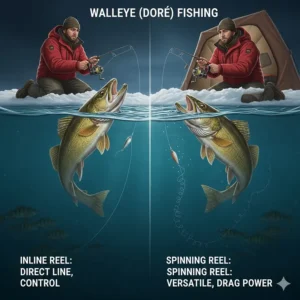
Deep-Water Walleye (12+ metres): For walleye, a 1/8 oz. lead head jig tipped with smaller minnows is a productive choice, but in deeper basin environments, spinning reels’ efficiency becomes critical. The faster retrieve gets your bait back to productive depths quickly after reeling up to check bait condition or retie.
Whitefish: Often overlooked by anglers, whitefish school in substantial numbers at depths of 15-30 metres. Spinning reels’ versatility handles both the depth requirements and these fish’s surprising power when hooked on light tackle.
Ice Fishing Reel Comparison: Making Your Decision
The ice fishing reel comparison ultimately depends on your specific fishing scenarios, target species, and personal preferences. Here’s how to evaluate your needs.
Consider Your Primary Fishing Style
Stationary Shelter Fishing: If you primarily fish from a permanent or portable shelter with multiple holes, inline reels’ one-handed operation proves ideal. You can manage 3-4 rods simultaneously, responding quickly to bites whilst remaining comfortable inside your shelter.
Mobile Hole-Hopping: Anglers who drill numerous holes searching for active fish benefit from spinning reels’ versatility. You can quickly adapt presentations from finesse jigging to aggressive ripping without changing gear.
Multi-Species Approach: Target various species during a single outing? Spinning reels’ adaptability handles everything from panfish to pike without requiring reel changes. Inline reels work brilliantly for their intended applications but struggle when presentations demand rapid, aggressive rod movements.
Evaluate Your Target Depth
0-15 Metres: Either reel type works, but inline reels provide subtle advantages in line management and precision. The trigger system’s instant depth control proves particularly valuable in this range where fish often suspend at specific depths.
15-30 Metres: Spinning reels become increasingly advantageous as depth increases. The faster retrieve speeds minimise time spent reeling from depth, maximising productive fishing time. Line capacity also becomes critical at these depths.
30+ Metres: Spinning reels are essentially mandatory. The line capacity requirements alone eliminate most inline reels, whilst the physical effort of retrieving from extreme depths demands efficient gear ratios.
Budget Considerations
If you’re new to ice fishing, it’s recommended to opt for a rod and reel combo, as this will ensure your gear will work properly and fit perfectly straight out of the box. Combo packages often save 20-30% compared to buying components separately.
Budget-Friendly Start ($30-$60 CAD): The Shimano Sienna 500 or Camekoon Snow Storm 600 provide excellent entry points without sacrificing essential performance. These reels handle 90% of ice fishing scenarios Canadian anglers encounter.
Mid-Range Excellence ($60-$120 CAD): Pflueger President series or Daiwa QR750 offer refined performance, better components, and enhanced durability. Expect 5+ years of reliable service with minimal maintenance.
Premium Performance ($120-$190 CAD): 13 Fishing Black Betty variants or Pflueger President XT deliver flagship features, exceptional build quality, and confidence-inspiring reliability in extreme conditions. Serious anglers fishing 30+ days per season find this investment worthwhile.
Canadian Ice Fishing Regulations and Considerations
Before purchasing any ice fishing reel, familiarise yourself with provincial regulations and seasonal considerations that affect Canadian ice anglers.
Provincial Licensing Requirements
All provinces require anglers to possess valid fishing licences, with separate regulations governing ice fishing seasons, catch limits, and permitted gear. Anglers are permitted to ice fish in Ontario using two holes, so double your chances with an extra rod or two. This two-rod allowance means serious anglers often invest in both inline and spinning setups to cover all presentations.
British Columbia, Alberta, Saskatchewan, Manitoba, Ontario, Quebec, and the Atlantic provinces each maintain specific regulations regarding:
- Number of rods permitted per angler (1-2 depending on province)
- Use of live versus artificial bait
- Species-specific size and possession limits
- Seasonal closures protecting spawning fish
Ice Safety and Thickness
Experts say minimum 4 inches (10 cm) clear, solid ice is needed for walking on frozen lakes, with Ontario’s Ministry of Natural Resources suggesting minimum 12 inches (30 cm) blue ice for light vehicles. Always check local ice conditions before venturing out, as early and late season ice can vary dramatically in strength despite appearing thick.
Climate Change Impacts
In Minnesota, warmer winters have resulted in the cancellation of fishing tournaments and reduction in ice fishing, influencing food security and overall well-being of communities. Canadian anglers face similar challenges as ice seasons become less predictable. Shorter ice seasons make reel selection even more critical—you want reliable gear that performs during limited fishing opportunities.
Where to Buy in Canada
Purchasing ice fishing reels in Canada offers multiple options, each with distinct advantages for different buyer priorities.
Physical Retail Locations
Canadian Tire: Carries mainstream brands like Shimano, Rapala, and select Pflueger models. Benefits include ability to handle reels before purchase, immediate availability, and easy returns. Sales events during fall offer 20-40% discounts.
Bass Pro Shops/Cabela’s: Premium selection including 13 Fishing, Clam, and high-end Shimano. Knowledgeable staff can provide setup advice and combo recommendations. Locations in major cities across Ontario, Alberta, Manitoba, and Saskatchewan.
Independent Tackle Shops: Stores like The Fishin’ Hole, Tackle Depot, and Angling Sports offer expert local knowledge, regional insights, and specialised products unavailable in chain stores. Support local businesses whilst gaining valuable fishing intelligence.
Online Retailers
Amazon.ca: Widest selection with competitive pricing and Prime shipping to most Canadian addresses. Customer reviews provide real-world performance feedback. Watch for seasonal sales during Black Friday and Boxing Week.
Tackle Depot: Canadian-owned online retailer specialising in ice fishing equipment. Free shipping on orders over $149 CAD, with flat-rate $15 shipping otherwise. Excellent customer service and product knowledge.
Fishing World Canada: Curated selection of premium ice fishing gear with detailed product descriptions and setup recommendations. Ships across Canada with transparent shipping costs calculated at checkout.
Buying from US Retailers
Some premium reels like certain 13 Fishing or Clam models have limited Canadian distribution. When buying from US retailers:
- Factor in currency conversion (typically 1.25-1.35 CAD per USD)
- Include estimated duties and taxes (5-15% depending on province)
- Verify shipping restrictions (some companies won’t ship to Canada)
- Account for longer delivery times (7-21 days vs 2-5 domestic)
- Ensure warranty coverage extends to Canadian customers
Maintenance and Storage Tips
Proper maintenance extends your reel’s lifespan and ensures reliable performance when the next cold snap arrives.
Post-Session Care
After each ice fishing trip, implement this quick maintenance routine:
Remove Ice and Moisture: Bring reels inside to room temperature, allowing condensation to evaporate naturally. Never use heat guns or place near radiators—rapid temperature changes crack graphite components and damage seals.
Light Lubrication: Apply a thin coat of reel oil to bail mechanisms (spinning reels) or trigger assemblies (inline reels). Use cold-weather formulations that won’t thicken in freezing temperatures. Quality brands include Quantum Hot Sauce or Ardent Reel Butter Ice.
Line Inspection: Check the first 3-4 metres of line for abrasion, nicks, or excessive memory. This section contacts ice holes, sharp edges, and fish teeth most frequently. Replace damaged sections immediately.
Off-Season Storage
Before summer storage, perform thorough maintenance:
Deep Cleaning: Disassemble reels (if comfortable doing so) to remove accumulated dirt, fish scales, and old lubricant. Use mild soap and warm water, avoiding high-pressure sprays that force water past seals.
Fresh Lubrication: Apply fresh grease to gears and oil to bearings. This prevents corrosion during storage and ensures smooth operation when ice season returns.
Proper Storage Location: Store in climate-controlled spaces avoiding extreme temperature fluctuations. Basements work well; avoid garages and sheds where summer heat degrades lubricants and winter cold makes them brittle.
Loosen Drags: Back off drag tension completely to prevent washers from compressing into permanent deformation. This single step significantly extends drag life.
🎣 Looking to Upgrade Your Ice Arsenal?
Explore these hand-selected ice fishing reels available now on Amazon.ca. Every product featured has been verified for Canadian availability, competitive pricing in CAD, and genuine customer reviews from anglers who fish our waters. Click any highlighted reel name to check current promotions and fast shipping options!
How to Choose the Right Ice Fishing Reel for Your Needs
Selecting between inline vs spinning reel ice fishing requires evaluating multiple factors beyond simple preference. Follow this decision framework to identify your ideal setup.
Step 1: Identify Your Primary Target Species
List the three species you fish most frequently, ranking them by time spent pursuing each. If panfish dominate your ice time, inline reels deserve serious consideration. Pike and deep-water walleye enthusiasts lean toward spinning reels.
Step 2: Assess Your Typical Fishing Depths
Review your last season’s fishing logs or recall your most productive depths. Consistently fishing under 15 metres? Inline reels excel. Regularly targeting 20+ metre depths? Spinning reels prove more practical.
Step 3: Evaluate Your Experience Level
Honest self-assessment matters. If you’re a beginner with ice fishing, a spinning reel is recommended, as their learning curve is less steep. Experienced anglers comfortable learning new techniques can explore inline advantages without frustration.
Step 4: Consider Your Budget
Establish realistic spending limits before shopping. Remember you’ll need multiple reels for a complete ice arsenal—budget for 2-3 reels covering different applications rather than a single premium reel.
Step 5: Factor in Glove Use
Canadian winters demand gloves, but hand size and glove thickness vary. Try operating reels whilst wearing your typical ice fishing gloves. If spinning reel bails prove difficult to operate, inline triggers offer practical advantages.
Step 6: Plan for Expansion
Your first ice fishing reel likely won’t be your last. Consider which system offers the best foundation for future expansion. Many anglers start with a versatile spinning setup, then add inline reels for specific applications as their experience grows.
Step 7: Seek Local Advice
Connect with successful ice anglers in your region through forums, Facebook groups, or local tackle shops. Regional fishing patterns heavily influence ideal gear selection—what works brilliantly on Saskatchewan prairie lakes might struggle on Ontario’s Canadian Shield waters.
Frequently Asked Questions
❓ What is the main advantage of inline reels over spinning reels for ice fishing?
❓ Can I use my summer spinning reel for ice fishing in Canada?
❓ What size spinning reel should I buy for walleye ice fishing in Canada?
❓ How much should I spend on my first ice fishing reel in Canada?
❓ Do inline reels work well for deep water ice fishing in Canadian lakes?
Conclusion: Your Perfect Ice Fishing Reel Awaits
The inline vs spinning reel ice fishing debate ultimately resolves differently for each angler based on target species, typical depths, experience level, and fishing style preferences. Neither option reigns supreme across all applications—instead, each excels in specific scenarios that match Canadian ice fishing diversity.
Inline reels deliver unmatched finesse for panfish specialists and shallow-water anglers who value precise presentations and zero line twist. The trigger-operated systems provide exceptional depth control whilst accommodating glove use—practical considerations that matter during Saskatchewan’s brutal January cold snaps or Manitoba’s windy prairie conditions. Premium inline models like the 13 Fishing Black Betty 6061 ($135-$165 CAD) represent long-term investments for serious anglers, whilst budget options like the Camekoon Snow Storm 600 ($50-$70 CAD) introduce newcomers to inline advantages without significant financial commitment.
Spinning reels counter with unbeatable versatility, familiar operation, and superior performance for larger fish in deeper water. Spinning reels are the more common option, as they boast easier drag adjustments and a wider array of different models. The Shimano Sienna 500 ($28-$35 CAD) proves that exceptional value exists at budget price points, whilst premium offerings like the Pflueger President XT ($110-$145 CAD) satisfy demanding anglers pursuing trophy walleye and pike across Ontario’s thousands of lakes.
Most experienced Canadian ice anglers eventually adopt both systems, matching reels to specific applications rather than forcing a single solution across all scenarios. Start with a versatile spinning setup covering your primary fishing situations, then expand your arsenal with inline reels targeting specialised presentations as your skills and interests evolve. Remember that reel selection represents just one component of ice fishing success—understanding fish behaviour, reading electronics effectively, and perfecting your jigging cadence matter equally.
As Canada’s 2.3 million ice fishing participants head to frozen lakes this season, they’ll rely on equipment that performs reliably in our harsh winter conditions. Whether you choose inline precision or spinning versatility, invest in quality gear from Canadian retailers, maintain it properly, and you’ll enjoy seasons of productive ice fishing across this nation’s incredible winter fisheries.
Recommended for You
- 7 Best Ice Fishing Rod Lengths for Canadian Waters (2026 Guide)
- 7 Best Ice Fishing Rods Canada 2026: How To Choose Ice Fishing Rod
- 7 Best Lake Trout Ice Fishing Rods Canada 2026
Disclaimer: This article contains affiliate links to Amazon.ca. If you purchase products through these links, we may earn a small commission at no additional cost to you.
✨ Found this helpful? Share it with your fishing buddies! 💬🤗
