
In This Article
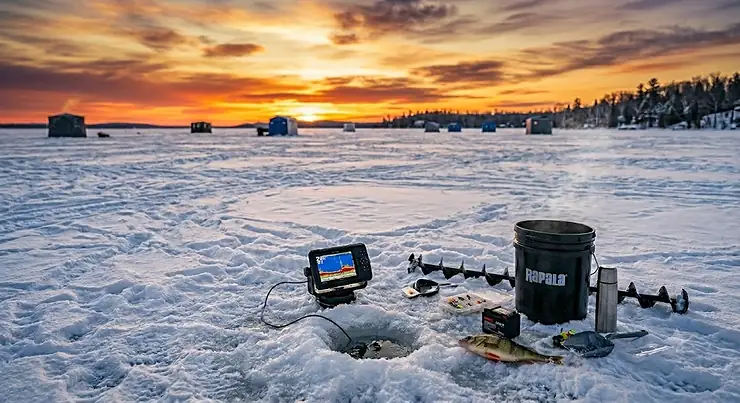
A portable fish finder for ice fishing is a self-contained sonar unit — display, battery, and transducer in one carry case — that shows depth, bottom structure, and fish activity beneath the ice in real time. Unlike boat-mounted electronics, these units are built to be carried hole to hole across a frozen lake, then packed away in minutes.
If you’ve ever stood on a frozen lake watching other anglers haul in fish while your line sits untouched, the difference is usually visibility, not luck. A good unit shows you exactly where the bottom is, how your jig is moving, and whether anything’s actually down there — which matters more in Canada’s short ice season than almost anywhere else, since you can’t afford to waste good ice guessing.
Quick Comparison Table
| Fish Finder | Type | Price Range (CAD) | Best For |
|---|---|---|---|
| Garmin Striker 4 Portable Bundle | GPS/CHIRP combo | $280–$320 | All-around value, kayak crossover |
| Humminbird ICE-55 Flasher | Classic flasher | $450–$550 | Cold-weather reliability, no screen lag |
| Deeper PRO+ 2 | Castable smart sonar | $280–$350 | No-transducer-arm convenience, app users |
| Garmin Striker Cast GPS | Castable sonar | $150–$190 | Budget castable, beginners |
| LUCKYLAKER Ice Portable | Handheld wired | $50–$90 | First-timers, kids, backup unit |
| Humminbird ICE HELIX 5 CHIRP GPS G3 | Flasher + 2D sonar/GPS | $650–$800 | Serious weekend anglers, mapping |
| Humminbird Ice Helix 7 CHIRP GPS G4 | Premium flasher + GPS | $1,300–$1,700 | Tournament-level, boat crossover |
Looking at the spread, there’s a clear split between two camps: dedicated flashers (Humminbird ICE-55, the Helix line) that prioritize instant, lag-free response, and app-connected castables (Deeper, Striker Cast) that trade a tiny bit of speed for GPS mapping and phone-screen convenience. Budget under $100 CAD and you’re in handheld-sonar territory, which is fine for learning but not for serious walleye chasing. The jump from the $650 Helix 5 to the $1,300+ Helix 7 mostly buys screen size and MEGA imaging compatibility, not core ice performance.
💬 Just one click — help others make better buying decisions too!😊
✨ Don’t Miss These Exclusive Deals!
🔍 Take your ice fishing setup to the next level with these carefully selected products. Click on any highlighted item to check current pricing and availability on Amazon.ca.
Top 7 Portable Fish Finders for Ice Fishing — Expert Picks
1. Garmin Striker 4 Portable Bundle
The Garmin Striker 4 Portable Bundle pairs a 3.5-inch colour display with built-in GPS in a kit small enough to fit in a sled alongside your auger. It uses Garmin’s CHIRP sonar (77/200 kHz), which sends a continuous frequency sweep instead of a single pulse, giving sharper fish arches and better target separation than older transducers. In practice, that means you can actually tell your jig apart from a perch hovering six inches away — something cheaper units blur together.
What most Canadian buyers overlook is that this unit doubles as your open-water electronics. The portable kit includes a sealed rechargeable battery, transducer cable storage, and a suction-cup mount, so the same box that gets you through January on Lake Simcoe goes straight into a canoe in May. Reviewers on outdoor gear sites consistently flag it as the budget benchmark against pricier ice-specific units.
✅ Doubles as a boat/kayak unit in summer
✅ GPS lets you mark productive holes
✅ Easiest unit on this list for a first-timer to learn
❌ 3.5″ screen is small for side-by-side flasher/sonar views
❌ Not a true ice flasher — slight lag versus dedicated flashers
Price & verdict: Around $280–$320 CAD on Amazon.ca. Best value if you also fish open water.
2. Humminbird ICE-55 Flasher
The Humminbird ICE-55 is the no-nonsense flasher diehard hardwater anglers reach for. It’s engineered for peak performance in temperatures as cold as -20°C, with a centre-dial LCD that gives a digital depth readout and automatic depth scale. A dual-beam transducer (9° and 19°, 240/455 kHz) gives a wide cone of coverage so you don’t miss fish swimming past at an angle.
What that means on the ice: no boot-up screen, no menu diving — you drop the transducer, and the dial responds instantly. For anyone who’s fished a frozen Prairie lake at -25°C with gloves on, that instant feedback matters more than any app feature. It ships with a rechargeable 12-volt, 9-amp-hour battery and charger built in.
✅ True real-time flasher, zero screen lag
✅ Rated for extreme Canadian cold
✅ Rugged carrying case built for rough handling
❌ No GPS or mapping
❌ Small fiber-optic dial isn’t as intuitive for total beginners
Price & verdict: Around $450–$550 CAD on Amazon.ca. Best for anglers who want speed over screens.
3. Deeper PRO+ 2 Smart Sonar
The Deeper PRO+ 2 ditches the transducer pole entirely — it creates its own Wi-Fi connection and streams sonar straight to your phone via the free Fish Deeper app, with accuracy up to 330 feet (100 m) and three beam widths for scanning or pinpointing. For ice fishing specifically, it works as a flasher with no transducer or wires needed at all, just drop it in the hole.
The real-world advantage here is hole-hopping speed. Pulling a transducer arm out of a slushy hole and re-rigging it ten times a day gets old fast in a Canadian winter — the Deeper skips that step. The trade-off: you’re relying on a phone screen in the cold, so a battery pack or insulated phone case is worth budgeting for alongside it.
✅ No transducer arm — fastest hole-hopping setup here
✅ Builds GPS bathymetric maps you can reuse all season
✅ Works across boat, kayak, shore, and ice
❌ Needs a phone with a charged battery, which drains faster in the cold
❌ Screen glare from a phone is worse than a dedicated display in bright snow
Price & verdict: Around $280–$350 CAD on Amazon.ca, sold by Deeper Sonar Canada. Best for anglers who already fish open water and want one tool year-round.
4. Garmin Striker Cast GPS
The Garmin Striker Cast GPS is the lightest, most affordable way into app-based sonar. It streams wirelessly from up to 200 feet away and works in freshwater, saltwater, and below ice, with both traditional 2-D sonar and a dedicated ice fishing flasher mode built into the app.
This is the unit to hand a teenager or a fishing buddy who’s never used electronics before — the app interface is genuinely simple, and at this price point, losing it down a hole stings far less than dropping a $1,500 unit. The trade-off is a smaller scanning cone than the dedicated flashers above.
✅ Lowest-cost GPS-enabled option on this list
✅ Doubles as a casting sonar for open-water shore fishing
✅ Compact enough to fit in a jacket pocket
❌ Smaller battery life than dedicated flasher units
❌ Phone dependency in cold weather
Price & verdict: Around $150–$190 CAD on Amazon.ca. Best budget pick for app-comfortable anglers.
5. LUCKYLAKER Ice Portable Fish Finder
The LUCKYLAKER Ice Portable is the cheapest legitimate option here, and it’s aimed squarely at first-timers. It’s built specifically for ice use, with a sonar scan speed increased by roughly 30% over the standard model to better detect through ice, and a maximum depth range of 328 feet (100 m).
What most buyers overlook: this isn’t a flasher replacement for serious anglers — it’s a learning tool, or a backup that lives in your bag in case your main unit’s battery dies in the cold. It runs in extreme temperatures and has a backlight for low-light fishing.
✅ Lowest price point — easy entry for kids or beginners
✅ Simple wired setup, nothing to pair or charge via app
✅ Genuinely usable backup unit
❌ Basic display, no fish ID beyond rough size icons
❌ Build quality won’t survive years of rough winter handling
Price & verdict: Around $50–$90 CAD on Amazon.ca. Best for testing the waters before investing more.
6. Humminbird ICE HELIX 5 CHIRP GPS G3 All-Season
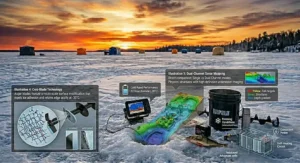
The Humminbird ICE HELIX 5 is where casual anglers start taking ice electronics seriously. It combines Dual Spectrum CHIRP sonar with 3/4-inch target separation, built-in GPS with Humminbird Basemap covering more than 10,000 lakes, and AutoChart Live ICE for building real-time 1-foot contour maps as you fish.
The mapping feature is the part most reviews undersell: drive around a new lake (or walk it on ice) and the unit quietly builds your own depth map, which is genuinely useful on Canadian Shield lakes where bathymetric charts are often outdated or nonexistent. It transfers to a boat in summer with an optional transducer, transducer cord, and gimbal mount.
✅ Builds custom lake maps as you fish
✅ Flasher and 2D sonar shown together on one screen
✅ Crosses over to boat fishing in open-water season
❌ Noticeably pricier than entry flashers
❌ Five-inch screen feels small next to the Helix 7
Price & verdict: Around $650–$800 CAD on Amazon.ca. Best for anglers ready to invest in mapping and GPS.
7. Humminbird Ice Helix 7 CHIRP GPS G4 All Season
The Humminbird Ice Helix 7 CHIRP GPS G4 is the unit serious tournament and guide-level anglers reach for. It offers ¾-inch target separation, a switchable circular flasher view or widescreen sonar mode (or both windows at once), adjustable zoom, and a full-colour 7-inch HD LCD display with brightness adjustment for day or night use. GPS with Humminbird Basemap covers more than 10,000 water bodies and is compatible with LakeMaster and Navionics maps, plus AutoChart Live ICE for real-time contour building.
The honest take: most weekend anglers don’t need this much screen real estate. Where it earns its price is split-screen flexibility — running flasher and 2D sonar simultaneously lets you watch your jig’s exact behaviour while still seeing the full water column, which matters when you’re chasing finicky walleye on pressured lakes near Ontario cottage country.
✅ Largest, brightest screen on this list
✅ Split flasher + 2D sonar view simultaneously
✅ Compatible with MEGA Side Imaging/MEGA Live (separate transducer)
❌ Significant price jump over the Helix
❌ Overkill for casual once-a-season anglers
Price & verdict: Around $1,300–$1,700 CAD on Amazon.ca. Best for dedicated ice anglers and tournament use.
How to Choose a Portable Fish Finder for Ice Fishing in Canada
- Decide flasher vs. screen sonar first. Flashers (Humminbird ICE-55, Helix line) respond instantly with no lag — better for fast jigging. Screen sonar shows more context but reads slightly slower.
- Match battery type to your cold tolerance. Lead-acid batteries (Garmin Striker, Humminbird flashers) hold a charge better in deep cold than the smaller lithium cells in castable units.
- Decide if you need GPS mapping. If you fish the same two or three lakes, skip it. If you explore new Canadian Shield lakes each winter, mapping pays for itself fast.
- Budget for accessories, not just the unit. A sled, transducer arm, and insulated battery case (or warm phone case for app units) often add $50–$100 CAD.
- Check Amazon.ca seller and shipping details. Several units here ship from third-party Canadian resellers — confirm “Ships from and sold by Amazon.ca” or a verified Canadian seller before buying for fastest delivery in remote regions.
- Consider all-season crossover. Most units on this list also work on a boat or kayak come spring — factor that into the price if you only fish a few months otherwise.
- Don’t oversize for your skill level. A $1,500 Helix 7 won’t outfish a $300 Striker 4 in the hands of someone who hasn’t learned to read a flasher yet.
Real-World Scenarios: Which Fish Finder Fits Your Ice Fishing Style
The Northern Ontario weekend warrior driving up from Toronto for two days on Lake Nipissing wants something that survives a rough truck ride and works the moment it’s pulled out at -15°C. The Humminbird ICE-55 or the Striker 4 bundle both fit — rugged, simple, no app dependency.
The Prairie angler chasing walleye on unfamiliar Saskatchewan lakes benefits most from GPS mapping. The Helix 5 or Helix 7’s AutoChart Live ICE turns an unfamiliar lake into a usable depth map within an hour of fishing it.
The parent introducing kids to ice fishing in Quebec or the Maritimes doesn’t need precision — they need something cheap enough to not panic over and simple enough for a ten-year-old to operate. The LUCKYLAKER handheld or the Garmin Striker Cast app covers that without much financial risk.
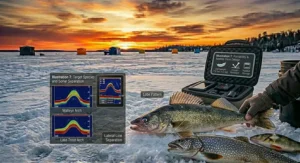
Setting Up and Using Your Ice Fishing Fish Finder
- Cold-start your battery indoors. Lead-acid and lithium batteries both lose capacity in extreme cold; charge fully the night before and keep the unit in an insulated bag, not the truck bed, on the drive out.
- Clear slush from the hole before dropping the transducer. Ice chips and slush scatter the sonar signal and give false bottom readings.
- Switch to “ice mode” if your unit has one. Helix and similar combo units have a dedicated ice setting that adjusts scan speed for a stationary transducer rather than a moving boat.
- Store the unit warm between trips, not in an unheated shed. Repeated freeze-thaw cycles shorten LCD and battery lifespan faster than steady cold.
- Common first-30-days mistake: cranking gain/sensitivity too high, which clutters the screen with noise. Start low and increase gradually until fish marks appear clearly against a clean background.
Features That Actually Matter (And Those That Don’t)
Matters: target separation (smaller numbers like ¾” mean you can tell your jig from a fish nearby), battery type and cold performance, and whether the unit has a true ice/flasher mode versus just open-water sonar repurposed for ice.
Matters less for most anglers: side imaging and MEGA Live capability — genuinely powerful, but mostly wasted on a stationary ice hole compared to a moving boat. Screen size past 5–7 inches is largely a comfort upgrade, not a performance one.
Flashers vs. Castable Sonars: Which Type Wins on the Ice?
| Factor | Dedicated Flasher | Castable/App Sonar |
|---|---|---|
| Response speed | Instant, no lag | Slight delay via Wi-Fi/app |
| Cold-weather reliability | Excellent (sealed lead-acid) | Good, but phone battery drains faster |
| Setup speed per hole | Moderate (transducer arm) | Fast (some, like Deeper, need no arm) |
| Best For | Fast jigging, dedicated ice anglers | Multi-season users, app-comfortable anglers |
The data above makes the trade-off clear: flashers win on raw responsiveness and cold-weather toughness, which is why they remain the choice of serious Canadian ice anglers, while castable units win on convenience and crossover value if you’re not fishing ice every weekend. Neither is objectively “better” — it depends on whether you’re optimizing for speed on the ice or flexibility across seasons.
Ice Safety and Canadian Regulations Every Angler Should Know
No fish finder matters if the ice underneath isn’t safe. Provincial guidance such as Alberta’s recommends never walking on ice less than 10 cm (4 inches) thick and never driving on ice less than 30 cm (12 inches) thick. Federal guidance for ice work in Canada is based on Gold’s formula for calculating safe load limits on floating ice covers, originally published by the National Research Council.
Regulations also vary by province. In Ontario, for example, ice huts must be registered in certain Fisheries Management Zones and removed before ice breakup, even where no fixed removal date applies. Always check your province’s current fishing regulations and ice hut rules before heading out — they change year to year.
You can find official guidance here:
- Government of Canada — Field Guide to Working Safely on Ice Covers (PDF)
- Ontario.ca — Ice Fishing Rules and Ice Hut Registration
- Government of Alberta — Ice Safety Tips
- Wikipedia — Fish Finder (sonar technology overview)
Common Mistakes When Buying a Portable Fish Finder for Ice Fishing
- Buying a boat-only unit without an ice kit. Some Garmin and Humminbird models need a separate ice transducer bundle — check the listing carefully before ordering.
- Ignoring battery type in extreme cold. Lithium batteries in app-based units lose capacity fast below -15°C; budget for a backup power bank.
- Skipping the warranty/return window for Amazon.ca third-party sellers. Confirm whether the seller is Amazon.ca itself or a marketplace reseller, since return policies can differ.
- Overbuying screen size for casual use. A 7-inch premium unit is wasted on someone fishing twice a season.
- Forgetting accessory costs. Sleds, ice transducer poles, and insulated cases for app-based units add real cost beyond the listed price.
FAQ
❓ What is the best portable fish finder for ice fishing?
❓ Do I need GPS on an ice fishing fish finder?
❓ Can I use a regular boat fish finder for ice fishing in Canada?
❓ How thick does ice need to be before fishing safely in Canada?
❓ Does Amazon.ca ship ice fishing fish finders to all provinces?
Conclusion
For most Canadian ice anglers, the sweet spot sits between the Garmin Striker 4 Portable Bundle for all-season value and the Humminbird ICE HELIX 5 for anyone ready to invest in GPS mapping. Dedicated flasher purists will still reach for the Humminbird ICE-55, and anyone testing the waters — literally — can start with the LUCKYLAKER or Garmin Striker Cast without much financial risk. Whatever you choose, pair it with proper ice safety habits; no amount of sonar resolution helps if the ice itself isn’t sound.
Recommended for You
- 7 Best Flasher vs LCD Fish Finder Ice Fishing Picks (Canada 2026)
- 7 Best Ice Fishing Flashers in Canada for 2026 (Real-Time Sonar Picks)
- 7 Best 20 lb Propane Tanks for Ice Fishing in Canada (2026)
Disclaimer: This article contains affiliate links. As an Amazon Associate, I earn from qualifying purchases. If you purchase products through these links, we may earn a small commission at no additional cost to you.
✨ Found this helpful? Share it with your friends! 💬🤗
