
In This Article
Picture this: you’re settled into your cozy ice fishing shelter on a frozen Canadian lake, lines in the water, hot coffee in hand—when suddenly a fierce prairie wind tears across the ice. Without proper ice shelter anchors, your entire setup could become a tumbling hazard faster than you can say “walleye.” That’s not just inconvenient; it’s dangerous.
Ice shelter anchors are the unsung heroes of ice fishing, particularly across Canada’s wind-swept frozen lakes where gusts can reach 60+ km/h without warning. Whether you’re fishing Lake Simcoe in Ontario, Lake Winnipeg in Manitoba, or any of the thousands of frozen bodies of water across our provinces, securing your shelter isn’t optional—it’s essential.
According to Ice fishing practices documented on Wikipedia, portable ice shelters have become increasingly sophisticated, but they’re only as good as their anchoring systems. These simple yet critical tools drill or screw into the ice, creating stable anchor points that can withstand significant lateral forces. In Canada, where ice fishing represents both tradition and recreation for millions of anglers, choosing the right anchor system can mean the difference between a comfortable day on the ice and a rescue operation.
The Canadian market offers everything from budget-friendly basic stakes to premium screw-in systems with drill adapters, typically ranging from $20 to $80 CAD. In this comprehensive guide, we’ll examine seven top-performing products available on Amazon.ca, explore what makes ice shelter anchors effective in harsh Canadian conditions, and help you select the perfect system for your specific needs.
Quick Comparison Table of Top Ice Shelter Anchors
| Product | Type | Quantity | Price Range (CAD) | Best For | Rating |
|---|---|---|---|---|---|
| Eskimo 69138 Ice Anchors | Screw-in | 2-pack | $35-$45 | Premium durability | 4.7/5 |
| CLAM 8064 Ice Anchor Kit | Self-tapping spike | 2-pack + straps | $30-$40 | Sled-style shelters | 4.5/5 |
| DenniesCare Ice Anchor Kit | Screw-in with drill adapter | 4 anchors + adapter | $40-$55 | Quick installation | 4.6/5 |
| Brocraft Ice Shelter Anchors | Screw-in | 2-pack | $25-$35 | Budget-friendly | 4.2/5 |
| Otter Quick-Snap Tool + Anchors | Universal system | Tool + anchors | $50-$70 | Professional anglers | 4.8/5 |
| BIGROCK Otter Anchor Kit | Heavy-duty screw-in | 4-pack with pouch | $60-$80 | Large hub shelters | 4.6/5 |
| Generic Freeze-In Stakes | Freeze-in tube style | 4-8 pack | $20-$30 | Permanent setups | 4.0/5 |
💬 Just one click – help others make better buying decisions too! 😊
Top 7 Ice Shelter Anchors: Expert Analysis
1. Eskimo 69138 Ice Anchors (2-Pack)
When Canadian ice anglers talk about the gold standard, they’re usually referring to Eskimo 69138 Ice Anchors. These self-tapping beauties have earned their reputation through decades of brutal Canadian winters.
Key Specifications:
- Solid stainless steel construction
- Self-tapping sharp point design
- Large grip handles for gloved operation
- Length: approximately 20 cm (8 inches)
Price: $35-$45 CAD on Amazon.ca
What Makes Them Special: The stainless steel construction resists corrosion even when exposed to salt-treated ice roads or wet storage conditions common in Canadian garages. The large T-handle provides excellent torque, allowing you to screw these into thick ice without needing power tools. Canadian buyers consistently praise their ability to bite into both fresh clear ice and older, harder ice conditions.
✅ Pros:
- Exceptional build quality lasts multiple seasons
- Easy to install by hand, even in -25°C weather
- Won’t bend under pressure from wind-driven shelters
❌ Cons:
- Higher price point than generic alternatives
- Only 2 per pack (most shelters need 4-6)
Canadian Customer Feedback: “Used these on Lake of the Woods during a particularly nasty wind event. My Eskimo shelter didn’t budge while other anglers were chasing their setups across the ice.” – Manitoba angler review
2. CLAM 8064 Ice Anchor Kit
The CLAM 8064 Ice Anchor Kit takes a different approach with self-tapping spikes specifically engineered for sled-style portable shelters—the type many Canadian anglers drag behind snowmobiles.
Key Specifications:
- Two self-tapping spikes
- Two quick-release nylon straps included
- Two mounting hardware sets
- Compatible with any sled-style fish house
Price: $30-$40 CAD
Design Philosophy: Rather than screwing directly through grommets, the CLAM system uses spikes that drive into the ice, then attach to your shelter sled via quick-release straps. This makes setup and teardown remarkably fast—critical when you’re dealing with changing weather or need to relocate quickly.
✅ Pros:
- Complete kit includes all necessary hardware
- Quick-release design speeds up pack-up time
- Specially tooled spikes drive easily into ice
❌ Cons:
- Requires sled-style shelter design
- Straps may wear over time with heavy use
Canadian Customer Feedback: “Perfect for my Clam Fish Trap. Takes less than five minutes to anchor down, and I’ve never had issues even in 50+ km/h winds.” – Alberta ice fisher
3. DenniesCare Ice Anchor Kit (4-Piece with Drill Adapter)
For anglers who value speed and efficiency, the DenniesCare Ice Anchor Kit represents modern convenience. This is the system for those cold morning setups when your hands are already numb.
Key Specifications:
- Four screw-in ice anchors
- One drill adapter included
- 100% solid steel metal construction
- Built-in washers to protect grommets
Price: $40-$55 CAD
The Drill Adapter Advantage: This kit’s standout feature is the included drill adapter that fits standard cordless drills. According to multiple Canadian reviewers, this transforms a 10-minute hand-cramping anchor installation into a 2-minute power-assisted operation. In temperatures hovering around -20°C, that difference matters tremendously.
✅ Pros:
- Drill adapter dramatically speeds installation
- Four anchors provide complete shelter security
- Built-in washers prevent grommet damage
❌ Cons:
- Requires bringing a cordless drill to the ice
- Initial ice penetration can chip before biting in
Canadian Customer Feedback: “The drill adapter is a game-changer. My hands stay warm in my mitts while my DeWalt does the hard work. Haven’t manually screwed in an anchor all season.” – Saskatchewan angler
4. Brocraft Ice Shelter Anchors (2-Pack)
Not everyone needs premium-priced equipment, and Brocraft Ice Shelter Anchors serve the budget-conscious Canadian angler who still wants reliable performance.
Key Specifications:
- Screw-in design
- Two anchors per package
- Standard size fits most shelter grommets
- Steel construction
Price: $25-$35 CAD
Value Proposition: These represent the entry point for quality ice shelter anchors. While they lack the stainless steel construction of Eskimo models, they perform adequately for occasional anglers or those fishing in more sheltered locations where extreme wind isn’t a constant concern.
✅ Pros:
- Most affordable quality option on Amazon.ca
- Functional design that gets the job done
- Compact and easy to store
❌ Cons:
- Some users report bending under extreme conditions
- May require more effort to screw into thick ice
Canadian Customer Feedback: “For weekend warriors like me who hit the ice 6-8 times per season, these are perfect. They’re not Eskimo quality, but they cost half as much and work fine for typical Ontario conditions.” – Barrie angler
5. Otter Quick-Snap Universal Ice Anchor Tool
The Otter Quick-Snap Tool isn’t just an anchor—it’s a complete system that represents professional-grade equipment for serious Canadian ice anglers.
Key Specifications:
- One-handed operation design
- Black powder coat finish
- Fully welded steel construction
- Fits most screw-in type ice anchors
- Attaches to cordless drills
Price: $50-$70 CAD (tool + compatible anchors)
Professional Engineering: Otter designed this tool for guide services and tournament anglers who set up and break down shelters multiple times daily. The quick-snap mechanism allows you to install or remove anchors with one hand, leaving your other hand free to steady yourself on slippery ice or hold a flashlight during dawn setups.
✅ Pros:
- One-handed operation unmatched by competitors
- Durable powder coat resists Canadian winter conditions
- Universal fit works with multiple anchor brands
❌ Cons:
- Higher investment than basic anchor sets
- Requires purchasing compatible anchors separately
Canadian Customer Feedback: “As an ice fishing guide on Lake Simcoe, I move clients between spots constantly. This tool has saved my back and my patience. Best investment I’ve made.” – Ontario guide service
6. BIGROCK Otter Ice Fishing Anchor Kit (4-Pack)
Available at Canadian Tire, the BIGROCK Otter Anchor Kit targets anglers with larger hub-style shelters who need serious holding power.
Key Specifications:
- Four extremely tough screw-in anchors
- Handy carrying pouch included
- Designed for hub and pop-up style shelters
- Heavy-duty construction
Price: $60-$80 CAD
Heavy-Duty Philosophy: When you’re running a 6-person hub shelter that presents significant wind resistance, standard 2-packs won’t cut it. This kit provides four robust anchors with a carrying case, addressing the needs of Canadian anglers who invest in premium shelters and need matching anchor quality.
✅ Pros:
- Four anchors provide comprehensive coverage
- Carrying pouch keeps equipment organized
- Specifically engineered for larger shelters
❌ Cons:
- Overkill for small pop-up or flip-over shelters
- Premium price reflects heavy-duty construction
Canadian Customer Feedback: “My Eskimo Fatfish 949i needs serious anchoring. These four BIGROCK anchors keep it planted even during those brutal wind events we get on prairie lakes.” – Manitoba reviewer
7. Generic Freeze-In Ice Shelter Stakes
For anglers who establish semi-permanent ice fishing locations, freeze-in stakes offer a traditional yet effective alternative to screw-in systems.
Key Specifications:
- Tube-style design holds water
- 4-8 stakes per package depending on supplier
- Various lengths available (30-60 cm)
- Lightweight aluminum or heavy-duty steel options
Price: $20-$30 CAD
Old-School Reliability: These work on a simple principle: drill a hole, insert the hollow stake, fill it with water, and let Canadian winter do the rest. Within an hour or two at -10°C, you have an anchor frozen solid into the ice. Many Québec and northern Ontario anglers still swear by this method for weekend-long fishing camps.
✅ Pros:
- Extremely secure once frozen in place
- Budget-friendly option
- Works well for extended stays on the ice
❌ Cons:
- Requires time for water to freeze
- Difficult to remove for quick relocations
- Not ideal for day trips
Canadian Customer Feedback: “I run a fishing derby operation on Lac Saint-Jean. We set up 20+ shelters and leave them for the weekend. Freeze-in stakes are perfect because they’re cheap, secure, and we’re not moving shelters hourly.” – Québec derby organizer
Understanding Ice Shelter Anchors: Why They Matter in Canada
Canada’s ice fishing culture spans from Atlantic provinces to Pacific territories, but one constant unites all regions: wind. Unlike indoor fishing or summer angling, ice fishing exposes you to the full force of weather systems with zero natural windbreaks. An unsecured shelter becomes a sail, and on frictionless ice, even a moderate 30 km/h wind can send equipment tumbling.
Ice shelter anchors serve three critical functions. First, they provide life safety by preventing shelters from becoming projectiles that could injure other anglers. Ontario’s ice fishing regulations, while focused primarily on catch limits and seasons, emphasize responsible ice use—which implicitly includes proper shelter security.
Second, anchors protect your investment. Modern ice fishing shelters cost anywhere from $200 to $2,000 CAD. Watching your expensive Eskimo or Clam shelter cartwheel across the ice isn’t just frustrating; it often means damaged poles, torn fabric, and costly repairs.
Third, they enable comfort and fishing success. A properly anchored shelter maintains its position over productive fishing spots, keeps draft-blocking skirts flat against the ice, and allows you to focus on fishing rather than constantly monitoring wind conditions.
The physics are straightforward but critical: ice shelter anchors work by creating attachment points below the ice surface that resist horizontal movement. Screw-in designs create mechanical interference as their threads bite into the ice structure. Freeze-in stakes leverage the incredible strength of frozen water—ice has a compressive strength of approximately 5-7 MPa, meaning properly frozen stakes can resist tremendous force.
Canadian conditions present unique challenges. Our ice doesn’t just freeze; it goes through freeze-thaw cycles, snow loading, and dramatic temperature fluctuations. Ice on Lake Winnipeg behaves differently than ice on a small northern Saskatchewan lake. Anchors must perform in temperatures ranging from -40°C in the Prairies to -5°C during mild Atlantic winters, in ice conditions from fresh clear blue ice to old opaque ice riddled with melt channels.
Types of Ice Shelter Anchoring Systems
Screw-In Ice Anchors
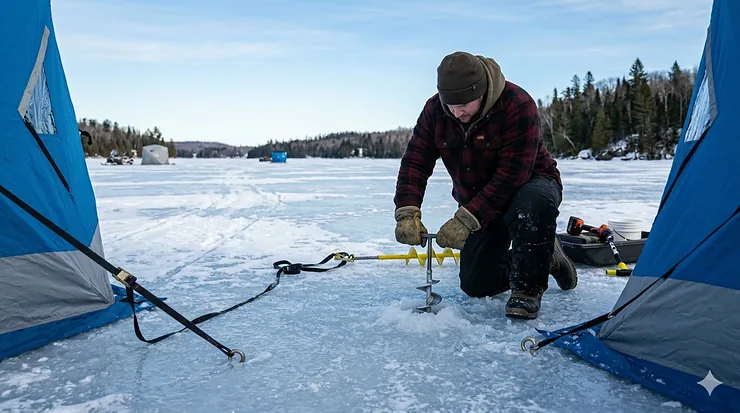
Screw-in ice anchors represent the most popular category in Canada, and for good reason. These feature threaded shafts that spiral into the ice, creating mechanical resistance. The Eskimo 69138 and similar models use this design. Installation involves either hand-turning the T-handle or using a drill adapter for power-assisted installation.
Advantages: Quick setup, easy removal, reusable for years, works in various ice thicknesses.
Ideal Conditions: Day trips, mobile fishing, varying ice conditions, temperatures from -5°C to -35°C.
Self-Tapping Spike Systems
The CLAM 8064 exemplifies this category. Rather than threading into ice, these spike systems use pointed ends that penetrate ice through percussion and rotation. They typically attach to shelter sleds via straps rather than threading through grommets.
Advantages: Fast installation, works well with sled-based shelters, simple design means fewer parts to fail.
Ideal Conditions: Flip-over and sled shelters, anglers who frequently relocate, Prairie conditions where setup speed matters.
Drill-Adapter Systems
Modern innovation meets traditional anchoring with drill-adapter systems like the DenniesCare kit. These combine screw-in anchors with adapters that fit standard cordless drills, typically using 1/4-inch or 3/8-inch chuck connections.
Advantages: Minimal physical effort, extremely fast installation, saves hand strength for fishing, consistent depth and tension.
Ideal Conditions: Extended trips where multiple setups occur, extremely cold weather where manual operation is difficult, anglers with hand strength limitations, guide operations.
Freeze-In Stakes
The old-school method still beloved by many Canadian anglers, freeze-in stakes use water-filled tubes that create solid ice columns. Once frozen, these provide exceptional holding power.
Advantages: Extremely strong hold, inexpensive, works with any shelter design, virtually unbreakable.
Ideal Conditions: Multi-day trips, permanent seasonal locations, derby operations, extremely windy exposed locations.
How to Choose Ice Shelter Anchors for Canadian Conditions
Assess Your Shelter Type and Size
The first consideration is simple geometry. A small flip-over shelter measuring 1.2 x 1.5 metres presents minimal wind resistance and requires just 2-4 anchors. Conversely, a large hub shelter like the Eskimo Fatfish 949i spans nearly 3 x 3 metres and needs 6-8 anchor points for adequate security.
Hub-style and pop-up shelters typically feature in-skirt grommets designed for screw-in anchors. Sled-based flip-over models often work better with spike systems that attach via straps. Review your shelter’s manufacturer recommendations—Eskimo, Clam, and Otter all provide specific anchor guidance in their manuals.
Consider Your Fishing Style
Day-trippers who chase fish across the ice need quick-deploy, easy-removal systems. Screw-in anchors with drill adapters shine here. Weekend warriors establishing a base camp benefit from freeze-in stakes or heavy-duty screw systems. Tournament anglers require professional-grade tools like the Otter Quick-Snap that enable rapid multi-location setups.
Evaluate Regional Wind Conditions
Prairie anglers face different challenges than those fishing sheltered Laurentian Shield lakes. Consult Environment Canada’s historical wind data for your region. If you regularly experience 40+ km/h winds, invest in premium anchors like the Eskimo 69138 or BIGROCK systems. Calmer inland lakes tolerate budget options adequately.
Factor in Ice Conditions
Fresh early-season ice drills easily but may be thinner, requiring careful anchor placement to avoid weakening ice integrity. Late-season “candled” ice that’s begun melting becomes softer, and anchors may not grip as firmly. Some anglers carry different anchor types for varying conditions—screw-ins for hard ice, longer freeze-in stakes for softer conditions.
Temperature Considerations
Extreme cold affects both materials and human dexterity. At -30°C, you want large-handle anchors you can operate with heavy mitts. Stainless steel resists cold-weather brittleness better than standard steel. Drill-adapter systems minimize exposed-hand time, reducing frostbite risk during setup.
Installation Techniques and Best Practices
Proper installation transforms good anchors into great performance. Canadian anglers have developed proven techniques refined over decades of harsh winters.
Pre-Installation Site Selection: Never anchor directly over your fishing holes—this seems obvious but happens surprisingly often. Position anchors at 45-degree angles from each corner of your shelter, roughly 30-60 cm from the skirt edge. This angle creates optimal resistance against wind loads while keeping anchors accessible.
The Three-Step Screw-In Method: First, start the anchor perpendicular to the ice surface. Many failures occur because anchors enter at angles, reducing thread engagement. Second, rotate smoothly without excessive downward pressure—let the threads do the work. Third, stop when resistance increases significantly but before the handle bottoms out against ice; over-tightening can crack ice or strip threads.
Power Tool Technique: When using drill adapters, set your drill to low speed (300-500 RPM) and use minimal downward force. High-speed drilling generates heat that can melt ice around threads, reducing grip. Canadian ice is hard enough that forcing isn’t necessary.
The Critical Pre-Freeze Check: Before leaving your shelter unattended, conduct a pull test. Grab the shelter fabric near each anchor point and apply firm upward pressure. Properly installed anchors should show zero movement. Any shifting indicates insufficient installation—remove and reinstall.
Removal Without Damage: Reverse-threading screw-in anchors prevents ice damage and preserves equipment. For frozen-in stakes, pour warm (not boiling) water down the tube and wait 5-10 minutes. Boiling water can crack surrounding ice, while patience yields clean removal.
Maintenance and Storage Tips for Canadian Climates
Ice shelter anchors endure brutal conditions, but proper care extends their lifespan from seasons to decades.
Post-Use Cleaning: After each trip, wipe anchors dry before storage. Canadian ice often contains road salt from nearby plowing operations, and this accelerates corrosion. A quick rinse with fresh water and towel dry takes 30 seconds but prevents rust.
Garage Storage Challenges: Many Canadian garages experience temperature swings from -20°C to +15°C. This freeze-thaw cycling promotes condensation. Store anchors in breathable bags or hanging from hooks where air circulates. Sealed plastic containers trap moisture.
Inspection Protocol: Before each season, inspect anchor threads for wear, handles for cracks, and metal for deep rust. Surface rust on standard steel is cosmetic, but pitting indicates structural weakness. Stainless steel models like the Eskimo 69138 should show minimal corrosion even after years.
Preventive Maintenance: A light coating of food-safe mineral oil prevents rust without contaminating fish habitat. Apply before seasonal storage. Check drill adapter connections for stripped threads or loose set screws.
Ice Shelter Anchors vs. Alternative Methods
Comparison with Snow Anchors
Some anglers attempt using camping snow anchors for ice shelters. While these work in deep powder snow over ice, they fail on windswept Canadian lakes where snow blows clear. Ice anchors provide direct mechanical connection to the load-bearing ice surface.
Ice Screws vs. Purpose-Built Anchors
Ice climbing screws offer extreme holding power but present several drawbacks. They’re expensive ($30-50 CAD each), challenging to install without experience, and overkill for most fishing shelters. Purpose-built fishing anchors balance cost, ease-of-use, and adequate strength.
Weight-Based Systems
Placing weights inside your shelter seems logical until wind creates lift. A 6-person hub shelter in 60 km/h wind generates significant upward force. Weights prevent sliding but don’t address tipping or loft. Anchors provide the only reliable solution.
Benefits vs. Traditional Alternatives Table
| Feature | Ice Shelter Anchors | Snow Anchors | Weights/Sandbags | No Anchoring |
|---|---|---|---|---|
| Wind Resistance | Excellent | Poor on bare ice | Moderate | None |
| Setup Time | 5-10 minutes | 15-20 minutes | 10-15 minutes | 0 minutes |
| Portability | High | High | Low (heavy) | N/A |
| Cost (CAD) | $25-$80 | $20-$40 | $0-$30 | $0 |
| Safety Level | Very High | Low-Moderate | Moderate | Extremely Low |
| Reusability | Years | Years | Years | N/A |
Common Mistakes to Avoid
Canadian ice anglers, particularly newcomers, often make predictable errors that compromise safety and effectiveness.
Mistake #1: Insufficient Anchor Quantity Using just two anchors on a 4-person shelter is asking for trouble. Calculate minimum anchors as: shelter floor area in square metres ÷ 1.5 = minimum anchors. A 9 square metre shelter needs at least 6 anchors.
Mistake #2: Anchoring Over Fishing Holes This creates weak points in ice structure and risks anchor interference with fishing lines. Maintain 45 cm minimum clearance between anchors and holes.
Mistake #3: Neglecting Tension Adjustment Ice expands and contracts with temperature changes. Anchors installed at -15°C may loosen when temperatures drop to -30°C. Check and re-tighten after significant temperature shifts.
Mistake #4: Over-Reliance on Budget Equipment For serious Canadian conditions—multi-day trips, exposed locations, valuable shelters—budget anchors represent false economy. The $15 CAD saved isn’t worth shelter damage or safety risks.
Mistake #5: Ignoring Ice Thickness Requirements Ontario regulations emphasize safe ice practices. Minimum 10 cm (4 inches) for walking, but anchors need 15+ cm for reliable holding power. Thinner ice may crack around anchor threads.
Frequently Asked Questions
❓ How many ice shelter anchors do I need for my shelter in Canada?
❓ What is the price range for quality ice shelter anchors in Canada?
❓ Can I use a cordless drill with ice shelter anchors in cold Canadian weather?
❓ How do screw in ice anchors compare to freeze in shelter stakes for Canadian conditions?
❓ Are stainless steel ice anchors worth the extra cost in Canada?
Price Range and Value Analysis
Understanding the price-to-performance relationship helps Canadian anglers make informed decisions.
Budget Tier ($20-$35 CAD): Products like Brocraft anchors and generic screw-in models serve occasional users adequately. Expect 2-3 seasons of reliable use with proper care. Best for anglers fishing 5-10 days annually in moderate wind conditions. Limited warranty coverage.
Mid-Range Tier ($35-$55 CAD): CLAM and DenniesCare kits occupy this category. Enhanced durability, better materials, often include accessories like straps or drill adapters. Suitable for regular anglers fishing 15-25 days per season. Typically includes manufacturer warranty. These represent the “sweet spot” for most Canadian recreational anglers.
Premium Tier ($55-$80+ CAD): Eskimo and BIGROCK systems deliver professional-grade performance. Stainless construction, precision engineering, multi-season warranties. Designed for 30+ fishing days annually, guide operations, or extreme condition use. Cost-per-use drops significantly over the product lifespan.
The Canadian Durability Factor: Our conditions accelerate wear. A $25 USD anchor reviewed by Minnesota anglers fishing in -10°C won’t perform identically for Manitoba anglers facing -35°C. Budget an extra 15-20% for Canadian conditions when comparing online reviews.
Conclusion: Securing Your Ice Fishing Investment
Ice shelter anchors might seem like minor accessories compared to your shelter, electronics, or rods, but they’re the foundation of safe, successful Canadian ice fishing. From the wind-swept expanses of Lake Winnipeg to the protected coves of Georgian Bay, proper anchoring transforms ice fishing from a gamble with weather into a controlled, enjoyable experience.
The seven products we’ve examined represent the best options available to Canadian anglers in 2026. Eskimo 69138 Ice Anchors deliver unmatched durability for serious enthusiasts. CLAM 8064 kits provide excellent value for sled-shelter users. DenniesCare systems modernize installation with drill adapters. Budget-conscious anglers find reliability in Brocraft models, while professionals appreciate Otter Quick-Snap tool systems.
Your choice ultimately depends on fishing frequency, shelter type, regional conditions, and budget. Remember that Canadian winter doesn’t forgive shortcuts—invest in quality anchoring appropriate to your needs. The $40-$60 CAD spent on proper ice shelter anchors protects hundreds or thousands of dollars in shelter investment while, more importantly, safeguarding your safety and that of fellow anglers.
Before your next ice fishing adventure, assess your current anchor situation honestly. Are you relying on hope rather than mechanical security? Are your anchors showing rust, bent threads, or other wear? Canadian ice fishing season is precious—don’t waste a single day dealing with preventable shelter problems.
Recommended for You
- 7 Best Portable Ice Shanties Canada 2026
- Insulated vs Non-Insulated Ice Shelter: 7 Best Options Canada 2026
- 7 Best Insulated Ice Fishing Shelters Canada 2026 | Stay Warm
Disclaimer: This article contains affiliate links to Amazon.ca. If you purchase products through these links, we may earn a small commission at no additional cost to you.
✨ Found this helpful? Share it with your fishing buddies! 💬🤗
