
In This Article
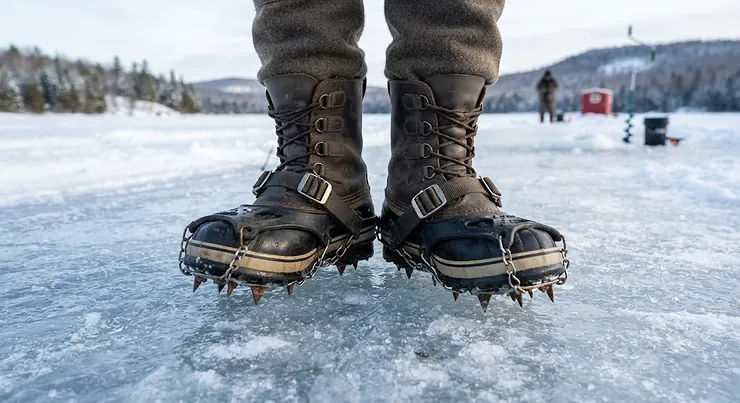
Every ice angler has a version of the same story. You’re hauling a sled loaded with an auger, a heater, and a five-gallon bucket of optimism across a frozen bay, and somewhere between the truck and your favourite hole, your boots find a patch of glare ice with all the grip of a hockey rink freshly zambonied. That split second — arms windmilling, gear flying — is exactly what ice cleats for ice fishing exist to prevent. These simple traction devices strap over your winter boots and use metal spikes, studs, or coils to bite into ice that would otherwise send you sprawling.
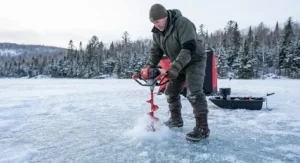
Choosing the right pair isn’t as simple as grabbing whatever’s on the shelf at the hardware store, though. Ice fishing puts unique demands on traction gear: hours of standing, dragging sleds over variable ice, walking on everything from wind-polished glare ice to snow-crusted pressure ridges, and doing it all at temperatures where cheap rubber turns brittle and useless. According to the Canadian Red Cross, slips, falls, and cold-water immersion remain a real risk for winter anglers, which is exactly why traction shouldn’t be an afterthought.
So what is an ice cleat, in plain terms? It’s a traction device — typically stainless steel spikes, carbon steel studs, or coiled wire — mounted on a rubber, TPR, or fabric harness that stretches or straps over your existing winter boots, giving you grip on ice and packed snow without needing specialized footwear.
Below, we’ve dug into seven real, purchasable options spanning budget strap-ons to premium crampon-style systems, with honest analysis of where each one earns its keep on the ice — and where it falls short.
Quick Comparison Table
| Product | Type | Spike Count | Best For |
|---|---|---|---|
| Kahtoola MICROspikes | Crampon-style | 12 stainless steel | Glare ice & mixed terrain |
| Hillsound Trail Crampon | Aggressive crampon | 10-11 carbon steel | Rough shore ice, pressure ridges |
| Yaktrax XTR | Chain-link | Stainless steel chain | Heavy off-trail hauling |
| Korkers Ice Walker BOA | Push-through stud | 22 steel spikes | Quick on/off, dial-fit safety |
| Due North Everyday G3 | Strap-on | Tungsten carbide | Budget-conscious all-purpose use |
| Yaktrax Pro | Coil | 1.4mm steel coils | Light snow, casual walking on ice |
| Cimkiz Crampon-Style | Budget crampon | 19 stainless steel | Tightest budget, cold-weather flex |
Look at that table long enough and a pattern emerges: the more aggressive the spike geometry, the better the bite on hard glare ice, but the trade-off is usually weight, bulk, or price. The Kahtoola MICROspikes and Hillsound Trail Crampon sit at the traction-heavy end for a reason — true crampon-style points penetrate ice rather than just scuffing across it. Meanwhile, coil-based options like the Yaktrax Pro trade some raw bite for comfort and packability, which matters when you’re wearing them for six straight hours in a shanty.
Just one click — help other anglers avoid an icy tumble too!
Top 7 Ice Cleats for Ice Fishing: Expert Analysis
1. Kahtoola MICROspikes — best crampon-style grip for glare ice
The MICROspikes have been refined through nearly two decades of field feedback, and it shows in the details most cheaper cleats skip entirely. Twelve heat-treated stainless steel spikes, each roughly a centimetre long, sit on a dynamic flex-chain connected to a TPR elastomer harness that stays pliable even when the mercury drops well below freezing. That flex-chain design is the real trick here — because the spikes move independently rather than being bolted to a rigid plate, they contour to uneven ice instead of rocking on high points the way flatter designs sometimes do.
Based on the spec comparison, the twelve-spike layout gives noticeably more edge-to-edge coverage than basic coil traction, which matters most when you’re walking across a mix of glare ice and snow-dusted patches in the same fifty metres — a near-daily reality on Canadian lakes. Anglers hauling sleds across open, wind-scoured bays or walking pressure ridges are the ideal audience; casual dock-to-shanty walkers may find this more traction than they strictly need.
Reviewers consistently report that the MICROspikes hold up over multiple seasons of hard use, with the flex-chain and welded links cited repeatedly as more durable than budget alternatives whose chain loops aren’t welded. A recurring theme in user feedback is that the price feels steep at first glance but justifies itself in longevity — several buyers specifically compare them favourably against cheaper units that failed within a season.
Pros:
- ✅ Twelve spikes give excellent edge coverage on glare ice
- ✅ TPR harness stays flexible in extreme cold
- ✅ Backed by a four-year manufacturer warranty
Cons:
- ❌ Pricier than most strap-on alternatives
- ❌ Overkill for anglers who mostly walk groomed paths
In the C$140-C$160 range, these sit at the premium end of the lineup, but reviewers consistently frame the extra cost as a durability investment rather than a splurge.
2. Hillsound Trail Crampon — most aggressive traction for rough shore ice
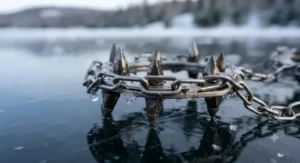
If the MICROspikes are the all-rounder, the Hillsound Trail Crampon is the specialist for genuinely nasty terrain — think shoreline pressure ridges, refrozen slush humps, and the kind of jagged ice edges that form where current keeps a channel from fully sealing. Ten to eleven heat-treated carbon steel spikes measuring roughly 1.5 to 2 centimetres — noticeably longer than microspike-style points — combine with anti-balling plates that shed snow buildup before it turns into a slippery platform underfoot.
What most buyers overlook about this model is that the anti-balling pads aren’t just a nice-to-have; without them, packed snow compresses into an ice ball under the arch, which is precisely how a “traction device” ends up making footing worse instead of better. The ratchet-buckle or hook-and-loop binding system (depending on version) also means a genuinely secure mount to the boot, reducing the twist-and-slip that loose strap-on cleats can develop over a long walk.
This is the pick for anglers who fish exposed, wind-battered water bodies where shorelines heave and crack throughout the season, or for anyone dragging a heavy sled where a secure, non-shifting mount matters more than ultralight packability. Aggregated review sentiment highlights the spikes’ bite on “wet wood, glare ice, and packed snow” as a standout, though a common complaint in user reviews is that carbon steel — unlike stainless — can develop surface rust where the protective coating wears thin.
Pros:
- ✅ Long spikes bite deep into hard, uneven ice
- ✅ Anti-balling plates prevent dangerous snow buildup
- ✅ Secure ratchet or strap binding resists shifting
Cons:
- ❌ Carbon steel spikes can surface-rust over time
- ❌ Bulkier and heavier than microspike-style options
Expect to pay in the C$110-C$140 range — a fair middle ground for the aggressive traction on offer, especially if your ice fishing regularly means clambering over shoreline ridges rather than gliding across flat bays.
3. Yaktrax XTR Extreme Outdoor Traction — toughest chain-link boot spikes
Yaktrax built its reputation on the humble coil cleat, but the XTR line is a different animal entirely — a stainless steel chain-and-spike system mounted on a natural rubber outsole, engineered for the kind of off-trail abuse that would shred a lighter product within weeks. The patent-pending spike layout is specifically designed to resist snow packing between the links, a problem that plagues cheaper chain-style cleats.
Here’s what the spec sheet won’t tell you, but forum discussion among ice anglers consistently does: the XTR is frequently cited as the “last pair you’ll ever buy” among long-time users comparing it directly against Yaktrax’s own lighter Diamond Grip and Chain lines. That kind of brand-internal loyalty is telling — anglers who’ve tried the cheaper Yaktrax options often graduate to the XTR specifically because the rubber outsole and thicker spike mounts hold up to years of dragging sleds and kneeling on ice to drill holes.
This is squarely a pick for anglers who spend full days on the ice across an entire season, rather than occasional weekend trips. The natural rubber sole also means better underfoot cushioning than thinner elastomer harnesses, which matters when you’re standing for hours over an augured hole.
Pros:
- ✅ Stainless steel chain resists long-term corrosion
- ✅ Rubber outsole adds cushioning for all-day standing
- ✅ Spike design fights snow buildup between links
Cons:
- ❌ Heavier underfoot than coil or microspike designs
- ❌ Some noise on hard ice, which cautious anglers report muffling near fish
Priced around C$60-C$80, the XTR lands as a genuine mid-range workhorse — not the cheapest chain option, but the one repeatedly singled out for multi-season durability by anglers who’ve cycled through lighter alternatives first.
4. Korkers Ice Walker BOA Ice Cleats — fastest dial-in safety fit
The standout feature here isn’t the traction hardware, though 22 push-through steel studs made from replaceable components are nothing to sneeze at — it’s the BOA L6 lacing system, built from 49 strands of aircraft-grade stainless steel cable, wrapped around the boot for a genuinely tunable fit that a stretch-on elastomer harness simply can’t match.
Based on the spec comparison, the ability to fine-tune tension on the fly is a bigger deal than it sounds for ice fishing specifically: bulky, insulated winter boots vary wildly in volume from morning (feet not yet swollen from hours of standing) to afternoon, and a BOA dial lets you adjust without removing gloves or fumbling with buckles in sub-zero wind. Replaceable studs also mean the traction hardware isn’t a disposable, throw-away-the-whole-unit proposition once spikes dull — a genuine long-term value angle over glued or moulded stud systems.
Aggregated customer sentiment is strongly positive, with reviewers repeatedly calling out the tension adjustment as “simple” and the engineering as “well thought out” compared to older buckle or strap systems they’d previously tried. This is the pick for anglers who prioritize a locked-in, no-slip mount over raw ice-penetration depth — a safety-first choice rather than an aggression-first one.
Pros:
- ✅ BOA dial allows precise, glove-friendly fit adjustment
- ✅ Steel studs are replaceable rather than disposable
- ✅ Consistently praised for secure, no-shift performance
Cons:
- ❌ BOA cable is one more mechanical part that can wear
- ❌ Studs offer less aggressive bite than true crampon spikes
At roughly C$70-C$90, the Ice Walker BOA sits in solid mid-range territory, and the replaceable-stud design meaningfully improves its long-term value equation against systems where dulled spikes mean buying a whole new pair.
5. Due North Everyday G3 Ice Cleats — best all-purpose strap-on value
Due North’s Everyday G3 line pairs tungsten carbide spikes — a harder, more wear-resistant material than the stainless steel used in several cheaper competitors — with a proprietary rubber tread and an enclosed toe design that helps keep snow and slush from working its way inside the harness. With over four thousand aggregated customer reviews averaging 4.3 out of 5 stars, this is one of the more thoroughly vetted budget-to-mid options on the market.
What most buyers overlook about this model is the tungsten carbide detail specifically: carbide holds an edge considerably longer than standard steel spikes under repeated ice contact, which is exactly the kind of spec that never shows up in a glance at the product photo but matters enormously by February when cheaper spikes have already dulled. The full-foot coverage and textured lining also add a layer of slip resistance underfoot even when the outer spikes eventually do wear down.
This is a strong match for anglers who want dependable, all-purpose traction without committing to a premium crampon-style price tag — a solid “first pair” recommendation for anyone newer to ice fishing who isn’t yet sure how many days a season they’ll actually rack up on frozen water.
Pros:
- ✅ Tungsten carbide spikes resist dulling longer than steel
- ✅ Enclosed toe design blocks snow and slush intrusion
- ✅ Backed by thousands of aggregated positive reviews
Cons:
- ❌ Less aggressive bite than dedicated crampon-style options
- ❌ Medium-duty build not intended for daily commercial use
In the C$30-C$45 range, the Everyday G3 delivers a genuinely strong value-per-dollar ratio, particularly for anglers who want proven reliability without paying crampon-style prices.
6. Yaktrax Pro Traction Cleats — best budget slip-resistant coils
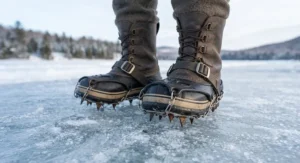
The original Yaktrax Pro remains one of the most recognizable traction products on the market for a reason: a low-profile coil design using 1.4mm abrasion-resistant stainless steel wire, wrapped in a 360-degree pattern that provides grip in essentially every direction of foot movement, mounted to an elastic outer band with an easy on/off heel tab.
Here’s the honest trade-off worth weighing: coils don’t penetrate ice the way spikes do, so on true glare ice, the Pro won’t match a crampon-style pick. What it does exceptionally well is packed snow, light frost, and the kind of mixed conditions where you’re walking as much as standing — and it does it while being genuinely comfortable to wear for hours, since there’s no rigid plate or long spike digging through a boot sole. One long-running informal comparison among ice anglers testing Yaktrax’s own coil-based Diamond Grip against basic chain cleats found the two nearly indistinguishable in practice, suggesting the coil format holds its own even against slightly pricier siblings in the same lineup.
This is the pick for anglers who want dependable, comfortable slip resistant ice cleats for the walk from truck to shanty and back, rather than technical traction for climbing over broken ice.
Pros:
- ✅ 360-degree coil grip works in every direction
- ✅ Low-profile design stays comfortable over long wear
- ✅ Abrasion-resistant coils hold up over repeated seasons
Cons:
- ❌ Less bite than true spikes on hard glare ice
- ❌ Elastic band can degrade faster than harder harness materials
Sitting around C$40-C$55, the Pro remains a smart budget entry point, especially for anglers whose ice fishing mostly involves flat, snow-dusted lake access rather than technical shoreline scrambling.
7. Cimkiz Crampon-Style Ice Cleats — cheapest true crampon spikes
Rounding out the list is a genuinely budget-friendly crampon-style option: nineteen stainless steel spikes per foot mounted on a TPE harness rated to stay flexible down to roughly -45°C, aimed squarely at anglers who want spike-based traction without paying premium-brand prices.
Based on the spec comparison, nineteen spikes is actually more contact points than several pricier competitors on this list, which on paper suggests strong coverage — and aggregated review sentiment backs that up, with users reporting confident grip transitioning between black ice and snow-covered surfaces, plus straps that held tension through vigorous movement. A common complaint in user reviews, however, is that the connecting chains have occasionally come apart during use, which is worth a pre-trip inspection habit rather than a dealbreaker on its own.
This is the pick for budget-conscious anglers or those buying multiple pairs for a family outing who want genuine crampon-style bite without the premium-brand price tag — just build in the habit of checking chain integrity before each trip, since that’s the one recurring durability flag in aggregated feedback.
Pros:
- ✅ Nineteen spikes per foot beat several pricier rivals on count
- ✅ TPE harness stays flexible in extreme cold
- ✅ Genuinely low price for true crampon-style traction
Cons:
- ❌ Some reports of chains separating during hard use
- ❌ Overall build feels less premium than name-brand options
At around C$25-C$35, this is the entry point of the lineup — a sensible pick for outfitting a whole ice-fishing crew without spending premium-brand money per pair.
Practical Usage Guide: Getting the Most From Your Ice Cleats
Buying the right pair is only half the equation — how you use and maintain ice cleats determines whether they last one season or five. Before your first trip, size them correctly: most brands recommend going up one size over your street shoe size when fitting over bulky insulated winter boots, since an undersized harness stretches thin and tears faster, while an oversized one shifts and rotates underfoot.
Put them on before you step onto the ice, not after you’ve already felt your boot slide — that sounds obvious, but it’s the single most common first-30-days mistake reported across ice fishing forums. Once you’re wearing them, avoid walking on bare pavement, concrete, or vehicle floor mats for extended stretches; spikes and coils dull rapidly on hard, abrasive surfaces that aren’t ice or snow, which is why most anglers pull cleats off before driving.
For maintenance, rinse salt or slush residue off metal components after trips near roadways or parking areas, since road salt accelerates corrosion on carbon steel spikes faster than on stainless. Dry the harness fully before storing it in a warm space; leaving a wet elastomer band coiled in a cold trunk over the off-season is a common way rubber prematurely cracks. Inspect chain links and stud mounts each season before first use — a five-minute check catches the kind of loose connection that several reviewers flagged only after it failed mid-trip.
Real-World Scenarios: Which Ice Cleats Fit Your Ice Fishing Style
Picture three different anglers heading out this winter. The first is a weekend hobbyist who fishes maybe six or seven times a season on a familiar, flat lake fifteen minutes from home — for this angler, something like the Yaktrax Pro or Due North Everyday G3 delivers plenty of confidence-building grip without overspending on traction they’ll rarely max out.
The second is a dedicated angler who fishes three or four days a week across an entire season, often hauling a heavy sled solo across exposed bays where wind keeps the surface polished to glare ice — this is exactly the profile that justifies the Kahtoola MICROspikes or Yaktrax XTR, where durability and consistent bite pay for themselves over dozens of trips.
The third is a shoreline scrambler who fishes rivers and current areas where pressure ridges and broken shelf ice are part of daily terrain — here, the Hillsound Trail Crampon‘s longer spikes and anti-balling plates earn their keep in a way that flatter coil designs simply can’t match on that kind of jagged, uneven surface.
✨ Don’t Miss These Exclusive Deals!
🎣 Take your winter fishing setup to the next level — click on any highlighted product above to check current pricing and availability before your next trip out.
How to Choose Ice Cleats for Ice Fishing
Here’s a quick framework for narrowing down the field:
- Match spike type to your typical ice. Flat, groomed lake access favours coils; rough, mixed shoreline terrain favours crampon-style spikes.
- Consider your boot volume. Bulky insulated pac boots need a harness rated for larger sizing or an adjustable BOA-style fit.
- Weigh durability against frequency of use. Occasional users can save money on lighter builds; frequent anglers benefit from stainless steel and reinforced chains.
- Check cold-flex ratings. Rubber and TPE harnesses that stiffen in extreme cold become harder to stretch on and more prone to cracking.
- Factor in replaceable parts. Systems with replaceable studs, like the Korkers BOA line, extend usable life well past the point cheaper units get discarded.
- Read aggregated review themes, not star ratings alone. A 4.3-star average with recurring chain-durability complaints tells you more than the number itself.
- Buy for your worst day, not your average one. The trip where cleats matter most is the coldest, windiest, iciest one of the season.
Ice Cleats vs Traditional Boot Soles: Slip Resistant Traction Compared
| Factor | Standard Winter Boot Sole | Ice Cleats (Strap-On/Crampon) |
|---|---|---|
| Grip on glare ice | Poor to moderate | Strong to excellent |
| Grip on packed snow | Moderate | Good to excellent |
| Cost | Included in boot price | Additional C$25-C$160 |
| Best For | Everyday sidewalk walking | Frozen lakes, shoreline ice, active ice fishing |
Recent research from Toronto’s University Health Network KITE Research Institute tested eleven winter boot models on an icy walkway and found that even the highest-rated boots still carried a measurable slip risk under real ice conditions — a reminder that “slip resistant” boot marketing and true ice traction aren’t the same thing. Standard rubber soles are typically tested against wet tile or oily indoor floors, not the frozen, refrozen, wind-polished surface of an actual lake. Ice cleats close that gap by adding metal contact points that physically penetrate ice rather than merely gripping it by friction, which is precisely why even a great pair of winter boots benefits from a cleat add-on the moment you step onto a frozen body of water.
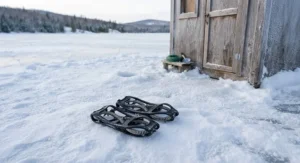
Common Mistakes When Buying Ice Cleats
The most frequent error is buying based on price alone and ending up with a stretch-rubber-only harness that has no metal traction whatsoever — some cheap “grip” products marketed for winter are really just textured rubber overshoes, offering minimal bite on true glare ice. A second common mistake is guessing at sizing rather than measuring boot volume; an oversized harness rotates underfoot exactly when you need stability most, turning a safety product into a tripping hazard. Research from the University of Alberta’s public health program also cautions that cleats should be treated as an added precaution on top of quality boots, not a substitute for them — a mistake worth avoiding is assuming any cleat compensates for worn-out or poorly insulated footwear underneath. Finally, many buyers skip checking cold-flex ratings entirely, only to find their elastomer harness has gone stiff and difficult to stretch on at -25°C, precisely the temperature they bought the cleats for in the first place.
Safety, Regulations and Ice Thickness Compliance in Canada
No traction device replaces sound judgment about the ice itself. The Canadian Red Cross recommends a minimum ice thickness of 15 centimetres for walking or ice fishing alone, checked with an auger or spud bar at multiple points since thickness varies across a single body of water — clear blue ice is generally strongest, while grey or opaque ice signals weakness and should be avoided entirely. Cleats improve your footing once you’re safely out there; they do nothing to change what’s beneath the surface, so ice-thickness checks always come first.
Workplace safety guidance echoes the same layered approach for anyone spending long hours outdoors in winter conditions. WorkSafeNB’s winter safety guidance recommends walking slowly and deliberately on icy surfaces, using slip-resistant footwear as a first layer of protection, and treating ice grippers as additional traction on top of that foundation — advice that applies just as directly to a solo angler on a frozen bay as it does to a worksite crew. Combine sound ice-thickness practices with a properly fitted pair of cleats, and you’ve covered both halves of the safety equation that matter most.
Long-Term Cost & Maintenance: Strap-On Cleats vs Crampon-Style Cleats
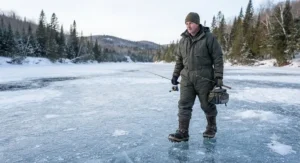
Looking at total cost of ownership rather than sticker price changes the calculus meaningfully. A C$30 strap-on pair of steel-spike cleats replaced every one to two seasons works out to roughly C$15-C$30 per season over a five-year span, depending on wear. A C$150 crampon-style pair like the Kahtoola MICROspikes, backed by a four-year warranty and reviewer reports of multi-season durability, can work out to a comparable or even lower per-season cost if it genuinely lasts that long — the upfront number looks steeper, but the real comparison is cost divided by seasons of reliable service, not the price tag alone. Systems with replaceable studs, like the Korkers Ice Walker BOA, complicate this math further in a good way: replacing worn studs for a fraction of a new unit’s price extends the harness’s usable life well past what a fixed-spike design manages.
Frequently Asked Questions
❓ Do ice cleats work on wet ice?
❓ Can you wear ice cleats over insulated winter boots?
❓ How long do ice fishing cleats last?
❓ Are crampon-style cleats better than coil cleats for ice fishing?
❓ Can ice cleats damage boat docks or vehicle floors?
Conclusion
There’s no single “best” ice cleat for every angler — there’s only the best match for your ice, your boots, and how many days a season you’re actually out there. If your fishing spot tends toward flat, snow-dusted lake access, a coil-based pick like the Yaktrax Pro or a value strap-on like the Due North Everyday G3 will serve you well without overspending. If glare ice, exposed bays, or rough shoreline terrain are part of your regular routine, the crampon-style bite of the Kahtoola MICROspikes or Hillsound Trail Crampon earns its higher price tag through consistent, season-after-season traction. And if a locked-in, adjustable fit matters more to you than raw spike aggression, the Korkers Ice Walker BOA splits that difference neatly.
Whichever pair you land on, remember that traction gear and ice-thickness judgment work as a team, not a substitute for one another. Check the ice, strap on the right cleats for the terrain ahead, and spend your energy watching bobbers instead of your footing.
Recommended for You
- Ice Fishing Rescue Rope: 7 Best Lifesaving Picks For 2026
- 7 Best Ice Fishing Flotation Devices In Canada 2026
- Ice Chisel For Safety: 7 Top Picks Ranked For 2026
Disclaimer: This article contains affiliate links. As an Amazon Associate, I earn from qualifying purchases. If you purchase products through these links, we may earn a small commission at no additional cost to you.
✨ Found this helpful? Share it with your friends! 💬🤗
