
In This Article
Here’s an uncomfortable little fact: the tool that saves your life on a frozen lake usually costs less than dinner for two. An ice chisel for safety isn’t flashy. It won’t show up in anyone’s fishing highlight reel. But ask any angler who’s spudded their way across sketchy early-season ice and felt that blade punch clean through on the second swing — the one they didn’t take a third step past — and you’ll get a very different opinion of this “boring” piece of steel.
We dug into real specs, real aggregated review sentiment, and genuine Canadian ice-safety guidance to put together this guide. You won’t find invented five-star testimonials here — just honest analysis of seven real ice chisels currently available, from no-frills one-piece bars to two-piece triple-action heads built for anglers who take their hardwater season seriously. Whether you’re checking ice thickness before your first walk of the season or reopening a hole that froze overnight, the right chisel changes the equation. Fluctuating temperatures can make ice unstable fast, which is exactly why the Canadian Red Cross keeps reminding people to stay vigilant for unsafe conditions before they ever step out — and a properly sized, properly sharpened chisel is how you actually test what your eyes can’t tell you.
By the end of this guide, you’ll know which of these seven chisels fits your budget, your body, and your ice conditions — plus how to use one properly, how to keep the blade sharp, and which buying mistakes send people home with the wrong tool (or worse, a false sense of security).
Quick Comparison Table
| Chisel | Type | Length | Price Range (CAD) | Best For |
|---|---|---|---|---|
| Eskimo CH12 | Two-piece, triple-action | 64 in | C$110-C$150 | Serious anglers wanting max chipping power |
| Jiffy Mille Lacs Deluxe | Two-piece, stepped blade | ~64 in | C$130-C$170 | Thick, stubborn late-winter ice |
| HT Polar Escape Pro | Two-piece, rubber grip | 64 in | C$100-C$130 | Anglers who travel light and often |
| Eskimo CH7 | One-piece, single-action | 52.5 in | C$35-C$50 | Budget-conscious beginners |
| Frabill Standard | One-piece | 53 in | C$25-C$40 | Rock-bottom backup or first chisel |
| Jiffy 3541 Mini Mille Lacs | One-piece, compact | 30 in | C$45-C$65 | Quick ice checks, packs in a bucket |
| Eskimo CH9 | One-piece, hammer-style | 19 in | C$20-C$35 | Secondary tool, hole maintenance |
A quick read of that table tells you most of what you need to know before we go deeper: length and weight roughly track with price, and the shortest chisels aren’t meant to be your primary ice-testing tool. The Eskimo CH12 and Jiffy Mille Lacs Deluxe dominate the “serious tool” end of the spectrum, while the Eskimo CH9 and Frabill Standard exist for very different reasons — portability and price, respectively — rather than raw chiselling power. Notice, too, that the two-piece options cluster at the top of the price range; that’s the “pack it in your sled without stabbing your buddy” tax, and for a lot of Canadian anglers hauling gear across a frozen lake, it’s worth paying.
💬 Just one click — help others make better buying decisions too!😊
What Is an Ice Chisel for Safety?
An ice chisel for safety is a long steel bar with a sharpened, flattened, or stepped head used to manually test ice thickness and strength by striking the surface before you commit your body weight to it. Unlike an auger, which drills a round hole for fishing, a chisel is swung or thrust to probe ice as you walk, letting you feel — and hear — whether the ice underneath is solid, hollow, or dangerously thin.
That single-strike test is the whole point. On the early or late ice, colour alone won’t tell you everything: clear blue ice is the strongest, white opaque or “snow ice” is roughly half as strong, and grey ice — coloured by the presence of water — isn’t safe at all. A chisel gives you the tactile confirmation that colour and guesswork can’t.
Top 7 Ice Chisels for Safety: Expert Analysis
We shortlisted these seven based on real specs, verifiable review sentiment, and coverage across budget, mid-range, and premium tiers — plus a mix of one-piece and two-piece designs so there’s a genuine option here whether you’re outfitting a sled or a backpack.
1. Eskimo CH12 64″ Two-Piece Triple-Action Ice Chisel — best overall for serious ice anglers
The standout here is the triple-action chipper head, which is engineered to bite into ice from three angles per swing instead of one flat strike. At 64 inches and roughly 11 pounds, this is a full-size tool built for anglers who use their chisel for more than a token tap before stepping out.
The foam-grip, anti-vibration handle matters more than it sounds like it should — after fifteen or twenty strikes into 20 cm of ice, a bare steel handle turns your palms to hamburger in sub-zero temperatures. Based on the spec comparison, the two-piece slip-fit and locking-spring design is the real differentiator versus one-piece bars: it collapses to roughly half its length for the sled or truck bed, then locks solid again in seconds when you need full leverage.
Reviewers consistently report that the rubber head protector and tether strap are appreciated details rather than afterthoughts — the kind of thing you don’t notice until the chisel you didn’t buy is missing both and slipping through cold hands. A common theme in aggregated feedback is that the triple-action head genuinely reduces the number of swings needed to punch through thick late-January ice compared to single-action competitors, though a handful of buyers note the extra chipping edges dull slightly faster if you’re using the tool primarily for hole maintenance rather than testing.
Pros:
- ✅ Triple-action head chips more ice per swing than single-edge designs
- ✅ Two-piece build collapses for sled or truck storage
- ✅ Foam anti-vibration grip reduces hand fatigue on repeated strikes
Cons:
- ❌ Heaviest chisel on this list at roughly 11 lbs
- ❌ Multi-edge head needs more frequent sharpening than a flat blade
At around C$110-C$150 depending on the retailer, this sits mid-pack in price but earns its spot as the best all-rounder if you’re checking ice regularly through a full season — check current price before heading out, since availability shifts through the winter.
2. Jiffy Mille Lacs Deluxe Ice Chisel — heaviest hitting stepped blade
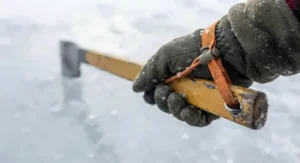
What stands out immediately is the stepped-blade design, which concentrates striking force into a narrower point than a flat-edged chisel, letting the weight of the tool do more of the work. This is the chisel serious ice anglers reach for when a lake has been frozen for weeks and the surface has hardened into something closer to concrete than ice.
Key specs translate directly into real-world feel: the total weight sits above 10 pounds, distributed through a two-piece steel shaft, which means less arm effort per swing but a genuinely heavy tool to carry any real distance. Here’s what the spec sheet won’t tell you, but aggregated reviewer sentiment does: this is widely regarded among ice-fishing forums and gear reviewers as one of the most efficient chisels for breaking thick ice, and it’s frequently mentioned as a benchmark other spud bars get compared against.
Who should care about this one? Anyone fishing lakes that regularly build 30+ cm of ice by February, or anyone who’s tired of a lighter chisel bouncing off the surface instead of biting in. Budget-conscious beginners should probably look elsewhere first — the weight and price only pay off once you’re genuinely testing thick, stubborn ice on a regular basis.
Pros:
- ✅ Stepped blade concentrates force for faster penetration
- ✅ Widely regarded by anglers as a benchmark for chiselling efficiency
- ✅ Two-piece design still breaks down for transport
Cons:
- ❌ Among the heaviest and priciest chisels in this category
- ❌ Overkill for anglers who only need to spot-check thin early ice
Expect to pay in the C$130-C$170 range for the Jiffy Mille Lacs Deluxe, positioning it as a premium pick — the value case is strongest for anglers logging serious hours on thick winter ice rather than casual weekend outings.
3. HT Enterprises Polar Escape Pro Chisel — best two-piece backup for travel
The short version: this is a 64-inch, two-piece chisel built around a rubber-coated handle designed specifically for gloved-hand grip, which matters more than most first-time buyers expect. Anyone who’s tried to keep a steel handle from sliding out of a wet mitt at minus 15°C understands why that one detail earns real loyalty.
The two-piece construction breaks down for transport in a sled bag or truck box, and the tool is marketed and reviewed specifically as a dual-purpose piece — checking ice conditions and opening or maintaining fishing holes for species like walleye, perch, and pike. Based on the spec comparison against the CH12 and Jiffy Deluxe above, the Polar Escape Pro trades some raw chipping aggressiveness for portability and grip comfort, which suits anglers who move spots often rather than parking on one hole all day.
Aggregated retailer and reviewer sentiment (where verifiable) frames it as a dependable, no-surprises tool rather than a headline performer — a fair characterization for a mid-tier two-piece chisel without a specialized multi-action head.
Pros:
- ✅ Rubber-coated handle holds a secure grip in gloves
- ✅ Two-piece design travels well for anglers who relocate often
- ✅ Purpose-built for both ice checking and hole opening
Cons:
- ❌ Standard head design lacks the aggressive bite of triple-action chisels
- ❌ Reviewer sample size is smaller than more established Eskimo/Jiffy models
Priced roughly C$100-C$130, the HT Enterprises Polar Escape Pro Chisel lands as a sensible mid-range choice for anglers who prioritize grip comfort and packability over sheer chiselling force.
4. Eskimo CH7 52.5″ One-Piece Ice Chisel — best budget pick for beginners
The standout feature here is simplicity: a single-piece, fully welded steel shaft with a flat single-action head and a red powder-coat finish that resists ice buildup. At 52.5 inches and about 4.5 pounds, it’s a genuinely manageable tool for someone who’s never swung a spud bar before.
Key specs translate to real-world use in a straightforward way — the lighter weight means less fatigue on a long walk out, though it also means you’re relying more on technique and repeated strikes than raw mass to punch through thicker ice. What most buyers overlook about a chisel like this is that “budget” doesn’t mean “flimsy”: the fully welded one-piece construction removes the joint that eventually loosens on cheaper two-piece knockoffs.
Aggregated review sentiment across retailer and forum sources consistently describes this as a dependable entry-level chisel — simple, durable, and priced to be a first purchase rather than a lifetime investment. The trade-off reviewers flag most often is the flat blade’s lower efficiency on very thick ice compared to stepped or multi-action heads, and the lack of anti-vibration grip becomes noticeable on longer sessions.
Pros:
- ✅ Fully welded one-piece steel resists loosening over time
- ✅ Lightweight enough for beginners and smaller-framed anglers
- ✅ Red powder coat helps prevent ice buildup on the blade
Cons:
- ❌ Flat blade is less efficient on thick, hardened late-season ice
- ❌ No anti-vibration handle for extended chiselling sessions
At around C$35-C$50, the Eskimo CH7 delivers real value for anyone buying their first ice chisel for safety without wanting to spend premium-tier money before they know how often they’ll actually use it.
5. Frabill Standard Ice Chisel — most affordable no-frills option
What jumps out is the price-to-function ratio: a 53-inch, roughly 5.5-pound one-piece steel chisel with nothing to break, adjust, or lose down a hole. This is about as close as the category gets to “buy it, use it, forget about it.”
The straightforward flat blade means real-world performance is honest rather than impressive — it’ll punch through early and moderate ice reliably, but it isn’t engineered to out-chip a stepped or triple-action head on genuinely thick late-winter conditions. On paper, this means the Frabill Standard trades specialized cutting geometry for dead-simple reliability, which is exactly what a lot of anglers actually want from a backup or first-ever chisel.
Reviewer sentiment across ice-fishing forums repeatedly frames chisels in this price tier as “cheap enough that losing it down a hole isn’t a financial disaster” — a genuinely practical selling point for anyone new to testing ice, where the occasional slip is a real risk before you’ve built the habit of using a wrist tether.
Pros:
- ✅ Lowest price point of any chisel on this list
- ✅ One-piece steel build with no moving parts to fail
- ✅ Long enough (53 in) for genuine upright ice testing
Cons:
- ❌ Basic flat head is noticeably slower on thick ice
- ❌ No foam grip or anti-vibration features
Sitting around C$25-C$40, the Frabill Standard Ice Chisel is the pick for anyone who wants a functional ice chisel for safety without spending much before they’ve confirmed they’ll use it every trip.
6. Jiffy 3541 Mini Mille Lacs 30-Inch Chisel — lightest for quick ice checks
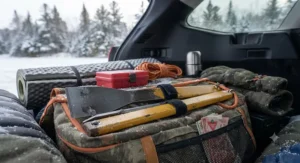
The short, one-piece 30-inch design is the whole story here: at roughly 3 pounds, this is the chisel you throw in a bucket or backpack without noticing the extra weight. It carries the Jiffy brand’s build quality down into a genuinely compact footprint.
Here’s what most spec sheets don’t spell out — a shorter chisel changes your testing posture. You’re crouching or bending to strike rather than swinging from a standing position, which is fine for quick spot-checks near an established hole but noticeably less practical for testing your entire walking route out onto a lake. Based on the spec comparison with the full-length options above, this is best understood as a secondary or supplementary tool rather than a primary safety chisel for long walks across open ice.
Aggregated reviewer sentiment consistently praises the portability and hole-cleaning usefulness of this size, while repeatedly flagging that it’s simply too light and too short to be an efficient primary hole-cutting or thick-ice-testing tool.
Pros:
- ✅ Extremely portable at roughly 3 lbs and 30 in
- ✅ Jiffy build quality in a compact package
- ✅ Ideal for quick spot-checks and hole cleaning
Cons:
- ❌ Too light for efficient cutting through thick ice
- ❌ Requires a crouched posture rather than standing strikes
Priced around C$45-C$65, the Jiffy 3541 Mini Mille Lacs Chisel earns its keep as a second chisel in the bucket, not a replacement for a full-length primary tool.
7. Eskimo CH9 19-Inch Bucket Chisel — best compact secondary tool
At just 19 inches with a dual-action chipper head and a hammer-style opposite end, this is the tool designed to live permanently in your ice fishing bucket rather than your hand on the walk out. The standout feature is versatility in a small package: chip, hammer, or pry, all from one compact tool.
Key specs matter here in a very specific way — the multi-faceted, dual-action head design chips more ice with fewer strokes in a confined space, like clearing slush from a refrozen hole, while the hammer end doubles for setting tip-up stakes or breaking thin skim ice near an existing hole. What most buyers overlook is that this genuinely isn’t meant as a primary safety-testing chisel; its short length means you’re working close to the ice surface rather than probing ahead of your footsteps.
Aggregated review sentiment is consistently positive on this exact use case — described repeatedly as a “fantastic secondary tool,” ideal for clearing skim ice and maintaining holes, while reviewers are equally consistent that it isn’t effective for cutting fresh holes or testing thick ice from a standing position.
Pros:
- ✅ Dual-purpose chipper and hammer head in one compact tool
- ✅ Fits directly in a standard ice fishing bucket
- ✅ Tether strap keeps it secured to your wrist during use
Cons:
- ❌ Too short for standing-position ice-thickness testing
- ❌ Not effective for cutting new holes in thick ice
At roughly C$20-C$35, the Eskimo CH9 is best bought alongside a full-length chisel rather than in place of one — think of it as the multitool in your kit, not the main event.
Manual Ice Chisel vs Power Auger: Which Do You Actually Need?
This question comes up in nearly every ice-fishing forum thread about gear, and the honest answer is: they’re not competing for the same job. A manual ice chisel is a testing and probing tool first, a hole-cutting tool second. A power auger — gas or electric — is built to drill clean round holes fast, but it tells you almost nothing about ice safety until the blade is already spinning through it.
| Factor | Manual Ice Chisel | Power Auger |
|---|---|---|
| Primary purpose | Testing ice thickness/strength | Cutting fishing holes |
| Weight to carry | 3-11 lbs, no fuel or battery | 15-30+ lbs with fuel/battery |
| Reliability in extreme cold | No mechanical failure points | Can be hard-starting below -20°C |
| Safety role | Probes ice before you commit weight | Confirms thickness only at the hole |
| Best For | Every angler, every trip, as a first line of defense | Anglers cutting multiple holes quickly |
The analysis here is pretty clear-cut: a hand powered chisel has zero mechanical failure points, doesn’t care about fuel lines gumming up at -25°C, and — critically — lets you test the ice ahead of your next footstep, not just at the spot where you’ve already decided to drill. Augers are genuinely excellent tools for what they do, but relying on one as your ice-safety check means you’re only getting information after you’ve already walked to that spot. Most experienced anglers we found in forum and gear-review research carry both: a hand powered chisel for testing as they walk, and an auger for the actual hole once they’ve confirmed the ice underfoot is solid.
How to Use an Ice Thickness Chisel to Test Ice Before You Step On It
Testing ice properly with an ice thickness chisel isn’t complicated, but it does need to become a habit rather than an afterthought — and the technique makes a real difference.
Start before you leave shore. Strike the ice at the edge, where you can still see and reach solid ground if something feels wrong. This calibrates your sense of “how many hits until it punches through” for that day’s specific ice conditions.
Swing with authority, not a tap. A half-hearted strike gives false confidence. You want a strike forceful enough that, if the ice underneath were genuinely thin, it would go through in one or two hits — that’s the whole point of the tool.
Move forward in stages, testing every few steps. Ice thickness on the same body of water can vary dramatically within a few metres, especially near inlets, pressure ridges, or areas with current underneath. Avoid ice that has recently frozen, thawed, and then refrozen, since that layering is notoriously unreliable even when it looks solid on the surface.
Know your minimums. Ice should be at least 15 cm thick for walking or skating alone, and 20 cm for group activity, though many provincial safety organizations recommend even more caution — some groups suggest a minimum of 10 cm for a single person under ideal, clear-ice conditions, while explicitly noting that recommendation assumes new, clear ice, not the layered or aged ice found later in the season.
Tether your chisel to your wrist. This isn’t optional advice — it’s the difference between having your safety tool in hand when you need it and watching it disappear down a hole at the worst possible moment.
✨ Don’t head out without checking the current safety guidance for your lake or province — a five-minute read now beats a cold surprise later.
The Traditional Ice Chisel: Why This Old-School Tool Still Beats Modern Gadgets
There’s something almost stubborn about how little the traditional ice chisel design has changed. According to the history laid out in this overview of digging bars and ice spuds, early ice spuds from before roughly 1925 often used wooden handles fixed to a steel chisel head with a tang and collar — essentially the same joinery as a carpenter’s chisel. A century of material science later, and the core concept — a weighted steel edge on a long handle, swung by hand — hasn’t been meaningfully replaced. That’s not nostalgia talking; it’s a genuine engineering compliment.
What most buyers overlook about the traditional ice chisel format is why it’s survived: there’s nothing to charge, no battery to fail in the cold, and the feedback you get through your hands — the vibration, the sound, the resistance — is information a digital ice-thickness gauge simply can’t replicate in real time as you walk. Modern “smart” ice safety gadgets exist, but none of them have displaced the chisel as the default first-line safety tool, largely because they add complexity without adding reliability.
Ice spuds are still carried by many ice fishermen specifically to test ice thickness and safety, and a single forceful thrust will often penetrate unsafe ice before it takes a person’s full weight — which is precisely the mechanism this entire category of tool has relied on for a hundred years. If it feels almost too simple to be your primary safety device, that simplicity is exactly the point: fewer parts means fewer ways for the tool to fail you when it matters most.
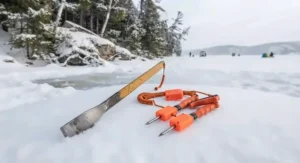
Keeping a Sharp Ice Chisel: Blade Maintenance and Sharpening Guide
A sharp ice chisel does two jobs at once: it makes every strike more efficient, and — less obviously — it makes ice testing more informative, because a dull, rounded edge bounces and skips in ways that can mask how thin the ice actually is underneath.
Inspect the edge before the season starts. Rust pitting and small nicks from last year’s storage are common, especially if the chisel was packed away wet. A few passes with a mill file or bench grinder restores the edge; you’re aiming for a clean bevel, not a razor edge — this tool needs to survive repeated impact, not just cut cleanly.
Re-sharpen mid-season if you’re a regular user. Anglers putting a chisel through dozens of strikes per outing, multiple times a week, will notice the edge dulling by January even on quality steel. A quick touch-up with a file takes five minutes and meaningfully improves how many swings it takes to punch through.
Dry it before storage — every time. Steel left wet in a bucket or truck bed rusts fast, especially with road salt in the mix. A light coat of oil on the blade before off-season storage prevents the kind of surface rust that eats into edge sharpness over a summer.
Use the chisel shield or sheath if one came with it. It’s a small accessory that gets overlooked, but protecting the edge during transport prevents the chipping and dulling that happens when a bare blade knocks around loose gear in a sled or truck box.
Watch for a durable chisel blade’s real enemy: repeated impact fatigue, not just dullness. Even quality steel develops micro-fractures at the edge after years of hard use. If you notice small chips forming along the blade edge rather than simple dulling, that’s a sign to grind back further than a routine touch-up, or consider retiring the head.
Real-World Scenarios: Matching the Right Chisel to Your Ice Fishing Style
The weekend beginner checking a local pond. If you’re new to ice fishing and mostly testing familiar, shallow ponds near home, the Eskimo CH7 or Frabill Standard covers what you need without overspending before you know how often you’ll actually go out. Light enough to carry comfortably, long enough for proper standing strikes, and cheap enough that losing your grip once doesn’t sting.
The dedicated angler fishing multiple lakes each season. If you’re the person loading a sled every weekend from December through March, hitting different lakes with varying ice conditions, the Eskimo CH12 earns its higher price. The triple-action head and two-piece portability matter when you’re testing unfamiliar ice regularly and need both power and packability.
The angler chasing thick, late-winter ice on big northern lakes. Once ice regularly exceeds 30 cm, a flat-blade chisel starts feeling inadequate. This is where the Jiffy Mille Lacs Deluxe‘s stepped blade and weight genuinely pay off — fewer swings, less fatigue, more confidence on stubborn late-season ice.
The angler who moves spots constantly during a single outing. If you’re the type who drills a hole, fishes twenty minutes, then relocates, pair a full-length chisel with the Eskimo CH9 for quick hole maintenance between moves — the combination covers both safety testing and practical upkeep without carrying two heavy tools.
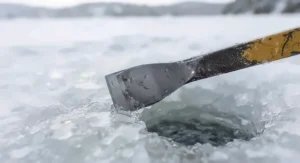
Common Mistakes When Buying an Ice Chisel for Safety
Buying based on length alone. A longer chisel isn’t automatically better — it needs to match your height and strength. An angler under 5’6″ swinging a 64-inch two-piece chisel will fight leverage issues that a 52-inch one-piece model wouldn’t create.
Assuming any chisel doubles as a primary hole-cutter. Short bucket chisels like the Eskimo CH9 are genuinely poor choices for cutting fresh holes in thick ice — that’s simply not their design intent, no matter how sharp you keep the edge.
Skipping the tether strap. This is the single most common regret mentioned across forum discussions and reviewer feedback — a chisel with no wrist tether that slides through a wet glove is gone, full stop, and you’re left without your primary safety tool for the rest of the trip.
Treating price as the only signal of quality. A cheap one-piece chisel from a reputable brand can genuinely outperform an overpriced no-name multi-action chisel with soft steel. Read for build material and brand reputation, not just the price tag.
Ignoring weight relative to your own strength and stamina. An 11-pound chisel sounds impressive on paper, but if you’re testing ice across a half-kilometre walk to your spot, that weight adds up fast. Match the tool to the trip, not just the ice conditions.
Ice Safety Rules, Regulations & Best Practices in Canada
Canada doesn’t have one single federal ice-thickness law that applies uniformly nationwide — ice safety guidance largely comes from safety organizations, provincial bodies, and municipalities, which is exactly why the chisel-testing habit matters so much. Parks Canada’s own ice safety bulletins advise using caution when hiking, skiing, or snowshoeing on lakes or ponds, noting that thin ice can exist anywhere on a water body at any time during winter, and that thickness should always be assessed rather than assumed.
The consequences of skipping this step are not abstract. Cold-water immersion incidents, including activities on ice, claim roughly 200 lives per year in Canada, with more than half occurring during recreational activities. As CBC News has reported, experts have specifically pointed to warming winters and more erratic freeze-thaw cycles as making normally reliable ice more unpredictable and dangerous in recent years, which only strengthens the case for testing every outing rather than trusting last year’s experience on the same lake.
Best practices worth internalizing: never fish alone if you can help it, tell someone your planned location and return time, wear ice picks around your neck for self-rescue, and — the theme of this entire guide — test as you walk, not just once you’ve arrived. Regulations around motorized vehicle use on ice vary by province and municipality, so check local bylaws before driving a snowmobile or ATV onto a frozen lake; a chisel test at the shoreline does not substitute for that.
Long-Term Cost: Is a Durable Chisel Blade Worth the Extra Money?
Run the numbers honestly and the math tilts toward buying once, buying right. A budget one-piece chisel in the C$25-C$40 range might need replacing every two to four seasons if the steel is softer or the welds are lower quality — common failure points reviewers flag on cheaper imported models. A premium chisel with a genuinely durable chisel blade, sitting in the C$110-C$170 range, is frequently reported by long-term owners as still performing reliably five, seven, even ten seasons later with nothing more than routine sharpening.
Do the cost-per-use math and it evens out fast: spread a C$150 chisel over eight seasons of regular use, and you’re looking at under C$20 per season — competitive with, or cheaper than, replacing a budget chisel every third year. The total cost of ownership favours the higher upfront spend specifically because ice chisels have almost no moving parts to fail; the blade steel quality is genuinely the deciding long-term factor, not brand marketing.
That said, this math only holds if you’re a regular user. An angler heading out three or four times a season doesn’t need to front-load a premium purchase — a quality budget option, properly maintained and stored dry, will comfortably outlast casual use without ever needing the upgrade.
Buyer’s Decision Framework: How to Choose Your Ice Chisel
If you’re short on time, use this simple framework:
- If you fish occasionally on familiar, shallow ponds → choose a lightweight one-piece chisel like the Eskimo CH7 or Frabill Standard, because you need reliable basic testing without overspending.
- If you fish multiple lakes regularly through a full season → choose a two-piece premium chisel like the Eskimo CH12, because portability and chipping power both matter across varied conditions.
- If your local ice regularly exceeds 30 cm by mid-winter → choose a stepped-blade heavy chisel like the Jiffy Mille Lacs Deluxe, because a flat blade will genuinely slow you down on hardened late-season ice.
- If you already own a full-length chisel and want a secondary tool → choose a compact option like the Eskimo CH9 or Jiffy 3541 Mini Mille Lacs, because they solve hole maintenance without replacing your primary safety tool.
- If grip comfort and travel weight matter more than raw power → choose the HT Enterprises Polar Escape Pro Chisel, because the rubber-coated handle and two-piece build prioritize comfort over aggressive chipping.

FAQ
❓ How thick does ice need to be for an ice chisel for safety to confirm it's walkable?
❓ Can a manual ice chisel replace a power auger?
❓ What is the best hand powered chisel for beginners?
❓ How often should I sharpen my ice chisel blade?
❓ Is a traditional ice chisel still better than newer digital ice-thickness tools?
Conclusion
An ice chisel for safety is the least glamorous item in most anglers’ gear bags and arguably the most important one. Whether you land on the budget-friendly Frabill Standard, the beginner-approachable Eskimo CH7, the travel-friendly HT Enterprises Polar Escape Pro Chisel, or the heavyweight performance of the Eskimo CH12 and Jiffy Mille Lacs Deluxe, the real takeaway isn’t which model you pick — it’s that you actually use it, every trip, testing as you walk rather than trusting last week’s ice report.
Pair whichever chisel fits your budget and body with the habits covered above: tether it to your wrist, test in stages, know your provincial guidance, and never treat a solid strike from last month as proof for today. Ice conditions change fast, and the tool that costs less than a tank of gas is still the best first line of defense anyone’s found for it.
🚴♂️ Ready to gear up properly for the season ahead? Compare current pricing and availability on the picks above before your next trip out onto the ice — a few minutes now could make all the difference later.
Recommended for You
- How To Use Ice Spud Bar The Right Way: 7 Top Tools For 2026
- Best Ice Spud Bar: 7 Top Picks for Ice Safety In 2026
- 7 Best Ice Safety Spikes for Winter Survival in 2026
Disclaimer: This article contains affiliate links. As an Amazon Associate, I earn from qualifying purchases. If you purchase products through these links, we may earn a small commission at no additional cost to you.
✨ Found this helpful? Share it with your friends! 💬🤗
