
In This Article
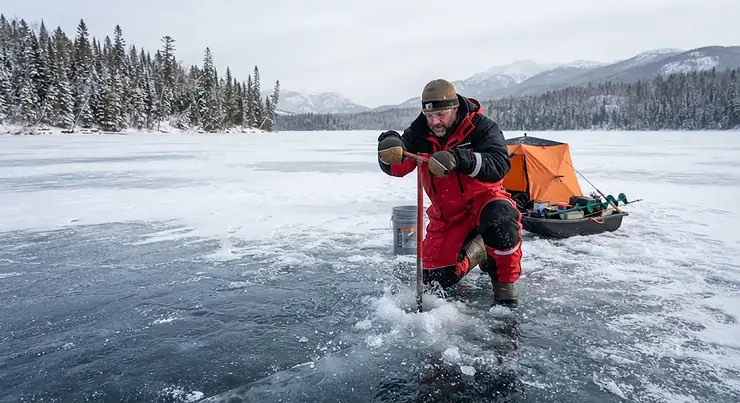
Here’s an uncomfortable truth: the ice under your boots doesn’t care how confident you feel. An ice spud bar — sometimes called an ice chisel — is a long steel bar with a flattened, chisel-shaped tip you use to strike the ice ahead of you, testing its thickness and integrity before you commit your full weight to it. It’s the oldest, lowest-tech safety tool an ice angler owns, and it’s still the one veteran anglers refuse to leave in the truck.

Every winter, Canadian news outlets run the same grim story: someone assumed the ice looked thick enough, and it wasn’t. According to the Lifesaving Society, roughly one in twelve drowning victims in Canada falls through ice, and the organization’s minimum-thickness guidelines only apply to clear, new ice under ideal conditions — which, let’s be honest, describes maybe half the lakes you’ll actually fish this year. That’s exactly why finding the best ice spud bar for your situation isn’t a “nice to have.” It’s cheap insurance, usually under C$150, against a decision you can’t take back.
This guide walks through seven real, currently available spud bars and chisels — budget, mid-range, and heavy-duty — with honest analysis of who each one suits, what the specs actually mean once you’re standing on grey, questionable ice, and where the aggregated review sentiment lines up (or doesn’t) with the marketing copy. No invented testimonials, no exact prices that’ll be stale by next week — just a straight comparison to help you pick the best ice spud bar for how you actually fish.
Quick Comparison Table
| Product | Length | Weight | Design | Price Range (CAD) | Best For |
|---|---|---|---|---|---|
| Eskimo Redneck Economy Ice Chisel | 133 cm (52.5 in) | 2.0 kg (4.5 lb) | One-piece, single-action | C$45–C$60 | Best all-around value |
| Jiffy Mille Lacs Ice Chisel | 132 cm (52 in) | 1.96 kg (4 lb 5 oz) | One-piece, stepped edge | C$60–C$75 | Best for testing ice, not just chopping it |
| Frabill Standard Ice Chisel | 135 cm (53 in) | 2.5 kg (5.5 lb) | One-piece, welded steel | Under C$35 | Best budget pick |
| Tie Down RoofZone Heavy-Duty Spud Bar | 138 cm (54.5 in) | ~2.7 kg (6 lb) | Bolt-on replaceable blade | C$70–C$85 | Best heavy duty spud bar for dual-purpose use |
| HT Enterprises Polar Escape Pro Chisel | 163 cm (64 in) | ~2.3 kg (5 lb) | Two-piece, rubber grip | C$115–C$130 | Best for transport and storage |
| Clam One-Piece Ice Chisel | 137 cm (54 in) | 2.3 kg (5 lb) | One-piece, stepped teeth | C$60–C$70 | Sharpest bite for fast chipping |
| Jiffy Mini Mille Lacs Ice Chisel | 76 cm (30 in) | ~1.4 kg (3 lb) | One-piece, compact | C$40–C$55 | Lightest option for long walks |
Looking at the table, weight and length matter more than most first-time buyers expect — a bar under 120 cm puts you uncomfortably close to the very ice you’re testing, while anything over 3 kg turns a quick safety check into an arm workout after your third hole. The Jiffy Mille Lacs Ice Chisel and Eskimo Redneck Economy Ice Chisel land in the sweet spot most Canadian anglers settle on, but if you’re already carrying an auger, shanty, and sled across the lake, the compact Jiffy Mini Mille Lacs Ice Chisel might matter more than raw chipping power.
💬 Just one click — help others make better buying decisions too!😊
Top 7 Ice Spud Bars: Expert Analysis
Ice fishing has been a Canadian winter tradition for generations — Wikipedia notes that for First Nations communities in particular, it’s remained a practical way to access traditional food sources, not just a recreational pastime. That long history is part of why the ice chisel spud bar has barely changed in decades: it works, and there’s not much to improve on a sharpened piece of steel on a stick. What’s changed is the range of options now sitting on Amazon.ca, from bare-bones welded bars to two-piece travel designs. Here’s how the seven real, verifiable products stack up.
1. Eskimo Redneck Economy Ice Chisel — best all-around value for everyday ice checks
The Eskimo Redneck Economy Ice Chisel earns its “economy” name honestly, but don’t mistake affordable for flimsy. At 133 cm and 2.0 kg, the weight-to-length ratio is tuned so a moderate swing delivers real impact without turning your forearm to jelly after the tenth strike. The single-action chipper head means one edge does the work — simpler to control than multi-faceted designs, though it takes a slightly harder swing to punch through thick, honeycombed late-season ice. This is squarely a beginner-to-intermediate angler’s tool: light enough to double as a walking staff on the trek out, sturdy enough that you won’t baby it. Aggregated feedback across ice-fishing forums consistently describes this chisel going through 10–13 cm of ice “like butter” on a solid swing, though a handful of long-time users note the one-piece welded design means there’s nothing to sharpen easily beyond a file — a real limitation once the edge dulls after a season or two of hard use.
Pros:
- ✅ Excellent weight-to-length balance for repeated swings
- ✅ Fully welded steel — nothing to loosen or rattle
- ✅ Red powder coat resists ice buildup on the head
Cons:
- ❌ Single-action edge needs a firmer swing on thick ice
- ❌ Edge is harder to resharpen than replaceable-blade designs
In the C$45–C$60 range, this is one of the easiest recommendations in this whole roundup — check current price before you buy, since retailer promotions shift often.
2. Jiffy Mille Lacs Ice Chisel — most trusted stepped-edge design for ice testing
If you asked ten hardcore ice anglers which chisel they’d replace a lost one with, an uncomfortable number would say the Jiffy Mille Lacs. At 132 cm and just under 2 kg, it’s built specifically around the stepped-edge concept: instead of one flat blade hitting the ice all at once, the stair-stepped teeth strike in sequence, concentrating force into a smaller contact area with each hit. In practice, that means less swing effort to get the same read on ice integrity — which matters when you’re testing thickness every ten metres on a long walk out, not just chopping one hole. Reviewers and forum users repeatedly single out the balance and “razor sharp” factory edge as reasons they upgraded from heavier, cruder bars, with several explicitly noting they switched away from an 11-lb Eskimo-style chisel specifically because the extra weight wasn’t buying them better safety information, just more fatigue.
Pros:
- ✅ Stepped-edge design tests ice with less swing effort
- ✅ Comes factory-sharp out of the box, per user reports
- ✅ Light enough to carry one-handed for long stretches
Cons:
- ❌ Premium pricing compared to basic welded bars
- ❌ One-piece length can be awkward in a smaller ice sled
Expect to land in the C$60–C$75 range — genuinely one of the best ice spud bar picks here if your priority is safety testing over hole-chopping.
3. Frabill Standard Ice Chisel — best budget pick under C$40
Sometimes the honest answer to “which spud bar should I buy” is: the cheapest real one, not the cheapest fake one. The Frabill Standard Ice Chisel, at 135 cm and roughly 2.5 kg, is a straightforward welded-steel bar with no frills — no rubber grip upgrade, no replaceable blade, no two-piece breakdown. What it does have is a genuinely functional design that multiple long-time users describe finding at local sporting goods stores for well under C$30 before shipping, making it the rare piece of ice fishing gear that doesn’t punish a tight budget. It’s a reasonable first spud bar for someone who fishes occasionally and wants a legitimate ice thickness testing tool without committing serious money to something they’re not sure they’ll use every weekend.
Pros:
- ✅ Lowest realistic price point of any legitimate option here
- ✅ Simple welded build with minimal failure points
- ✅ Widely available with a wrist-loop ring for safety
Cons:
- ❌ No rubber or foam grip — cold hands notice fast
- ❌ Heavier per unit of chipping power than stepped designs
At under C$35, the value case makes itself — just don’t expect the refined edge geometry of the pricier picks on this list.
4. Tie Down RoofZone Heavy-Duty Spud Bar — toughest build for heavy ice and multi-use
Here’s a genuinely useful bit of insider knowledge: some of the most durable spud bars in Canadian garages aren’t marketed as ice fishing gear at all — they’re roofing tools. The Tie Down RoofZone spud bar, at 138 cm with a replaceable 8.9 cm (3.5 in) bolt-on blade and a knob handle, was designed for tearing off shingles and prying fasteners, which means it’s engineered for repeated hard impacts against a resistant surface all day long. That’s precisely the stress profile of chipping through thick, late-winter ice. The replaceable blade is the standout feature that separates this from every welded chisel on this list: when the edge finally dulls after a hard season, you bolt on a fresh blade instead of retiring the whole tool. Ice anglers who’ve adopted this cross-purpose tool describe it holding up to fastener removal and slag clearing on job sites, which says plenty about its tolerance for abuse on the ice.
Pros:
- ✅ Bolt-on replaceable blade extends usable life significantly
- ✅ Built for sustained high-impact professional use
- ✅ Doubles as a legitimate roofing and demolition tool
Cons:
- ❌ Not marketed for ice fishing, so sizing info is roofing-specific
- ❌ Knob handle grips differently than dedicated fishing chisels
If you want the heavy duty spud bar in this comparison — the one you could genuinely hand down — budget C$70–C$85 and expect to check current price, since roofing-supply retailers price it differently than sporting goods stores.
5. HT Enterprises Polar Escape Pro Chisel — best two-piece design for travel and storage
At 163 cm, the HT Enterprises Polar Escape Pro Chisel is the longest bar in this comparison by a wide margin, which sounds excessive until you consider what that length buys you: more standoff distance from ice you haven’t confirmed is safe yet. The two-piece breakdown design is the real differentiator here — where most spud bars are an awkward 130+ cm dead weight strapped to a sled, this one splits down for transport, which matters more than it sounds like if you’re hiking any real distance to your spot or trying to fit gear into a smaller vehicle. The rubber-coated handle is a genuine upgrade for anyone who’s ever gripped bare cold steel with wet gloves at -15°C (5°F) and immediately regretted it. This is priced as a premium tool, and the limited review volume on retailer sites suggests it’s a newer or lower-volume product — worth noting honestly rather than pretending there’s a deep well of verified customer feedback to draw from yet.
Pros:
- ✅ Two-piece design breaks down for easy transport
- ✅ Longest reach of any chisel in this comparison
- ✅ Rubber-coated handle improves cold-weather grip
Cons:
- ❌ Premium price relative to one-piece competitors
- ❌ Two-piece joint is a potential failure point over time
Expect the C$115–C$130 range for this one — a legitimate premium pick if packability outweighs raw simplicity for you.
6. Clam One-Piece Ice Chisel — sharpest stepped bite for fast chipping
The Clam One-Piece Ice Chisel, at roughly 137 cm and 2.3 kg, uses a stepped cutting-edge geometry similar in spirit to the Jiffy Mille Lacs, and multiple users report the factory edge needs a quick pass with a file before its first outing to reach full sharpness — a small but honest maintenance note worth knowing before you’re standing on the ice disappointed. Once properly sharpened, the stair-stepped teeth bite aggressively and consistently, which is exactly what you want in a sharp spud bar meant for chopping through refrozen holes quickly, not just tapping test points. One recurring theme in aggregated owner feedback is a preference split: anglers who’ve owned both an Eskimo one-piece and a Clam one-piece tend to have strong, specific brand loyalty, though the reasoning cited most often comes down to head shape rather than any measurable performance gap.
Pros:
- ✅ Aggressive stepped-tooth edge bites well once sharpened
- ✅ Solid 2.3 kg weight gives real chipping authority
- ✅ Proven one-piece design with no joint to loosen
Cons:
- ❌ Factory edge often needs sharpening before first use
- ❌ Two-piece Clam variants reportedly develop a wobbly joint
Priced around C$60–C$70, it’s a strong pick if you value edge aggression over out-of-box readiness.
7. Jiffy Mini Mille Lacs Ice Chisel — lightest pick for long walks and quick checks
Not every angler needs a full-length bar. The Jiffy Mini Mille Lacs Ice Chisel, at a compact 76 cm and an estimated 1.4 kg, trades chopping power for something a lot of mobile anglers actually value more: the ability to strap a legitimate ice testing chisel to a pack or sled without it becoming the heaviest thing you’re carrying. This isn’t the tool for cutting a fishing hole in 25 cm of hard ice — it’s the tool for someone who moves spot to spot frequently, jigging light, and wants quick reassurance taps as they walk rather than a hole-cutting workhorse. Anglers who fish this way describe it as the chisel they’ll actually carry every single time, as opposed to the heavier bar that quietly stays in the truck on “quick trip” days — and a spud bar left in the truck protects nobody.
Pros:
- ✅ Genuinely portable — won’t get left behind on short trips
- ✅ Enough weight to give a meaningful ice-thickness read
- ✅ Compact enough to strap to a pack or bucket
Cons:
- ❌ Not designed for serious hole-chopping duty
- ❌ Shorter length means less standoff from untested ice
Typically found in the C$40–C$55 range, it’s less a competitor to the full-size bars above and more a smart second tool for mobile days on the ice.
How to Use an Ice Spud Bar the Right Way (Setup, Technique & Maintenance)
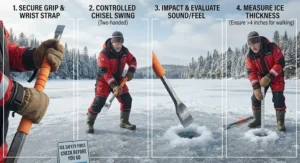
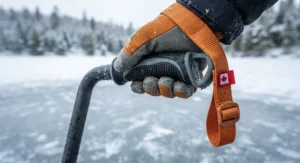
Buying the best ice spud bar for your needs is only half the job — using it correctly is what actually keeps you dry. Before your first outing each season, check the wrist-loop or lanyard hole; if your chisel didn’t come with one, tie on a length of paracord and loop it around your wrist every single time, because a spud bar without a tether has a well-documented tendency to disappear straight through the hole you just made. Technique matters more than force: walk slowly toward untested ice, striking downward in front of you every few steps rather than every few metres, and pay attention to how many hits it takes to penetrate. If a single hard swing punches through cleanly, that’s your signal to stop advancing, not to swing again out of curiosity.
Maintenance is minimal but not nothing. A light coat of oil on bare steel after a wet day prevents surface rust from forming over the off-season, and if your chisel has a single-bevel edge, only sharpen that one face — a double-bevel edge tends to stick in the ice rather than chip it cleanly. Common first-season mistakes include gripping too high on the shaft (which reduces striking force) and testing ice only once before committing your full weight, when experienced anglers typically recommend a minimum of two solid strikes in the same spot before trusting the result.
Which Ice Spud Bar Fits Your Ice Season? 3 Real Angler Scenarios
The weekend family angler: fishing established, well-travelled lakes a few times a season with kids in tow. Priority is straightforward reassurance, not hole-chopping speed. The Eskimo Redneck Economy Ice Chisel or Frabill Standard Ice Chisel covers this without overspending on features that won’t get used.
The mobile jig-and-move angler: covering significant ice distance in a single outing, testing frequently, minimizing pack weight. The Jiffy Mini Mille Lacs Ice Chisel or full-size Jiffy Mille Lacs Ice Chisel fits this pattern — light enough to actually carry, sharp enough to trust.
The serious late-season or backcountry angler: dealing with thick, honeycombed, or unpredictable ice far from help, often chopping holes as well as testing. The Tie Down RoofZone Heavy-Duty Spud Bar or HT Enterprises Polar Escape Pro Chisel brings the durability and reach this situation demands.
Common Ice Spud Bar Problems (and How to Fix Them)
Problem: the chisel edge is dull and skating off the ice instead of biting. Solution: sharpen a single bevel with a mill file, working away from your body, and avoid the temptation to bevel both sides.
Problem: a two-piece design has developed a loose, wobbly joint. Solution: check the threading for ice or grit buildup before each trip and consider a one-piece bar like the Eskimo Redneck Economy Ice Chisel if the joint issue persists across seasons — this is a documented complaint on some two-piece designs.
Problem: cold hands losing grip on bare steel. Solution: wrap the handle in hockey or tennis-grip tape, or choose a chisel with a factory rubber grip like the HT Enterprises Polar Escape Pro Chisel.
Problem: you keep leaving the spud bar in the truck on “quick” trips. Solution: keep a lightweight secondary chisel like the Jiffy Mini Mille Lacs Ice Chisel permanently in your ice-fishing bag rather than the vehicle.
Problem: uncertainty about how many strikes actually mean “safe.” Solution: there’s no universal number — treat any ice under 10 cm as unsafe per Lifesaving Society guidance, and use the chisel as one input alongside visual ice colour and local knowledge, not a standalone guarantee.
Your Ice Spud Bar Decision Framework: If This, Then That
If you fish mostly established lakes with other anglers already out → a mid-weight, budget-friendly bar like the Eskimo Redneck Economy Ice Chisel covers you.
If your top priority is ice safety testing accuracy over hole-chopping → choose a stepped-edge design like the Jiffy Mille Lacs Ice Chisel or Clam One-Piece Ice Chisel.
If you’re covering long distances on foot each trip → prioritize weight and choose the Jiffy Mini Mille Lacs Ice Chisel.
If you need one tool that survives years of hard, repeated impact → the Tie Down RoofZone Heavy-Duty Spud Bar is built for exactly that abuse profile.
If storage space or travel is your constraint → the two-piece HT Enterprises Polar Escape Pro Chisel breaks down smaller than any one-piece alternative.
How to Choose the Best Ice Spud Bar
- Match length to your comfort with distance from untested ice. Shorter bars under 100 cm put you closer to ice you haven’t confirmed; 130–140 cm is the practical sweet spot for most adults.
- Weigh chipping power against fatigue. A heavier chisel around 2.5–3 kg chips more per swing but tires your arm faster over a long walk — match this to how far you typically travel on foot.
- Decide if you need a stepped or single-action edge. Stepped designs generally give a clearer, lower-effort read on ice condition; single-action edges are simpler and often more affordable.
- Check for a wrist-loop attachment point. If it’s missing, budget five minutes and a length of paracord before your first trip out.
- Consider one-piece versus two-piece. One-piece bars have fewer failure points; two-piece bars pack down for easier transport and storage.
- Factor in replaceable-blade options if you’re a heavy user. A bolt-on blade like the RoofZone’s extends the tool’s working life well beyond a welded edge.
- Set a realistic budget band. Genuinely functional options exist from under C$35 to over C$120 — more money buys convenience features, not necessarily more safety.
Common Mistakes When Buying an Ice Spud Bar
The single most common mistake is treating a spud bar as a one-time purchase decision rather than an annual habit check — even the best ice spud bar needs its edge inspected each season, and a dull chisel gives false confidence by requiring more strikes than it should to reveal thin ice. A second mistake is buying based purely on length without considering weight; a long, heavy bar sounds impressive but becomes the piece of gear quietly left behind on shorter trips, which defeats its entire purpose. Buyers also frequently skip the wrist lanyard, assuming their grip will hold on a downward strike into ice — a mistake CBC’s coverage of ice-related incidents implicitly underscores by noting how quickly conditions considered “deceptively solid” can catch experienced people off guard. Finally, some buyers assume any metal pole works as well as a purpose-built chisel — a length of rebar can test ice in a pinch, but it lacks the balanced weight-to-length ratio and consistent edge geometry that make a dedicated tool faster and more reliable to read.
Ice Spud Bar vs Ice Auger: Which Ice Thickness Testing Tool Do You Actually Need?
These two tools get confused constantly, and the honest answer is that they solve different problems. An ice auger — hand, electric, or gas-powered — is built to drill a clean, round hole for fishing; it’s not designed as a proactive ice thickness testing tool because by the time you’re drilling, you’ve already committed your full weight to that spot. A spud bar, by contrast, is meant to be used ahead of you, striking ice you haven’t stepped on yet to gauge its integrity before you commit. In practice, most experienced anglers carry both: the spud bar for the walk out and periodic safety checks, the auger for actually making fishing holes once you’ve confirmed the ice is sound. If you’re only buying one tool this season and safety is genuinely the priority, the spud bar wins that comparison — an auger tells you nothing about the ice between your truck and your fishing spot.
What to Expect: Real-World Performance on the Ice
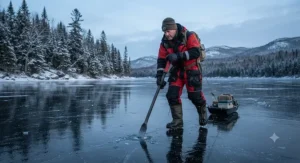
Specs on a page translate differently once you’re actually out there in -10°C wind. A 2 kg chisel that feels perfectly manageable in a warm garage starts to feel heavier by hole twelve, especially with cold, stiffening hands. Stepped-edge designs like the Jiffy Mille Lacs Ice Chisel genuinely do require less obvious effort to get a clear read — you’ll notice the difference most on that thin, deceptive “first ice” of the season, where a duller single-action edge can require several strikes before telling you anything useful. Expect any one-piece steel bar to transmit some vibration back into your hands on a hard strike; this is normal and not a defect, though a rubber-coated handle like the HT Polar Escape Pro’s noticeably dampens it. Realistically, budget bars perform within a reasonable margin of premium ones for the core safety-testing job — the price difference mostly buys comfort, durability, and convenience features rather than a dramatically better safety read.
Ice Spud Bars for Different Types of Anglers
Beginners benefit most from a simple, forgiving one-piece design like the Eskimo Redneck Economy Ice Chisel — fewer parts to maintain while you’re still learning to read ice by feel and sound. Budget-conscious anglers shouldn’t feel pressured past the Frabill Standard Ice Chisel; it does the core safety job without the premium markup. Serious or backcountry anglers who put real hours on remote ice each season are the actual target market for a heavy duty spud bar like the RoofZone, where the replaceable blade pays for itself over several seasons of hard use. Parents supervising kids on the ice should prioritize a lightweight, always-in-the-bag option like the Jiffy Mini Mille Lacs Ice Chisel — the best tool is the one that’s actually with you, not the one gathering dust in the garage because it felt like a chore to carry.
Ice Safety, Regulations & Compliance in Canada
Unlike some outdoor gear, there’s no federal safety certification or CSA standard governing spud bars themselves — an ice safety spud is a manual testing tool, not a regulated piece of protective equipment. What is standardized, at least as guidance, are minimum ice-thickness recommendations from organizations like the Lifesaving Society: roughly 10 cm for a single person walking, ice fishing, or skiing, rising sharply for snowmobiles, ATVs, and vehicles. These figures assume clear, new ice under ideal conditions, which is precisely why a physical testing tool matters — you can’t eyeball “ideal conditions” from the shore. Recent winters have made this more urgent rather than less: Global News reported a string of fatal ice incidents during an unseasonably warm stretch, with authorities specifically urging Canadians to physically check ice thickness rather than judge it by appearance alone. Provincial and local authorities occasionally post their own advisories for popular lakes, but no advisory replaces testing the specific ice under your own feet with your own ice safety spud, at the specific spot you intend to walk.
Frequently Asked Questions
❓ What is a spud bar used for in ice fishing?
❓ How thick should ice be before you walk on it in Canada?
❓ Is an ice chisel the same as a spud bar?
❓ What length ice spud bar should I buy?
❓ Can I make my own spud bar instead of buying one?
Conclusion
There’s no single best ice spud bar for every angler — the right pick depends on how far you walk, how often you fish, and whether you’re testing ice or actively chopping through it. The Eskimo Redneck Economy Ice Chisel and Jiffy Mille Lacs Ice Chisel cover the vast majority of Canadian ice anglers well, the Frabill Standard Ice Chisel protects a tight budget without cutting the actual safety function, and the Tie Down RoofZone Heavy-Duty Spud Bar rewards anyone putting serious hours on demanding ice. What matters more than which one you choose is that you choose one, tether it to your wrist, and actually use it every single time you’re unsure — because the cheapest spud bar on this list still beats the most expensive pair of dry boots you’ll never get to wear if you skip the check. Compare the options above against your own ice season, pick the one that matches how you actually fish, and check current prices before you head out — availability and pricing shift constantly heading into peak season.
✨ Don’t Miss These Exclusive Deals!
🔍 Take your ice safety setup to the next level with these carefully selected picks. Click on any highlighted item to check current pricing and availability. A few extra dollars spent now could mean a much safer, drier season on the ice this winter!
Recommended for You
- 7 Best Ice Safety Spikes for Winter Survival in 2026
- 7 Best Self Rescue Ice Picks That Could Save Your Life (2026)
- Ice Fishing Picks: 7 Best Life-Saving Picks for 2026
Disclaimer: This article contains affiliate links. As an Amazon Associate, I earn from qualifying purchases. If you purchase products through these links, we may earn a small commission at no additional cost to you.
✨ Found this helpful? Share it with your friends! 💬🤗
