

In This Article
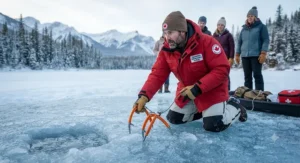
Every winter, Canadian lakes and rivers quietly turn into playgrounds — and every winter, a handful of people find out the hard way that “it looked solid” isn’t the same thing as “it was solid.” That’s where ice safety spikes come in. They’re small, unglamorous, and genuinely one of the cheapest insurance policies you can buy for a day on frozen water. If you’ve never used one, the concept is almost embarrassingly simple: two handles, two spikes, one cord around your neck, and a fighting chance to claw yourself back onto solid ice if the bottom drops out from under you.
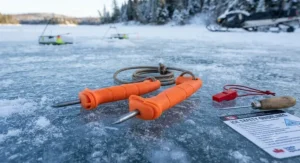
This guide breaks down seven real, currently available ice safety spikes worth considering for the 2026 season, from bare-bones budget sets to the rescue-grade version that professionals actually recommend by name. We’ll walk through what separates a decent set from a dangerous one, how to actually wear and use them (most people get this part wrong), and which option fits your specific situation — whether that’s solo ice fishing on a remote northern lake or supervising a pond-hockey afternoon with the kids. According to the Canadian Red Cross, self-rescue tools like ice picks are a core part of staying safe once you’re out on the ice — so let’s get into which ones are actually worth carrying.
Quick Comparison Table
Before the deep dive, here’s the fast version — seven products, one glance, no scrolling required.
| Product | Type | Key Feature | Best For |
|---|---|---|---|
| Eagle Claw Ice Safety Picks | Fixed-spike | Simple stainless steel spikes | First-time buyers on a budget |
| Rapala Ice Safety Spikes | Retractable | Spikes retract flush into the handle | Pocket-carry convenience |
| Huntury Retractable Ice Safety Picks | Retractable + whistle | 11.5-ft extended lanyard | Taller users, bulky winter gear |
| Pick-of-Life Ice Awls | Fixed-spike, premium | Floating, reflective rescue cord | Backcountry and remote ice |
| Gisafai 4 Pcs Safety Picks Kit | Retractable, multi-pack | Four full sets plus a whistle | Families and group outings |
| SF Ice Picks with Whistle | Fixed-spike + whistle | Built for skating, skiing, sledding too | Multi-sport winter households |
| Okuyonic Dual Handheld Ice Picks | Dual handheld | Bright, high-visibility handles | Budget dual-spike shoppers |
Looking at the spread above, the split isn’t really between “good” and “bad” — every product here uses the same core mechanism. The real differences come down to retraction, cord length, and whether you’re outfitting one person or a whole family, which is exactly what pushes most buyers toward either the Eagle Claw Ice Safety Picks for pure simplicity or the Pick-of-Life Ice Awls when remote conditions raise the stakes.
💬 Just one click — help others make better buying decisions too!😊
Top 7 Ice Safety Spikes: Expert Analysis
We researched real listings, real specs, and real aggregated review themes for each of these — no invented testimonials, no fabricated star ratings. Here’s the honest breakdown of all seven.
1. Eagle Claw Ice Safety Picks — trusted budget pick from a century-old tackle brand
Eagle Claw has been putting hooks in Canadian tackle boxes since the 1920s, and this stripped-down safety set carries that same no-nonsense DNA into the winter safety aisle. Each handle houses a sharp stainless steel spike inside a moulded polymer grip, connected by a woven cord you sling around your neck before you ever step onto the lake. There’s no retraction mechanism — the spikes sit under a simple plastic sheath you pull free with a tug, meaning one less moving part to freeze up at minus twenty. That simplicity is the whole pitch. Based on the spec comparison against pricier retractable models, the Eagle Claw Ice Safety Picks trade convenience for reliability — nothing to jam, nothing to wear out after a season of being yanked from a snowsuit pocket. For a first-time ice angler or a parent buying a set for each kid, that’s arguably the smarter trade. Reviewers consistently report the cord is generous enough to sit comfortably over bulky winter layers, though a handful mention the plastic spike covers can pop loose if tossed unprotected into a tackle bag.
Pros:
- ✅ Simple fixed-spike design with nothing to jam
- ✅ Backed by a century-old fishing brand
- ✅ Lightweight enough that you’ll forget you’re wearing them
Cons:
- ❌ No retraction mechanism to shield spikes in storage
- ❌ Basic cord lacks reflective tracers for low light
Expect to pay under C$15 for the pair, at the time of research, which makes this one of the easiest “just buy it” decisions in the whole category — check current price before you head out, since fishing gear pricing shifts with the season.
2. Rapala Ice Safety Spikes — spikes that retract flush for snag-free carry
Rapala’s version solves the one recurring complaint about fixed-spike picks: exposed points that snag on everything they touch. The hardened steel spikes retract completely into contoured, finger-shaped handles when pressed closed, and those handles are moulded with concave grooves that match where fingers naturally curl. That shape matters more than it sounds — cold, wet gloves lose grip fast, and a smooth cylindrical handle is exactly what slides out of a panicked hand. What most buyers overlook about this model is that retraction isn’t only about tidiness in a tackle bag; it’s a functional safety feature, since spikes that snag on a jacket zipper while you’re yanking them free in an emergency cost you seconds you don’t have. Based on the spec sheet, the Rapala Ice Safety Spikes are built for anglers who want gear that lives permanently in a jacket pocket, not buried in a tackle box. Reviewers consistently note the retraction stays smooth through a full winter of use, though a smaller number mention the mechanism can stiffen in extreme cold until it’s warmed slightly against the body.
Pros:
- ✅ Spikes retract flush for snag-free storage
- ✅ Ergonomic, finger-grooved handles for a secure grip
- ✅ Backed by a well-known, established tackle brand
Cons:
- ❌ Retraction mechanism can stiffen in extreme cold
- ❌ Sold in a single colourway with no size variants
Rapala’s spikes typically land in the C$15-C$25 range, and for the added mechanism and brand reputation, that’s a fair premium over the bare-bones Eagle Claw set — check current price on amazon.ca before your next trip out.
3. Huntury Retractable Ice Safety Picks — 11.5-ft lanyard built for taller users and bulky snowsuits
Most retractable ice pick lanyards max out around 5.6 feet, which sounds like plenty until you’re wearing three layers under a float suit and realize your arms can barely reach your own chest pocket. Huntury’s retractable cord stretches to 11.5 feet, a genuinely unusual spec in this category, and the kit bundles in a safety whistle plus protective covers over each spike tip. The retractable housing means the spikes disappear into their casing between uses, so you’re not carrying exposed points against your jacket lining all day. The extended reach is the real standout, and it solves a real problem: shorter cords force some users to awkwardly hunch to keep the picks within grabbing distance. Here’s what most buyers overlook about lanyard length — it directly affects how naturally you can drive the spikes into ice at an angle rather than straight down, which is the more effective self-rescue motion. A common theme in aggregated reviews is appreciation for the bundled whistle, since it turns one purchase into two pieces of safety gear; some reviewers note the retractable housing feels a touch lighter-duty than the metal spikes on pricier sets.
Pros:
- ✅ Unusually long 11.5-foot retractable lanyard
- ✅ Bundled safety whistle for signalling after self-rescue
- ✅ Protective covers keep spike tips shielded in storage
Cons:
- ❌ Retraction housing feels lighter-duty than premium picks
- ❌ Whistle cord can tangle with the main lanyard
This set generally sits in the C$15-C$20 range, and the extra length alone makes it worth a look for taller riders, snowmobilers in bulky gear, or anyone who’s found a shorter cord awkward before — check current price for the latest availability.
4. Pick-of-Life Ice Awls — the rescue-professional-grade pick with a floating cord
This is the set referenced by name in a lot of ice-safety literature, and for good reason: it was purpose-built with input from cold-water rescue professionals rather than adapted from a generic pick mould. The handles are engineering-grade plastic housing genuine aircraft-aluminum spikes, connected by a six-foot orange cord with reflective tracers woven through it — and critically, that cord is buoyant. Drop the awls while thrashing in open water and they float on the surface instead of sinking, which matters enormously, since a sunk pick is a useless pick. Based on the spec comparison, the floating cord is the single biggest functional difference between this and nearly every cheaper alternative on this list, and it lines up with the equipment priorities laid out by the Lifesaving Society, which lists ice picks among the core items in any cold-water safety kit. For snowmobilers, backcountry travellers, or anyone spending real time on remote ice far from help, the premium here buys genuine peace of mind. Aggregated feedback consistently highlights the reflective cord as a nighttime visibility win, and the aircraft-aluminum spikes are frequently described as noticeably sharper than plastic-tipped competitors right out of the packaging.
Pros:
- ✅ Aircraft-aluminum spikes outperform plastic-tip competitors
- ✅ Six-foot cord floats and includes reflective tracers
- ✅ Referenced by name in cold-water rescue guidance
Cons:
- ❌ Higher price point than basic fixed-spike sets
- ❌ Six-foot cord is shorter than some retractable rivals
Expect to pay in the C$25-C$40 range, at the time of research, positioning this as the premium pick of the group — check current price, since this is the set most worth paying up for if you’re regularly out on remote or backcountry ice.
5. Gisafai 4 Pcs Retractable Ice Safety Picks Kit — four-piece kit built for families and group outings
Buying one set of spikes covers one person; buying this kit covers a whole outing. The Gisafai 4 Pcs Retractable Ice Safety Picks Kit bundles four retractable picks along with a safety whistle, all housed in protective sleeves that keep spike tips covered between uses. Each unit works like a standalone retractable pick — press to expose the spike, retract to shield it — just multiplied across enough units for a family of four or a small skating group. Here’s what to weigh: per-unit cost drops noticeably when buying in a set like this, but you’re also trusting four identical units to hold up at the same rate, so if there’s a weak point in the build, you’ll likely find it across the whole kit at once rather than in isolation. For parents outfitting kids for a pond-hockey afternoon, or a fishing group that wants everyone equally equipped, the value math works strongly in this kit’s favour. A common note in aggregated feedback is satisfaction with the price-per-unit value, alongside occasional comments that the plastic components feel noticeably lighter-duty than single-unit premium picks like the Pick-of-Life Ice Awls.
Pros:
- ✅ Four full sets — outfits a whole family at once
- ✅ Includes a bundled safety whistle
- ✅ Strong price-per-unit value versus buying singles
Cons:
- ❌ Build quality feels lighter than premium single sets
- ❌ Four separate units means four things to track
This kit typically runs in the C$20-C$30 range for all four sets combined, which works out to a genuinely low cost per person — check current price, especially if you’re kitting out kids who’ll outgrow the gear anyway.
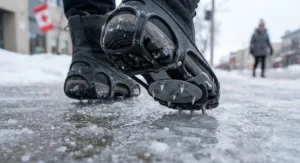
6. SF Ice Picks with Emergency Whistle — all-in-one rescue and signalling kit for multi-sport use
Some ice pick sets are built with ice fishing specifically in mind; this one is pitched more broadly, at anyone who might find themselves on ice for any reason. The SF Ice Picks with Emergency Whistle pair fixed safety awls with an emergency whistle and lanyard, marketed explicitly for skating, skiing, and sledding as well as ice fishing. The angled, breaking-tool-style tips are designed to bite into ice at a slant rather than straight down, which is the motion self-rescue instructors actually teach. Based on the spec sheet, the multi-sport framing isn’t just marketing — pairing a whistle with the picks reflects the same two-part safety logic recommended by groups like the Canadian Red Cross: get yourself out, then signal for help. What most buyers overlook is that a whistle carries much farther than a shout once you’re soaked and cold shock has compromised your voice, so bundling it with the picks genuinely closes a gap that pick-only sets leave open. Reviewers consistently mention the picks feel adequately sharp for their price point, with a smaller number noting the whistle’s plastic loop is the first part to show wear.
Pros:
- ✅ Bundles picks with a loud emergency whistle
- ✅ Angled tip design matches taught self-rescue technique
- ✅ Marketed and built for varied winter activities
Cons:
- ❌ Whistle loop is a reported early wear point
- ❌ No retraction — spikes stay exposed under a cap
Pricing generally sits in the C$15-C$25 range, right in the middle of the pack — check current price, and consider it a strong all-rounder if you split your winter between fishing, skating, and sledding rather than sticking to one activity.
7. Okuyonic Dual Handheld Ice Picks — classic dual-spike design with a bold, hard-to-lose handle colour
This is the shape most people picture when they hear “ice safety spikes” — two separate handheld picks joined by a cord, each with its own protective cone cover. The dual handheld design mirrors the natural crawling motion self-rescue guides describe: alternating spike, kick, spike, kick, dragging yourself onto solid ice one stroke at a time. The handles are moulded in a bright, high-visibility colour specifically so they’re easy to spot if dropped on snow or against dark ice. Here’s what the spec sheet won’t spell out directly, but the dual-handheld format implies: because each pick is independent rather than fused into one retractable unit, you get a slightly longer effective reach per stroke, since your hands aren’t constrained to a fixed distance between them. On paper this means marginally more efficient self-rescue leverage, though the trade-off is two loose pieces to manage instead of one compact unit. A common theme in aggregated reviews is approval of the bright handle colour for visibility, with occasional mentions that the plastic construction feels appropriate for its low price rather than premium-grade.
Pros:
- ✅ Classic dual-spike design for a natural crawling motion
- ✅ High-visibility handle colour, easy to spot if dropped
- ✅ One of the most affordable options in the category
Cons:
- ❌ Plastic build reflects its budget price point
- ❌ Two separate handheld units instead of one compact set
Typically priced under C$15, at the time of research, this is the entry point for anyone who wants a genuine dual spike set without paying for premium materials — check current price for the latest listing.
How to Use Ice Safety Spikes: Setup, Wear & Your First Winter Season
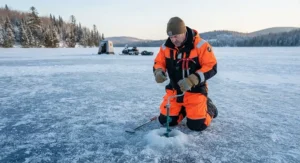
Owning a set does nothing if it’s zipped inside a backpack when you actually need it. Here’s the setup that matters: loop the cord over your head so it sits outside your outer jacket, not tucked under your base layer or float suit — you need to reach both spikes within two or three seconds, and digging through zippers isn’t in the budget. Before your first outing each season, test the retraction or cover mechanism at room temperature and again outside in the cold; plastics behave differently at minus fifteen than they do in your kitchen, and this is exactly the kind of thing you don’t want to discover mid-emergency.
Maintenance is minimal but not optional. Rinse salt or slush off the spikes after coastal or road-adjacent outings, dry the cord fully before storing it (a damp cord can freeze stiff overnight in an unheated garage), and inspect the spike points each season for dulling or corrosion. The most common first-30-days mistake isn’t a gear failure — it’s human error: people tuck the picks inside a jacket “to keep them from swinging around,” which is precisely the habit that turns a five-second rescue into a thirty-second scramble. Wear them outside your layers, every single time, or they’re just dead weight around your neck.
✨ Don’t Miss These Exclusive Deals!
🔍 Take your winter safety kit to the next level with these carefully selected picks. Click on any highlighted item to check current pricing and availability — a small investment now could make all the difference out on the ice.
Real-World Scenarios: Matching Ice Safety Spikes to Your Winter Activity
Different ice, different risk, different gear. A weekend ice angler heading out alone to a remote northern lake — hours from cell coverage, drilling holes far from any access point — is exactly the profile the Pick-of-Life Ice Awls were designed for. The floating cord and reflective tracers aren’t overkill in that scenario; they’re the difference between a recoverable mistake and a genuine emergency, especially if help is a long way off.
Contrast that with a family running a Saturday pond-hockey session on a well-travelled, regularly-checked neighbourhood pond. The risk profile is lower, supervision is higher, and the priority shifts to outfitting everyone — not just the most experienced person in the group. That’s where the Gisafai 4 Pcs Retractable Ice Safety Picks Kit earns its keep, since four sets at once means nobody’s left without one, kids included.
Then there’s the budget-conscious first-timer: someone who walks a dog across a frozen local pond a few times a winter and just wants baseline protection without overthinking it. The Eagle Claw Ice Safety Picks or the Okuyonic Dual Handheld Ice Picks both fit that use case well — simple, cheap, and good enough that there’s no longer an excuse not to wear something.
Problem → Solution: Common Ice Safety Spike Issues, Solved
Problem: The spikes are frozen shut and won’t retract or expose. Solution: warm the mechanism against your body for a minute before use, and avoid letting a wet cord freeze solid overnight — dry it indoors between outings.
Problem: The cord is too short and awkward to reach. Solution: size up to a longer-lanyard model like the Huntury Retractable Ice Safety Picks, which stretches to 11.5 feet instead of the standard 5-6 feet.
Problem: You forgot to wear them and they’re buried in a bag. Solution: attach the cord to your jacket zipper pull as a physical reminder before you step onto ice — out of sight genuinely does mean out of mind here.
Problem: You dropped one pick in open water and it sank. Solution: choose a set with a buoyant cord, like the Pick-of-Life Ice Awls, so a drop doesn’t mean a total loss mid-rescue.
Problem: You can’t find the picks against white snow after a fall. Solution: prioritize bright, high-visibility handles — the Okuyonic Dual Handheld Ice Picks are built specifically around this idea.
What Are Ice Safety Spikes?
Ice safety spikes are a self-rescue tool consisting of two handheld or connected spikes worn on a cord around the neck, used to dig into ice and pull yourself out and forward if you fall through. They’re standard equipment for ice fishing, skating, and snowmobiling, and are recommended by Canadian safety organizations as core cold-water rescue gear.
The mechanics are almost deceptively basic: you fall through, you cover your mouth and nose against the gasp reflex from cold shock, you locate solid ice ahead of you, and you drive one spike into it, then the other, using them as ice-axe-style anchors to kick and crawl your way back onto the surface. It’s not a substitute for good judgment about ice thickness — nothing replaces staying off questionable ice in the first place — but it’s the tool that turns “I fell through and I’m stuck” into “I fell through and I got myself out.”
How to Choose Ice Safety Spikes: 7-Step Buying Framework
- Decide between retractable and fixed-spike designs. Retractable sets stay tidy and snag-free; fixed-spike sets have fewer moving parts to jam in extreme cold.
- Check the cord length. Standard cords run 5-6 feet — if you’re tall or wear bulky winter gear, look for an extended option like the 11.5-foot Huntury lanyard.
- Look at spike material. Stainless steel and aircraft aluminum hold an edge and resist corrosion far better than basic plastic-coated tips.
- Prioritize handle grip and visibility. Cold, wet gloves need a textured or grooved handle, and a bright colour helps you find dropped picks against snow.
- Consider bundled extras. A whistle turns a self-rescue tool into a signalling tool too, closing the gap between getting out and getting help.
- Ask whether the cord floats. A buoyant cord matters most for anyone on remote or open water, since a sunk pick can’t be recovered mid-emergency.
- Match price to frequency of use. A casual once-a-winter user doesn’t need the same set as a daily ice angler — spend accordingly rather than defaulting to the priciest option.
Common Mistakes When Buying Ice Safety Spikes
The biggest mistake isn’t picking the “wrong” product off this list — nearly all seven will outperform not carrying anything at all. It’s buying a single set for a whole family and assuming everyone’s covered, when really only one person can wear it at a time. A close second: buying based on price alone and skipping the cord-length check, then discovering months later that the picks are awkward to reach under a bulky snowsuit. Buyers also frequently overlook the whistle question, treating it as a nice-to-have rather than recognizing that most self-rescue guidance treats “get out” and “signal for help” as two separate, equally important steps. Finally, plenty of people buy ice safety spikes and then store them somewhere that isn’t on their body — a glovebox, a sled, a tackle bag left in the truck — which defeats the entire purpose of a tool that only works if it’s within arm’s reach the moment you need it.
Ice Safety Spikes vs Traditional Ice Picks and Other Rescue Gear
It’s worth being honest about what ice safety spikes are — and aren’t — compared to the alternatives people sometimes substitute in a pinch.
| Option | Cost | Reliability | Portability | Best For |
|---|---|---|---|---|
| Ice safety spikes | Low (C$15-C$40) | High — purpose-built | Excellent, worn around neck | Anyone on ice, any activity |
| No safety gear | None | Very low | N/A | Nobody — not a real option |
| Improvised tools (keys, screwdriver) | None extra | Low, unreliable grip | Poor, easy to drop | Emergency-only, last resort |
| Ice staff only | Low-moderate | Moderate — tests ice, doesn’t rescue | Good | Checking ice thickness ahead |
Reading the table, the comparison isn’t close: improvised tools like keys or a screwdriver simply weren’t designed for the job and tend to slip out of numb, wet hands at the exact moment grip matters most. An ice staff is genuinely useful gear, but it solves a different problem — testing ice ahead of you rather than pulling yourself out once you’re already in the water. Purpose-built ice safety spikes remain the only option on this list engineered specifically for the self-rescue motion itself, which is why safety organizations like CCOHS list dedicated ice picks separately from general ice-testing tools in their guidance for anyone working near ice-covered water.
Ice Safety Spikes Buying Guide: Awls, Dual Spikes & Grip Explained
What Is an Ice Awl Safety Tool?
An ice awl safety tool is essentially the more rugged, often premium-grade cousin of a basic ice pick — the term “awl” typically signals a sharper, more purpose-engineered spike, often made from aircraft-grade aluminum rather than coated steel or plastic. The Pick-of-Life Ice Awls are the clearest example in this category: built with input from rescue professionals rather than adapted from a generic mould. If you see “awl” in a product name, it’s usually a signal that the manufacturer is leaning into the rescue-professional positioning rather than the casual angler market.
Dual Spike Set vs Single Pick
A dual spike set — two independent handheld picks joined by a cord, like the Okuyonic Dual Handheld Ice Picks — gives you slightly more freedom of movement per stroke, since your hands aren’t locked to a fixed distance apart. A single retractable pick unit, by contrast, keeps both spikes in one compact housing, which some users find easier to manage in a panic since there’s only one object to control rather than two. Neither format is objectively superior; it’s a genuine preference trade-off between reach and simplicity.
Grip Ice Spikes — Handle Design for Cold Hands
Grip matters more than almost any other spec on this list, because the moment you actually need ice safety spikes, your hands will be numb, wet, and shaking. Contoured, finger-grooved handles — like those on the Rapala Ice Safety Spikes — are built specifically to counteract that. A smooth, cylindrical handle might look identical on a store shelf, but it’s a meaningfully worse choice for the one scenario that actually matters.
Floating Safety Spikes and Building Your Ice Safety Gear Kit
Why Floating Safety Spikes Matter
A cord that sinks is a real liability if you drop your picks while thrashing in open water — you won’t get a second chance to grab them. Floating safety spikes, like the buoyant reflective cord on the Pick-of-Life Ice Awls, stay on the surface instead, which is a small design detail with an outsized real-world impact for anyone on remote or open water far from immediate help.
Rescue Spikes for Ice Fishing: Beyond Self-Rescue
Rescue spikes for ice fishing aren’t only useful for saving yourself — a dropped pick can also be slid across the ice to someone else who’s fallen through, giving them a grip point without you needing to approach unstable ice directly. Anglers spending hours near drilled holes are statistically at elevated risk simply due to time spent near thin or weakened ice, which is exactly why the Canadian Red Cross recommends extending a rescue device rather than approaching a hole on foot whenever possible.
Assembling Your Complete Ice Safety Gear Kit
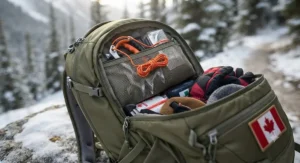
Ice safety spikes are one piece of a larger kit, not the whole solution. A complete ice safety gear setup pairs picks with a personal flotation device or thermal buoyant suit, a whistle, a rope or throw bag, a cell phone in a waterproof pouch, and — ideally — a buddy who knows your route and return time. Picks get you out of the water; the rest of the kit is what keeps a bad afternoon from becoming a tragedy.
Safety, Regulations & Ice Thickness Guidelines Across Canada
Canada doesn’t have one single federal ice-thickness law, but provincial safety authorities and organizations like the Lifesaving Society consistently point to a minimum of roughly 10 cm (about 4 inches) of new, clear ice before walking or skating alone, with considerably more required for groups, snowmobiles, or vehicles. Spring ice is treated as a separate risk category entirely — even ice that measures thick enough can be dangerously weakened by repeated thaw-and-refreeze cycles, which is why most guidance explicitly warns against trusting late-season ice regardless of its measured depth.
For workplaces operating on or near ice-covered water, CCOHS guidance goes further, recommending staggered spacing of at least 10 metres between workers, mandatory flotation suits, and dedicated ice picks kept accessible in a pocket at all times — treating self-rescue gear as standard PPE rather than an optional extra. Recreational users would do well to borrow that same mindset: ice safety spikes aren’t a backup plan, they’re baseline equipment, in the same category as a seatbelt or a bike helmet.
Frequently Asked Questions
❓ How much do ice safety spikes cost in Canada?
❓ Are ice safety spikes actually effective?
❓ Do I need retractable or fixed-spike ice safety picks?
❓ Where should I wear my ice safety spikes?
❓ Can ice safety spikes float if I drop them in the water?
Conclusion
Ice safety spikes aren’t exciting gear. Nobody buys them for the thrill of it, and with any luck, you’ll own a pair for years without ever actually needing to use them for real. But that’s exactly the kind of purchase worth making without overthinking it — cheap, small, and genuinely capable of turning a life-threatening fall through the ice into a cold, unpleasant, but survivable story you tell later.
For most casual users, the Eagle Claw Ice Safety Picks or Okuyonic Dual Handheld Ice Picks cover the basics without any fuss. Families and groups get the most value from the Gisafai 4 Pcs Retractable Ice Safety Picks Kit, since outfitting everyone matters more than any single premium feature. And if you’re regularly on remote, backcountry, or poorly-travelled ice — the kind of terrain where help is genuinely far away — the Pick-of-Life Ice Awls are worth the extra cost for the floating, reflective cord alone.
Whatever you choose, the single most important step is simple: wear it, every time, outside your layers, where you can actually reach it. As reporting from Cottage Life on real ice-fishing rescue stories makes clear, the difference between a close call and a tragedy often comes down to exactly this kind of preparation being within arm’s reach when it counts.
Recommended for You
- 7 Best Self Rescue Ice Picks That Could Save Your Life (2026)
- Ice Fishing Picks: 7 Best Life-Saving Picks for 2026
- 7 Best Swivel Ice Fishing Seats in Canada 2026 (Ranked)
Disclaimer: This article contains affiliate links. As an Amazon Associate, I earn from qualifying purchases. If you purchase products through these links, we may earn a small commission at no additional cost to you.
✨ Found this helpful? Share it with your friends! 💬🤗
