
In This Article
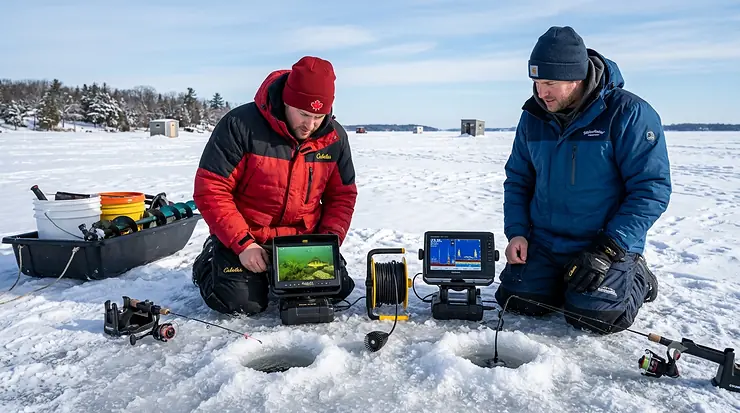
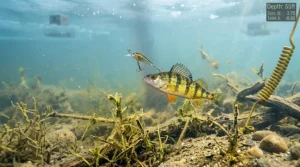
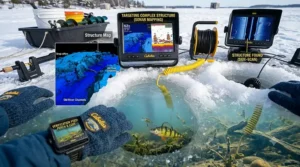
An ice camera (underwater fishing camera) drops a waterproof lens below the ice and streams live video to a surface monitor, so you literally watch fish swim past your jig. A fish finder — often a circular “flasher” on the ice — uses sonar instead of video, sending sound waves through a transducer and showing depth, bottom structure, and fish as coloured blips in real time, even in murky water where a camera goes dark.
If you’re trying to decide between an ice camera vs fish finder for your first season on Canadian hardwater, here’s the short version: sonar finds fish faster across more water types, while a camera teaches you why fish are or aren’t biting. A lot of serious ice anglers in Ontario, Quebec, the Prairies, and Atlantic Canada end up running both, because each one covers a blind spot in the other.
This guide breaks down both technologies, walks through seven real units currently listed on Amazon.ca, and gives you a Canadian-specific buying framework — winter battery behaviour, shipping realities, and a few regulations you’ll want on your radar before you drill your first hole this season.
Quick Comparison Table: Ice Camera vs Fish Finder
| Feature | Sonar Flasher / Fish Finder | Underwater Camera |
|---|---|---|
| How it detects fish | Sound waves (sonar) | Direct video feed |
| Works in murky/stained water | ✅ Yes | ❌ Limited (a few feet at most) |
| Shows fish species/behaviour | ❌ No (just a “mark”) | ✅ Yes, clearly |
| Speed of feedback | Near-instant | Near-instant, but narrower view |
| Best for | Covering water, “hole-hopping” | Confirming species, teaching kids |
| Typical CAD price range | $300–$1,100 CAD+ | $200–$700 CAD+ |
| Cold-weather battery life | Strong with lithium packs | Moderate; drops faster in deep cold |
Looking at the table, sonar wins on raw fish-finding speed and works in conditions where a camera simply goes black, which matters a lot on stained Canadian lakes like parts of Lake Simcoe or the Bay of Quinte. A camera, meanwhile, earns its keep on clear-water lakes — think parts of the Canadian Shield in Ontario, Quebec’s Laurentians, or the deep, clear lakes around Kelowna, BC — where you can actually watch a fish inspect your jig and decide whether to commit. Most experienced ice anglers we found in our research treat a camera as a confirmation tool layered on top of sonar, not a replacement for it.
💬 Just one click — help others make better buying decisions too! 😊
✨ Don’t Miss These Exclusive Deals!
🔍 Take your ice fishing electronics setup to the next level with these carefully selected products. Click on any highlighted item to check current pricing and availability on Amazon.ca. These tools will help you create authentic, memorable days on the ice your family will love!
Top 7 Ice Cameras & Fish Finders for Canadian Anglers: Expert Analysis
These seven units are all currently listed on Amazon.ca and cover budget, mid-range, and premium tiers across both sonar flashers and underwater cameras. Prices shift constantly on Amazon, so treat every figure below as a snapshot rather than a quote — always check the live price before buying.
1. Vexilar FLX-28 Pro Pack II — Best Premium Flasher
The Vexilar FLX-28 is the flasher most tournament walleye and crappie anglers in Canada reach for when target separation matters more than anything else. Its quarter-inch target ID means you can watch your jig and a perch six inches below it as two distinct signals instead of one blurry blob — the difference between knowing a fish is “near” your bait versus knowing it’s actually interested.
What most first-time buyers overlook is the auto-ranging feature: instead of manually adjusting depth scale every time you move holes, the FLX-28 resets itself, which matters a lot if you’re the “hole-hopping” type working a Saskatchewan walleye flat or a Manitoba pickerel bay all day. The lithium-equipped Pro Pack II case also holds up well in prairie wind and -25°C mornings, where lead-acid batteries lose a noticeable chunk of their rated capacity.
Reviewers consistently flag two things: the five colour palettes make it easy to read in bright snow glare, and the weed mode genuinely helps in shallow, vegetated bays without drowning the display in false signals.
Pros: Industry-leading target separation; lithium battery holds up in deep cold; weed mode and night mode add real versatility.
Cons: Premium price puts it out of reach for casual anglers; no GPS or mapping, so it’s sonar-only.
Amazon.ca availability: In stock, Prime-eligible through select listings, ships within Canada.
Price range: Roughly $900–$1,100 CAD, depending on bundle and current promotions. Check current price on Amazon.ca — prices change frequently.
2. MarCum LX-7Li Digital Lithium Combo — Best for Big-Picture Sonar
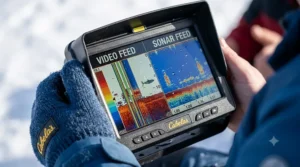
The MarCum LX-7Li blends a traditional flasher dial with a full digital graph on an 8-inch screen, so you can flip between “see fish right now” mode and “see fish history over the last few minutes” mode without buying two units. The dual-beam transducer (8° and 20° cone angles) lets you narrow your search cone when you want precision or widen it when you’re scanning a big flat for suspended walleye.
In practice, what the spec sheet doesn’t tell you is how much the lithium shuttle changes a day on Canadian ice: MarCum rates the battery for up to roughly two full days between charges, and that runtime barely dips even at sustained sub-zero temperatures, which is the opposite of how older sealed lead-acid units behave. The built-in USB ports for charging a phone are a small but genuinely useful touch on long Northern Ontario or Quebec ice-shack days.
Pros: Combo flasher + graph display; long lithium runtime in cold weather; sonar footprint tech reduces interference from nearby anglers.
Cons: 8-inch screen and case add bulk versus a pure flasher; learning curve for the multi-window display.
Amazon.ca availability: Listed and in stock; ships to most Canadian provinces.
Price range: Approximately $850–$1,050 CAD. Prices may vary — confirm on Amazon.ca before buying.
3. Humminbird ICE HELIX 7 CHIRP GPS — Best All-Season, GPS-Equipped Unit
If you want one unit that earns its keep in winter and summer, the Humminbird ICE HELIX 7 CHIRP GPS is the obvious candidate — swap the ice transducer for an open-water one and the same head works on your boat from May through October. Built-in GPS and Humminbird Basemap mean you can mark a productive hole on Lake Nipissing or Rice Lake in January and motor straight back to the same spot in July.
The real-world value here is AutoChart Live ICE: you can build a real-time 1-foot contour map of the area around your hole, which is enormously useful on big, unfamiliar Crown land lakes where you don’t already know where the drop-offs sit. Dual Spectrum CHIRP sonar also gives noticeably crisper bottom hardness reads than a basic single-frequency unit, which matters when you’re trying to distinguish a hard, fish-holding bottom from soft mud.
Pros: Doubles as a boat fish finder in open water; GPS and mapping built in; CHIRP sonar gives sharp target separation.
Cons: Significant step up in price over a flasher-only unit; the menu system takes a session or two to learn.
Amazon.ca availability: Multiple HELIX 7 ice bundles listed on Amazon.ca, sold and shipped by Amazon or verified third-party sellers.
Price range: Roughly $700–$1,000 CAD for the 5- and 7-inch ICE HELIX ice bundles (larger MEGA/360 bundles run substantially higher). Always confirm the current listing price.
4. Garmin Striker Plus 4 Ice Fishing Bundle — Best Budget Entry Point
The Garmin Striker Plus 4 is where most Canadian anglers start, and for good reason: it pairs a genuinely capable CHIRP sonar transducer with built-in GPS at a price that doesn’t require a second mortgage. The flasher-style display on the same screen as the traditional sonar view means new ice anglers get the fast “fish moving up/down” feedback of a flasher without buying a dedicated one.
What’s easy to miss in the spec sheet is how well this unit works as a gateway purchase — it converts cleanly between a kayak, an open-water boat, and an ice fishing portable kit using the same head, which suits anyone testing the waters (so to speak) before committing to a premium combo unit. For a first-time ice angler in, say, suburban Calgary or the Maritimes who fishes a handful of weekends a year, this is usually the smarter starting point than a $1,000 flasher.
Pros: Genuinely affordable; GPS waypoints for marking hot spots; converts between boat, kayak, and ice use.
Cons: Smaller 3.5–4-inch screen is harder to read in bright snow glare; basic CHIRP, not the dual-spectrum sonar found on pricier units.
Amazon.ca availability: In stock; ships across Canada, including remote postal codes (expect longer transit in northern regions).
Price range: Approximately $300–$420 CAD. Check current price on Amazon.ca.
5. Lowrance HOOK Reveal 5 SplitShot — Best Value Mid-Range Combo
The Lowrance HOOK Reveal 5 SplitShot sits comfortably between the Garmin Striker and the premium Humminbird/MarCum units, and it earns that spot with preloaded C-MAP mapping that’s genuinely useful for exploring new Canadian lakes without buying a separate chart card. The 5-inch colour display and SplitShot transducer give you both wide and narrow sonar cones from a single small transducer, which keeps your ice-fishing kit lighter than a dual-transducer setup.
In practice, this unit’s biggest real-world advantage for Canadian buyers is flexibility: it works as a capable boat fish finder all summer and converts to ice duty with an aftermarket portable kit, so you’re not buying two separate price tags for two seasons of fishing. Anglers comparing it against the Garmin Striker tend to choose the HOOK Reveal when colour mapping detail matters more than raw budget.
Pros: Preloaded mapping; flexible open-water-to-ice conversion; sharp 5-inch colour display for the price tier.
Cons: Requires an aftermarket ice conversion kit (sold separately) for true ice-ready use; no built-in flasher-only mode as fast as a dedicated flasher.
Amazon.ca availability: Listed on Amazon.ca with C-MAP US/Canada inland mapping options.
Price range: Roughly $350–$500 CAD. Prices vary by bundle — confirm current pricing.
6. Eyoyo 7″ Underwater Fishing Camera — Best Budget Underwater Camera
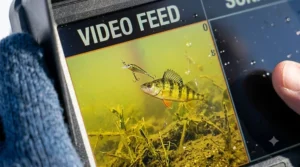
For pure entertainment value and teaching value with kids, the Eyoyo 7″ Underwater Fishing Camera is hard to beat at its price point. A 1000TVL camera with 12 infrared lights gives a genuinely watchable picture in low light, and the IP68 waterproof rating means it shrugs off the wet, salty slush common around Canadian ice shacks. Several Eyoyo bundles are sold and shipped directly through Amazon.ca, with Canadian fulfillment confirmed at checkout.
What the spec sheet won’t tell you is how this camera actually gets used in practice: most Canadian buyers run it less as a “find fish” tool and more as a “confirm and entertain” tool — dropping it down the hole once sonar has already flagged activity, then watching to see whether it’s a keeper walleye or a school of perch picking at the jig. The 6–8 hour battery life comfortably covers a full day on the ice, though cold can shave 10–20% off that runtime, so a spare battery is worth the extra cost for all-day trips.
Pros: Genuinely affordable; bright, clear screen in daylight; IR lighting works well in stained water; family-friendly and easy to set up.
Cons: Effective visibility in murky Canadian lakes can drop to just a few feet; no GPS or sonar — pure video only.
Amazon.ca availability: Multiple Eyoyo models sold by Eyoyo CA and fulfilled by Amazon, confirmed in stock for Canadian buyers.
Price range: Roughly $180–$320 CAD, depending on screen size and cable length. Check the current Amazon.ca listing.
7. Aqua-Vu Micro Revolution 5.0 HD — Best Premium Underwater Camera
Aqua-Vu essentially invented the modern underwater fishing camera category back in 1975, and the Micro Revolution 5.0 HD is the current flagship of that lineage. Its patented integrated reel system means you deploy and retrieve the camera with one hand — genuinely useful when you’re also holding a rod and trying not to drop a $400+ camera down an 8-inch hole. Built and tested in Minnesota’s brutal winters, it’s designed from the ground up for sub-zero performance rather than adapted from a generic action-camera housing.
The 1080p HD picture and 120° field of view are a real step up from budget cameras when water clarity allows it, and the IR light extends usable range in darker conditions. For Canadian anglers fishing clear Shield lakes — much of cottage-country Ontario, the Quebec Laurentians, or BC interior lakes — the extra resolution actually translates into being able to identify species and structure detail that a 1000TVL budget camera blurs into mush.
Pros: Tangle-free integrated reel system; sharp 1080p HD video; built for genuine four-season Canadian-winter durability.
Cons: Roughly double the price of a budget camera like the Eyoyo; smaller 5-inch screen than some 7-inch budget alternatives.
Amazon.ca availability: Listed on Amazon.ca; as a U.S.-based small-business brand, double-check current shipping timelines to your province before ordering close to ice-out.
Price range: Approximately $400–$600 CAD. Confirm current pricing and shipping eligibility on Amazon.ca.
Top 7 Products: Side-by-Side Comparison
| Product | Type | Best For | CAD Price Range |
|---|---|---|---|
| Vexilar FLX-28 Pro Pack II | Flasher | Target separation, tournament anglers | $900–$1,100 |
| MarCum LX-7Li | Combo flasher/digital | Big-picture sonar + cold-weather runtime | $850–$1,050 |
| Humminbird ICE HELIX 7 CHIRP GPS | GPS sonar (all-season) | One unit for ice and boat | $700–$1,000 |
| Garmin Striker Plus 4 Ice Bundle | GPS sonar (entry) | First-time ice anglers | $300–$420 |
| Lowrance HOOK Reveal 5 SplitShot | GPS sonar (mid-range) | Mapping + open-water/ice flexibility | $350–$500 |
| Eyoyo 7″ Underwater Camera | Underwater camera | Budget, family use | $180–$320 |
| Aqua-Vu Micro Revolution 5.0 HD | Underwater camera | Premium clear-water clarity | $400–$600 |
Stacked side by side, the spread makes the budget logic pretty clear: the Garmin Striker Plus 4 and Eyoyo camera together cost roughly the same as a single premium MarCum or Vexilar flasher, which is a perfectly reasonable way to cover both detection methods if you’re just getting into the sport. Anglers fishing tournament circuits or chasing finicky pressured fish on heavily fished Ontario lakes, on the other hand, tend to justify the jump to a Vexilar or MarCum because the extra target separation directly translates into more bites on tough days. One detail Canadian shoppers should note: Canadian retail pricing on electronics typically runs somewhat higher than equivalent U.S. listings once exchange rate and import costs are factored in, but buying through Amazon.ca avoids cross-border shipping fees, customs surprises, and warranty headaches that come with ordering from Amazon.com.
Practical Usage Guide: Getting the Most From Ice Electronics in Canadian Winters
Setting up either an ice camera or fish finder for the first time is straightforward, but a few Canadian-specific habits make a real difference in performance and lifespan.
Battery care matters more here than almost anywhere else in North America. Lithium batteries hold their charge far better than sealed lead-acid units once temperatures drop below -10°C, so if you’re buying new, prioritize lithium-equipped bundles even if they cost a bit more upfront. Store batteries indoors overnight rather than leaving them in an unheated vehicle or shed — extreme cold accelerates capacity loss over a season.
Keep connectors and transducer cables dry between trips. Slush and road salt around truck beds and ice shacks corrode contacts faster than fresh water alone. A quick wipe-down before storage prevents the white corrosion buildup that eventually causes intermittent power issues.
Common first-30-days mistakes include over-tightening the transducer cable storage wrap (which can crack cold plastic), running a camera with the IR lights on in clear, bright water (washing out the colour image unnecessarily), and forgetting to fully charge lithium packs before a multi-day weekend — they don’t always show low-battery warnings as early as lead-acid units did.
Real-World Scenarios: Matching Electronics to How You Fish
The Toronto-area weekend angler who drives up to Lake Simcoe or Georgian Bay a handful of times each winter is usually best served by the Garmin Striker Plus 4 — it’s light, affordable, and the GPS lets them return to a productive hole the following weekend without expensive gear sitting mostly idle.
The Northern Ontario or Manitoba serious walleye angler who fishes 20+ days a season and hole-hops constantly benefits most from a dedicated flasher like the Vexilar FLX-28 or MarCum LX-7Li — the instant feedback rewards exactly the run-and-gun style that defines aggressive walleye and pickerel fishing.
The family with young kids introducing them to ice fishing on a clear Quebec or BC lake gets the most value from an underwater camera like the Eyoyo — watching fish on screen holds a child’s attention far longer than staring at a blank hole, and it turns a quiet, cold afternoon into something genuinely engaging.
How to Choose an Ice Camera or Fish Finder in Canada
- Identify your typical water clarity first. Stained or tannic water (common across much of the Canadian Shield and many prairie reservoirs) favours sonar; clear lakes favour cameras.
- Decide if you need GPS. If you fish large, unfamiliar lakes or want to return to productive spots season after season, a GPS-equipped unit like the Humminbird HELIX or Lowrance HOOK Reveal earns its premium.
- Match battery type to your trip length. Day trips can manage with standard batteries; multi-day ice-shack stays benefit hugely from lithium packs given Canadian cold.
- Set a realistic budget tier first, then shop within it. Entry, mid-range, and premium tiers each have a genuinely good option — overspending on features you won’t use is the most common buying mistake.
- Check Amazon.ca shipping and stock before committing, especially if you’re in a more remote postal code where delivery windows run longer during peak winter demand.
- Consider buying both a budget flasher and a budget camera before splurging on one premium unit — for many anglers, this combination outperforms a single high-end device.
Common Mistakes When Buying Ice Fishing Electronics
The single most common mistake is buying a camera as a first and only purchase, expecting it to function like sonar. In stained water it simply won’t find fish the way a flasher does. The second is ignoring cold-weather battery behaviour — a unit rated for “10 hours” in the spec sheet was almost certainly tested at room temperature, not at -20°C on a Manitoba lake. The third is skipping the warranty and service-centre check: most major brands (Garmin, Humminbird, Lowrance, Vexilar, MarCum) have Canadian service support, but smaller off-brand camera manufacturers sometimes route warranty claims through U.S.-only support, which adds delay and cost.
Long-Term Cost & Maintenance in Canada
Beyond the upfront price, ongoing costs are modest but worth planning for. A replacement lithium battery for a premium flasher typically runs in the $100–$200 CAD range every few seasons, and transducer cables occasionally need replacing after repeated freeze-thaw cycling at connection points. Budget cameras like the Eyoyo line are inexpensive enough that many Canadian buyers simply replace the whole unit every few seasons rather than repair it, while premium units from Garmin, Humminbird, and Aqua-Vu are generally worth servicing given their higher resale value. Factor in a basic carrying case or soft pack if one isn’t included — Canadian winters are hard on exposed electronics during transport between the truck and the ice.
Canadian Regulations & Safety Considerations
Ice fishing electronics themselves aren’t regulated, but the activity around them is. Provincial fishing regulations — including rules on the number of lines you can run, how far you must stay from an unattended line, and ice hut registration requirements in certain zones — vary significantly by province and even by fisheries management zone. In Ontario, for example, anglers may use up to two lines while ice fishing in most waters, provided they stay within 60 metres of any line and maintain a clear, unobstructed view of it at all times. Federal fishing rules also apply on top of provincial ones, governed by Canada’s Fisheries Act and related regulations. Before heading out, check your provincial government site (most use a “.gc.ca” or provincial “.ca” domain) for current zone-specific rules, and always assess ice thickness independently — electronics tell you what’s under the ice, not whether the ice itself is safe to stand on. The Government of Ontario’s ice fishing safety page is a solid starting reference if you’re new to the province.
✨ Don’t Miss These Exclusive Deals!
🔍 Whether you’re leaning sonar, camera, or both, these Amazon.ca picks cover every budget tier. Click through to check live pricing and availability before your next ice trip!
Features That Actually Matter (And Those That Don’t)
Matters a lot: target separation (sonar), genuine cold-weather battery performance, transducer cone angle options, and screen brightness/anti-glare performance in direct snow reflection.
Matters less than the marketing suggests: maximum advertised depth range (most Canadian inland lakes never approach the 300-foot ratings these units boast), and screen resolution on underwater cameras beyond about 1000TVL/720p — in practice, Canadian water clarity is almost always the limiting factor long before camera resolution is.
FAQ
❓ Is an ice camera or fish finder better for ice fishing in Canada?
❓ Do Amazon.ca ice fishing electronics ship to remote parts of Canada?
❓ Can lithium batteries handle extreme Canadian cold?
❓ Do I need both a camera and a fish finder for ice fishing?
❓ What's the minimum budget to get started with ice fishing electronics in Canada?
Conclusion
There’s no single right answer in the ice camera vs fish finder debate — it genuinely comes down to where you fish and how you fish it. If you’re working unfamiliar or stained Canadian water and need to cover ground quickly, sonar units like the Vexilar FLX-28, MarCum LX-7Li, Humminbird ICE HELIX, Garmin Striker Plus 4, or Lowrance HOOK Reveal will outperform a camera every time. If you’re fishing clear Shield or interior lakes and want to actually watch fish react to your presentation — or you’re introducing kids to the sport — an underwater camera like the Eyoyo or Aqua-Vu Micro Revolution adds a dimension sonar can’t match. Many experienced anglers eventually own both, using sonar to find the bite and a camera to understand it. Whichever direction you go, prioritize lithium batteries, check Amazon.ca availability and shipping timelines for your region, and confirm current pricing before you buy — these are competitive categories and CAD pricing moves often.
✨ Don’t Miss These Exclusive Deals!
🔍 Ready to gear up for the ice? Check current pricing and availability on Amazon.ca for any of the seven picks above, and build the setup that matches how — and where — you actually fish this winter.
Recommended for You
- Top 7 Underwater Ice Fishing Cameras in Canada (2026)
- 7 Best Budget Ice Fishing Sonars in Canada (2026 Guide)
- Best GPS Fish Finder Ice Fishing in Canada 2026: Top 7
Disclaimer: This article contains affiliate links. As an Amazon Associate, I earn from qualifying purchases. If you purchase products through these links, we may earn a small commission at no additional cost to you.
Found this helpful? Share it with your friends! 💬🤗
