
In This Article
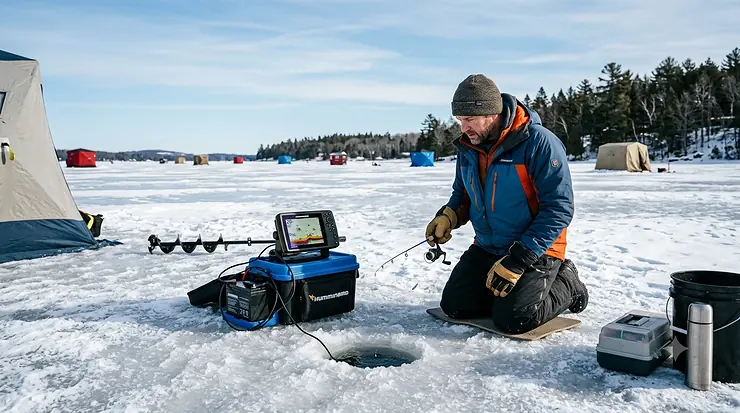
Budget ice fishing sonar is an entry-level to mid-range flasher or fish finder, usually priced under $600 CAD, that shows the depth of the water, the location of fish, and your jig in real time through a hole in the ice. It’s the cheapest reliable way to stop guessing and start seeing what’s happening beneath your boots.
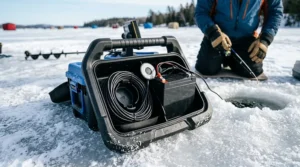
If you’ve ever sat over a hole for two hours wondering whether there’s anything down there at all, you already know why this gear matters. ❄️🎣 An affordable ice fish finder won’t have every bell and whistle a $1,500 unit has, but the right budget pick will tell you the three things that actually catch fish: how deep the bottom is, whether fish are near your bait, and how they’re reacting when you jig.
Here in Canada, the calculus is a little different than it is south of the border. Our winters are longer, our lakes get genuinely hard ice instead of slush, and our dollar means a $300 USD unit can land closer to $420 CAD once you account for exchange and duty. That’s exactly why this guide sticks to gear that’s actually sold and shipped through Amazon.ca, with Canadian Prime shipping and Canadian return policies, rather than American listings that may not ship north of the border at all.
We dug through current Amazon.ca listings, manufacturer specs, and angler feedback to put together seven real, buyable budget ice fishing sonar units, from a $35 CAD depth gauge to a $550 CAD all-season combo. Every product mentioned here is a real, named item you can search for on Amazon.ca today — no invented models, no guessed specs.
As an Amazon Associate, I earn from qualifying purchases.
Quick Comparison Table: Budget Ice Fishing Sonars at a Glance
| Product | Type | Approx. Price (CAD) | Best For | Amazon.ca Status |
|---|---|---|---|---|
| Garmin Striker 4 Portable Bundle | GPS fishfinder + flasher mode | $180–$250 | All-around budget pick, summer/winter | Prime-eligible |
| Vexilar FL-8SE Genz Pack | Classic 3-colour flasher | $440–$490 | Purists who want zero lag, zero menus | Ships from Canada |
| Deeper PRO+ 2 | Castable WiFi sonar + app | $280–$350 | Anglers who hate carrying batteries | Prime-eligible |
| Garmin Striker Cast | Castable Bluetooth sonar | $170–$220 | Lightest, most packable option | Prime-eligible |
| Humminbird ICE Helix 5 CHIRP GPS G3 | Digital CHIRP sonar + GPS | $500–$580 | Anglers who want a “last unit” | Ships from Canada |
| Venterior Portable Fish Finder | Basic wired depth/fish alarm | $30–$45 | First-timers, kids, backup unit | Sold & shipped by Venterior |
| LUCKY Portable Fish Finder | Wired depth/fish alarm | $40–$65 | Budget gift, secondary hole-hopper | Prime-eligible |
Looking at the spread above, the real story is that “budget” in ice fishing covers a $500 range, not a single price point. The Venterior and LUCKY units are depth gauges with fish alarms — useful, honest, and cheap, but they won’t show you a flasher-style live read. The Garmin Striker 4 and Striker Cast sit in the sweet spot most Canadian anglers actually buy: real sonar, real GPS, real warranty, under $250 CAD. The Vexilar and Humminbird units cost more but are built to be the only unit you ever buy, which changes the long-term math in CAD even if the sticker price stings more in February.
💬 Just one click — help others make better buying decisions too! 😊
✨ Don’t Miss These Exclusive Deals!
🔍 Take your ice fishing season to the next level with these carefully selected sonars. Click on any highlighted item to check current pricing and availability on Amazon.ca. These tools will help you put more fish on the ice for your family to enjoy! 💬😊
Top 7 Budget Ice Fishing Sonars for Canadian Anglers: Expert Analysis
1. Garmin Striker 4 Portable Bundle
The Garmin Striker 4 Portable Bundle is the unit most Canadian ice anglers land on after asking ten people for advice, and there’s a reason for that.
It runs Garmin’s CHIRP sonar at 77/200 kHz with a built-in flasher view, plus internal GPS so you can mark productive holes and find them again next weekend — useful when your “honey hole” is a featureless white expanse with no landmarks. What that means in practice: the CHIRP sweep gives you cleaner separation between your jig and a suspended fish than older single-frequency units, so you’re less likely to mistake “fish right on your bait” for “fish ten feet away.” In a Canadian winter, where daylight is short and you don’t want to waste it second-guessing the screen, that clarity matters.
What most buyers overlook about this model is that the 3.5-inch screen, while small, is genuinely readable in bright snow glare — something cheaper LCD units struggle with. Battery life on the included rechargeable pack typically covers a full day of hole-hopping, though cold reduces lithium battery output by roughly 10–20%, so keeping the battery inside your coat between holes on a -25°C day on a Saskatchewan or Manitoba lake will buy you noticeably more runtime.
Customer feedback on Amazon.ca consistently points to this being the unit people recommend to friends starting out, citing the balance of price and capability over flashier, pricier units.
Who it’s for: First-time ice anglers and anyone who wants one unit that works on a kayak in July and a bucket in January.
✅ Pros: Doubles as a summer fishfinder · GPS waypoint marking · Genuinely portable carry kit
❌ Cons: Small screen by 2026 standards · No CHIRP-specific ice transducer upgrade included
Price range: around $180–$250 CAD depending on bundle configuration — check current price on Amazon.ca, as prices and bundle contents shift through the season.
2. Vexilar FL-8SE Genz Pack
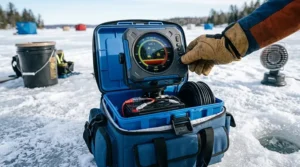
If the Garmin is the modern default, the Vexilar FL-8SE Genz Pack is the old-school standard it’s still measured against. This is a three-colour analog flasher — no menus, no boot-up screen, no software updates, just a dial and a needle that responds in real time.
The practical meaning of “analog flasher” is zero lag: what’s happening 30 feet down shows up on the dial essentially instantly, which matters enormously when you’re watching a fish’s reaction to your jig stroke. Digital units process and redraw; the FL-8SE just shows you the signal. Anglers who jig aggressively for walleye on big Canadian Shield lakes often prefer this immediacy over a prettier digital display.
The “Genz Pack” design — named for ice fishing pioneer Dave Genz — sits on top of a five-gallon bucket, which doubles as your seat. That’s a real Canadian-winter advantage: less gear to carry across the ice, fewer things to drop down a hole. With 10 steps of interference rejection, it also holds up well when you’re fishing shoulder-to-shoulder with other flasher users on a popular Ontario or Quebec lake during peak season.
Who it’s for: Anglers who already know they want a true flasher and are buying their “forever” unit rather than starting cheap and upgrading later.
✅ Pros: No lag, ever · Nearly indestructible housing · Doubles as a bucket seat
❌ Cons: No GPS or mapping · Highest price point on this list for a flasher-only unit
Price range: around $440–$490 CAD — this is the priciest unit here, but Canadian retailers and Amazon.ca sellers both confirm it ships within Canada, avoiding cross-border duty surprises.
3. Deeper PRO+ 2
The Deeper PRO+ 2 flips the whole format: instead of a screen on a shuttle, it’s a small WiFi sonar ball about the size of a tennis ball that talks to an app on your phone or tablet.
For ice fishing specifically, you drop it down the hole instead of casting it, and the Fish Deeper app switches into an ice mode that mimics a flasher view alongside a vertical sonar view. The real-world benefit here is logistics: no separate battery shuttle, no bucket-mounted transducer arm, just the ball and your phone. For anyone who fishes solo and walks several kilometres between holes on a big lake — common practice on Lake Winnipeg or Lake Simcoe — the weight savings genuinely matter after the fifth hole of the day.
The trade-off most reviews gloss over: it uses your phone’s battery and its own WiFi hotspot rather than mobile data, so it works fine in areas with no cell signal, but you do need to keep your phone charged and somewhat warm, since cold drains phone batteries faster than it drains the unit’s own battery.
Who it’s for: Anglers who already fish a lot of holes per day and want to cut shuttle weight, or who already own a Deeper unit for summer kayak fishing.
✅ Pros: Extremely light and packable · GPS-tagged holes saved automatically · Works for both ice and open water
❌ Cons: Depends on your phone’s battery and screen visibility in glare · Learning curve on the app’s ice mode
Price range: around $280–$350 CAD on Amazon.ca, with the unit typically sold and shipped from a Canadian-based Deeper seller.
4. Garmin Striker Cast
The Garmin Striker Cast is Garmin’s take on the castable-sonar idea, pairing over Bluetooth with the free Garmin app instead of WiFi.
What that distinction means practically: Bluetooth pairing tends to be a bit more stable in cold, battery-saving conditions than WiFi hotspot connections, which is a small but real edge for ice use. The unit floats, has its own GPS, and shows depth, bottom hardness, and fish arches on your phone screen. For Canadian anglers who already use Garmin gear elsewhere (a boat unit, a watch, a handheld GPS), staying in the same ecosystem also means one app and one login instead of three.
It’s the lightest and most pocket-friendly option in this whole list — small enough to genuinely forget you’re carrying it, which is exactly what you want when you’re already hauling an auger, a sled, and a rod through snow.
Who it’s for: Anglers who want castable convenience but are already inside the Garmin app ecosystem, or who fish solo and want minimal gear.
✅ Pros: Lightest unit on this list · Simple Bluetooth pairing · Doubles for summer bank and dock fishing
❌ Cons: Smaller screen real estate since it’s phone-only · No standalone display if your phone dies
Price range: around $170–$220 CAD — frequently the most affordable “real sonar” (not just a depth alarm) option on Amazon.ca.
5. Humminbird ICE Helix 5 CHIRP GPS G3
The Humminbird ICE Helix 5 CHIRP GPS G3 is the most expensive unit on this list, and it’s here because “budget” for a serious angler often means “the last unit I’ll need to buy,” not “the cheapest sticker price.”
This is a full digital sonar and GPS combo with Dual Spectrum CHIRP, giving roughly 3/4-inch target separation — tight enough to tell your jig apart from a fish kissing it, not just a blob near it. It includes a shuttle, ice transducer, and battery, and converts to open-water use with an optional transducer once the lakes thaw, which genuinely extends its useful season well past the ice months unique to a Canadian winter.
What most spec sheets don’t tell you: the flasher-and-2D-sonar split-screen mode is the real selling point for intermediate anglers, because it lets you learn to read a traditional flasher dial while still having the more intuitive 2D sonar view as a safety net. That’s a meaningfully gentler learning curve than jumping straight into flasher-only gear.
Who it’s for: Anglers ready to commit to one higher-end unit rather than upgrading twice, and anyone who already fishes open water with a boat and wants matching electronics.
✅ Pros: All-season unit, not ice-only · Tightest target separation on this list · Built-in GPS and mapping
❌ Cons: Highest price point here by a wide margin · More menu complexity than a simple flasher
Price range: around $500–$580 CAD — well above “entry budget” but still meaningfully under premium live-sonar combos that run well past $1,000 CAD.
6. Venterior Portable Fish Finder
The Venterior Portable Fish Finder isn’t a flasher and won’t pretend to be one — it’s a basic wired depth gauge with a fish alarm, and it’s here because plenty of Canadian anglers genuinely just need “how deep is it and is anything moving down there,” not a full sonar picture.
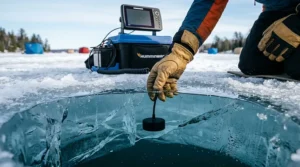
It runs on four AAA batteries, uses a simple 25-foot wired transducer you drop down the hole, and shows depth, approximate fish size, and bottom type (weeds, sand, rock) on a basic LCD. A verified Canadian reviewer on Amazon.ca specifically noted using it for ice fishing to gauge depth and reported it worked well moving from hole to hole — exactly the use case it’s built for.
The honest trade-off: this is genuinely entry-level. It can’t show you live jig movement or fish reaction the way a flasher or CHIRP unit can, and the AAA battery setup means cold weather will shorten runtime faster than a sealed rechargeable pack would. For its price, though, it removes the worst kind of guessing — drilling a hole over 2 feet of water when you meant to fish 20.
Who it’s for: First-time ice anglers, kids learning the sport, or anyone who wants a $40 backup unit in the sled in case the main unit’s battery dies.
✅ Pros: Genuinely inexpensive · Simple enough for a beginner in five minutes · Verified Canadian winter use in reviews
❌ Cons: No live flasher-style fish reaction display · AAA batteries drain faster in deep cold
Price range: around $30–$45 CAD — sold and shipped directly by Venterior through Amazon.ca.
7. LUCKY Portable Fish Finder
The LUCKY Portable Fish Finder sits right beside the Venterior in function — a wired, handheld depth and fish alarm unit — but with a slightly larger colour LCD and a longer roughly 25–26-foot transducer cable.
The practical difference for ice use: the colour display with selectable backgrounds (blue, red, grey contour modes) is a touch easier to read in bright midday snow glare than a basic monochrome screen, which matters more than it sounds like it would after your third hour on a sunny lake. Like the Venterior, it runs on AAA batteries and is explicitly marketed and used for ice fishing, with the manufacturer providing clear instructions for clearing snow and avoiding air gaps between the transducer and the ice or hole water for an accurate reading.
This is squarely a “good enough” tool, not a flasher replacement, and reviewers are upfront that it won’t distinguish small baitfish reliably. For a stocking-stuffer or a spare unit, though, it punches above its price.
Who it’s for: Gift buyers, anglers who want a cheap second unit for a fishing buddy, or anyone testing whether they even enjoy ice fishing before investing further.
✅ Pros: Larger, more readable display than most units in its price bracket · Genuinely simple setup · Works for both kayak and ice use
❌ Cons: Same depth-gauge limitations as the Venterior · Wired cable can stiffen in extreme cold
Price range: around $40–$65 CAD on Amazon.ca, with Prime-eligible shipping on most listings.
How to Choose Budget Ice Fishing Sonar in Canada
Before you scroll back up and pick by price alone, run through these seven questions — they’ll narrow the field faster than spec sheets will.
- Will you fish open water with it too? If yes, lean toward the Garmin Striker 4 or Humminbird Helix 5, since both convert to boat use with an extra transducer.
- Do you fish solo or with a group? Solo anglers walking many holes per day benefit most from light castable units like the Deeper PRO+ 2 or Striker Cast.
- How important is zero lag to you? Aggressive jiggers chasing walleye reaction often prefer the instant feedback of an analog flasher like the Vexilar FL-8SE.
- What’s your actual budget, in CAD, including tax? Ontario and Quebec add provincial sales tax on top of GST, so a “$200” unit can land closer to $226 CAD at checkout in those provinces.
- Do you fish in deep cold (below -20°C) often? If so, prioritize sealed rechargeable batteries over AAA-powered units, since lithium and sealed lead-acid packs hold capacity better in extreme cold than standard AAAs.
- Are you buying for a beginner or a kid? Start with a depth-gauge unit like the Venterior or LUCKY before investing in a full flasher — it’s a cheap way to confirm interest first.
- Do you already own electronics from one brand? Staying inside the Garmin or Humminbird ecosystem can simplify app logins, mounts, and accessories down the line.
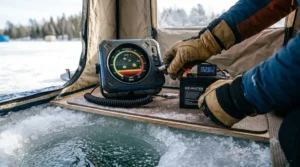
Setting Up Your Ice Fishing Sonar: A Practical Canadian Winter Guide
Getting a budget unit set up properly takes ten minutes the first time and thirty seconds every time after that — but the details matter more in a Canadian winter than they do in milder climates.
Clear the hole properly. Slush refreezes fast at -15°C and below, so skim your hole clean right before dropping the transducer, not five minutes before. Any ice film between the transducer and water will distort or kill the reading entirely.
Pre-warm sealed batteries indoors. Rechargeable battery packs (used in the Garmin Striker 4, Vexilar, and Humminbird units) hold more usable capacity if they start the day at room temperature rather than having sat in a cold garage overnight. A simple habit: charge and store the battery inside the house, and only move it to the sled right before you leave.
Keep AAA-powered units in an inner pocket between uses. For the Venterior and LUCKY units, body heat between holes meaningfully extends battery life on a cold day — cheap insurance against a dead unit at 2 p.m.
Calibrate your gain before you start jigging. Most flashers and CHIRP units default to a generic gain setting. Dial it down slightly if you’re getting a wide, fuzzy bottom signal (common in murky Prairie lakes) or up slightly in very clear water common to Canadian Shield lakes, where signal can otherwise look weaker than it is.
Avoid the most common rookie mistake: ignoring interference settings entirely. If you’re fishing near other anglers running their own units — a frequent situation on popular weekend lakes in Ontario’s cottage country — switch on interference rejection from the start rather than troubleshooting a glitchy screen an hour in.
Real-World Scenarios: Matching Sonar to Canadian Anglers
The Winnipeg weekend walleye angler. Fishes Lake Winnipeg most Saturdays in groups of three or four, often near other flashers. The Vexilar FL-8SE’s strong interference rejection and instant-feedback dial make it a natural fit, and the bucket-mounted design matches the “drill, sit, jig” style common on that lake.
The Ottawa Valley solo angler. Walks 1–2 km across the ice most trips, hole-hopping frequently in search of active fish. The Deeper PRO+ 2 or Garmin Striker Cast cuts carrying weight dramatically compared to a shuttle-based unit, which matters over a full day on foot.
The first-time family outing in rural Manitoba. Two adults, two kids, one rented shack. A single Garmin Striker 4 covers the adults’ main hole, while a $35 CAD Venterior or LUCKY unit lets a kid drop a line in a second hole and still feel like they’re “really fishing” without risking an expensive unit.
The Quebec angler running a boat in summer and a bucket in winter. Already owns open-water electronics and wants matching gear. The Humminbird ICE Helix 5 CHIRP GPS G3 converts between seasons with an extra transducer, avoiding the cost of two completely separate systems.
Common Mistakes When Buying Budget Ice Fishing Sonar
Buying the cheapest unit without checking what it actually shows. A depth-gauge unit like the Venterior or LUCKY is genuinely useful, but it is not a flasher substitute. Know which category you’re buying before you’re disappointed on the ice.
Ignoring Canadian shipping and stock status. Not every popular American ice fishing listing ships to Canada, or it ships with multi-week delays to northern and remote postal codes. Always confirm the Amazon.ca listing specifically, not just an Amazon.com search result.
Forgetting cold-weather battery behaviour. A battery rated for “10 hours” in a manufacturer’s lab test at room temperature may deliver notably less in a -25°C Prairie wind. Budget for a slightly larger battery margin than the spec sheet implies.
Skipping interference rejection settings. This is the single most common reason a perfectly good budget flasher “looks broken” on a busy lake — it isn’t broken, it’s picking up a neighbour’s unit.
Assuming a higher price always means a better fit. The Humminbird Helix 5 is excellent, but it’s overkill for a parent buying a first unit for a curious eight-year-old. Match the unit to the angler, not just the budget ceiling.
Flasher vs Digital Sonar: Which Is Right for You?
| Factor | Analog Flasher (e.g., Vexilar FL-8SE) | Digital CHIRP/GPS (e.g., Garmin Striker 4, Humminbird Helix 5) |
|---|---|---|
| Response speed | Instant, zero lag | Slight processing delay, usually imperceptible |
| Learning curve | Steeper at first, very intuitive once learned | Gentler thanks to visual sonar arches |
| GPS/mapping | None | Yes, on Garmin and Humminbird units |
| Best lake type | Crowded lakes (great interference handling) | Mixed-use, year-round anglers |
| Typical CAD price here | $440–$490 | $180–$580 depending on model |
The data above tells a clear story: flashers win on raw speed and crowd handling, while digital units win on versatility and ease for newer anglers. If you fish the same handful of busy lakes every winter and already know how to read a dial, the Vexilar’s lag-free response is hard to beat. If you’re newer to the sport, want GPS waypoints, or plan to use the unit on a boat come spring, a digital CHIRP unit like the Striker 4 or Helix 5 earns its higher price through year-round use.
What to Expect: Real-World Performance in Canadian Conditions
Spec sheets rarely mention what actually happens at -20°C on a windswept Saskatchewan lake. A few honest expectations:
Screens dim slightly in extreme cold, particularly on budget LCD units. It’s rarely enough to make the unit unreadable, but don’t expect summer-bright contrast in January.
Battery runtime drops 10–20% across nearly every battery chemistry once temperatures fall well below freezing, which is why the “full day” battery claims on most boxes assume milder conditions than a typical Canadian cold snap.
Wired transducer cables stiffen in deep cold, which can make coiling and storing the cheaper wired units (Venterior, LUCKY) slightly fussier — a minor annoyance, not a functional problem.
Bottom signal quality varies by lake type. Murky, weedy Prairie lakes often produce a thicker, fuzzier bottom return that benefits from lower gain settings, while clear Canadian Shield lakes typically show a crisp, thin bottom line even at default settings.
Long-Term Cost and Maintenance in Canada
A $470 CAD Vexilar and a $200 CAD Garmin Striker 4 look very different on a receipt, but the multi-season math can close that gap. The Vexilar’s analog design has essentially nothing to fail electronically and is widely serviced by ice fishing specialty shops across Canada, while replacement batteries for any of these units typically run $25–$60 CAD depending on chemistry and capacity.
Digital units carry a different kind of long-term cost: app and firmware updates are free, but if you ever need warranty service, factor in that some manufacturers route Canadian repairs through a US service centre, which can add shipping time versus a flasher you can often get serviced locally. None of these units currently carry import duties when purchased directly through Amazon.ca, since they ship from Canadian-based sellers or Amazon’s own Canadian fulfillment network — but always confirm “ships from and sold by” details before buying, since third-party marketplace listings occasionally ship cross-border.
Canadian Ice Safety and Fishing Regulations
No sonar unit, however good, replaces basic ice safety. The Canadian Red Cross recommends a minimum ice thickness around 15 cm to support a single walking adult, increasing for groups or motorized travel, and stresses that ice thickness should be checked at multiple points rather than assumed uniform across a lake — a good reminder before you haul a sled full of electronics out onto early-season ice. Review the Canadian Red Cross ice safety guidance before your first outing each season, and check the Canadian Coast Guard’s ice safety bulletin if you’re fishing near any shipping lanes or icebreaker activity.
On the licensing side, recreational fishing in Canada — including ice fishing — requires the appropriate provincial or territorial licence in freshwater, while Fisheries and Oceans Canada governs tidal water fishing federally. Requirements and age exemptions vary by province, so check your provincial regulations alongside your sonar shopping, since a flasher won’t help you if you’re fishing without a valid licence.
Features That Actually Matter (And Those That Don’t)
Actually matters: Target separation (how close together two objects can be and still show as distinct), interference rejection on crowded lakes, and realistic cold-weather battery life.
Actually matters: Whether the unit converts to open-water use, if you fish more than one season — this single feature can effectively cut your “true cost per season” in half over several years.
Doesn’t matter much for budget buyers: Built-in maps with thousands of preloaded lakes, since most ice anglers fish the same handful of familiar local lakes rather than navigating unfamiliar water. The flashy sonar at the heart of traditional sonar fish finder technology hasn’t fundamentally changed in decades — it’s the display and processing layered on top that varies between budget and premium units.
Doesn’t matter much: Touchscreen interfaces, which can be genuinely frustrating to operate with thick winter gloves on. A simple keypad, as found on the Garmin Striker 4 and most Humminbird units, is often the more practical choice on the ice specifically.
Frequently Asked Questions
❓ Can I use a budget ice fishing sonar in extreme Canadian cold?
❓ Does Amazon.ca ship ice fishing sonar to remote Canadian communities?
❓ What's the cheapest real ice fishing sonar option in Canada?
❓ Do I need a flasher, or is a digital fish finder good enough for ice fishing?
❓ Is a more expensive ice fishing sonar always better for beginners?
Conclusion
There’s no single “best” budget ice fishing sonar in Canada — there’s a best one for your lake, your group size, and how cold you’re willing to fish in. If you want one do-everything unit, the Garmin Striker 4 Portable Bundle remains the easiest recommendation for most Canadian anglers starting out. If you already know you want the instant feedback of a true flasher, the Vexilar FL-8SE Genz Pack is worth the higher price tag. And if you’re just testing the waters — literally — a $35 CAD Venterior or LUCKY unit will tell you whether ice fishing is a hobby worth investing further in before you spend a cent more.
Whatever you choose, check it against an up-to-date Amazon.ca listing before you buy, confirm it ships from within Canada, and pair it with a properly checked, ice-safe lake. The fish will still be there either way — the only question is whether you’ll be looking at them on a screen or just guessing.
✨ Don’t Miss These Exclusive Deals!
🔍 Take your ice fishing season to the next level with these carefully selected sonars. Click on any highlighted item to check current pricing and availability on Amazon.ca. These tools will help you create the kind of ice fishing memories your family will love! 💬🤗
Recommended for You
- Best GPS Fish Finder Ice Fishing in Canada 2026: Top 7
- 7 Best Portable Fish Finders for Ice Fishing in Canada (2026)
- 7 Best Flasher vs LCD Fish Finder Ice Fishing Picks (Canada 2026)
Disclaimer: This article contains affiliate links. As an Amazon Associate, I earn from qualifying purchases. If you purchase products through these links, we may earn a small commission at no additional cost to you.
✨ Found this helpful? Share it with your friends! 💬🤗
