
In This Article
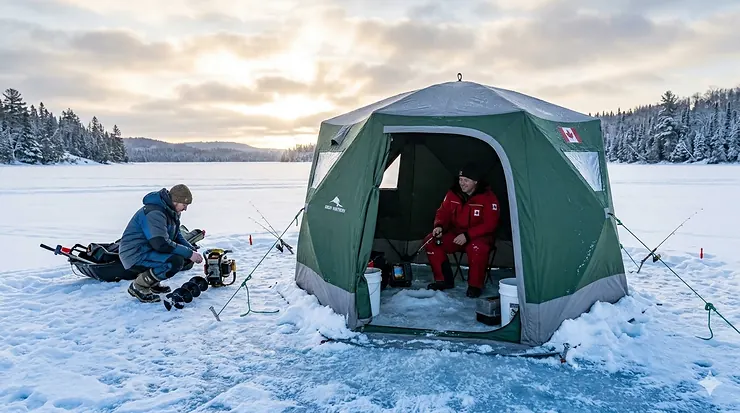
When temperatures plummet across the Canadian prairies and frozen lakes beckon, a quality hub style ice fishing shelter becomes your winter sanctuary. Unlike traditional flip-over designs, these pop-up marvels offer unmatched space, lightning-fast setup, and the versatility Canadian anglers demand for our brutal winters.
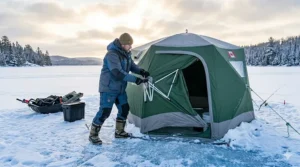
A hub style ice fishing shelter is a portable, pop-up tent designed for ice fishing that uses a hub-and-pole framework to create spacious interior fishing areas. These shelters expand from compact carrying bags into full-sized structures in under 60 seconds, offering superior fishable space compared to flip-over alternatives while maintaining excellent portability.
Ice fishing has deep roots in Canadian culture. According to Wikipedia, Arctic communities have used ice fishing techniques since the last ice age, with the Ojibwe people of northern Ontario being among the first to rely on ice fishing as a primary food source. Today, it’s evolved into a beloved winter tradition that combines outdoor adventure with social gatherings on frozen lakes from British Columbia to Newfoundland.
The Canadian market for hub shelters has exploded, with manufacturers now offering everything from budget-friendly 2-person tents to premium 8-person thermal palaces equipped with integrated lighting systems. Whether you’re planning a solo mission on a secluded lake or hosting a family ice fishing weekend, understanding the nuances between models can save you hundreds of dollars and countless hours of discomfort.
Quick Comparison Table
| Shelter Model | Capacity | Fishable Area | Insulation | Price (CAD) | Best For |
|---|---|---|---|---|---|
| Clam X-600 Thermal | 5-6 people | 94 sq ft | Yes (90g) | $1,199.99 | Premium groups |
| Otter Vortex Pro Lodge | 4-5 people | 60 sq ft | Yes | $799.99 | Mid-range quality |
| Eskimo FatFish 949i | 3-4 people | 61 sq ft | Yes (IQ fabric) | $650-750 | Wide-bottom design |
| VEVOR 6-8 Person | 6-8 people | 70 sq ft | Yes (300D) | $400-500 | Budget large groups |
| Otter Monster Lodge | 6-8 people | 115 sq ft | Yes | $1,194.99 | Ice camping |
| THUNDERBAY Ice Cube | 6-8 people | 68-112 sq ft | Varies | $500-700 | Value seekers |
| Garvee Pop-Up Hub | 6-8 people | 68 sq ft | Yes (420D) | $450-600 | Budget thermal |
💬 Just one click – help others make better buying decisions too! 😊
Top 7 Hub Style Ice Fishing Shelters: Expert Analysis
1. Clam X-600 Thermal – The Canadian Standard
The Clam X-600 Thermal has earned its reputation as Canada’s go-to premium hub shelter, and for good reason. With 94 square feet of fishable area and industry-leading 900 total denier fabric, this 6-sided powerhouse handles Prairie windstorms and Ontario blizzards without breaking a sweat.
Key Specifications:
- 90 grams insulation per square metre
- Flex-tested 11mm poles
- MaxEntry door system (38″ wide)
Price: $1,199.99 CAD at SAIL and specialty retailers
The thermal technology truly shines during multi-day trips. Canadian anglers report maintaining comfortable temperatures with minimal propane usage, even when outside temps dip to -30°C. The Clam X-600 Thermal features Full Thermal Trap Technology that locks in heat while reducing condensation—a game-changer for overnight ice camping on Northern Ontario lakes.
✅ Pros:
- Exceptional build quality for harsh Canadian winters
- Spacious enough for 5-6 anglers plus gear
- Industry-best MaxEntry door for easy access
❌ Cons:
- Premium pricing
- Heavier than budget options (60 lbs)
Canadian customers particularly appreciate the ample headroom and ability to comfortably fit cots for ice camping adventures. One Saskatchewan angler noted running just two holes for fishing while using the rest as a heated basecamp.
2. Otter Vortex Pro Lodge Thermal Hub – Premium Value
The Otter Vortex Pro Lodge strikes an impressive balance between quality and affordability. Currently on sale at $799.99 CAD (regularly $899.99), this 4-5 person hub delivers professional-grade features without the premium price tag.
Key Specifications:
- 60 square feet fishable area
- Full thermal insulation
- 8′ x 8′ footprint
Price: $799.99 CAD (sale price)
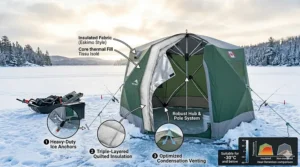
What sets the Otter Vortex Pro Lodge apart is its thoughtful Canadian design. The triple-layer insulated fabric keeps Alberta chinooks and Quebec cold snaps at bay equally well. The 8×8 footprint accommodates up to four anglers comfortably, or fits two cots perfectly for ice camping enthusiasts.
✅ Pros:
- Excellent price-to-performance ratio
- Fits easily in most SUVs and truck beds
- Strong Canadian dealer network
❌ Cons:
- Standard triangle door (less convenient than MaxEntry designs)
Alberta anglers particularly praise its performance in variable conditions, noting it heats efficiently on low propane settings.
3. Eskimo FatFish 949i – Wide-Bottom Innovation
The Eskimo FatFish 949i revolutionized hub shelter design with its flared wide-bottom architecture, and it remains a top rated hub ice tent among Canadian anglers. This clever engineering provides 61 square feet of fishable area in a 3-4 person shelter.
Key Specifications:
- IQ Insulated Quilted fabric (35% warmer)
- All-metal ball-and-socket hub design
- 99″ x 99″ flared footprint
Price: $650-750 CAD depending on retailer
The Eskimo FatFish 949i excels on windy lakes where stability matters. The flared bottom creates natural resistance against gusts, while the IQ insulated fabric maintains warmth without excessive propane consumption. Manitoba ice anglers report excellent performance during overnight trips, with the wide base providing ample room for gear storage.
✅ Pros:
- Innovative wide-bottom design maximizes space
- Durable all-metal hubs
- 6 self-tapping ice anchors included
❌ Cons:
- Slightly heavier than competitors
- Premium pricing for 3-4 person capacity
4. VEVOR 6-8 Person Pop-Up Hub – Budget Champion
Budget-conscious Canadians have embraced the VEVOR 6-8 Person hub shelter as an exceptional value proposition. Priced around $400-500 CAD on Amazon.ca, this spacious hub shelter delivers 70 square feet of fishable area without breaking the bank.
Key Specifications:
- 300D Oxford waterproof fabric
- 70 square feet fishable area
- Quick pop-up design with steel anchors
Price: $400-500 CAD on Amazon.ca
The VEVOR 6-8 Person shelter proves you don’t need to spend $1,000+ for reliable winter protection. While the fabric isn’t quite as burly as premium options, it handles typical Canadian ice fishing conditions admirably. British Columbia anglers report solid performance on milder coastal ice fishing expeditions.
✅ Pros:
- Outstanding value for money
- Generous capacity for groups
- Fast shipping within Canada
❌ Cons:
- Thinner fabric than premium brands
- May require additional insulation in extreme cold
Canadian customer reviews highlight its excellent value for occasional users or families just getting into ice fishing.
5. Otter Vortex Pro Monster Lodge – Ultimate Ice Camping
For serious ice campers, the Otter Vortex Pro Monster Lodge represents the pinnacle of spacious hub shelter design. With a staggering 115 square feet of fishable area, this family hub ice shanty comfortably accommodates 6-8 people or transforms into a luxurious 2-3 person basecamp.
Key Specifications:
- 115 square feet fishable area
- Full thermal insulation
- Accommodates multiple cots
Price: $1,194.99 CAD (sale from $1,299.99)
The Otter Vortex Pro Monster Lodge shines brightest during multi-day ice camping adventures. Saskatchewan anglers report fitting three cots with mattresses plus a portable kitchen setup. The thermal insulation handles -40°C temperatures when paired with an 18,000 BTU heater, though carbon monoxide detectors are absolutely essential.
✅ Pros:
- Massive interior space for ice camping
- Excellent thermal performance
- Perfect for extended trips
❌ Cons:
- Expensive initial investment
- Requires larger vehicle for transport
This shelter particularly appeals to dedicated ice fishing families planning weekend trips on remote Canadian lakes.
6. THUNDERBAY Ice Cube Series – Versatile Performer
The THUNDERBAY Ice Cube Series offers exceptional flexibility with multiple size options ranging from 2-person to 8-person configurations. This family of shelters provides 68-112 square feet of fishable area depending on model selection.
Key Specifications:
- Multiple size configurations
- Hub-style pop-up design
- Available in insulated and non-insulated versions
Price: $500-700 CAD depending on size and insulation
The THUNDERBAY Ice Cube appeals to Canadian anglers who value options. The series allows you to match shelter size precisely to your typical fishing party, avoiding the common mistake of buying too large or too small. Ontario ice fishing guides frequently deploy these shelters for client trips.
✅ Pros:
- Excellent size selection
- Competitive pricing
- Good availability on Amazon.ca
❌ Cons:
- Less established brand recognition
- Variable quality reports between models
7. Garvee Pop-Up Insulated Hub – Thermal Budget Option
The Garvee Pop-Up Insulated Hub delivers thermal protection at budget-friendly pricing, making it an attractive premium hub shelter brand alternative. With 420D three-layer fabric and 68 square feet of fishable area, it punches above its $450-600 CAD price point.
Key Specifications:
- 420D three-layer insulated fabric
- 6-8 person capacity
- Windproof hub design
Price: $450-600 CAD
The Garvee Pop-Up Hub represents the sweet spot for Canadian anglers wanting insulation without premium pricing. The 420D fabric provides legitimate thermal protection, while the hub design ensures quick setup even with gloved hands. Quebec anglers particularly appreciate its performance during late-season ice fishing when temps fluctuate.
✅ Pros:
- Insulated at budget price point
- Spacious for families
- Includes full accessory kit
❌ Cons:
- Limited Canadian dealer network
- Primarily Amazon.ca availability
✨ Don’t Miss These Exclusive Deals!
🔍 Take your ice fishing experience to the next level with these carefully selected hub style ice fishing shelters available in Canada. Click on any highlighted product name to check current pricing and availability on Amazon.ca or authorized Canadian retailers. These top rated hub ice tent options will keep you warm and comfortable throughout the harshest Canadian winters!
Understanding Hub Style Ice Fishing Shelter Design
The engineering behind modern hub shelters represents decades of refinement specifically for North American winters. Unlike flip-over designs that prioritize single-user portability, hub shelters optimize for group comfort and versatility.
The Hub Mechanism Explained
At the heart of every hub shelter lies an ingenious pole-and-hub system. Flexible fiberglass or composite poles insert into metal or plastic hubs positioned at the shelter’s corners and peak. When pulled taut, these poles create the characteristic dome shape that sheds snow and resists wind.
The 6-sided hub shelter configuration has become the Canadian standard because it maximizes interior volume while maintaining structural integrity. Square or rectangular designs create dead zones in corners, while 6-sided geometry provides usable space throughout the entire footprint.
Why Canadians Choose Hub Over Flip-Over Shelters
According to ice fishing experts across Canada, hub shelters dominate in specific scenarios:
Space Efficiency: A typical 8×8 hub provides double the fishable area of comparably-priced flip-over shelters. For families or fishing groups, this translates to actual comfort rather than sardine-can conditions.
Ice Camping Capability: Only spacious hub shelter designs accommodate cots, heaters, and extended-stay setups. Manitoba anglers regularly spend entire weekends in premium hubs, something impossible with flip-overs.
Cost Per Square Foot: Hub shelters deliver significantly more fishable area per dollar invested. A $800 hub might provide 70 square feet versus 25 square feet from a similarly-priced flip-over.
Thermal vs Non-Thermal: The Canadian Perspective
In Canadian conditions, thermal insulation isn’t luxury—it’s essential for extended comfort and safety. Non-insulated shelters work fine for Southern Ontario’s milder winters or short afternoon sessions. However, Prairie provinces and Northern territories demand thermal protection.
Thermal insulation provides three critical benefits:
Heat Retention: Insulated fabrics require 40-50% less propane to maintain comfortable temperatures. Over a season, this pays for the insulation premium through fuel savings.
Condensation Control: The thermal barrier prevents warm interior air from contacting cold fabric, dramatically reducing the condensation that plagues non-insulated shelters. No more ice rain dripping from the ceiling!
Extended Season: Thermal shelters comfortably extend your season into March and even early April in some regions, providing extra weeks of fishable ice time.
How to Choose Your Perfect Hub Style Ice Fishing Shelter
Step 1: Determine Your Typical Group Size
Be honest about your usual fishing party. Manufacturers rate capacity optimistically—their “6-person” shelter assumes six people standing shoulder-to-shoulder. For actual comfort, subtract 2 from the stated capacity.
For ice camping, reduce capacity even further. A “6-person” shelter realistically accommodates 3-4 people with cots and gear.
Step 2: Assess Your Transportation Options
Hub shelters pack remarkably compact, but larger models still require adequate vehicle space. Measure your truck bed or SUV cargo area before committing. Most 8×8 hubs fit in half-ton truck beds or mid-size SUVs, while monster lodges may require full-size trucks.
Step 3: Evaluate Your Climate Zone
According to Ontario ice fishing regulations, ice fishing occurs across dramatically different climate zones within Canada. Your shelter needs align with your region:
Prairie Provinces (AB, SK, MB): Prioritize wind resistance and thermal insulation. Temperatures routinely hit -30°C to -40°C with brutal winds.
Central Canada (ON, QC): Balanced approach works well. Thermal insulation recommended but not absolutely critical for daytime fishing.
Coastal BC: Lighter shelters sufficient for milder conditions. Focus on waterproofing rather than maximum insulation.
Northern Territories: Premium thermal insulation non-negotiable. Only top-tier shelters handle these extreme conditions safely.
Step 4: Budget Realistically
Quality hub shelters range from $400-1,300 CAD. Consider total cost of ownership:
Entry Level ($400-600): VEVOR, Garvee, basic THUNDERBAY models. Adequate for occasional use, mild conditions, or budget constraints.
Mid-Range ($700-900): Otter Vortex Pro series, Eskimo FatFish, premium THUNDERBAY. Best value for regular anglers seeking quality and longevity.
Premium ($1,000-1,300): Clam X-Series, Otter Monster Lodge. Investment pieces for serious ice anglers and ice campers.
Step 5: Consider Insulation Requirements
For most Canadian applications, insulated shelters justify their 20-30% price premium through improved comfort and reduced operating costs. Non-insulated shelters work for:
- Daytime-only fishing
- Mild climate zones
- Very short sessions
- Extremely budget-limited situations
Step 6: Evaluate Setup Complexity
Modern hub shelters deploy in 30-60 seconds with practice, but quality variations exist. Premium brands feature color-coded poles, reinforced attachment points, and intuitive designs. Budget options may require more patience and careful technique.
Step 7: Research Canadian Availability
According to Canadian ice fishing heritage, our vast geography creates availability challenges. Verify:
- Product ships to your province
- Warranty honored in Canada
- Local dealer support available
- Return policies for Canadian purchases
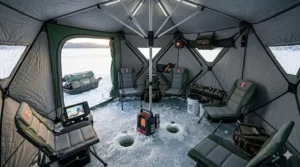
Top Features to Look For in 2026
Advanced Ventilation Systems
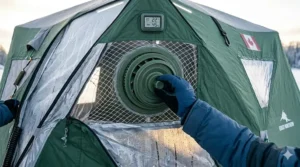
Premium hub shelters now incorporate adjustable venting to balance heat retention with fresh air circulation. Look for shelters with removable window panels and roof vents that allow fine-tuning based on conditions and heater usage.
Integrated Accessory Systems
The Clam Lock system and similar mounting solutions transform shelters into organized command centers. Rod holders, cup holders, electronics mounts, and gear hammocks keep everything accessible without cluttering the ice surface.
MaxEntry Door Technology
Clam’s MaxEntry and similar wide-door designs revolutionize shelter access. Traditional triangular doors force awkward crawling, while 38-inch MaxEntry doors allow normal walking entry/exit—crucial when wearing bulky winter gear or assisting children.
Reinforced Stress Points
Canadian conditions punish weak construction. Examine corner reinforcements, pole attachment points, and fabric seams. Double or triple-stitched seams with reinforcement patches indicate quality construction.
Quick-Deploy Anchoring
Steel self-tapping ice anchors have replaced traditional rope-and-stake systems. Modern anchors drill into ice in seconds using a cordless drill, providing rock-solid hold in extreme winds.
Essential Accessories for Hub Shelters
Portable Heaters (Mandatory for Canadian Winters)
Mr. Heater Big Buddy propane heaters remain the Canadian standard, providing 4,000-18,000 BTU adjustable heat. Always use two carbon monoxide detectors as mandated by safety guidelines. Never operate heaters overnight without proper ventilation and monitoring.
Foam Floor Tiles
Interlocking foam tiles insulate from ice-cold floors while providing cushioned comfort. The investment pays dividends during extended sessions, keeping feet warm and reducing fatigue.
LED Lighting Systems
Modern shelters increasingly feature integrated LED lighting channels, but standalone LED strips work excellently in older models. Battery-powered systems eliminate generator noise and fumes.
Sled Transportation
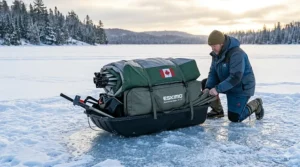
Jet sleds or purpose-built shelter sleds streamline transportation across ice. Match sled size to your shelter’s packed dimensions for optimal efficiency.
Hub Style Ice Fishing Shelter Comparison: Key Factors
| Factor | Hub Shelters | Flip-Over Shelters |
|---|---|---|
| Setup Time | 30-60 seconds | 15-30 seconds |
| Fishable Space | 50-115 sq ft typical | 15-35 sq ft typical |
| Ice Camping Ability | Excellent | Limited |
| Portability | Good (requires sled) | Excellent (built-in sled) |
| Price per Sq Ft | $10-20 | $30-50 |
| Group Fishing | Excellent (4-8 people) | Limited (1-3 people) |
| Storage Space | Compact bags | Bulky even collapsed |
Canadian Ice Fishing Regulations and Safety
Before deploying any hub style ice fishing shelter in Canada, familiarize yourself with provincial regulations. Requirements vary significantly:
Ontario Regulations
According to the Ontario Government fishing regulations, ice huts used in Fisheries Management Zones 9-12 and 14-20 must be registered. Registration is free and can be completed online. Your registration number must be displayed on the outside of your shelter in letters at least 6.3 cm (2.5 inches) high.
Ice huts must be removed by specific dates depending on location:
- FMZ 9-12: Typically mid-March
- FMZ 14-20: Late March to early April
Safety Guidelines
Canadian ice fishing safety demands respect for ice conditions:
- Minimum ice thickness: 10 cm (4 inches) for walking, 20-25 cm (8-10 inches) for snowmobiles, 30+ cm (12+ inches) for light vehicles
- Stay within 60 metres of your lines with clear, unobstructed view (Ontario regulation)
- Avoid pressure cracks, springs, and river inlets where ice forms irregularly
- Check ice thickness regularly as you move to new locations
Carbon monoxide poisoning presents serious risk in enclosed shelters. Always use detectors, ensure adequate ventilation, and never operate heaters unattended overnight.
Price Range & Value Analysis
| Price Range | What You Get | Best For |
|---|---|---|
| $400-600 CAD | Basic thermal or premium non-thermal, 4-6 person capacity, standard features | Occasional anglers, budget-conscious families |
| $700-900 CAD | Quality thermal insulation, 5-6 person capacity, enhanced features, established brands | Regular ice anglers seeking reliability |
| $1,000-1,300 CAD | Premium thermal, 6-8+ person capacity, advanced features, ice camping capable | Dedicated anglers, ice camping enthusiasts, guides |
Canadian Ice Fishing Regulations and Safety
Before deploying any hub style ice fishing shelter in Canada, familiarize yourself with provincial regulations. Requirements vary significantly:
Ontario Regulations
According to the Ontario Government fishing regulations, ice huts used in Fisheries Management Zones 9-12 and 14-20 must be registered. Registration is free and can be completed online. Your registration number must be displayed on the outside of your shelter in letters at least 6.3 cm (2.5 inches) high.
Ice huts must be removed by specific dates depending on location:
- FMZ 9-12: Typically mid-March
- FMZ 14-20: Late March to early April
Safety Guidelines
Canadian ice fishing safety demands respect for ice conditions:
- Minimum ice thickness: 10 cm (4 inches) for walking, 20-25 cm (8-10 inches) for snowmobiles, 30+ cm (12+ inches) for light vehicles
- Stay within 60 metres of your lines with clear, unobstructed view (Ontario regulation)
- Avoid pressure cracks, springs, and river inlets where ice forms irregularly
- Check ice thickness regularly as you move to new locations
Carbon monoxide poisoning presents serious risk in enclosed shelters. Always use detectors, ensure adequate ventilation, and never operate heaters unattended overnight.
Price Range & Value Analysis
| Price Range | What You Get | Best For |
|---|---|---|
| $400-600 CAD | Basic thermal or premium non-thermal, 4-6 person capacity, standard features | Occasional anglers, budget-conscious families |
| $700-900 CAD | Quality thermal insulation, 5-6 person capacity, enhanced features, established brands | Regular ice anglers seeking reliability |
| $1,000-1,300 CAD | Premium thermal, 6-8+ person capacity, advanced features, ice camping capable | Dedicated anglers, ice camping enthusiasts, guides |
❓ Frequently Asked Questions
❓ What is the best size hub style ice fishing shelter for 4 people in Canada?
❓ How much does a quality hub style ice fishing shelter cost in Canada?
❓ Do I need a thermal hub style ice fishing shelter for Canadian winters?
❓ How long does it take to set up a hub style ice fishing shelter?
❓ Can hub style ice fishing shelters withstand strong Canadian winds?
Conclusion: Finding Your Perfect Canadian Ice Fishing Shelter
Selecting the ideal hub style ice fishing shelter ultimately depends on your specific Canadian ice fishing style, budget, and environmental conditions. For Prairie anglers facing -40°C temperatures and howling winds, premium thermal options like the Clam X-600 Thermal ($1,199.99 CAD) or Otter Vortex Pro Monster Lodge ($1,194.99 CAD) represent smart long-term investments.
Budget-conscious anglers or those fishing milder regions find excellent value in the VEVOR 6-8 Person ($400-500 CAD) or Garvee Pop-Up Hub ($450-600 CAD). These spacious hub shelter review consistently highlight their impressive performance relative to pricing.
The sweet spot for most Canadian ice anglers remains the mid-range category. The Otter Vortex Pro Lodge at $799.99 CAD delivers professional quality at accessible pricing, while the Eskimo FatFish 949i brings innovative design to the 3-4 person segment.
Remember that your hub shelter investment extends beyond the initial purchase. Factor in accessories like proper heaters, floor insulation, lighting, and transportation sleds. Quality shelters from established brands typically deliver 10+ years of reliable service when properly maintained—amortizing even premium prices to very reasonable annual costs.
Most importantly, any hub shelter beats no shelter when Canadian winter descends. Start with a model that fits your current budget and needs, then upgrade as your ice fishing passion grows. The frozen lakes of Canada await, and with the right hub style ice fishing shelter, you’ll fish comfortably no matter what winter throws at you.
Recommended for You
- Hub Style Ice Shelter vs Flip Over: 7 Best Picks Canada 2026
- 7 Best Pop Up Ice Shelters Canada 2026: Fast Setup Guide
- 7 Best Pop Up Ice Fishing Shelters 2026
Disclaimer: This article contains affiliate links to Amazon.ca. If you purchase products through these links, we may earn a small commission at no additional cost to you.
✨ Found this helpful? Share it with your friends! 💬🤗
