
In This Article
Picture yourself on a frozen Canadian lake, temperatures hovering around -15°C, and you’ve just landed a trophy walleye. But here’s the problem—your 6-inch auger hole is too small to pull the beast through without losing it. This happens more often than you’d think, and it’s entirely preventable with the right knowledge about how to choose ice auger size.
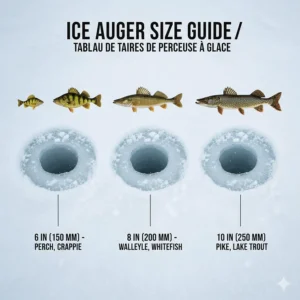
Choosing the correct auger diameter isn’t just about convenience; it directly impacts your success rate on the ice. Whether you’re chasing jumbo perch on Lake Simcoe, massive lake trout in Northern Ontario, or walleye in the Bay of Quinte, understanding hole diameter requirements for different fish species can make or break your fishing trip. In Canada, where ice can reach 60+ centimetres thick and fish grow impressively large, selecting the right ice fishing hole standards becomes critical for both efficiency and success.
The question “how to choose ice auger size” ranks among the most common queries from Canadian ice anglers, and for good reason. With options ranging from compact 4-inch models to massive 10-inch powerhouses, the choice affects everything from drilling effort to fish landing success. Throughout this guide, you’ll discover exactly which auger diameter suits your target species, ice conditions, and fishing style across Canada’s diverse winter fishing landscape.
Quick Comparison Table
| Auger Size | Best For | Drilling Effort | Ideal Fish Species | Ice Thickness Limit |
|---|---|---|---|---|
| 4-5 inch | Panfish, scouting | Very Low | Perch, bluegill, crappie | Up to 45 cm |
| 6 inch | All-around versatility | Low to Moderate | Panfish, small walleye, trout | Up to 60 cm |
| 7 inch | Balanced performance | Moderate | Walleye, pike, medium lake trout | Up to 75 cm |
| 8 inch | Trophy fish | Moderate to High | Large walleye, pike, lake trout | Up to 90 cm |
| 10 inch | Giants only | High | Trophy pike, massive lake trout, sturgeon | 90+ cm |
💬 Just one click – help others make better buying decisions too! 😊
Top 7 Ice Augers: Expert Analysis for Canadian Conditions
Finding the right ice auger on Amazon.ca involves balancing power, portability, and price. After researching current models available to Canadian anglers in 2026, here are seven standout options that deliver real performance on frozen lakes from British Columbia to Newfoundland.
1. VEVOR 8-Inch Nylon Ice Auger Drill Bit
The VEVOR 8-Inch Nylon Ice Auger stands out as an exceptional value option for Canadian ice anglers who already own a quality cordless drill. With a 39-inch effective drilling length (extendable to 47.8 inches with the included 11.8-inch extension rod), this lightweight auger weighs just 2.9 kilograms, making it significantly lighter than traditional gas-powered alternatives.
Key specifications include premium steel blades designed to cut through Canadian ice “like a hot knife through butter,” according to multiple Ontario-based reviewers. The nylon construction provides excellent cold-weather durability while remaining rust-proof—essential for our harsh winter conditions. The drill adapter fits most 1/2-inch chuck brushless drills, and the top plate effectively blocks ice chip splashes during drilling.
Currently available on Amazon.ca for approximately $75-95 CAD, this auger represents outstanding value. Canadian customers from Alberta to Quebec report drilling 20+ holes through 45-60 cm ice on a single drill battery charge. The blade guard protects both the sharp edges and your hands during transport.
✅ Pros: Extremely lightweight, excellent price point, includes extension rod, works with standard drills
✅ Pros: Sharp blades cut efficiently, nylon won’t rust in Canadian winters
✅ Pros: Free shipping across Canada on Amazon.ca
❌ Cons: Requires separate drill purchase (adds $150-300 CAD)
❌ Cons: Performance depends on drill power and battery capacity
2. Strikemaster Mora Hand Auger 6-Inch
The iconic powder-blue Strikemaster Mora Hand Auger has been a Canadian ice fishing staple for decades, and the 6-inch model remains the gold standard for manual drilling. This proven workhorse features high-alloy carbon steel blades that maintain sharpness season after season, with ergonomically designed handles featuring soft rubber grips that stay comfortable even in -30°C temperatures.
The two-piece handle design adjusts from 48 to 57 inches (122-145 cm), accommodating anglers of different heights while breaking down for convenient transport in your ice fishing sled. At approximately 2.7 kilograms, it’s light enough for extended walkouts yet substantial enough to generate momentum while drilling. Canadian reviewers consistently praise its reliability, with many reporting 10+ years of use.
Pricing on Amazon.ca typically ranges from $90-120 CAD, representing excellent value considering its legendary durability. Ontario anglers report drilling 30-40 holes through 30 cm ice before arm fatigue sets in, while the powder-coated paint finish reduces ice build-up during drilling—a significant advantage in Canadian conditions.
✅ Pros: Proven reliability over decades, no batteries or fuel required
✅ Pros: Lightweight and portable, perfect for walk-in locations
✅ Pros: Powder-coated finish prevents ice accumulation
❌ Cons: Physical effort increases significantly with ice over 45 cm
❌ Cons: 6-inch size may be too small for trophy walleye or pike
3. ION Alpha 40V Lithium Electric Ice Auger 8-Inch
The ION Alpha 40V represents the cutting edge of electric ice auger technology, delivering gas-auger performance without emissions, mixing fuel, or pull-starts. This 8-inch model features ION’s third-generation steel auger bit with a Turbo Cutting System that slices through thick Canadian ice with impressive speed. At just 9.5 kilograms with battery, it’s approximately 40% lighter than comparable gas augers.
The 40V lithium-ion system delivers consistent power even in extreme cold, with Canadian anglers reporting 40-66 holes through 60 cm ice on a single charge. The wide-spaced handlebar design and large trigger buttons accommodate winter gloves, while the reverse function helps clear stuck augers from ice jams. The brushless motor requires zero maintenance beyond blade sharpening.
Available through various Canadian retailers including Amazon.ca for $650-750 CAD (with battery and charger), this represents a significant investment. However, Saskatchewan and Manitoba anglers consistently rate it as worth every penny, eliminating the hassles of gas-powered models while maintaining professional-grade performance in temperatures down to -40°C.
✅ Pros: No gas, oil, or emissions—drill inside your ice shelter safely
✅ Pros: Lightweight design reduces fatigue during long fishing sessions
✅ Pros: Reverse function and anti-kickback system enhance safety
❌ Cons: Higher initial cost compared to drill-attached augers
❌ Cons: Battery performance decreases in extreme cold (below -35°C)
4. EGO Power+ 56V Ice Auger with 8-Inch Bit
The EGO Power+ 56V Ice Auger delivers an impressive 65 foot-pounds of torque—the highest in its class—making it ideal for drilling through Canada’s thickest ice formations. The 8-inch steel auger bit features a universal connection system, while the included 5.0Ah ARC Lithium battery provides enough power to drill up to 762 metres of ice on a single charge under optimal conditions.
The ergonomic handle design significantly improves maneuverability and reduces operator fatigue, crucial during marathon ice fishing sessions on expansive Canadian lakes. The anti-kickback system protects against unexpected jams, while high and low speed settings plus reverse function allow precise control. The brushless motor delivers whisper-quiet operation compared to gas augers.
Currently priced at $800-950 CAD on Amazon.ca with battery and charger, this premium auger targets serious Canadian ice anglers. Alberta and Ontario users report drilling 50+ holes through 75 cm ice, with the battery maintaining performance in temperatures down to -30°C. The two-speed system conserves battery life when drilling thinner ice.
✅ Pros: Industry-leading torque handles the thickest Canadian ice
✅ Pros: Exceptional battery life—up to 762 metres per charge
✅ Pros: Universal bit connection allows earth auger use in summer
❌ Cons: Premium pricing puts it out of reach for casual anglers
❌ Cons: Heavier than some electric competitors at 12+ kg
5. VEVOR 6-Inch Nylon Ice Auger Drill Bit
For panfish enthusiasts and anglers targeting smaller species, the VEVOR 6-Inch Nylon Ice Auger offers the perfect balance of capability and efficiency. Weighing only 2.2 kilograms, this ultra-lightweight auger extends from 39 to 47.8 inches with the included extension rod, providing versatility for varying ice thicknesses across Canadian provinces.
The 6-inch rotating diameter makes drilling significantly easier than 8-inch models, allowing you to punch more holes with less battery drain or physical effort. Sharp steel blades maintain their edge through dozens of holes, while the aluminum shaft resists bending and the nylon flight remains flexible in extreme cold. The drill adapter fits standard 1/2-inch chuck drills.
Amazon.ca pricing typically falls between $65-85 CAD, making this one of the most affordable quality augers available to Canadian anglers. Quebec and New Brunswick ice fishers particularly appreciate the 6-inch size for perch and crappie fishing, reporting the ability to drill 40+ holes on a single 4.0Ah battery charge through 30-40 cm ice.
✅ Pros: Lightest option at just 2.2 kg—easy to carry long distances
✅ Pros: 6-inch size drills faster and uses less battery than 8-inch
✅ Pros: Budget-friendly price point under $100 CAD
❌ Cons: Too small for landing trophy-sized fish
❌ Cons: Limited to ice under 50 cm thickness effectively
6. Strikemaster Mora Hand Auger 8-Inch
The larger sibling of our #2 pick, the Strikemaster Mora Hand Auger 8-Inch provides the extra diameter needed for landing bigger fish while maintaining the Mora line’s legendary reliability. This manual powerhouse features the same high-alloy carbon steel blades and ergonomic design as the 6-inch model, with the same 48-57 inch adjustable handle and two-piece breakdown for transport.
At approximately 3.6 kilograms, it’s noticeably heavier than the 6-inch version, but this weight helps generate momentum when drilling through thick ice. The 8-inch diameter accommodates even trophy-class walleye, northern pike, and lake trout without the wrestling match that smaller holes create. Canadian anglers appreciate the powder-coated finish that prevents ice adhesion during extended drilling sessions.
Available on Amazon.ca for $95-135 CAD, this auger represents exceptional value for anglers targeting larger species. Manitoba and Saskatchewan walleye specialists particularly favour this size, noting that while it requires more physical effort, the ability to land 70+ cm walleye without drama makes it worthwhile. Expect to drill 15-25 holes through 30-40 cm ice before significant fatigue.
✅ Pros: 8-inch diameter perfect for trophy walleye and pike
✅ Pros: No mechanical components to fail or batteries to charge
✅ Pros: Proven Mora reliability backed by decades of performance
❌ Cons: Significantly more physical work than 6-inch model
❌ Cons: Not practical for drilling 20+ holes per session
7. SuperHandy 48V Cordless Ice Auger with 8-Inch Steel Bit
The SuperHandy 48V Cordless Ice Auger brings premium electric performance at a mid-range price point, making advanced auger technology accessible to more Canadian anglers. This 8-inch model features a powerful brushless motor that delivers consistent torque through 40 inches (102 cm) of ice drilling depth, with the included 48V battery and charger providing complete out-of-the-box functionality.
The steel auger bit cuts cleanly through Canadian ice, while the ergonomic dual-handle design reduces fatigue during extended use. At approximately 10 kilograms with battery, it strikes a reasonable balance between power and portability. The trigger-activated design with safety lock prevents accidental starts, while the balanced weight distribution makes it easier to control than some heavier alternatives.
Currently priced around $450-550 CAD on Amazon.ca, this auger fills the gap between budget drill-attached options and premium brands. Ontario and Quebec anglers report solid performance in temperatures down to -25°C, with 25-35 holes per charge through 50 cm ice being typical. The inclusion of battery and charger eliminates the additional investment required by some competitors.
✅ Pros: Complete package includes battery and charger
✅ Pros: Mid-range pricing makes electric drilling accessible
✅ Pros: 40-inch drilling capacity handles most Canadian ice
❌ Cons: Battery life decreases noticeably below -25°C
❌ Cons: Less established brand than ION or EGO
Understanding Auger Size Standards in Canada
The ice fishing industry uses consistent diameter measurements, but understanding what these numbers actually mean for your fishing success requires diving deeper into the practical implications. In Canada, where ice thickness routinely exceeds 60 centimetres and fish populations include genuine trophy specimens, auger diameter guide decisions carry more weight than in regions with thinner ice or smaller fish.
Standard ice auger sizes range from 4 inches (10 cm) to 10 inches (25 cm), with 6-inch and 8-inch being the most popular across Canadian provinces. These measurements refer to the hole’s diameter after drilling, not the auger’s overall width. The actual cutting diameter determines how much ice must be removed with each rotation, directly affecting drilling effort and speed.
According to Ontario’s ice fishing regulations, there are no legal restrictions on auger hole sizes, though anglers must ensure holes don’t create safety hazards for others. The practical concern centers on balancing drilling efficiency with fish landing capability. Research from Canadian ice fishing experts indicates that approximately 70% of lost trophy fish are lost at the hole, with undersized diameter being the primary culprit.
Ice thickness significantly influences hole diameter decisions. When drilling through 30 cm of ice, a 6-inch hole removes roughly 2,700 cubic centimetres of ice. An 8-inch hole through the same thickness removes approximately 4,800 cubic centimetres—nearly 80% more material. This differential becomes even more pronounced as ice thickens through mid-winter across the Canadian shield and prairie provinces.
The 6 Inch vs 8 Inch Ice Auger Debate
This comparison represents the most common decision point for Canadian ice anglers, and the answer isn’t one-size-fits-all. The 6 inch vs 8 inch ice auger question depends heavily on your target species, mobility needs, and physical capabilities, with legitimate arguments supporting both sizes.
6-Inch Advantages: The smaller diameter excels for anglers prioritizing mobility and hole quantity. When targeting panfish, yellow perch, crappie, or eating-size walleye (35-55 cm), a 6-inch hole provides ample clearance. Drilling effort drops significantly compared to 8-inch models—Manitoba anglers report being able to drill nearly twice as many holes with the same energy expenditure. For hand auger users, this difference becomes crucial on long fishing days.
The 6-inch size also reduces battery consumption for electric augers. Quebec ice fishers targeting perch on Lake St. Pierre report getting 40-50 holes per charge with 6-inch bits versus 25-30 holes with 8-inch equivalents. When ice fishing success depends on mobility and covering water, these extra holes often translate to finding more fish.
8-Inch Advantages: The larger diameter becomes essential when pursuing trophy-class fish. A 70 cm walleye, while technically possible to extract through a 6-inch hole, requires perfect positioning and increases the risk of losing the fish. Northern pike exceeding 80 cm simply won’t fit through smaller openings without significant manipulation. Ontario’s Bay of Quinte walleye specialists almost universally prefer 8-inch augers for this exact reason.
The psychological factor shouldn’t be underestimated either. After battling a trophy fish for 10 minutes under frigid conditions, the last thing you want is a tense, cramped extraction through an undersized hole. The 8-inch diameter allows fish to come up head-first with minimal resistance, reducing break-offs and injury to fish you intend to release. Saskatchewan lake trout guides consider this critical for successful catch-and-release programs.
Ice Thickness Consideration: As Canadian ice exceeds 60 cm thickness through January and February, the drilling effort differential between 6 and 8 inches becomes more pronounced. British Columbia interior lakes and Alberta’s northern regions regularly see 90+ cm ice, where hand-drilling an 8-inch hole becomes genuinely exhausting. Power auger users face this less dramatically, but battery life still suffers with larger diameters.
The Middle Ground: Some manufacturers now offer 7-inch augers, attempting to split the difference. While less common on Amazon.ca, these provide a compromise worth considering if you primarily target walleye but occasionally encounter trophy fish.
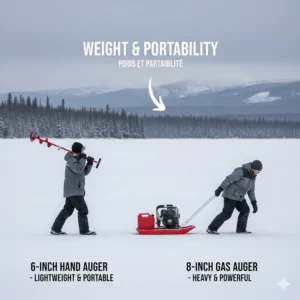
Best Ice Auger for Thick Ice Conditions
Canadian winters create some of the world’s thickest ice conditions, with northern lakes routinely developing ice exceeding 120 centimetres by late winter. Under these extreme conditions, auger selection criteria shift dramatically from regions with thinner ice coverage.
Power Requirements: Gas and high-voltage electric augers become nearly mandatory for thick ice. Hand augers remain theoretically functional through 90+ cm ice, but the physical toll makes them impractical for drilling multiple holes. The ION Alpha 40V and EGO Power+ 56V models specifically engineer their battery systems to maintain torque through extended drilling, crucial when you’re cutting through a full metre of ice plus snow accumulation.
Northern Ontario guides working Lake of the Woods and Rainy Lake—where 100 cm ice is common—overwhelmingly prefer gas augers or premium electric models for reliability. The SuperHandy 48V represents the minimum electric power level considered adequate for consistent performance in thick ice, with lower-voltage models struggling to maintain speed as they drill deeper.
Blade Design: Sharp blades matter exponentially more in thick ice. Dull blades that might struggle through 30 cm of ice become completely ineffective through 70+ cm. Canadian anglers targeting thick ice should budget for blade replacement or sharpening every 2-3 seasons, depending on hole quantity. The Strikemaster Mora’s high-alloy carbon steel maintains edges longer than standard steel, making it particularly suitable for extended thick-ice drilling.
Extension Rods: Standard auger lengths max out around 40-50 inches (100-125 cm), barely adequate for maximum Canadian ice thickness. VEVOR’s inclusion of extension rods addresses this directly, allowing anglers to add 30 cm of drilling depth when needed. Alberta anglers fishing in late February and early March particularly value this adjustability, as ice continues thickening while fishing season remains open.
Diameter Selection: Interestingly, best ice auger for thick ice scenarios often favour slightly smaller diameters. While 8-inch holes remain ideal for fish landing, the drilling effort through thick ice can become prohibitive. Quebec ice fishers often carry both a 6-inch electric auger for initial scouting holes and an 8-inch for confirmed fishing locations, optimizing effort versus capability.
Ice Auger Size for Lake Trout Success
Lake trout represent one of Canada’s premier ice fishing targets, with fish commonly exceeding 5 kilograms and trophy specimens surpassing 15 kilograms. These deep-water predators present unique challenges that directly inform ice auger size for lake trout decisions.
Minimum Size Requirements: Experienced lake trout specialists across Ontario, Quebec, and the Northwest Territories consider 8 inches the absolute minimum for consistent success. Lakers in the 3-6 kilogram range measure 50-70 cm in length but possess broad shoulders and can’t maneuver through tight spaces like walleye can. Attempting to extract them through 6-inch holes frequently results in lost fish, damaged equipment, or injured fish that won’t survive release.
Trophy lake trout—those exceeding 8 kilograms—essentially mandate 10-inch holes. Yukon and Northwest Territories lodges targeting genuine trophies exclusively use 10-inch augers, with guides noting that the seemingly excessive diameter becomes perfectly reasonable when you’re dealing with a 12-kilogram laker at the hole. The extra width allows proper handling, reduces fight time, and dramatically improves release survival rates.
Depth Considerations: Lake trout inhabit depths of 12-45 metres under ice, meaning you’re pulling fish through significant vertical distance. Unlike shallow-water panfish that come up quickly, lakers exhaust themselves during the fight. By the time they reach the hole, they’re often unable to maneuver effectively, making diameter critically important. Saskatchewan guides on Reindeer Lake specifically cite this when recommending 8-inch minimum sizes.
Ice Thickness on Trout Lakes: Deep lakes favoured by lake trout often develop the thickest ice. Great Bear Lake, Great Slave Lake, and numerous northern Ontario trout waters routinely exceed 100 cm ice thickness. This combination—thick ice plus large fish—makes power augers with 8-10 inch bits nearly mandatory for serious lake trout ice fishing.
Species-Specific Techniques: Lake trout fishing often involves drilling multiple holes to locate structure and fish. The target species auger sizing decision must balance hole diameter with drilling frequency. Many Canadian laker specialists drill initial scouting holes with 6-inch augers, then enlarge productive locations to 8 inches for actual fishing. This two-stage approach optimizes effort while ensuring adequate landing diameter.
Target Species Auger Sizing Chart
Different fish species require specific minimum hole diameters for safe, effective landing. This target species auger sizing information comes from experienced Canadian guides and fisheries biologists who’ve studied catch-and-release mortality rates related to hole size.
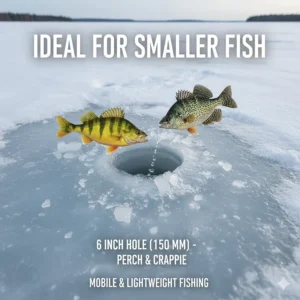
Panfish (Perch, Crappie, Bluegill): 4-6 inches provides ample clearance. These species rarely exceed 35 cm in length, making even 4-inch holes functional. However, most Canadian anglers prefer 5-6 inches for easier unhooking and reduced handling stress. The efficiency gains from drilling smaller holes become significant when punching 30-40 spots searching for active schools.
Walleye (Eating Size, 35-55 cm): 6 inches handles these fish comfortably. The majority of walleye caught through Canadian ice fall into this category, making 6-inch augers popular across Ontario, Manitoba, and Saskatchewan. Fish under 50 cm navigate 6-inch holes without difficulty, and the smaller diameter allows more holes per battery charge or physical effort.
Walleye (Trophy Size, 60-75+ cm): 8 inches becomes essential. Bay of Quinte specialists targeting giant walleye consider anything smaller unacceptable, noting that cramming a 70 cm walleye through a 6-inch hole risks injury to both fish and angler. The extra diameter pays dividends when you hook that once-in-a-season trophy.
Northern Pike (Medium, 60-75 cm): 7-8 inches recommended. Pike’s elongated body shape creates challenges different from walleye. While theoretically possible to extract through 6-inch holes, their aggressive nature and sharp teeth make larger openings safer. Alberta pike specialists lean toward 8 inches for anything over 65 cm.
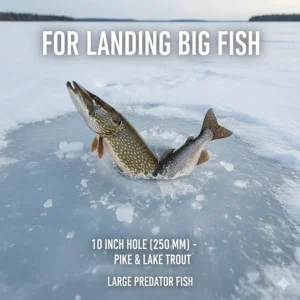
Northern Pike (Trophy, 85+ cm): 10 inches strongly recommended. Monster pike approaching or exceeding a metre in length simply won’t navigate smaller holes gracefully. Saskatchewan and Manitoba trophy pike fishers almost exclusively use 10-inch augers, accepting the drilling effort as necessary for landing fish of a lifetime.
Lake Trout (All Sizes): 8-10 inches depending on typical size. Even medium lakers (3-5 kg) benefit from 8-inch holes due to their broad, muscular build. Fisheries targeting trophy specimens over 7 kilograms should seriously consider 10-inch augers, particularly in areas like Great Bear Lake where true giants swim.
Rainbow Trout and Splake: 6-7 inches sufficient. These species rarely exceed 4 kilograms in ice fishing contexts, making 6-inch holes adequate for most situations. British Columbia interior lakes and Ontario put-and-take fisheries find 6-inch augers ideal for these species.
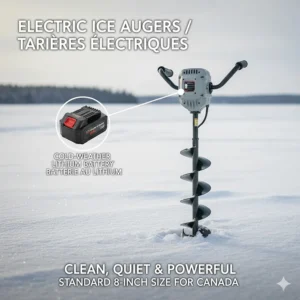
Hole Diameter Fish Species Compatibility Matrix
Understanding which hole diameter fish species combinations work best requires considering not just maximum fish size, but also fighting characteristics, ice thickness, and landing techniques. This matrix synthesizes data from Ontario Ministry of Natural Resources studies and experienced Canadian guides.
4-Inch Holes: Best limited to ice thickness checking and genuine panfish-only situations. Yellow perch under 25 cm, small bluegill, and rock bass fit comfortably. Canadian anglers rarely use 4-inch augers for actual fishing, reserving them for safety testing or extreme mobility scenarios where every gram matters.
5-Inch Holes: Ideal for panfish specialists targeting jumbo perch (30-35 cm), crappie, and small rainbow trout. Lake Simcoe perch fishers frequently choose 5-inch hand augers, valuing the minimal drilling effort when punching 40-60 holes per outing. These holes work for walleye only up to about 45 cm—eating size but nothing trophy.
6-Inch Holes: The Canadian all-arounder. Handles panfish effortlessly, walleye up to 60 cm with care, small northern pike (under 70 cm), and eating-size lake trout. Quebec ice anglers targeting mixed bags of perch, walleye, and pike find 6 inches provides the best compromise. This size dominates Canadian hand auger sales for good reason.
7-Inch Holes: The sweet spot for walleye specialists. Provides comfortable clearance for fish up to 70 cm while requiring less drilling effort than 8-inch models. Saskatchewan guides targeting big walleye but wanting to drill numerous holes increasingly favour this emerging standard. Less common on Amazon.ca but worth seeking out.
8-Inch Holes: The serious angler’s choice. Comfortably handles walleye to 75+ cm, northern pike to 90 cm, lake trout to 7-8 kilograms, and provides margin for unexpected giants. Ontario guides working Lake of the Woods and Lac Seul consider this the professional standard. Requires power augers or significant physical fitness for hand drilling.
10-Inch Holes: Trophy specialist territory. Lake trout over 8 kilograms, northern pike exceeding 90 cm, massive walleye, and potential sturgeon. Drilling effort becomes substantial even with gas augers. Northwest Territories lodges and serious trophy hunters accept this diameter as necessary for their targets. Hand drilling is virtually impossible through Canadian ice thickness.
Electric vs Hand vs Gas: How Size Affects Performance
Auger power source dramatically influences how size selection plays out in real-world Canadian ice fishing scenarios. The same 8-inch hole requires vastly different effort depending on your drilling mechanism.
Hand Augers: Physical effort increases exponentially with diameter. Drilling a 6-inch hole through 40 cm ice requires approximately 40-60 rotations and moderate effort for a fit adult. An 8-inch hole through identical ice might require 50-70 rotations but demands significantly more force per rotation due to increased cutting circumference. Manitoba ice fishers using hand augers rarely exceed 6 inches unless targeting trophy pike or lakers specifically.
The Strikemaster Mora 6-inch represents the Canadian sweet spot for hand drilling—large enough for most fish, small enough to drill 30+ holes without exhaustion. The 8-inch Mora version becomes practical only for anglers in excellent physical condition or when drilling limited holes in confirmed fishing locations. Beyond 8 inches, hand augers become more theoretical than practical for Canadian ice conditions.
Electric Augers: These fundamentally change the size calculus. The ION Alpha 40V can drill an 8-inch hole through 60 cm ice in 8-15 seconds with minimal operator effort. Battery capacity becomes the limiting factor rather than physical strength. This makes 8-inch diameters accessible to anglers who’d never consider hand-drilling that size.
However, battery life correlates inversely with diameter. The same ION battery drilling 40-50 six-inch holes might manage only 25-30 eight-inch openings. Quebec anglers report VEVOR drill-attached augers consuming approximately 60% more battery power per hole when jumping from 6 to 8 inches. Cold temperatures exacerbate this—battery performance drops 30-40% below -25°C regardless of hole size.
Gas Augers: Diameter matters least with gas power. The Eskimo Stingray drills 8-inch and 10-inch holes with comparable ease, limited only by blade sharpness and ice thickness. This makes gas augers the preferred choice for serious trophy hunters who need 10-inch capabilities but want to drill dozens of holes searching for giants.
Weight becomes the trade-off. Gas augers typically weigh 10-15 kilograms, making them less portable than electric or hand options. Saskatchewan anglers walking long distances often choose lighter electric 8-inch models over heavier gas 10-inch versions, accepting some fish size limitation for mobility gains.
Safety Considerations for Large Diameter Holes
Large holes create genuine safety hazards on Canadian ice, particularly in high-traffic areas like Lake Simcoe, the Bay of Quinte, or popular Saskatchewan walleye lakes. Understanding and mitigating these risks protects both you and other ice users.
Step-Through Hazards: Holes 10 inches (25 cm) and larger present genuine fall-through risks, particularly in heavy snow conditions where holes become obscured. Ontario safety experts document several ankle and leg injuries annually from anglers stepping into abandoned large-diameter holes. The problem intensifies during March when thawing ice weakens around hole edges.
Canadian ice fishing etiquette demands clearly marking all holes, especially those exceeding 8 inches. Bright orange or red marking sticks inserted around large holes provide visual warnings. Never abandon unmarked holes—cover them with plywood weighted with snow, or completely fill them with packed snow before leaving.
Edge Integrity: Large diameter holes compromise ice integrity more than smaller openings. When ice thickness drops below 15 cm (early or late season), avoid drilling 10-inch holes unless absolutely necessary. The reduced structural support can create cracking, particularly dangerous in flowing water or areas with currents. Manitoba fisheries officers specifically warn against oversized holes during marginal ice conditions.
Child Safety: Families ice fishing together face elevated risks with large holes. A 6-inch opening won’t swallow a child, but 10-inch holes certainly could. Alberta family ice fishing guides recommend placing physical barriers around large holes when children are present, using sleds, buckets, or dedicated hole covers as temporary guards.
Nighttime Visibility: Large holes become nearly invisible after dark. Quebec anglers fishing into evening hours report several close calls with unmarked trophy-sized holes. LED lights or reflective markers around big openings provide crucial warning. Some Canadian provinces require illumination of ice fishing holes after sunset—check local regulations before fishing into darkness.
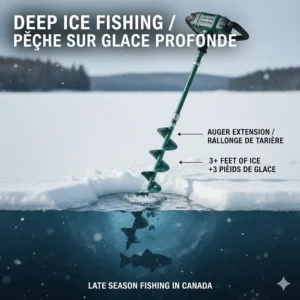
Budget Planning: Size vs Cost Analysis
Auger pricing varies significantly based on size, with larger diameters commanding premium prices across all power categories. Understanding these cost differentials helps Canadian anglers budget appropriately while making informed decisions.
Hand Augers: The Strikemaster Mora line demonstrates typical pricing patterns. The 5-inch model retails around $85-95 CAD on Amazon.ca, while the 6-inch jumps to $95-115 CAD, and the 8-inch reaches $110-135 CAD. Percentage-wise, upgrading from 6 to 8 inches adds approximately 15-20% to hand auger costs—relatively modest considering the capability increase.
Blade replacement costs also scale with size. Six-inch Mora replacement blades run $25-35 CAD, while 8-inch equivalents cost $30-45 CAD. Over a decade of use, these differences accumulate but remain reasonable relative to initial purchase price.
Electric Augers (Drill-Attached): VEVOR’s lineup shows minimal price differentiation. The 6-inch nylon model costs $65-85 CAD while the 8-inch version runs $75-95 CAD—only $10-15 difference. This narrow gap makes upsizing extremely cost-effective. However, remember that larger diameters demand more powerful drills. A budget drill adequate for 6-inch drilling may struggle with 8-inch loads, potentially necessitating a drill upgrade ($150-300 CAD additional cost).
Electric Augers (Dedicated): Premium models show more dramatic size-related pricing. While most stick with 8-inch as standard, some manufacturers charge $50-100 CAD extra for 10-inch bits. The ION Alpha typically costs $650-750 CAD for 8-inch versions, with 10-inch options adding another $75-100 CAD. Battery life also decreases with larger bits, potentially requiring second battery purchases ($200-300 CAD).
Gas Augers: Size differentiation peaks here. An 8-inch gas auger might retail for $800-1,000 CAD, while 10-inch versions jump to $950-1,200 CAD. Canadian retailers justify this premium citing increased manufacturing complexity and torque requirements for larger blades.
Value Proposition: For most Canadian anglers, the modest cost difference between 6 and 8 inches makes larger diameter the smart investment. The ability to land that trophy walleye or pike justifies an extra $20-50 CAD initial outlay. However, jumping from 8 to 10 inches requires genuine need justification—unless you’re specifically targeting trophy lake trout or massive pike, the cost premium and drilling effort rarely justify the upgrade.
Seasonal Considerations Across Canadian Provinces
Ice conditions vary dramatically across Canada’s geography and throughout the ice fishing season, directly impacting auger size selection. Understanding these regional and temporal differences helps you choose appropriately.
Early Season (December): Ice thickness ranges from 10-30 cm across southern Canada, with northern regions reaching 40-50 cm. This thinner ice favours smaller diameter augers for two reasons: faster drilling and reduced structural stress on developing ice. Ontario’s Kawartha Lakes region and southern Manitoba lakes see peak early-ice activity where 6-inch augers excel.
Many experienced anglers use early season to dial in techniques with lighter equipment before ice thickens. Quebec ice fishers often reserve hand augers specifically for first ice, switching to power models as conditions solidify. The reduced effort of 6-inch drilling when ice is thin allows more hole punching and fish finding.
Mid-Season (January-February): Peak ice thickness arrives, with southern Canadian lakes reaching 50-75 cm and northern waters exceeding 100 cm. Saskatchewan and Alberta lakes commonly hit 90+ cm by late January. This period demands serious consideration of power requirements—hand drilling 8-inch holes through 70 cm ice borders on impractical for most anglers.
Trophy fish activity also peaks during mid-winter, making 8-10 inch augers more valuable. Manitoba walleye guides specifically note that their largest fish come during January and early February, justifying the investment in larger drilling equipment despite thick ice challenges.
Late Season (March-April): Ice begins deteriorating from below, creating slushy, difficult conditions. Blade sharpness becomes crucial as deteriorating ice dulls edges faster than hard, clear ice. British Columbia interior lakes and southern Ontario waters see rapid ice degradation, where augering through 60 cm of honeycomb ice tests equipment thoroughly.
Interestingly, some anglers downsize during late season. The combination of tiring drilling conditions and generally smaller fish (trophy specimens often go off-feed pre-spawn) makes 6-inch augers attractive again. Nova Scotia and New Brunswick ice fishers specifically mention returning to smaller, lighter equipment for late-season mobility.
Regional Variations: Coastal provinces (British Columbia, Newfoundland, Nova Scotia, New Brunswick) typically see thinner ice (30-50 cm maximum), favouring hand augers and smaller diameters. Prairie provinces (Saskatchewan, Manitoba, Alberta) routinely exceed 75 cm, pushing anglers toward power equipment and justifying larger holes. Northern territories develop truly extreme ice (120+ cm), where specialized equipment becomes mandatory.
✨ Don’t Miss These Exclusive Deals!
🔍 Take your ice fishing success to the next level with these carefully selected augers available in Canada. Click on any highlighted item to check current pricing and availability on Amazon.ca. These tools will help you land trophy walleye, pike, and lake trout your fishing buddies will envy!
Maintenance Tips for Different Auger Sizes
Proper maintenance extends auger life significantly, with care requirements varying somewhat by diameter and construction type. Canadian winters place unique demands on equipment—sub-zero storage, freeze-thaw cycles, and corrosive road salt exposure all take their toll.
Blade Care: Larger diameter blades present proportionally larger maintenance challenges simply due to increased surface area requiring attention. Eight-inch blades accumulate more ice build-up than 6-inch equivalents, demanding more thorough post-trip cleaning. Ontario anglers recommend warming augers to room temperature before cleaning—attempting to scrape ice from frozen blades can chip protective coatings.
Sharpening becomes critical across all sizes. StrikeMaster recommends professional sharpening every 2-3 seasons for recreational users, or annually for guides drilling hundreds of holes. Larger blades cost more to sharpen ($35-50 CAD for 8-inch versus $25-35 CAD for 6-inch) but maintain their edge slightly longer due to thicker steel stock. Never attempt DIY sharpening unless you have proper files and experience—incorrect blade angles ruin cutting performance.
Power System Maintenance: Electric augers require minimal maintenance beyond blade care, though battery management becomes crucial in Canadian climates. Lithium batteries powering ION and EGO augers perform best when stored at 40-60% charge in temperatures around 10-15°C. Storing fully charged batteries in -20°C garage environments shortens lifespan dramatically. Saskatchewan anglers report doubling battery life by bringing them indoors between trips.
Gas augers demand significantly more maintenance regardless of size. Fuel stabilizers prove essential when storing between seasons—untreated fuel can gum carburetors in as little as 30 days. Manitoba guides emphasize running engines dry or adding stabilizer before storage. Two-stroke engines require proper oil ratios (typically 50:1), with synthetic oils performing better in extreme cold than conventional options.
Nylon Flight Augers: VEVOR’s nylon construction requires different care than steel augers. While rust-proof (a huge advantage in Canadian conditions), nylon can become brittle in extreme cold if previously stressed. Quebec anglers recommend avoiding torque stress on nylon augers below -30°C—the material becomes less flexible and more prone to cracking. Allow cold augers to warm slightly before aggressive drilling through thick ice.
Storage Considerations: Larger augers obviously require more storage space, but specific positioning matters too. Never store augers with weight resting on blade edges—hang them or lay flat with blades protected. Alberta ice fishers living in apartments particularly struggle with 8-inch gas augers, which can measure 150+ cm overall length. Breakdown designs (like the Mora’s two-piece handle) significantly ease storage constraints.
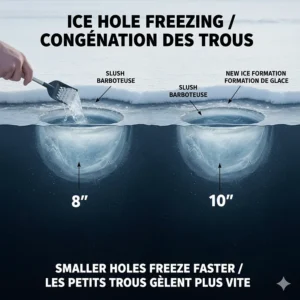
Comparing North American vs European Sizing Standards
While Canadian anglers primarily encounter North American auger standards, understanding European conventions helps when considering imported equipment or reading international fishing forums. Subtle differences exist that can create confusion.
North American augers universally measure diameter in inches—4″, 6″, 8″, 10″, etc. European manufacturers (particularly Scandinavian companies like Mora, despite StrikeMaster’s ownership) traditionally used metric measurements: 100mm, 150mm, 200mm, 250mm. Conversion isn’t perfectly clean: 6 inches equals 152.4mm, while 8 inches converts to 203.2mm.
This creates occasional sizing confusion. A European “150mm” auger produces a slightly smaller hole (5.9 inches) than a North American 6-inch model (152.4mm). For practical ice fishing purposes this difference rarely matters, but tournament anglers or those working under strict regulations should verify actual measurements rather than assuming equivalency.
Canadian retailers importing European augers sometimes round to nearest inch equivalents, creating further confusion. An auger labeled “6-inch” on Amazon.ca might actually drill 150mm (5.9″) or 152mm (5.98″) holes depending on manufacturing origin. Quality manufacturers specify exact cutting diameter in product specifications—always verify before purchasing if precise sizing matters for your application.
Interestingly, European auger design philosophy sometimes differs from North American approaches beyond simple measurements. Scandinavian manufacturers tend toward lighter construction optimized for hand drilling, while North American brands increasingly emphasize power auger compatibility and robust construction. This philosophical difference can affect durability and performance expectations.
Common Mistakes When Choosing Auger Size
Canadian ice anglers frequently make predictable errors when selecting augers, often learning through expensive mistakes or lost trophy fish. Avoiding these pitfalls saves money and frustration.
Mistake #1: Buying Too Small for Target Species
The most common error—purchasing a 6-inch auger to target trophy walleye or lake trout. While technically possible to land big fish through smaller holes, the difficulty and risk typically aren’t worth the modest cost savings. Ontario guides estimate 30-40% of lost trophy walleye result from inadequate hole diameter. The $20-40 CAD saved buying a 6-inch instead of 8-inch auger feels insignificant after losing a fish of a lifetime.
Mistake #2: Prioritizing Portability Over Functionality
Some anglers obsess over minimal weight, choosing 5-inch hand augers for applications clearly requiring larger holes. While ultralight setups appeal for long walks, functionality must come first. Saskatchewan ice fishers walking 2+ kilometres to remote lakes still generally choose 6-inch electric models over 5-inch hand augers—the drilling efficiency and fish-landing capability justify carrying the extra weight.
Mistake #3: Ignoring Local Ice Thickness
Southern Ontario anglers purchasing 10-inch augers designed for northern applications waste money and effort. Conversely, Northwest Territories anglers buying budget 6-inch drill-attached augers discover them inadequate for 100+ cm ice. Match equipment to your actual fishing conditions, not theoretical maximums you’ll rarely encounter.
Mistake #4: Overlooking Drill Power Requirements
Drill-attached augers seem economical until you discover your existing 12V drill can’t handle 8-inch bits through Canadian ice. The VEVOR 8-inch technically fits standard drills, but performance suffers dramatically without 18V+ brushless models. Budget for adequate drill power when choosing larger diameter bits—adding $200+ CAD for a suitable drill can make dedicated electric augers more cost-effective.
Mistake #5: Choosing Augers Based Solely on Price
The cheapest option rarely delivers best value. Quebec anglers report some budget 8-inch augers requiring so much more effort to drill than quality 6-inch models that the diameter advantage evaporates. Invest in proven brands—the Strikemaster Mora’s decades-long reputation justifies its pricing through reliability and performance consistency.
Mistake #6: Not Considering Multiple Sizes
Serious Canadian ice anglers often find owning both 6-inch and 8-inch augers optimal. Use the smaller size for scouting and high-volume drilling, reserving the larger model for confirmed fishing locations and trophy potential. The combined investment ($150-300 CAD for two VEVOR drill bits) provides maximum flexibility across different scenarios.
FAQ: Canadian Ice Auger Sizing Questions
❓ What size ice auger do I need for walleye fishing in Ontario?
❓ Can I use a 6 inch auger for lake trout ice fishing?
❓ How much does an 8 inch ice auger cost in Canada?
❓ What's the difference between drilling 6 inch vs 8 inch holes in thick ice?
❓ Do I need to register ice fishing holes in Canada?
Conclusion: Making Your Final Decision
Choosing the right ice auger size fundamentally shapes your Canadian ice fishing experience, influencing everything from daily physical fatigue to whether you successfully land trophy fish. After analyzing available options, regional considerations, and species-specific requirements, several clear principles emerge to guide your decision.
For the majority of Canadian ice anglers—those targeting mixed bags of panfish, walleye, and occasional pike across Ontario, Quebec, Manitoba, and Saskatchewan—an 8-inch auger represents the optimal choice. The modest additional drilling effort compared to 6-inch models pays massive dividends when you hook that trophy walleye or pike that simply won’t fit through smaller openings. Power auger users (electric or gas) face minimal downside to this larger diameter, while hand auger enthusiasts can reasonably manage 8-inch holes with decent fitness levels.
Specialized applications warrant different approaches. Dedicated panfish anglers walking long distances on Lake Simcoe or similar expansive waters benefit from 6-inch or even 5-inch hand augers, maximizing hole quantity over individual hole size. Conversely, trophy lake trout specialists in northern waters should seriously consider 10-inch augers, accepting the drilling burden as necessary for safely handling massive fish.
The emergence of affordable drill-attached augers like VEVOR’s $75-95 CAD models democratizes 8-inch drilling, making larger diameters accessible to anglers who’d never hand-drill that size. This represents perhaps the most significant recent development in Canadian ice fishing equipment—suddenly, the optimal diameter becomes achievable at entry-level price points.
Regional ice thickness must inform your decision. British Columbia interior lakes rarely exceeding 60 cm ice support different equipment than Saskatchewan’s 90+ cm conditions. Match your auger not just to target species, but to actual ice conditions you’ll encounter throughout the season.
Budget-conscious anglers should prioritize diameter over power source—a quality 8-inch hand auger ($110-135 CAD) delivers more fishing success than a underpowered 6-inch electric model at similar cost. You can always upgrade to powered drilling later while maintaining the larger diameter’s fish-landing advantages.
The investment in proper auger sizing pays dividends measured in decades. A well-chosen auger becomes your trusted ice fishing companion for 10-20+ years, making the initial decision worth careful consideration. Whether you’re just starting your Canadian ice fishing journey or upgrading well-worn equipment, prioritize actual fishing needs over marketing hype or marginal cost savings.
Recommended for You
- 7 Best StrikeMaster Ice Augers Canada 2026
- Gas vs Electric Ice Auger: 7 Top Picks Canada 2026
- 7 Best 8 Inch Ice Augers in Canada (2026)
Disclaimer: This article contains affiliate links to Amazon.ca. If you purchase products through these links, we may earn a small commission at no additional cost to you.
✨ Found this helpful? Share it with your friends! 💬🤗
