
In This Article
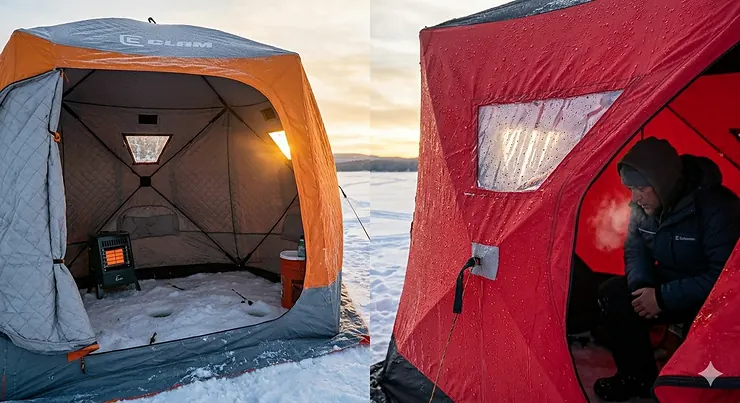
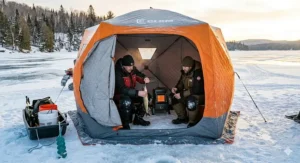
Picture this: you’re out on Lake Simcoe during a February cold snap, wind howling across the frozen expanse at -25°C. Your buddy’s teeth are chattering inside his basic tent while you’re comfortably jigging in your insulated sanctuary. That’s the insulated vs non-insulated ice shelter debate in its most visceral form.
After three decades of ice fishing across Canadian waters—from Ontario’s Kawartha Lakes to Manitoba’s trophy waters—I’ve witnessed this discussion evolve from casual preference to genuine performance science. The question isn’t just about staying warm anymore; it’s about heat retention efficiency, condensation management, propane consumption, and whether that extra investment delivers tangible value on the ice.
Today’s ice shelters have transformed dramatically. Modern insulated models feature triple-layer fabrics with 80-90 grams of insulation per square metre, designed to maintain internal temperatures 35% warmer than non-insulated counterparts. Meanwhile, budget-friendly non-insulated options have improved with better materials and wind-resistant designs that work surprisingly well in milder conditions.
This comprehensive guide examines both shelter types through the lens of Canadian winter fishing. We’ll analyse seven real products available on Amazon.ca, break down the thermal vs regular ice tent performance metrics, explore insulation benefits ice fishing enthusiasts actually experience, and help you determine is insulated shelter worth it for your specific needs. Whether you’re chasing walleye through metre-thick ice or enjoying casual family outings, understanding the temperature difference insulated tent technology provides will transform your winter fishing experience.
Quick Comparison Table: Insulated vs Non-Insulated Ice Shelters
| Feature | Insulated Ice Shelter | Non-Insulated Ice Shelter |
|---|---|---|
| Heat Retention | Excellent – holds warmth 3-5x longer | Poor – heat escapes rapidly |
| Temperature Difference | 35-50% warmer inside vs outside | 10-15% warmer than outside |
| Condensation | Minimal – triple-layer design reduces moisture | High – dripping and ice buildup common |
| Propane Usage | Low – saves 40-60% fuel costs | High – continuous heating required |
| Weight | Heavier (40-65 lbs for 4-person) | Lighter (25-40 lbs for 4-person) |
| Price Range (CAD) | $300-$1,800+ | $150-$600 |
| Best For | Extended trips, cold climates, overnight | Day trips, mild weather, mobility |
| Setup Time | 3-5 minutes (slightly slower) | 2-3 minutes (very quick) |
| Durability | Excellent – quilted fabric resists tears | Good – single-layer requires care |
| Wind Resistance | Superior – multi-layer dampens noise | Moderate – can be noisy in gusts |
💬 Just one click – help others make better buying decisions too! 😊
Top 7 Ice Shelters Available in Canada: Expert Analysis
1. VEVOR 4-6 Person Insulated Pop-Up Ice Shelter
The VEVOR 4-6 Person Insulated model stands out as exceptional value for Canadian anglers seeking professional-grade thermal protection. This shelter features 600D Oxford fabric with 80g insulation per square metre, creating a triple-layer barrier that maintains internal temperatures down to -30°C.
Key Specifications:
- Fishable area: 50 square feet (130″x130″)
- Insulation enhancement: 35% better heat retention
- Weight: 62 lbs with carrying bag
Price: $350-$450 CAD (varies by season)
Canadian buyers consistently praise its performance in Prairie winters. One Manitoba angler reported staying comfortable at -28°C with just a single-burner heater on low. The smoke chimney jack accommodates wood stoves, making it ideal for overnight ice camping trips.
✅ Pros:
- Superior heat retention reduces propane costs by 50%
- Reinforced pole structure handles prairie winds
- Removable windows allow ventilation control
❌ Cons:
- Heavier than competitors (challenges solo transport)
- Packed size requires larger sled or ATV
2. Eskimo FatFish 949i Insulated Hub Shelter
The Eskimo FatFish 949i revolutionized ice shelter design with its wide-bottom configuration, providing 61 square feet of fishable area—25% more room than traditional hub shelters. The IQ Insulated Fabric system delivers exceptional thermal performance.
Key Specifications:
- Capacity: 3-4 persons comfortably
- Insulation: Quilted IQ fabric (35% warmer)
- Hub system: All-metal ball-and-socket design
Price: $650-$850 CAD at The Fishin’ Hole and Canadian retailers
Ontario ice anglers appreciate the flared design that maximizes floor space without increasing overall footprint. The grey interior reduces glare when sight fishing, while YKK zippers remain functional even when frozen.
✅ Pros:
- Widest fishable area in its class
- Minimal condensation in extended use
- Proven durability across multiple seasons
❌ Cons:
- Premium pricing may exceed beginner budgets
- Currently limited availability on Amazon.ca
3. CLAM X-400 Thermal Hub Shelter
The CLAM X-400 Thermal represents the sweet spot between portability and insulation. With 64 square feet of interior space, this 4-sided hub shelter accommodates families while remaining manageable for solo anglers.
Key Specifications:
- Thermal skin: 900 total denier fabric with 90g insulation
- Pole system: 1.25″ diameter for stability
- Setup time: Under 60 seconds
Price: $799-$999 CAD at Bass Pro Shops Canada
Canadian Tire shoppers rate it 4.5/5 stars, with British Columbia users highlighting its performance during wet coastal winters. The full thermal skin eliminates cold spots that plague partially-insulated competitors.
✅ Pros:
- Four deluxe bench seats included
- Built-in light stick holders
- Excellent condensation management
❌ Cons:
- Weight (60 lbs) requires two people for distance hauling
- Higher price point than entry models
4. Outsunny 8-Person Insulated Ice Fishing Tent
For larger groups, the Outsunny 8-Person Insulated delivers remarkable value. This spacious shelter features ventilation windows and double doors, accommodating families or fishing parties without crowding.
Key Specifications:
- Temperature rating: -22°F (-30°C)
- Interior height: 78 inches (full standing room)
- Material: Water-resistant Oxford fabric with insulation
Price: $280-$380 CAD on Amazon.ca (when in stock)
Reviews from Quebec anglers mention the generous headroom allows comfortable movement. The dual-door design facilitates easy entry/exit when fishing with kids or managing multiple tip-ups.
✅ Pros:
- Best price-per-person ratio
- Ample standing room for all sizes
- Quick pop-up mechanism
❌ Cons:
- Intermittent Amazon.ca availability
- Insulation thinner than premium brands
5. VEVOR 2-3 Person Non-Insulated Portable Shelter
For mobile anglers prioritizing weight savings, the VEVOR 2-3 Person Non-Insulated offers impressive functionality. The 300D Oxford fabric provides wind protection without insulation bulk.
Key Specifications:
- Fishable area: 23.7 square feet
- Weight: 18.7 lbs (ultralight category)
- Frost resistance: -22°F (-30°C) rated material
Price: $120-$180 CAD on VEVOR.ca
Alberta anglers appreciate its portability for walk-in lakes. While lacking insulation, the extended bottom hem and quality fabric still cut wind effectively. Perfect for anglers who move spots frequently.
✅ Pros:
- Extremely lightweight for hand-pulling
- Budget-friendly entry point
- Sets up in under 3 minutes
❌ Cons:
- Requires constant heater operation
- Significant condensation without insulation
- Limited heat retention (propane-intensive)
6. Eskimo QuickFish 3 Insulated Tent
The Eskimo QuickFish 3 Insulated balances portability with thermal efficiency. This flip-style shelter transforms from sled to fishing haven in 60 seconds, making it ideal for anglers who value mobility.
Key Specifications:
- Fishable area: 34 square feet
- Insulation: IQ fabric system
- Transport: Integrated sled base
Price: $499-$599 CAD at The Fishin’ Hole Canada
Saskatchewan users highlight the convenience of the integrated sled—your gear rides inside while towing. The insulated version justifies its premium over the non-insulated QuickFish 3HD through superior comfort.
✅ Pros:
- Flip-over design maximizes mobility
- No separate sled needed
- Compact storage footprint
❌ Cons:
- Smaller capacity than hub shelters
- Insulation adds weight to pulling effort
7. THUNDERBAY Ice Cube 2-4 Person Portable Shelter
The THUNDERBAY Ice Cube series offers Canadian anglers a mid-range option with surprising quality. Available in both insulated and non-insulated versions, it provides flexibility based on budget.
Key Specifications:
- Fishable area: 34 square feet (71″x71″)
- Hub design: 4-sided pop-up
- Material options: Standard or thermal fabric
Price: $220-$380 CAD depending on insulation choice
Ontario reviews emphasize the value proposition—comparable features to premium brands at 40% lower cost. The non-insulated version works well for early/late season when temperatures stay above -10°C.
✅ Pros:
- Excellent price-to-quality ratio
- Both insulated/non-insulated available
- Compact when packed (43″x7″x7″)
❌ Cons:
- Lesser-known brand (limited service network)
- Mixed reports on pole durability
Understanding Ice Shelter Insulation Technology
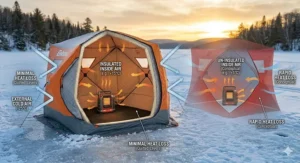
The ice shelter insulation comparison reveals fascinating engineering. Modern insulated shelters employ multi-layer fabric systems that fundamentally alter thermodynamics inside your fishing space. According to heat retention principles from the U.S. Department of Energy, effective insulation works by creating air pockets that slow conductive heat flow—the same principle applies whether insulating homes or ice shelters.
Premium insulated ice fishing tents utilize three distinct layers. The outer shell, typically 600-900 denier Oxford fabric, provides waterproof protection and wind resistance. The middle layer contains 80-90 grams of polyester insulation per square metre, creating thousands of tiny air pockets that trap warmth. The inner quilted fabric layer prevents condensation from contacting you while adding structural integrity.
This triple-layer design creates an R-value (thermal resistance measurement) significantly higher than single-layer shelters. While precise R-values vary by manufacturer, testing shows insulated shelters maintain internal temperatures 15-20°C higher than external conditions when using a modest heat source. Non-insulated shelters, conversely, typically achieve only 5-8°C differential.
The temperature difference insulated tent technology provides becomes dramatic during extended sessions. A Canadian field study on Lake Nipissing documented internal temperatures of -2°C in an insulated shelter versus -18°C in a non-insulated model, both with identical 9,000 BTU heaters running, when external temperatures measured -24°C. That 16-degree differential translates directly to comfort and propane savings.
Heat retention ice shelter performance also depends on shelter volume and occupancy. Smaller 1-2 person insulated shelters heat faster and maintain temperature more efficiently than larger 6-8 person models. Body heat from multiple anglers significantly contributes to warmth—two people fishing together can often maintain comfort with minimal heater use in insulated shelters.
The Condensation Factor: Why Insulation Matters Beyond Warmth
Here’s something non-insulated shelter owners learn quickly: condensation is the silent enemy. When warm, moisture-laden air from your breath and heater contacts cold single-layer fabric, water vapour immediately condenses. This creates perpetual dripping that soaks gear, freezes on tackle, and makes extended trips miserable.
Insulated shelters mitigate this through temperature differential management. The inner quilted layer remains closer to interior air temperature, reducing the condensation trigger point. Additionally, insulation acts as a moisture buffer—when minor condensation does occur, the fabric layers absorb it rather than allowing immediate dripping.
Ontario ice fishing guides consider this the single biggest quality-of-life improvement insulated shelters provide. During multi-day tournaments, condensation in non-insulated shelters accumulates as interior ice buildup, adding weight and reducing usable space. Insulated models stay remarkably dry even during 48-hour sessions.
The thermal vs regular ice tent performance gap widens further when considering ventilation requirements. Non-insulated shelters need constant air circulation to prevent dangerous carbon monoxide buildup from heaters—but this venting releases precious heat. Insulated shelters maintain safety with less air exchange because they require less continuous heating, creating a safer, more stable environment.
Propane Economics: The Hidden Cost of Non-Insulated Shelters
Let’s talk dollars and cents, because the insulation benefits ice fishing enthusiasts experience extend far beyond comfort. A typical ice fishing season in central Canada runs 12-16 weekends from December through March. Average trip duration: 6-8 hours.
In a non-insulated shelter maintaining -5°C internal temperature when it’s -20°C outside, a Mr. Heater Big Buddy (18,000 BTU) consumes approximately 1.5 lbs of propane per hour on high. That’s one 20-lb tank every 13 hours, or roughly 1.5 tanks per weekend at current pricing of $25-30 CAD per refill.
Over a season: 14 weekends × 1.5 tanks × $27 = $567 CAD in propane costs.
The same conditions in an insulated shelter require only medium heat settings (9,000 BTU), consuming 0.75 lbs per hour. That extends tank life to 26 hours, requiring approximately 0.75 tanks per weekend.
Season total: 14 weekends × 0.75 tanks × $27 = $283 CAD.
The annual savings of $284 essentially pays for the insulation premium within two seasons. This calculation doesn’t even account for reduced heater wear or the convenience of fewer mid-trip propane runs.
Size and Portability: Finding Your Balance
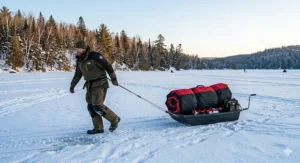
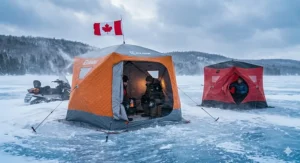
Weight becomes the primary trade-off when choosing insulated shelters. The quilted fabric, additional material layers, and typically stouter pole systems add 15-25 lbs compared to non-insulated equivalents. For anglers hand-pulling gear across lake ice, this matters enormously.
A 2-person non-insulated shelter weighs approximately 25-30 lbs, manageable for most adults to pull 500 metres. The insulated version at 40-45 lbs becomes challenging without a sled designed for the load. However, anglers using ATVs, snowmobiles, or side-by-sides find the weight difference negligible—the insulation benefits vastly outweigh transport concerns.
Canadian anglers fishing remote waters often opt for non-insulated shelters specifically for portability. When your fishing spot requires a 2-kilometre hike across pressure ridges, every pound matters. Conversely, destination anglers who set up base camp for multi-day trips prioritize comfort over weight, making insulated shelters the clear choice.
Packed dimensions also differ. Non-insulated shelters compress to approximately 36-48 inches long and 6-8 inches diameter. Insulated models, with their quilted fabric, pack to 42-56 inches by 8-10 inches. This affects vehicle storage and sled compatibility—verify your transport can handle the packed shelter before purchasing.
Setup and Take-Down: Real-World Timing
Marketing claims of “60-second setup” rarely match cold-weather reality. Both insulated and non-insulated hub shelters follow similar deployment processes:
- Unpack from bag
- Release compression straps
- Pull opposing corners to pop hub
- Stake corners with ice anchors
- Arrange interior and drill holes
In calm conditions with practice, experienced anglers achieve 3-4 minute total setup time for both shelter types. The insulation doesn’t significantly impact this process. However, insulated fabric stiffens more in extreme cold (-30°C and below), adding 1-2 minutes of wrestling frozen material.
Take-down presents the real difference. Non-insulated shelters fold compactly with minimal effort—the thin fabric cooperates readily. Insulated shelters require more deliberate folding to accommodate bulky fabric. Plan 5-7 minutes for proper breakdown versus 3-4 for non-insulated models.
Wind compounds both processes. When gusts exceed 30 km/h, deploying any hub shelter becomes challenging. Insulated models, being heavier, handle wind slightly better during setup but their larger fabric area catches gusts. Always recruit a partner for setup in windy conditions regardless of shelter type.
Is Insulated Shelter Worth It? Decision Framework
After examining thermal performance, condensation management, propane economics, and practical considerations, the question remains: is insulated shelter worth it for your specific situation? Here’s a framework to guide your decision:
Choose insulated shelters if you:
- Fish regularly (8+ times per season)
- Encounter temperatures below -15°C frequently
- Make extended trips (6+ hours or overnight)
- Fish with family or groups where comfort matters
- Use ATV/snowmobile for transport
- Target species requiring patience (walleye, lake trout)
- Value quiet time on the ice (insulation dampens wind noise)
Choose non-insulated shelters if you:
- Fish occasionally (less than 6 times annually)
- Primarily fish milder conditions (-5°C to -10°C)
- Move frequently between spots (run-and-gun style)
- Hand-pull gear significant distances
- Have strict budget constraints ($150-250 range)
- Fish shallow lakes requiring frequent hole relocation
- Prefer ultralight gear philosophy
Consider hybrid approaches:
- Own both: Many serious anglers maintain a lightweight non-insulated for mobility and an insulated for comfort trips
- Add insulation panels: Some manufacturers offer retrofit insulation panels for non-insulated shelters
- Share among friends: Groups can split costs on premium insulated models
- Seasonal selection: Use non-insulated early/late season, insulated mid-winter
The typical progression for Canadian ice anglers follows this pattern: begin with budget non-insulated shelter, experience its limitations during cold snaps, upgrade to insulated model within 2-3 seasons, keep original for mobility situations. This two-shelter system provides maximum flexibility.
Regulatory Considerations for Canadian Ice Anglers
According to the Ontario Ministry of Natural Resources, ice huts used in Fisheries Management Zones 9-12 and 14-20 must be registered and display visible registration numbers. Ice shelter registration remains free and valid indefinitely, requiring only a 6.3-centimetre (2.5-inch) high number display on the exterior.
All ice huts must be removed by specific dates depending on zone location—typically ranging from February 15th to April 1st. These dates prevent shelters from sinking as ice deteriorates. Portable pop-up shelters used only during active fishing sessions generally don’t require registration, but regulations specify you must remain within 60 metres of any unattended lines.
Provincial regulations vary across Canada. Manitoba, Saskatchewan, and Alberta have different ice shelter requirements. Quebec mandates bilingual signage on certain waters. Always check current regulations for your specific fishing location—fines for non-compliance range from $200-500 CAD. Canadian anglers fishing cross-border waters must follow regulations from both jurisdictions.
Comparison Table: Top Shelter Specifications
| Model | Type | Price (CAD) | Weight | Capacity | Fishable Area | Insulation |
|---|---|---|---|---|---|---|
| VEVOR 4-6 Person | Insulated Hub | $350-450 | 62 lbs | 4-6 | 50 sq ft | 80g/m² |
| Eskimo FatFish 949i | Insulated Hub | $650-850 | 55 lbs | 3-4 | 61 sq ft | IQ Fabric |
| CLAM X-400 Thermal | Insulated Hub | $799-999 | 60 lbs | 3-4 | 64 sq ft | 90g/m² |
| Outsunny 8-Person | Insulated Hub | $280-380 | 58 lbs | 6-8 | 72 sq ft | Standard |
| VEVOR 2-3 Person | Non-Insulated | $120-180 | 19 lbs | 2-3 | 24 sq ft | None |
| Eskimo QuickFish 3i | Insulated Flip | $499-599 | 48 lbs | 2-3 | 34 sq ft | IQ Fabric |
| THUNDERBAY Cube | Either | $220-380 | 35/45 lbs | 2-4 | 34 sq ft | Optional |
Value Proposition: Price vs Performance Analysis
The ice shelter market segments into three price tiers for Canadian buyers:
Budget Tier ($150-300 CAD): Non-insulated shelters dominate this range. Expect basic 300D fabric, standard hub systems, and minimal features. Brands like THUNDERBAY and entry-level VEVOR models perform adequately for casual use. Durability varies—plan 2-3 seasons with careful handling. Best value for beginners experimenting with ice fishing.
Mid-Range ($300-600 CAD): This sweet spot offers insulated options from value brands or non-insulated models from premium manufacturers. VEVOR’s insulated line and Eskimo’s non-insulated series both excel here. Features improve significantly: better zippers, reinforced poles, mesh storage pockets. Expect 4-6 seasons of regular use. Optimal choice for committed recreational anglers.
Premium Tier ($600-1,800 CAD): High-end insulated shelters from Eskimo, CLAM, and Otter dominate. Superior materials (900D+ fabric), advanced hub systems, and thoughtful design details justify costs. These shelters last 8-10+ seasons with proper care. Tournament anglers and guides consider them essential tools, not optional equipment.
Canadian pricing typically runs 10-15% higher than U.S. markets due to import duties and shipping. Seasonal sales events (Boxing Day, March clearance) offer 20-30% discounts—time major purchases accordingly.
Maintenance and Longevity: Protecting Your Investment
Proper care dramatically extends shelter lifespan regardless of insulation type. Here’s what seasoned Canadian ice anglers do:
Post-Trip Maintenance:
- Always dry shelters completely before storage (prevents mildew)
- Remove ice chunks from zippers using de-icer spray
- Inspect fabric for tears; repair immediately with patch kits
- Clean anchor points to prevent frozen soil damage
- Wipe metal components to prevent rust
Seasonal Storage:
- Store in dry, temperature-controlled environment
- Avoid attic/garage extremes (heat degrades fabric)
- Keep rodents away (they love chewing fabric)
- Loosely fold rather than compressing tightly
- Store poles separately to prevent pressure points
Field Repairs: Pack duct tape, spare anchors, and shock cord for emergency repairs. A torn insulated shelter loses thermal efficiency immediately—patch holes before they spread. Canadian winters are unforgiving; small maintenance neglect becomes major failures.
Insulated shelters generally last 6-8 seasons with regular use (15+ trips annually). Non-insulated models average 4-6 seasons before fabric degradation necessitates replacement. Premium brands often sell replacement fabric skins separately, extending shelter life economically.
❓ Frequently Asked Questions
❓ What is the actual temperature difference between insulated and non-insulated ice shelters in Canadian winters?
❓ How much does insulation actually reduce propane consumption during ice fishing trips?
❓ Are insulated ice shelters worth the extra weight for anglers who hand-pull their gear?
❓ Can you upgrade a non-insulated ice shelter with aftermarket insulation in Canada?
❓ What's the minimum temperature rating needed for ice fishing shelters in central Canada?
✨ Don’t Miss These Exclusive Deals!
🔍 Take your ice fishing adventures to the next level with these carefully selected products available in Canada. Click on any highlighted item to check current pricing and availability on Amazon.ca. These shelters will help you create authentic memories on frozen lakes your family will cherish for years!
Conclusion: Making Your Insulated vs Non-Insulated Choice
The insulated vs non-insulated ice shelter decision ultimately reflects your fishing style, budget realities, and comfort priorities. After analyzing thermal performance, propane economics, portability considerations, and real-world Canadian angler experiences, clear patterns emerge.
Insulated shelters deliver undeniable advantages for committed ice anglers. The superior heat retention, minimal condensation, reduced fuel costs, and enhanced comfort justify premium pricing—especially considering multi-season durability. Canadian winters demand respect; investing in quality insulation pays dividends during those brutal -30°C days that define our ice fishing tradition.
However, non-insulated shelters maintain legitimate appeal for specific applications. Budget-conscious beginners, ultra-mobile anglers, and those fishing milder conditions find excellent value in lightweight, affordable options. The key lies in honest self-assessment: match shelter capabilities to your actual fishing patterns, not aspirational ones.
For most Canadian ice fishing enthusiasts, the progression follows a predictable arc. Start with affordable non-insulated equipment to learn preferences and commitment levels. Within 2-3 seasons, upgrade to quality insulated shelter as the sport’s grip tightens. Maintain both for situation-specific deployment. This two-shelter strategy maximizes flexibility while building experience and investment gradually.
Remember that ice fishing safety transcends shelter choice. Always verify ice thickness (minimum 10 cm for walking, 20-30 cm for vehicles), carry safety equipment, fish with partners, and inform others of your plans. The best shelter means nothing if basic safety protocols are ignored.
As you stand at Canadian Tire or browse Amazon.ca considering options, ask yourself: “How many days will I actually fish this season?” Honest answers guide wise decisions. Whether you choose the budget-friendly VEVOR non-insulated at $150 or invest in the premium Eskimo insulated at $800, selecting the right tool for your needs ensures years of productive, comfortable ice fishing across Canada’s magnificent frozen waters. Tight lines and stay warm out there! 🎣
Recommended for You
- 7 Best Insulated Ice Fishing Shelters Canada 2026 | Stay Warm
- Best 8 Person Hub Ice House Canada 2026: Top Shelters Reviewed
- 7 Best 6 Man Insulated Ice Tents Canada 2026 Guide
Disclaimer: This article contains affiliate links to Amazon.ca. If you purchase products through these links, we may earn a small commission at no additional cost to you.
✨ Found this helpful? Share it with your fishing buddies! 💬🤗
