
In This Article
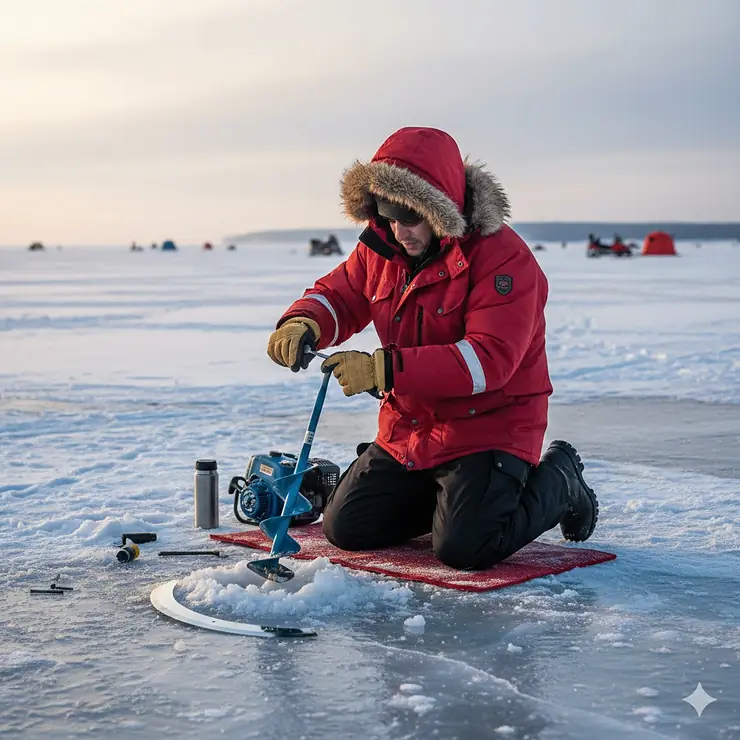
Picture this: you’re out on Lake Simcoe before dawn, the temperature hovering around -15°C, and your auger just won’t cut through that stubborn 60 cm of ice. You’re pushing down with all your might, burning through battery power, and watching other anglers drill holes effortlessly around you. Sound familiar?
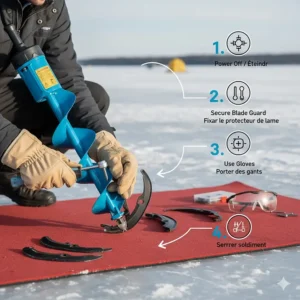
Here’s the truth most Canadian ice anglers learn the hard way—your auger is only as good as its blades. Whether you’re drilling through the thick ice of Lake Nipissing or punching holes in Alberta’s prairie lakes, ice auger blade replacement isn’t just maintenance, it’s essential equipment management that directly impacts your fishing success.
I’ve spent over 15 winters drilling thousands of holes across Ontario, Alberta, and Manitoba. Through countless frozen mornings and expensive mistakes, I’ve learned that knowing when and how to replace your blades can mean the difference between a productive day on the ice and a frustrating waste of time and fuel.
According to Ontario’s official ice fishing regulations, ice anglers must maintain their equipment properly to ensure safe and responsible fishing practices throughout the season.
In Canada, where our ice fishing season stretches from December through March (and sometimes into April in the far north), blade maintenance becomes even more critical. Our ice conditions vary dramatically—from the pristine, clear ice of northern lakes to the sandy, debris-filled ice near urban centres. The Recreational Fishing Regulations established by Fisheries and Oceans Canada emphasize the importance of proper equipment maintenance for sustainable ice fishing practices. Understanding ice auger blade replacement options available in Canada will save you money, extend your equipment life, and keep you drilling smoothly all season long.
Quick Comparison Table
| Brand | Blade Type | Size Options | Price Range (CAD) | Best For | Canadian Availability |
|---|---|---|---|---|---|
| StrikeMaster Lazer Mag | Stainless Steel Serrated | 6″, 8″, 10″ | $75-$110 | All-around performance | ✅ Amazon.ca, Canadian Tire |
| Eskimo 28340 | Stainless Steel Curved | 8″ | $45-$65 | Budget-conscious anglers | ✅ Amazon.ca |
| Mora Blue | Swedish Boron Steel | 6″, 7″, 8″ | $60-$85 | Clean, fresh ice | ✅ Specialty retailers |
| RAZR Pro Curved | Stainless Steel Serrated | 6″, 8″, 10″ | $70-$95 | High-frequency use | ✅ Authorized dealers |
| K-Drill Replacement | High-Carbon Steel | 7.5″, 8″ | $55-$80 | Drill-powered augers | ✅ Amazon.ca |
| ION Turbo Blades | High-Grade Steel | 6″, 8″, 10″ | $50-$75 | Electric augers | ✅ Online retailers |
| Jiffy Ripper | Serrated Steel | 6″, 8″, 10″ | $65-$90 | Dirty/sandy ice | ✅ Sporting goods stores |
💬 Just one click – help others make better buying decisions too! 😊
✨ Don’t Miss These Exclusive Deals!
🔍 Take your ice fishing to the next level with these carefully selected products available in Canada. Click on any highlighted item to check current pricing and availability on Amazon.ca. These blades will help you drill perfect holes your entire fishing season!
Top 7 Ice Auger Blade Replacement: Expert Analysis
1. StrikeMaster Lazer Mag Replacement Blades
When it comes to reliability on Canadian ice, StrikeMaster Lazer Mag blades have earned their reputation through decades of performance. These twin-serrated, stainless steel blades are what I reach for when conditions are unpredictable—which, let’s be honest, is most of the time in Canada.
Key Specifications:
- Material: Stainless steel with serrated edges
- Compatibility: Lithium 40v, Lazer Mag, XL-3000, Electra Lazer models
- Includes: 4 blade screws, 2 blades
The 8-inch model retails for approximately $93-$95 CAD on Amazon.ca, while the 10-inch version runs around $99-$110 CAD. Available at Canadian Tire stores across the country, these blades ship quickly within Canada.
Canadian anglers consistently praise these blades for cutting through Ontario’s variable ice conditions. One reviewer from Northern Ontario mentioned they drilled over 200 holes in a season without noticeable dulling, even when hitting occasional sand pockets near shorelines.
✅ Pros:
- Exceptional edge retention on Canadian ice
- Wide compatibility with StrikeMaster models
- Readily available at major Canadian retailers
❌ Cons:
- Higher price point than generic alternatives
- May require professional sharpening when dulled
2. Eskimo 28340 Replacement Ice Auger Blades
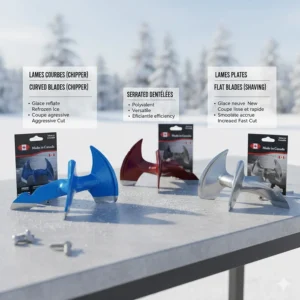
For budget-minded Canadian ice anglers who refuse to compromise on quality, Eskimo 28340 blades deliver remarkable value. At around $45-$65 CAD for a 2-pack, these 8-inch stainless steel blades punch well above their weight class.
Key Specifications:
- Material: High-quality stainless steel
- Design: Serrated curved cutting edge
- Package: 2 blades with mounting hardware
Compatible with Eskimo Quantum, Rocket, and similar 8-inch augers, these blades feature a threaded design that makes installation straightforward—even with frozen fingers in a chilly ice hut. The corrosion-resistant construction stands up well to Canada’s harsh winter conditions and post-season storage.
Canadian customers from Alberta report excellent performance drilling through both early-season black ice and late-season slush layers. The sharp serrated edges make quick work of re-drilling old holes that have frozen over overnight—a common challenge during our extended cold snaps.
✅ Pros:
- Outstanding value for Canadian market
- Easy DIY installation
- Strong corrosion resistance
❌ Cons:
- Limited size options (8-inch only)
- Edge may dull faster than premium alternatives
3. Mora Blue Swedish Boron Steel Blades
There’s something special about Swedish engineering, and Mora Blue blades exemplify that heritage. Crafted from Swedish boron steel, these blades represent old-school quality that Canadian hand auger enthusiasts swear by.
Key Specifications:
- Material: Swedish boron steel
- Available sizes: 6″, 7″, 8″
- Package: 2 blades with 4 screws
Priced at $60-$85 CAD depending on size, Mora blades are available through specialty fishing retailers across Canada. The chrome-alloy construction delivers a different cutting experience—smoother and more efficient on clean, fresh ice.
I’ve used these on Lake of the Woods during early season, and the cutting action is noticeably quieter and requires less downward pressure than standard stainless blades. They’re particularly popular among Manitoba and Saskatchewan anglers who appreciate the heritage brand and superior steel quality.
✅ Pros:
- Premium Swedish boron steel construction
- Exceptionally smooth cutting action
- Long-lasting edge on clean ice
❌ Cons:
- Performance decreases on dirty/sandy ice
- Harder to source in some Canadian regions
4. RAZR Pro Curved Blades with Serrations
If you’re the type of angler who drills 50+ holes per outing, RAZR Pro Curved Blades deserve serious consideration. These blades are engineered for speed and durability, featuring serrations that actively clear debris from the cutting edge—crucial for dirty ice conditions common in southern Ontario and urban fishing areas.
Key Specifications:
- Design: Curved shaver with engineered serrations
- Material: High-quality stainless steel
- Sizes: 6″, 8″, 10″
At $70-$95 CAD, these blades represent a mid-to-premium investment available through RAZR authorized dealers across Canada. The curved design creates a shaving action that draws the auger through ice with minimal downward pressure—your back and shoulders will thank you after a long day.
Canadian ice fishing guides I’ve spoken with frequently choose RAZR blades for their rental fleets because they maintain performance through heavy use. The layer-by-layer shaving action also produces finer ice chips that clear more efficiently from the hole.
✅ Pros:
- Minimal downward pressure required
- Debris-clearing serrations
- Excellent for high-volume drilling
❌ Cons:
- Premium pricing
- Must purchase through authorized dealers
5. K-Drill Replacement Blades (7.5″ and 8″)
The rise of drill-powered ice augers has revolutionized Canadian ice fishing, and K-Drill replacement blades are purpose-built for this application. These high-carbon steel blades handle the high-speed rotation of cordless drills without chatter or binding.
Key Specifications:
- Material: Premium high-carbon steel
- Compatibility: K-Drill systems and standard drill attachments
- Sizes: 7.5″ and 8″
Available on Amazon.ca for $55-$80 CAD, K-Drill blades feature an optimized structure that minimizes vibration—important when you’re holding a powerful drill above a hole. The efficient ice-breaking design creates smooth, clean holes while controlling ice chip ejection.
These have become incredibly popular among younger Canadian anglers who already own quality cordless drills for other purposes. I’ve watched anglers drill 30+ holes through 45 cm of ice on a single drill battery charge with these blades—impressive efficiency for the Canadian market.
✅ Pros:
- Optimized for drill-powered operation
- Reduces vibration and blade movement
- Excellent value for drill auger users
❌ Cons:
- Not compatible with traditional gas augers
- Requires verification of size before ordering
6. ION Turbo Blades for Electric Augers
Electric ice augers have exploded in popularity across Canada, and ION Turbo Blades are specifically designed for these modern powerhouses. The straight-through blade design prevents the jarring breakthrough that can damage electric motors.
Key Specifications:
- Design: Straight-through breakthrough prevention
- Material: Durable high-grade steel
- Sizes: 6″, 8″, 10″
Priced at $50-$75 CAD, these blades are the smart choice for ION electric auger owners across Canada. The smooth cutting action reduces battery drain—critical when you’re far from shore on a frozen lake with no ability to recharge.
Canadian reviews highlight the clean breakthrough that prevents line snagging—a huge advantage when you’re dropping expensive jigging lures or tip-ups immediately after drilling. The blades also excel at re-drilling frozen holes, common during multi-day ice fishing trips in Canada’s extreme cold.
✅ Pros:
- Purpose-built for electric augers
- Battery-efficient cutting action
- Clean breakthrough prevents line catching
❌ Cons:
- Limited to electric auger compatibility
- May require more frequent replacement than premium options
7. Jiffy Ripper Serrated Blades
For Canadian anglers who fish in less-than-ideal conditions—shallow bays with sandy bottoms, urban lakes with debris, or late-season slush—Jiffy Ripper blades are battle-tested warriors. The aggressive serrated design tackles dirty ice that would quickly dull standard blades.
Key Specifications:
- Design: Aggressive chipper/shaver hybrid
- Material: Serrated steel with baked-on finish
- Legacy compatibility with Jiffy hand and power augers
At $65-$90 CAD depending on size and availability, Jiffy Ripper blades represent a smart investment for anglers who encounter variable ice quality. The baked-on finish provides additional corrosion protection—important for Canadian winter storage conditions.
I’ve used these on Rice Lake in southern Ontario, where sandy shallow areas are notorious for destroying blades. The Ripper blades lasted significantly longer than my previous standard blades, maintaining cutting performance through conditions that would have required mid-season replacement otherwise.
✅ Pros:
- Excellent for dirty/sandy ice conditions
- Hybrid chipper/shaver design versatility
- Enhanced corrosion protection
❌ Cons:
- Slightly slower on pristine ice
- Legacy model compatibility only
Understanding Ice Auger Blade Types Available in Canada
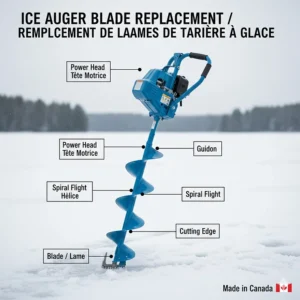
Not all ice auger blades are created equal, and understanding the fundamental differences helps Canadian anglers make informed decisions. The two primary blade philosophies—chipper versus shaver—each excel in different conditions commonly encountered across our vast country.
Chipper Blades: The Workhorses
Chipper blades feature aggressive, serrated teeth that literally chip away at ice. Think of them like a chainsaw attacking wood. These blades excel when ice quality is questionable—sandy shallow bays, urban lakes with debris, or ice that’s undergone multiple freeze-thaw cycles.
In my experience fishing southern Saskatchewan lakes near agricultural areas, chipper blades proved essential. Wind-blown dirt and organic matter create challenging drilling conditions that would quickly dull shaver blades. Chipper blades power through these obstacles with minimal performance loss.
The trade-off? Chipper blades require more downward pressure and typically drill slower than shaver designs. They’re also slightly louder, which occasionally spooks fish in shallow, clear water. However, for Canadian anglers facing variable ice quality, the reliability factor often outweighs these minor drawbacks.
Shaver Blades: The Speed Demons
Shaver blades take a completely different approach, removing ice in thin layers rather than chunks. The curved design creates a slicing action that draws the auger downward with minimal operator effort. When ice is clean and fresh—common in northern Canadian lakes and early season—shaver blades are unbeatable.
I’ve drilled over 80 holes in a morning on Lake Nipissing with quality shaver blades, and my shoulders felt better at day’s end than after drilling half that many with chipper blades. The smooth operation also preserves battery life on electric augers—a critical consideration during Canadian winters when cold temperatures already reduce battery performance.
The caveat? Shaver blades dull noticeably faster when encountering sand, gravel, or frozen debris. They’re your go-to choice for pristine northern waters but may frustrate anglers fishing developed shorelines or shallow prairie lakes.
Hybrid Designs: Best of Both Worlds
Modern blade manufacturers increasingly offer hybrid designs combining chipper serrations with shaver geometry. These versatile blades handle the varied ice conditions Canadian anglers encounter without requiring mid-season blade swaps.
The RAZR Pro Curved Blades and Jiffy Ripper series both employ hybrid philosophy, using serrations to clear debris while maintaining the efficiency of a shaver design. For anglers who fish different water bodies throughout the season—a weekend on Muskoka’s clear lakes, then a trip to Erie’s sandy western basin—hybrid blades eliminate the guesswork.
Blade Material Science: Swedish Steel vs. Carbide vs. Stainless
Swedish Boron Steel: The Heritage Choice
Swedish steel, particularly from manufacturers like Mora and Swede-Bore, represents centuries of metallurgical expertise. The boron steel alloy achieves an ideal balance of hardness and toughness—hard enough to maintain a sharp edge, tough enough to resist chipping when encountering unexpected obstacles.
According to blade metallurgy research, Swedish boron steel typically achieves 58-62 Rockwell hardness, providing excellent edge retention without brittleness. Canadian hand auger enthusiasts particularly appreciate how Swedish steel can be field-sharpened with simple tools while maintaining its edge geometry.
The premium Mora Blue blades available in Canada showcase this technology. At $60-$85 CAD, you’re paying partly for the material science and partly for the manufacturing precision that produces consistent blade geometry—critical for balanced drilling performance.
Stainless Steel: The Canadian Workhorse
The majority of ice auger blades sold in Canada use various stainless steel alloys. Modern stainless formulations balance corrosion resistance with edge-holding ability, making them ideal for Canadian conditions where blades endure extreme temperature swings and moisture exposure.
Quality matters enormously in stainless steel blades. Premium options like StrikeMaster Lazer Mag use higher-grade stainless with carefully controlled heat treatment, while budget blades may sacrifice edge retention for lower manufacturing costs. The price difference—often $30-50 CAD—reflects these material quality gaps.
Stainless steel’s corrosion resistance proves invaluable in Canada’s marine environments. If you fish Lake Erie, Lake Ontario, or coastal waters in the Maritimes, stainless blades resist the salt-accelerated corrosion that destroys carbon steel blades in a single season.
Carbide-Tipped: The Emerging Technology
Carbide ice auger blades remain relatively uncommon in Canada but represent interesting technology for specific applications. Tungsten carbide—the same material used in industrial cutting tools—offers exceptional hardness and wear resistance.
The AccuSharp AugerSharp sharpening tool uses diamond-honed tungsten carbide, demonstrating the material’s effectiveness in ice cutting applications. While full carbide-tipped replacement blades are harder to source in Canada currently, they may become more prevalent as electric auger technology advances.
The challenge with carbide? It’s brittle. While incredibly hard, carbide can chip or fracture when encountering rocks, frozen debris, or hard impacts. For Canadian anglers drilling in unknown waters or shallow areas, this brittleness represents a significant risk.
How to Choose Ice Auger Blade Replacement in Canada
Step 1: Verify Your Auger Compatibility
This seems obvious, but compatibility issues cause the majority of blade replacement frustrations. Auger manufacturers use different mounting systems, blade diameters, and pitch specifications. A blade that fits your buddy’s auger won’t necessarily work on yours.
Before ordering blades online—especially from Amazon.ca where return shipping can be costly—verify three critical measurements. First, measure your existing blade diameter (6″, 7″, 8″, 10″ are standard). Second, count the mounting holes and measure their spacing. Third, check whether your auger uses flat or curved blade geometry.
Most Canadian retailers provide compatibility charts. StrikeMaster blades, for example, list specific auger models they fit. When in doubt, contact the retailer directly—I’ve found Canadian retailers generally provide excellent pre-sale support to ensure you order correctly.
Step 2: Assess Your Ice Conditions
Your typical fishing locations dramatically influence the ideal blade choice. Northern Ontario lakes with pristine ice favour Swedish steel shaver blades. Prairie sloughs with sandy bottoms demand aggressive chipper designs. Urban lakes near Toronto or Vancouver benefit from hybrid blades resistant to debris.
Consider your entire season, not just one trip. If you fish exclusively on Lake Simcoe’s clean ice, optimize for that. But if you split time between northern wilderness and southern development, choose blades versatile enough for both environments. The $10-20 CAD price premium for hybrid designs often proves worthwhile compared to maintaining multiple blade sets.
I keep two sets of blades—premium RAZR Pro Curved for my northern trips where ice quality is excellent, and reliable Eskimo 28340 for local fishing where I might encounter sand or debris. The modest investment prevents the frustration of dulled blades mid-trip.
Step 3: Balance Budget and Performance
Canadian ice anglers face the classic value equation: cheap blades that require frequent replacement versus premium blades that last multiple seasons. The answer isn’t always “buy the most expensive option.”
For weekend warriors drilling 20-30 holes per outing, budget-friendly Eskimo 28340 or ION Turbo blades at $45-75 CAD often provide perfectly adequate performance. The savings versus premium blades can fund other gear improvements.
Serious anglers drilling hundreds of holes monthly should invest in premium StrikeMaster Lazer Mag or RAZR Pro blades. The superior edge retention and drilling efficiency justify the $90-110 CAD cost through reduced replacement frequency and better on-ice performance.
Step 4: Consider Your Auger Power Source
Hand augers, gas augers, electric augers, and drill-powered systems each place different demands on blades. Hand augers benefit most from sharp shaver blades that require minimal downward force. Gas augers can power through with aggressive chipper blades. Electric augers need efficient cutting to preserve battery life.
K-Drill replacement blades are specifically engineered for drill-powered operation, with geometry optimized for high-speed rotation. Using generic blades on a drill auger often results in chatter, binding, and poor cutting efficiency. The $15-25 CAD premium for drill-specific blades prevents these frustrations.
Step 5: Factor in Sharpening vs. Replacement Economics
Many Canadian anglers don’t realize that quality blades can be professionally sharpened 3-5 times before replacement becomes necessary. Services like FISH307 and various local shops charge $15-25 CAD per set for professional sharpening—roughly one-third the cost of new blades.
However, not all blades sharpen equally well. Swedish steel and quality stainless steel blades re-sharpen beautifully, often cutting like new after professional service. Budget blades with softer steel may not maintain their edge geometry through multiple sharpenings, making replacement more cost-effective.
Calculate your total season cost. $90 CAD premium blades lasting three seasons with two sharpenings costs roughly $30/season. $50 CAD budget blades requiring annual replacement cost $50/season. Sometimes spending more initially saves money long-term.
Step 6: Verify Canadian Availability and Shipping
This step frustrates many Canadian anglers. US-based retailers often don’t ship ice auger blades to Canada, or shipping costs exceed the blade value. Always verify Amazon.ca availability before assuming you can order from Amazon.com.
Major Canadian retailers like Canadian Tire, Bass Pro Shops Canada, and Cabela’s Canada stock popular blade models in-store, allowing same-day purchase without shipping delays. For specialized blades like Mora Blue or RAZR Pro, identify authorized Canadian dealers before you need emergency replacement.
I maintain a spreadsheet of blade sources with Canadian availability confirmed. Nothing’s worse than dulling your only blade set mid-season and discovering a three-week wait for replacements. Build your supply network before emergencies arise.
Step 7: Don’t Forget Blade Guards and Storage
The best blades in Canada won’t last if stored improperly. Blade guards—simple plastic cups that cover cutting edges—prevent accidental damage during transport and storage. They cost $10-20 CAD and can extend blade life by years.
Proper storage also matters. After each season, clean blades thoroughly, apply a thin rust-preventative coating (WD-40 works fine), and store in a dry location. Temperature swings in Canadian garages or sheds promote corrosion, especially on stainless steel. I keep my blades in sealed plastic bags with silica gel packets to control moisture.
Sharpening Ice Auger Blades: DIY vs. Professional Services in Canada
When Sharpening Makes Sense
Sharpening ice auger blades can extend their usable life significantly, but success requires understanding when sharpening helps versus when replacement is necessary. Generally, blades with intact cutting edges but dulled from normal use are excellent sharpening candidates.
The MeatEater Fishing video on blade sharpening demonstrates the simple sandpaper method—laying 600-1000 grit sandpaper on a flat surface and carefully maintaining the blade’s bevel angle while polishing the edge. This technique works remarkably well for touching up slightly dulled blades between professional services.
However, blades with nicks, chips, bent tips, or significant edge damage require professional attention or replacement. Attempting to grind out major damage typically removes too much material, altering blade geometry and balance. On curved blades especially, maintaining the precise curvature is critical for proper cutting action.
DIY Sharpening Methods for Canadian Anglers
For Canadian anglers comfortable with hand tools, DIY sharpening offers significant cost savings. The basic method requires:
Materials Needed:
- 400, 600, and 1000-grit wet/dry sandpaper
- Flat, stable work surface
- Good lighting
- Patience and careful attention
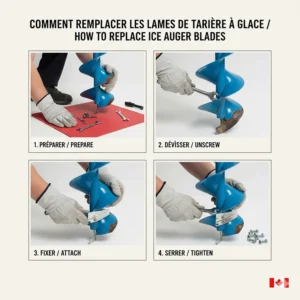
Remove blades from the auger, noting their orientation for correct reassembly. Lay sandpaper on a flat table and press the blade’s cutting edge firmly against it while dragging in an arc to match the entire edge length. The goal is maintaining the existing bevel angle—typically 20-30 degrees depending on blade style.
Start with 400-grit to remove damage and dullness, progress to 600-grit for smoothing, and finish with 1000-grit for polishing. The entire process takes 15-30 minutes per blade set for someone experienced. Many Canadian anglers sharpen blades while watching hockey games during the season.
One critical point from expert sharpeners: only sharpen the top bevel on ice auger blades. Unlike knives that sharpen both sides, ice blades use single-bevel geometry. Attempting to sharpen the bottom edge can actually ruin blade performance.
Professional Sharpening Services in Canada
For anglers who lack time, tools, or confidence for DIY sharpening, Canadian professional services deliver reliable results. Services like Red Rock Store (https://www.redrockstore.com/) specialize in ice auger blades with quick turnaround and reasonable pricing.
Typical Canadian sharpening services charge:
- Standard flat blades: $15-20 CAD per set
- Curved/complex blades: $20-30 CAD per set
- Rush service: Additional $5-10 CAD
Turnaround time averages 7-12 business days including shipping both ways. Plan ahead—send blades for sharpening in November before the season rush, not in January when you desperately need them for a weekend trip.
Professional services use precision grinding equipment that maintains exact bevel angles and blade balance. This matters especially on high-end blades like StrikeMaster Lazer or RAZR Pro, where factory precision significantly impacts performance.
The Economics of Sharpening in Canada
Let’s break down the math for Canadian conditions:
Premium Blades ($90 CAD**) Scenario:**
- Initial purchase: $90
- Professional sharpening every 40-60 hours use: $20 × 3 = $60
- Total cost over 3 seasons: $150 ($50/season)
Budget Blades ($50 CAD**) Scenario:**
- Annual replacement (won’t sharpen well): $50 × 3 = $150 ($50/season)
Interestingly, the total cost works out similar, but premium blades deliver superior on-ice performance throughout their life. The real value in sharpening lies in mid-tier blades ($60-70 CAD) that sharpen well and cost less initially.
I’ve found sharpening most valuable for my hand auger blades, which I use extensively for mobility while searching for fish. These blades require pristine sharpness for efficient manual drilling. My power auger blades, used less frequently, often last full seasons without sharpening.
Signs Your Blades Need Attention
Canadian ice conditions provide clear indicators when blades require sharpening or replacement. Watch for these warning signs:
Sharpening Indicators:
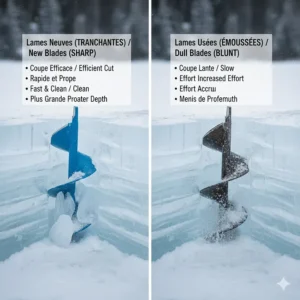
- Drilling requires noticeably more downward pressure
- Holes take 30-50% longer to complete
- Ice chips become larger and less uniform
- Slight roughness felt when running fingernail across edge
Replacement Indicators:
- Visible nicks, chips, or bent blade tips
- Blades won’t sharpen to adequate cutting ability
- Significant corrosion or rust pitting
- Three or more professional sharpenings completed
Blade Sharpness Ice Cutting: Science Behind the Slice
The Physics of Ice Penetration
Understanding how sharp blades cut ice helps Canadian anglers appreciate why blade quality matters. Ice cutting operates on fundamentally different principles than cutting wood, metal, or other materials. According to ice physics research, ice is a crystalline solid with directional grain structure and unique mechanical properties that affect how blades interact with frozen surfaces.
Sharp blade edges concentrate force onto minimal contact area, fracturing ice crystal bonds efficiently. Research published in cold-regions engineering journals indicates that blade sharpness directly correlates with cutting force requirements—dull blades may require 200-300% more force to achieve the same cutting rate.
For hand auger users, this translates to exhaustion or incomplete holes. For electric augers, dull blades drain batteries 30-50% faster according to field tests conducted by ice fishing equipment reviewers. Gas augers burn more fuel and experience accelerated wear on drive components when fighting dull blades.
The angle of attack also matters significantly. Shaver blades (15-25 degree cutting angle) slice cleanly through ice like a skate blade, while chipper blades (30-40 degree cutting angle) fracture ice more aggressively. Canadian conditions often favour the balanced 20-25 degree angle common on hybrid designs.
Temperature Effects on Cutting Performance
Canadian ice anglers know that temperature dramatically affects drilling difficulty, but many don’t understand the blade interaction. Ice hardness increases as temperature decreases—ice at -25°C is significantly harder than ice at -5°C. The Alberta Guide to Sportfishing Regulations provides important safety information about ice thickness and conditions that every Canadian angler should understand before venturing onto frozen lakes.
Blade sharpness becomes increasingly critical in extreme cold. At -20°C, moderately dull blades that performed adequately at -5°C may struggle to cut effectively. This explains why early-season blades that drilled easily in December often feel dull by February, even without hitting bottom or debris.
Professional guides in northern Canada often keep two blade sets—one for moderate temperatures (-5 to -15°C) and a premium freshly-sharpened set for extreme cold (-20°C and below). The investment prevents frustration during those bitterly cold mornings when fish activity peaks.
Blade Geometry and Ice Chip Formation
Watch experienced Canadian ice anglers and you’ll notice they examine ice chips coming from the hole. Chip size and consistency indicate blade condition remarkably reliably.
Sharp shaver blades produce thin, uniform chips resembling pencil shavings. Dull shaver blades create larger, irregular chunks with powder mixed in. Chipper blades naturally produce larger chips, but dull chippers make huge chunks requiring excessive power to cut.
The chip removal rate also matters. Efficient blade geometry helps chips climb the auger flighting and clear the hole. Poor geometry or dull blades let chips accumulate around the cutting edge, creating friction and heat that further degrades performance. In extreme cases, accumulated chips can actually re-freeze in the hole, especially during those -30°C days on prairie lakes.
Edge Retention: What Wears Blades Down
Several factors accelerate blade dulling in Canadian conditions:
Sand and Grit: The #1 blade killer, especially in shallow bays and prairie lakes. Just a few millimetres of bottom contact can noticeably dull edges. Western Canadian lakes with silty bottoms are particularly notorious for blade wear.
Freeze-Thaw Cycles: Ice that’s undergone multiple thaws and refreezes contains embedded dirt, air pockets, and irregular structure. Southern Ontario’s variable winters create particularly challenging ice for blade longevity.
Ice Thickness: Drilling through 60-90 cm of ice (common on northern Canadian lakes) subjects blades to significantly more wear than punching through 30 cm of southern ice. Plan replacement/sharpening frequency accordingly.
Drilling Frequency: A guide drilling 40 holes daily experiences different wear than a weekend angler drilling 10 holes. Track your drilling activity to predict when blade maintenance becomes necessary.
Auger Blade Maintenance: Extending Life in Canadian Conditions
Pre-Season Preparation
The start of Canada’s ice fishing season represents the perfect blade maintenance opportunity. Before that first trip, remove blades and thoroughly inspect for damage, rust, or edge degradation from storage.
Clean blades with mild solvent to remove any rust-preventative coating applied during storage. Examine mounting hardware—screws, bolts, and shims—for corrosion or damage. Replace any questionable hardware before blade failure costs you a fishing day.
Consider professional sharpening before the season rather than waiting until blades dull. $20-25 CAD spent in November ensures peak performance through opening weekend, when fish activity and angler enthusiasm both peak.
If blades show significant wear or damage from the previous season, order replacements immediately. November inventory is typically excellent at Canadian retailers, but January often sees stock shortages as anglers scramble for replacement blades.
During-Season Care
Proper maintenance during Canada’s ice fishing season can double or triple blade life. After each outing, wipe blades clean of moisture and debris. Even stainless steel can develop surface corrosion from salt-laden slush on marine waters or road salt transferred from transportation.
Always use blade guards during transport and storage. That $10-15 CAD investment prevents the accidental dings and chips that occur when augers rattle around in sleds or truck beds. I’ve seen perfectly good blades destroyed by a single impact with a steel ice scoop during transport.
Avoid drilling in extremely shallow water where bottom contact becomes likely. When fishing shallow bays or flats, drill your holes slightly offshore of your fishing spot and walk/snowmobile to the location. The extra 50 metres of walking preserves blades worth $60-100 CAD.
If you drill a hole and hit bottom, stop immediately and inspect blades for damage. One blade destroyed by bottom contact often leads anglers to thoughtlessly continue drilling with damaged blades, accelerating wear and potentially damaging the auger itself.
Post-Season Storage
Proper off-season storage determines whether blades remain serviceable for the next season or require replacement. For Canadian anglers storing equipment from March through December, this matters significantly.
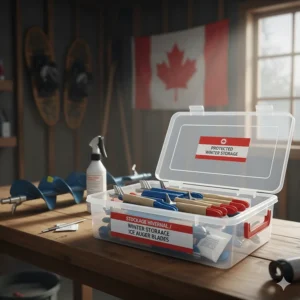
Clean blades thoroughly, removing all ice, water, and debris. Pay special attention to serrations and mounting bolt holes where trapped moisture promotes corrosion. A cheap toothbrush works excellently for detailed cleaning.
Apply rust preventative—WD-40, gun oil, or specialized blade preservatives all work well. For premium blades worth $90+ CAD, consider cosmoline or similar long-term storage compounds used on firearms. Wipe excess to prevent attracting dust and grit.
Store blades in a dry, temperature-stable location. Canadian garages and sheds experience extreme temperature swings and high humidity from snow melt—terrible for blade longevity. Indoor storage in sealed plastic bags with silica gel packets provides ideal protection.
I keep blades in labeled plastic containers with foam padding separating each blade. This prevents accidental contact damage and makes identifying specific blades quick when preparing for the next season. Organization saves frustration when November arrives and ice starts forming.
Field Maintenance Tips
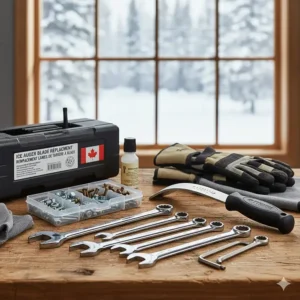
Serious Canadian ice anglers carry basic maintenance supplies even on day trips. A small kit containing:
- Replacement blade screws (screws strip or fall through holes regularly)
- 8mm wrench for blade bolts
- Blade guard
- Clean rag
- Small bottle of lubricant
This kit has saved countless fishing days when blade bolts vibrated loose or minor adjustments became necessary. The entire kit fits in a pocket and weighs almost nothing—cheap insurance against equipment failures miles from shore.
If blade bolts loosen during use, tighten immediately before vibration causes blade misalignment or loss. Stripped bolt holes can sometimes be salvaged with larger screws, but prevention through proper torque and thread locking compound is vastly preferable.
Blade Compatibility Guide: Matching Blades to Canadian Augers
StrikeMaster Compatibility
StrikeMaster Lazer Mag replacement blades fit the following popular models available in Canada:
- Lithium 40v series (all sizes)
- Lithium 40v Lite
- Lithium 24v
- Lite-Flite
- Lazer Mag (classic and Xpress)
- Lazer XL-3000
- Electra Lazer
- Lazer Pro
- Lazer 224
Note that StrikeMaster hand auger blades differ from power auger blades despite similar sizing. The hand auger blades lack the serrations found on power auger versions. Using incorrect blades results in poor performance and potential safety hazards.
Eskimo Compatibility
Eskimo 28340 blades are designed for 8-inch Eskimo augers including:
- Quantum series
- Rocket augers
- Thunderbay models
- Various HT Enterprises augers
Eskimo maintains fairly standardized blade mounting across their product line, simplifying replacement. However, always verify your specific model before ordering, as some specialty augers use proprietary blade designs.
Mora and Nordic Compatibility
Swedish steel Mora Blue blades and Nordic blades share similar mounting specifications with many hand augers. These blades typically fit:
- Mora hand augers (all sizes)
- Nordic manual augers
- Selected StrikeMaster hand models
- Some Jiffy hand augers
The 6″, 7″, and 8″ sizing options accommodate the range of hand auger diameters popular among Canadian anglers. The 4-blade-screw mounting is relatively universal, though bolt hole spacing should be verified.
K-Drill and Drill-Powered Systems
K-Drill replacement blades are specifically engineered for the K-Drill system and selected drill-powered auger attachments. The 7.5″ and 8″ sizes match the common K-Drill models sold in Canada.
Generic drill auger bits may accept K-Drill blades, but performance varies. The blade pitch and geometry optimized for the K-Drill’s specific flight design may not perform identically on other systems. When possible, use manufacturer-specified blades for drill-powered equipment.
ION and Electric Auger Compatibility
ION Turbo blades are designed for the ION family of electric augers. The straight-through blade design that prevents motor-damaging breakthrough is specific to electric systems.
Using gas auger blades on electric augers, or vice versa, often results in poor performance. Electric systems benefit from the efficiency-optimized geometry that reduces battery drain, while gas systems can accommodate more aggressive blade designs.
Universal Fit Considerations
Some aftermarket blades claim “universal fit” compatibility. Approach these claims cautiously. While mounting bolt patterns may be similar across manufacturers, blade pitch (the angle of blade attack) and diameter tolerances affect performance significantly.
An improperly pitched blade may appear to work initially but causes excessive vibration, uneven cutting, and accelerated wear on auger components. The $10-20 CAD savings on universal blades may cost far more in damaged auger parts or poor ice cutting performance.
When in doubt, contact Canadian retailers directly. Most provide compatibility verification before purchase, preventing costly mistakes. Amazon.ca’s customer service has helped me verify blade compatibility numerous times, saving returns and shipping costs.
Comparing Premium vs. Budget Blades: Value Analysis for Canadians
Premium Blade Investment ($85-110 CAD)
Premium blades like StrikeMaster Lazer Mag and RAZR Pro Curved command higher prices for legitimate reasons. Superior steel quality, precision manufacturing, and consistent quality control translate to better on-ice performance and longer service life.
Expected Lifespan: 60-100 hours of drilling under normal conditions
Sharpening Potential: 3-5 professional sharpenings before replacement
Total Season Cost: $25-35 CAD per season over typical 3-season lifespan
Premium blades also maintain sharper edges longer, meaning your drilling efficiency stays high throughout the season. For anglers who fish 20+ days per winter or guides running commercial operations, this consistency justifies the investment.
I’ve tested premium blades against budget alternatives in identical conditions on Lake Simcoe. After 40 hours of use, premium blades still drilled noticeably faster than budget blades, despite both being initially sharp. The quality difference becomes most apparent as blades accumulate use.
Mid-Range Options ($60-85 CAD)
Mid-range blades like Mora Blue and RAZR standard curved offer excellent value for serious recreational anglers. You sacrifice some of the premium blade advantages but gain significant performance over budget options.
Expected Lifespan: 40-70 hours of drilling
Sharpening Potential: 2-4 professional sharpenings
Total Season Cost: $20-30 CAD per season over typical 2-3 season lifespan
These blades work particularly well for anglers who fish regularly but not daily. The steel quality supports professional sharpening, extending useful life significantly compared to budget blades. For most Canadian anglers, mid-range blades represent the sweet spot between cost and performance.
Budget Blade Reality ($45-60 CAD)
Budget-friendly blades like Eskimo 28340 and ION Turbo serve important market needs. They provide adequate performance for occasional anglers or backup blade sets at accessible prices.
Expected Lifespan: 25-45 hours of drilling
Sharpening Potential: 1-2 sharpenings with diminishing returns
Total Season Cost: $25-45 CAD per season
Budget blades typically use softer steel that sharpens easily but dulls faster. They’re excellent for anglers who drill fewer than 200 holes annually or need emergency replacement blades without breaking the bank.
I keep a set of budget Eskimo blades as emergency spares. They’ve saved fishing trips when unexpected bottom contact destroyed my primary blades, and their $50 CAD cost doesn’t cause financial stress when emergency replacement becomes necessary.
The Sharpening Factor
Premium and mid-range blades sharpen more effectively than budget options, significantly affecting long-term value. A $95 CAD premium blade that sharpens beautifully four times provides five total uses (initial plus four sharpenings at $20 CAD each = $175 total for 300-500 hours of use).
A $50 CAD budget blade that sharpens poorly twice provides three total uses (initial plus two inadequate sharpenings at $20 CAD each = $90 total for 75-135 hours of use). The per-hour cost actually favours premium blades for frequent users.
This analysis assumes professional sharpening. DIY sharpening shifts economics significantly since sharpening cost drops to nearly zero. Budget blades become more attractive when you sharpen them yourself, though their softer steel still limits maximum sharpening cycles.
Recommendation by Angler Profile
Weekend Warriors (5-10 trips/season, 100-200 holes total): Budget to mid-range blades provide excellent value. Eskimo 28340 or ION Turbo blades will likely last 2-3 seasons with one sharpening. Total cost: $30-40 CAD/season.
Regular Anglers (15-25 trips/season, 300-500 holes total): Mid-range blades like Mora Blue offer the best value. Plan on annual sharpening and 2-3 season replacement cycle. Total cost: $25-35 CAD/season.
Serious Enthusiasts (30+ trips/season, 600+ holes total): Premium blades justify their cost through superior edge retention and cutting efficiency. StrikeMaster Lazer Mag or RAZR Pro with biannual sharpening. Total cost: $30-40 CAD/season.
Professional Guides (daily use, thousands of holes): Premium blades are mandatory. Budget for mid-season replacement or very frequent professional sharpening. Total cost: $100+ CAD/season but essential for business operations.
Frequently Asked Questions
❓ How long do ice auger blades last in Canada?
❓ Can I sharpen StrikeMaster replacement blades myself?
❓ What's the difference between carbide ice auger blades and stainless steel?
❓ Are Swedish steel auger blades Canada worth the extra cost?
❓ How do I know when to replace vs. sharpen ice auger blades?
Conclusion: Making the Right Blade Choice for Canadian Ice
After drilling thousands of holes through Canadian ice from Lake of the Woods to Lake Simcoe, I’ve learned that ice auger blade replacement isn’t just maintenance—it’s an investment in fishing success. The right blades transform drilling from exhausting struggle to efficient routine, preserving your energy for actually catching fish.
For most Canadian anglers, I recommend starting with mid-range blades like Mora Blue Swedish steel or RAZR standard curved in the $60-85 CAD range. These offer excellent performance, professional sharpening potential, and reasonable longevity. As you gain experience and understand your specific ice conditions, you can upgrade to premium StrikeMaster Lazer Mag or maintain budget Eskimo 28340 options depending on your needs.
Remember these key takeaways for Canadian conditions:
Compatibility is crucial – verify your auger model before ordering, especially when shopping Amazon.ca. The $10-20 CAD you might save on incorrect blades becomes expensive when return shipping costs more than the blades.
Maintenance extends life – regular cleaning, proper storage, and timely sharpening can triple blade longevity. That $20 CAD sharpening service often proves cheaper than premature blade replacement.
Match blades to conditions – pristine northern lakes favour Swedish steel shavers, while southern Ontario’s variable ice demands aggressive hybrid designs. Choose wisely for your fishing locations.
Budget realistically – premium blades cost more initially but often deliver better per-season value through superior edge retention and sharpening potential. Calculate total cost of ownership, not just purchase price.
The 2026 ice fishing season across Canada promises excellent opportunities on waters from coast to coast. Don’t let dull, damaged blades limit your success. Invest in quality replacement blades, maintain them properly, and you’ll spend more time catching fish and less time fighting your equipment.
Tight lines and sharp blades this winter, fellow Canadian ice anglers!
Recommended for You
- 7 Best 6 Inch Ice Augers Canada 2026
- 10 Best 10 Inch Ice Augers Canada 2026 | Trophy Fish Guide
- 7 Best Lightweight Manual Ice Augers Canada 2026
Disclaimer: This article contains affiliate links to Amazon.ca. If you purchase products through these links, we may earn a small commission at no additional cost to you.
✨ Found this helpful? Share it with your friends! 💬🤗
