
In This Article
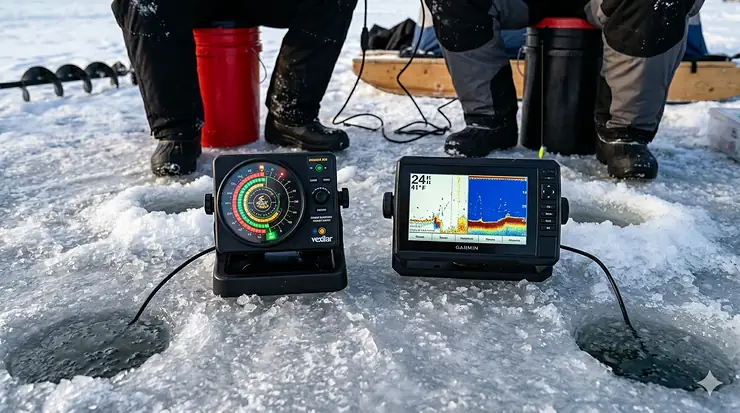
A flasher vs LCD fish finder ice fishing debate is really a question of speed versus detail: a flasher shows sonar returns instantly on a spinning ring of lights, while an LCD graph draws a scrolling picture of the water column with a slight delay but far more visual context. Both can put fish on the ice. The “right” one depends on how you fish, where in Canada you fish, and how much screen information you actually want to process while standing over a hole at -20°C.
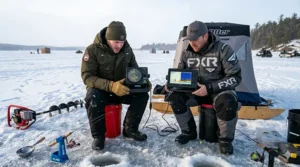
Hardwater season runs long up here — from early ice on Northern Ontario lakes and the Quebec interior in November right through to late-season walleye on Lake Winnipeg or Lake Diefenbaker in March. That long season, plus genuinely brutal cold, means Canadian anglers ask different questions than someone shopping in Minnesota: How does the battery hold up at -25°C? Will the unit ship to a rural Manitoba address? Is it actually listed on Amazon.ca, or am I about to order from a U.S. seller who won’t cross the border?
This guide breaks down seven real, currently sold flasher and LCD units, compares how they perform specifically in Canadian conditions, and walks through the buying decisions — battery type, transducer angle, screen size, GPS mapping — that matter more on a Canadian lake than on a spec sheet. Pricing throughout is shown in CAD ranges rather than exact figures, since Amazon.ca pricing shifts with promotions and exchange rates.
Quick Comparison Table: Flasher vs LCD Fish Finder Ice Fishing
| Unit | Type | Display | Real-Time Speed | Best For | Price Range (CAD) |
|---|---|---|---|---|---|
| Vexilar FL-8SE Genz Pack | Flasher | 3-colour LED | Instant | Beginners, panfish, budget | $300–$420 |
| Vexilar FLX-28 | Flasher (auto-ranging) | 5-colour LED | Instant | Walleye/lake trout pros | $850–$1,050 |
| MarCum LX-7 | Hybrid sonar/LCD | 8″ colour LCD | Near-instant | Anglers wanting flasher + graph | $900–$1,100 |
| Humminbird ICE HELIX 7 CHIRP GPS G4 | LCD + GPS | 7″ colour LCD | Slight lag | Hole-hopping with mapping | $950–$1,200 |
| Garmin Striker Vivid 5cv Bundle | LCD + flasher mode | 5″ colour LCD | Near-instant | All-rounders, boat crossover | $450–$650 |
| Lowrance HOOK Reveal 5 Ice Machine | LCD + flasher mode | 5″ SolarMAX LCD | Near-instant | Budget-conscious LCD fans | $550–$750 |
| Deeper PRO+ 2 Smart Sonar | App-based wireless | Smartphone screen | Slight lag (Wi-Fi) | Light, mobile setups | $280–$400 |
Looking at the spread above, the gap between a true flasher and an LCD unit isn’t really about which one “sees” fish better — modern transducers on both sides are sensitive enough to show a jig and a fish a few centimetres apart. The real split is reaction time versus information density: flashers like the Vexilar units update so fast that you can watch a fish react to your jig stroke by stroke, while LCD units like the Humminbird and Lowrance trade a fraction of a second of lag for a scrolling history, GPS waypoints, and lake mapping you simply can’t get from a spinning dial. Budget-conscious anglers should note that the cheapest unit here, the Deeper PRO+ 2, sacrifices the instant on-ice readability of a dedicated screen for phone-based convenience — a real trade-off when you’re wearing mitts in a Saskatchewan wind.
💬 Just one click — help others make better buying decisions too!😊
✨ Don’t Miss These Exclusive Deals!
🔍 Take your ice fishing setup to the next level with these carefully selected units. Click on any highlighted product to check current pricing and availability on Amazon.ca. These tools will help you put more fish on the ice all winter long!
Top 7 Flasher and LCD Fish Finders for Ice Fishing in Canada — Expert Analysis
1. Vexilar FL-8SE Genz Pack
The Vexilar FL-8SE Genz Pack is the unit most Canadian ice guides cut their teeth on, and for good reason. It runs a classic three-colour LED flasher with six depth ranges (6–37 m / 20–120 ft) and ten interference-rejection settings, which matters when you’re set up shoulder-to-shoulder with three buddies on a packed Lake Simcoe weekend. In practice, that interference rejection is the difference between a clean signal and a flasher full of static noise when six other units are pinging the same hole-dense bay.
What most first-time buyers overlook is that this is a 12-volt lead-acid battery system, not lithium — it’s heavier in a bucket but it shrugs off deep cold better than some early lithium packs did, and it’s been doing it since 2002. Owners consistently mention the rugged Genz Pack housing and bucket-top mount as genuinely “set it and forget it” for the entire season.
Best for: Beginners, panfish and perch anglers, anyone who wants zero menus to learn.
✅ Pros: Dead-simple operation; legendary durability; widely available accessories
✅ Pros: Excellent interference rejection in crowded ice-fishing communities
✅ Pros: Lowest price point of any serious flasher in this list
❌ Cons: No GPS or mapping
❌ Cons: Heavier lead-acid battery vs. newer lithium units
Price & value verdict: Around $300–$420 CAD makes this the easiest entry point into real flasher technology — check current price on Amazon.ca.
2. Vexilar FLX-28
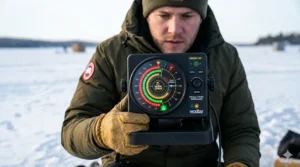
The FLX-28 is Vexilar’s flagship and the first auto-ranging flasher the brand ever built — drop the Ice-Ducer in the hole, turn it on, and it automatically selects depth range and interference rejection for you. For Canadian anglers who hole-hop constantly across a big Manitoba or Saskatchewan flat, not having to manually re-range every move is a real time saver, not a gimmick.
The practical upgrade over the FL-8SE is five colour palettes (versus three) and a broadband Ice-Ducer transducer rated 160–300 kHz, which sharpens target separation in deep, clear lakes like Lake Nipigon or the Quebec Shield lakes where lake trout suspend well off bottom. The trade-off is cost: this sits at the top of the flasher market.
Best for: Serious lake trout, walleye, and tournament-style anglers who move often.
✅ Pros: Auto-ranging saves time when hole-hopping
✅ Pros: Five colour palettes including a dedicated night mode
✅ Pros: Broadband transducer improves deep-water target separation
❌ Cons: Premium price for a flasher-only unit
❌ Cons: No built-in mapping (pair with a separate GPS if needed)
Price & value verdict: Roughly $850–$1,050 CAD — a serious investment, but the auto-ranging genuinely changes how fast you can fish a day.
3. MarCum LX-7
The MarCum LX-7 blurs the line in the flasher vs LCD fish finder ice fishing debate better than almost anything else on the market: it’s a true digital sonar that displays vertical water-column, vertical zoom, a traditional widescreen graph, and a classic flasher dial — all selectable on one 8-inch panoramic LCD. MarCum’s pitch, echoed by sponsored pros like Joel Nelson, is that real-time speed is what separates ice sonar from boat sonar, and the LX-7 is built to be essentially as fast as a mechanical flasher while still giving you a graph history.
In practice, this means a Northern Ontario perch angler can watch the flasher dial to see instant jig reaction, then flip to the graph view to confirm whether that “fish” was actually a school moving through. The dual-beam transducer (8°/20° cone) is a real-world advantage in shallow weed bays versus deep basin structure — narrow for precision, wide for searching.
Best for: Anglers who want flasher speed and LCD context without buying two units.
✅ Pros: Four colour palettes and genuinely fast real-time response
✅ Pros: Switchable 8°/20° transducer cone for shallow or deep water
✅ Pros: USB port for firmware upgrades
❌ Cons: 8-inch panel is bulkier in a portable shuttle than a 5″ LCD
❌ Cons: No built-in GPS mapping on this model
Price & value verdict: Expect $900–$1,100 CAD — positioned as a premium hybrid for anglers who refuse to choose between flasher and graph.
4. Humminbird ICE HELIX 7 CHIRP GPS G4
The Humminbird ICE HELIX 7 CHIRP GPS G4 is built for anglers who treat ice season like a mapping project. Dual Spectrum CHIRP sonar delivers ¾-inch target separation, but the standout for Canadian anglers is AutoChart Live Ice, which lets you build your own 1-foot contour map of an unmapped Crown land lake using nothing but the holes you drill that day — genuinely useful on the thousands of small Canadian lakes that never made it onto a commercial chart.
What the spec sheet won’t tell you: the included 15Ah lithium battery with USB charging ports means you can top up a phone or heated mitts off the same battery, a small but real bonus on a long Northern Ontario day. Built-in GPS with Humminbird Basemap (10,000+ lakes) plus LakeMaster or Navionics compatibility rounds this into a genuine summer-to-winter crossover unit.
Best for: Anglers fishing unfamiliar or unmapped Canadian lakes who want to build their own maps over a season.
✅ Pros: Build custom contour maps on lakes with no existing chart
✅ Pros: 15Ah lithium battery with USB ports
✅ Pros: Switches to Open Water Mode for summer boat use
❌ Cons: Slight sonar lag compared to a dedicated flasher when jigging fast
❌ Cons: Higher price tier once you add a battery and shuttle
Price & value verdict: Around $950–$1,200 CAD — pricier, but it doubles as your boat’s summer fish finder, which softens the per-season cost.
5. Garmin Striker Vivid 5cv Ice Fishing Bundle
The Garmin Striker Vivid 5cv Ice Fishing Bundle earns its spot as the most balanced all-rounder here. It pairs a 5-inch high-contrast colour display with the GT8HW-IF transducer, giving you a built-in flasher view alongside Garmin CHIRP traditional sonar — so you get near-instant jig reaction without giving up a screen history entirely.
For Canadian buyers specifically, the GPS and Quickdraw Contours feature matters more than it sounds: mark a hot hole on a remote Manitoba lake in November, and Quickdraw will have built a usable contour map by January without you ever touching a paid chart. The bundle also converts to open-water use with an optional all-season transducer kit, which Canadian anglers who fish both ice and boat seasons will appreciate for cost-per-use.
Best for: Anglers who want one capable, mid-priced unit that does flasher, graph, and mapping reasonably well.
✅ Pros: Built-in flasher mode plus traditional CHIRP sonar on one screen
✅ Pros: Quickdraw Contours builds your own maps for free
✅ Pros: Converts to open-water use with an add-on transducer
❌ Cons: 5″ screen is small for split-screen viewing
❌ Cons: Lead-acid battery in the standard bundle adds bulk
Price & value verdict: Generally $450–$650 CAD, making this one of the better value-per-feature units on this list — Canadian retailers have shown notably better pricing on this bundle than U.S. retailers at times, so it’s worth comparing Bass Pro Shops Canada, Cabela’s Canada, and Amazon.ca before buying.
6. Lowrance HOOK Reveal 5 Ice Machine
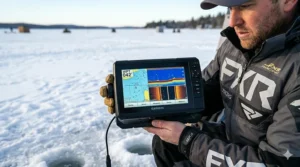
The Lowrance HOOK Reveal 5 Ice Machine bundle takes Lowrance’s best-selling HOOK Reveal display and packages it specifically for hardwater, with a dedicated Ice Fishing Mode that switches the unit into a vertical jigging display. The SolarMAX screen technology is a genuine practical advantage on bright late-winter days on open ice, where screen glare on cheaper LCDs becomes a real problem by March.
FishReveal combines CHIRP sonar with DownScan-style target identification, so the unit is built to highlight actual fish marks rather than leaving you to interpret raw sonar lines — useful for anglers newer to reading LCD graphs who find a pure flasher’s lights easier emotionally but want more data underneath. The bundle includes two stowaway tackle boxes, a 12-volt battery, and charger, which simplifies shopping for first-time LCD buyers.
Best for: First-time LCD buyers who want fish identification help without learning a flasher dial.
✅ Pros: SolarMAX display performs well in direct sunlight
✅ Pros: FishReveal helps newer anglers identify real fish marks
✅ Pros: Complete bundle includes battery, charger, and storage boxes
❌ Cons: No CHIRP DownScan imaging at this price point (added on pricier Lowrance models)
❌ Cons: Lacks the auto-ranging speed of a dedicated flasher
Price & value verdict: Roughly $550–$750 CAD — a strong mid-range LCD pick, particularly for anglers transitioning away from a flasher for the first time.
7. Deeper PRO+ 2 Smart Sonar
The Deeper PRO+ 2 flips the whole flasher vs LCD fish finder ice fishing question by removing the dedicated screen entirely — it’s a wireless, castable sonar puck that streams to the Fish Deeper app on your phone over Wi-Fi (no mobile data or cell signal required), with a dedicated ice fishing display offering both flasher and vertical zoom views. For Canadian anglers who already carry a phone in an insulated case, this means one less piece of hardware to keep charged in the cold.
The practical trade-off is real: a phone screen with gloves on, in bright sun, on a windy March day on Lake Erie’s ice, is harder to read than a dedicated unit with physical buttons. What the spec sheet won’t mention is that recent firmware updates extended out-of-water power-off timing from 5 to 15 minutes specifically to give anglers more time drilling and checking holes — a small but telling sign Deeper has been listening to ice anglers’ actual complaints.
Best for: Anglers who want the lightest possible portable setup and already fish from a phone-in-hand style.
✅ Pros: No separate screen or battery to manage — uses your phone
✅ Pros: Genuinely castable for shore and open-water use beyond ice season
✅ Pros: Three frequency/beam options for narrow or wide scanning
❌ Cons: Wi-Fi connection and phone-screen readability lag a true flasher in deep cold or bright glare
❌ Cons: Heavy reliance on phone battery life on long days
Price & value verdict: Around $280–$400 CAD, making this the most budget-friendly tech-forward option, provided you’re comfortable fishing off a phone screen.
Practical Usage Guide: Setting Up Your Ice Fishing Sonar for Canadian Winters 🇨🇦
Getting a flasher or LCD unit running smoothly through a real Canadian winter takes a few extra steps beyond what the manual covers:
- Pre-warm lithium batteries indoors. Lithium cells lose meaningful capacity below -10°C; keeping the battery in an inside jacket pocket on the drive out, rather than in a cold truck bed overnight, noticeably extends runtime.
- Check transducer ice buildup between holes. Refreezing slush around the Ice-Ducer or skimmer transducer is the single most common cause of “my flasher stopped showing bottom” complaints in Canadian ice-fishing forums — a quick wipe before each drop solves it.
- Run a screen protector or silicone cover on LCD units. Static cold-weather dryness plus glove friction scratches screens faster than most anglers expect over a full season.
- Avoid leaving lead-acid batteries fully discharged in an unheated shed. Sub-zero storage on a dead lead-acid battery shortens its life dramatically; top up before storing.
- Update firmware before first ice. Both Humminbird and Lowrance pushed ice-specific mode improvements in the past year, and updating in a warm garage beats troubleshooting on the ice.
Common first-30-day mistakes include over-tightening transducer cables in the cold (the plastic gets brittle and cracks) and assuming a flasher’s “no signal” reading means no fish, when it often just means the transducer isn’t flush against clean ice or water in the hole.
Real-World Scenario: Which Fish Finder Fits Your Canadian Ice Fishing Style
The Lake Simcoe weekend hole-hopper (Ontario): Drilling 15–20 holes a day chasing perch and walleye in a crowded bay calls for fast interference rejection and a unit you’re not afraid to bang around. The Vexilar FL-8SE or the Garmin Striker Vivid 5cv both fit — budget allowing, the Garmin’s GPS waypoint marking pays off once you’ve found a productive hole in a sea of identical-looking ones.
The remote Quebec Shield lake trout angler: Fishing deep, clear water with sparse, suspended fish and no cell signal means mapping built on the spot matters more than flash. The Humminbird ICE HELIX 7 G4’s AutoChart Live Ice, or the Vexilar FLX-28’s auto-ranging and broadband transducer for deep target separation, both serve this trip well.
The first-ice Manitoba family outing: New to electronics, budget-conscious, and not trying to become a sonar expert in one weekend — the Lowrance HOOK Reveal 5 Ice Machine’s FishReveal fish-identification feature removes the guesswork of reading a flasher dial, while the bundled storage boxes keep a family trip organized.
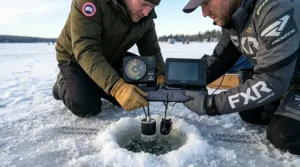
How to Choose a Flasher vs LCD Fish Finder for Ice Fishing in Canada
- Decide how fast you need a reaction. If you’re a finesse jigger who reacts to a fish approaching the bait in real time, a true flasher (Vexilar) or flasher-mode LCD (Garmin, Lowrance) will feel more responsive than a slower-refreshing graph.
- Weigh mapping against simplicity. GPS contour mapping (Humminbird, Garmin) is genuinely valuable on unfamiliar or unmapped Canadian lakes, but it’s one more menu system to learn under cold-weather time pressure.
- Match battery type to your cold tolerance. Lithium batteries (MarCum LX-7, Humminbird) are lighter and charge faster but need indoor pre-warming below -10°C; lead-acid units (Vexilar FL-8SE) are heavier but more forgiving of deep cold storage.
- Check for boat crossover value. If you also fish open water, Humminbird, Garmin, and Lowrance units convert between Ice Mode and Open Water Mode, effectively halving your per-season electronics cost.
- Be honest about screen-reading conditions. Bright open ice in March glare favours SolarMAX-style screens (Lowrance) or a phone in a glare hood; permanent ice shacks favour a brighter dedicated LCD (MarCum, Humminbird).
- Confirm Amazon.ca availability before committing to a bundle. Some U.S.-market bundles (certain MarCum and Deeper kits in particular) show inconsistent stock or ship from U.S. sellers; check delivery estimates to your postal code first.
- Set a real budget tier and stick to it. A $350 CAD flasher and a $1,100 CAD GPS/LCD combo can both put fish on the ice — the expensive unit buys convenience and mapping, not necessarily more fish.
Flasher vs LCD Fish Finder Ice Fishing: Real-World Performance Comparison
On paper, flashers win on speed and LCDs win on information — but the real-world gap is narrower than marketing suggests. A modern hybrid like the MarCum LX-7 genuinely keeps pace with a Vexilar’s reaction time in flasher mode, which means the “flasher is always faster” rule is starting to soften as digital processing improves.
Where the real-world difference shows up is learning curve and failure mode. A flasher gives a beginner almost nothing to misinterpret: a mark is a mark. An LCD graph, by contrast, takes a few outings to read confidently — new anglers commonly mistake thermoclines or suspended debris for fish on a graph, something a flasher’s simpler three-light system doesn’t really allow. In cold-weather failure scenarios, flashers also tend to degrade more gracefully: a weak battery dims an LED display gradually, while some LCD units have been reported to freeze or lag when internal components drop below their rated operating temperature, which matters on a -30°C Prairie morning fished outside a shack.
For ease of use specifically, anglers moving from open-water LCD fishing to ice tend to adapt to LCD ice modes (Garmin, Lowrance, Humminbird) faster than to a flasher, simply because the interface is familiar. Anglers starting from zero, by contrast, often find a flasher’s “more signal equals closer/bigger” logic more intuitive than learning to read a scrolling graph.
Common Mistakes When Buying Ice Fishing Electronics in Canada
- Buying a U.S.-only bundle without checking Amazon.ca shipping. Some accessory bundles list as available on Amazon.com but show limited or no stock for Canadian addresses — always verify before ordering, especially to rural or northern postal codes.
- Ignoring cold-weather battery ratings. Not all lithium packs are rated the same for sub-zero discharge; a battery that performs fine at -5°C can underperform badly at -25°C.
- Skipping the transducer angle question. A narrow-cone transducer (8–9°) is sharper in deep water but can miss fish off to the side in shallow weed bays — buying the wrong cone angle for your typical lake is one of the most common regret-purchases.
- Overlooking warranty service location. Canadian buyers occasionally discover a U.S. warranty centre adds shipping time and customs delays versus a Canadian-based authorized dealer — checking this before buying saves a frustrating mid-season repair wait.
- Assuming all-season conversion kits are included. Several GPS/LCD bundles only include the ice transducer, not the open-water transducer or boat mount — confirm exactly what’s in the box before assuming year-round use.
Canadian Ice Safety and Licensing Rules Every Angler Should Know
No sonar unit replaces basic ice judgment, and Canadian safety organizations are consistent on the numbers. According to guidance from the Canadian Red Cross, clear blue ice is the strongest and ice should generally be at least 20 centimetres thick before supporting group activity, with white or opaque ice considered roughly half as strong for a given thickness. Parks Canada’s ice safety bulletins echo this, recommending a minimum of 15 cm for walking and skating, with thicker ice always preferred, and stressing that anglers should never test ice alone.
This isn’t theoretical caution. In March 2026, CBC News reported that 23 ice anglers had to be airlifted off Georgian Bay after an ice shelf they were fishing on separated from shore and drifted into open water — a reminder that even a fully charged flasher or LCD unit can’t tell you whether the ice itself is sound. The OPP’s blunt assessment afterward was that no ice should be considered guaranteed safe, regardless of how solid it looks.
Beyond ice thickness, every Canadian province requires a valid fishing licence for ice fishing, with rules, seasons, and licence types varying provincially. Ontario’s own provincial ice fishing rules page is a good example of how specific this gets: anglers in several Fisheries Management Zones must register their ice hut number, huts must be removed from the ice by a set date each spring, and tip-ups can’t use mechanical hook-setting springs within 30 metres of open water. Always confirm current requirements with your own province’s natural resources ministry before heading out, since limits, hut rules, and closed seasons differ by water body. Bilingual product labelling is a legal requirement for retail packaging sold in Canada, so don’t be surprised to see English/French specs on imported sonar units even when the unit itself is U.S.-manufactured.
Frequently Asked Questions
❓ Is a flasher or LCD fish finder better for ice fishing beginners?
❓ Can ice fishing fish finders be used in open water too?
❓ Do ice fishing fish finders ship to remote parts of Canada?
❓ How cold can these units operate before performance drops?
❓ Do I need a fishing licence to use a fish finder while ice fishing in Canada?
Conclusion
There’s no single winner in the flasher vs LCD fish finder ice fishing debate — there’s only a better fit for how you actually fish. If speed and simplicity matter most, the Vexilar FL-8SE remains a genuinely excellent, low-cost entry point, while the FLX-28 sits at the top for anglers who’ve outgrown it. If you want mapping, GPS, and a unit that earns its keep in summer too, the Humminbird ICE HELIX 7 G4 and Garmin Striker Vivid 5cv both make a strong case, with the Garmin offering noticeably better value for a first-time GPS buyer. The MarCum LX-7 splits the difference better than almost anything else here, and the Deeper PRO+ 2 is worth a serious look if minimal hardware matters more to you than screen readability in bright glare.
Whatever you choose, the same Canadian-specific basics apply every season: pre-warm your battery, check ice thickness before you check your sonar, and confirm your provincial licence is current. The electronics help you find fish — they don’t replace good judgment on the ice.
✨ Don’t Miss These Exclusive Deals!
🔍 Ready to gear up? Check current pricing and Amazon.ca availability on any of the units above before first ice — stock on popular bundles tends to tighten as winter approaches.
Recommended for You
- 7 Best Ice Fishing Flashers in Canada for 2026 (Real-Time Sonar Picks)
- 7 Best 20 lb Propane Tanks for Ice Fishing in Canada (2026)
- 7 Best Propane Hose Extension Ice Shelter Picks for Canada 2026
Disclaimer: This article contains affiliate links. As an Amazon Associate, I earn from qualifying purchases. If you purchase products through these links, we may earn a small commission at no additional cost to you.
✨ Found this helpful? Share it with your friends! 💬🤗
