
In This Article
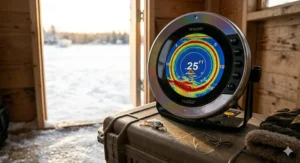
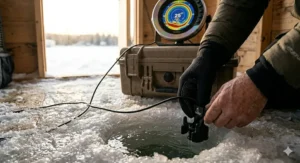
An ice fishing flasher is a sonar tool that shows you, in real time, exactly what’s happening below your hole: how deep the water is, where your jig sits, and whether a fish is moving in on it. Unlike a traditional graphing fish finder that scrolls a history of returns across the screen, a flasher displays everything live on a circular dial — so there’s no lag between what’s happening under the ice and what you see.
If you’ve ever sat over a hole for an hour with no idea whether fish were even nearby, you already know why this gear matters. For Canadian anglers, the case is even stronger: our ice season stretches from November in the Prairies to as late as April in parts of Northern Ontario and Québec, and a flasher turns that long season from guesswork into a genuine numbers game. You’re not just finding a spot — you’re learning, hole to hole, whether to move on or wait the fish out.
This guide rounds up seven real, Amazon.ca-available flashers and fish finders across every budget tier, with honest commentary on who each one actually suits, how it holds up in a Canadian winter, and where the real trade-offs are. Prices below are shown as CAD ranges, since exact pricing shifts often — always check the current price on Amazon.ca before buying.
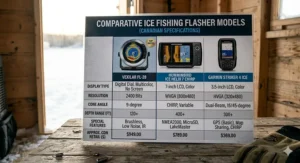
Quick Comparison: Ice Fishing Flashers at a Glance
| Flasher | Type | Price Range (CAD) | Best For | Amazon.ca |
|---|---|---|---|---|
| Vexilar FLX-28 Pro Pack Elite | Classic 3-colour flasher | $850–$1,050 | Serious, high-frequency ice anglers | Yes |
| Vexilar FLX-18 ProPack II | Classic 3-colour flasher | $550–$650 | Most Canadian hardwater anglers | Yes |
| MarCum LX-7 | Digital LCD flasher/graph | $900–$1,100 | Anglers who want a big, detailed screen | Yes |
| Humminbird ICE Helix 5 CHIRP GPS G3 | GPS + flasher combo | $700–$850 | All-season anglers (boat + ice) | Yes |
| Garmin Striker Plus 4 Ice Bundle | GPS + flasher combo | $480–$560 | Budget-conscious GPS users | Yes |
| Deeper PRO+ 2 Smart Sonar | App-based wireless sonar | $260–$330 | Hole-hoppers, snowmobile anglers | Yes |
| LUCKY Portable Fish Finder | Entry-level handheld sonar | $45–$70 | First-timers and kids | Yes |
A few things jump out here. The price gap between the entry-level LUCKY unit and the Vexilar FLX-28 is roughly 15-to-1, yet both technically “find fish” — the difference is in target separation, interference rejection, and how usable the unit is once a buddy sets up 20 feet away with their own sonar running. The middle tier (Garmin Striker Plus 4 and Deeper PRO+ 2) is where most Canadian recreational anglers land, because GPS waypoint marking matters more on big Canadian Shield lakes than it does on a small pond, and neither bundle demands a second mortgage. If you fish competitively or guide, the jump to a Vexilar FLX-18 or MarCum LX-7 pays for itself the first season in fish caught.
💬 Just one click — help others make better buying decisions too! 😊
✨ Don’t Miss These Exclusive Deals!
🔍 Take your ice season to the next level with these carefully selected sonar units. Click on any highlighted product to check current pricing and availability on Amazon.ca.
The 7 Best Ice Fishing Flashers for Canadian Anglers
1. Vexilar FLX-28 Pro Pack Elite
The Vexilar FLX-28 Pro Pack Elite is the flagship of Canada’s most trusted flasher brand, and it shows the moment you turn the dial. It runs on a 12-volt Vexilar lithium battery, offers five colour palettes, and includes the ProView Ice-Ducer transducer with auto-zoom ranges — meaning you’re not manually re-ranging every time a fish rises off bottom.
What the spec sheet won’t tell you is how this performs when three buddies are fishing 15 feet apart in a popular spot on Lake Simcoe or Lake Winnipeg. Vexilar’s interference rejection genuinely holds up in crowded conditions, which is the single biggest complaint anglers have about cheaper flashers once the ice gets busy in January. The lithium battery also matters more in Canada than the spec implies — lithium chemistries lose far less capacity than lead-acid in -20°C shack temperatures, so you actually get the runtime advertised instead of half of it.
Who it’s for: Anglers who fish 20+ days a season, guides, and tournament competitors who need zero lag and zero interference, even in a crowded derby.
✅ Pros:
- Auto-zoom and 1/2″ target separation catch subtle bites other flashers miss
- Lithium battery performs reliably in deep cold
- Five-colour display reads well in bright midday glare
❌ Cons:
- Premium price puts it out of reach for casual anglers
- Heavier shuttle pack than budget alternatives
Price & verdict: Around $850–$1,050 CAD. If ice fishing is a serious hobby and not just a once-a-winter outing, this is the unit you stop upgrading from.
2. Vexilar FLX-18 ProPack II
The Vexilar FLX-18 ProPack II is the flasher most Canadian ice shacks actually have in them, and for good reason. It’s the modern successor to the legendary FL-18, adding low-power and high-power modes plus two zoom zones to the proven three-colour flasher format Vexilar pioneered back in 1989.
In practice, the low-power mode is the underrated feature here — most marketing focuses on depth range, but the real value in shallow Canadian lakes (think 8–15 feet, which describes a huge share of Ontario and Manitoba panfish water) is a flasher that doesn’t wash out or over-range in shallow conditions. The FLX-18 handles that transition cleanly, which is exactly where cheaper units start to struggle.
Who it’s for: The all-around Canadian ice angler who fishes everything from shallow panfish lakes to 40-foot walleye structure and wants one flasher that does both well.
✅ Pros:
- Proven, durable Genz Pack-style shuttle design
- Excellent shallow-water performance via low-power mode
- Strong resale value — Vexilar units hold value on the used market
❌ Cons:
- No GPS or mapping built in
- Standard battery (non-lithium versions) loses some capacity in extreme cold
Price & verdict: Around $550–$650 CAD. This is the benchmark mid-tier flasher in Canada — if you’re choosing your first “real” flasher, start here.
3. MarCum LX-7
The MarCum LX-7 swaps the spinning-disc flasher dial for an 8-inch LCD screen with four colour palettes, giving you a “big picture” view that splits into water-column vertical, vertical zoom, and a flasher-dial display all at once.
This is where commentary actually matters more than specs: an 8-inch screen sounds like a simple upgrade, but the real-world benefit is being able to watch your jig action and the fish’s reaction simultaneously instead of toggling modes. For Canadian walleye anglers working a slow death-roll jig presentation, that simultaneous view is the difference between guessing when a fish committed and actually seeing it happen. MarCum’s noise-rejection software is also a standout in derby and group-fishing conditions, similar to Vexilar’s approach but with a different screen philosophy.
Who it’s for: Detail-oriented anglers, especially walleye and lake trout specialists, who want a graph-style display without giving up flasher speed.
✅ Pros:
- Large 800×600 LCD is easy to read even with polarized sunglasses on
- Strong target separation for distinguishing bait from fish
- Multiple simultaneous display windows
❌ Cons:
- One of the pricier options in this list
- LCD units draw more battery than classic disc flashers, so plan for a backup battery on long days
Price & verdict: Around $900–$1,100 CAD. Worth the jump if you’ve outgrown a classic flasher and want more visual information without losing real-time response.
4. Humminbird ICE Helix 5 CHIRP GPS G3
The Humminbird ICE Helix 5 CHIRP GPS G3 is built for the angler who refuses to own two separate sonar units for boat and ice season. It pairs Dual Spectrum CHIRP sonar with built-in GPS, mapping support for over 10,000 lakes, and a 5-inch full-colour HD display that runs both a flasher view and a traditional 2D sonar view.
The GPS is the real differentiator for Canadian conditions specifically. On sprawling Shield lakes — Lake of the Woods, Rainy Lake, Great Slave Lake — marking a productive hole with a waypoint and being able to walk straight back to it after a snowfall covers your tracks is a genuinely practical, not just nice-to-have, feature. AutoChart Live Ice also lets you build a real-time contour map of a basin as you drill holes, which is a meaningful research advantage on unfamiliar water.
Who it’s for: Anglers who fish open water in summer and want one unit that transitions cleanly between seasons, plus anyone fishing large, unfamiliar Canadian lakes who benefits from GPS mapping.
✅ Pros:
- True dual-purpose unit: works on ice and on a boat with the right transducer
- Built-in GPS and contour mapping
- Crystal-clear 5″ HD screen even compared to older Helix generations
❌ Cons:
- Costs more upfront than a flasher-only unit with similar performance
- Slight learning curve switching between ice mode and open-water mode
Price & verdict: Around $700–$850 CAD. A smart buy if you already own or plan to own a boat — you’re paying once for two seasons of use.
5. Garmin Striker Plus 4 Ice Fishing Bundle
The Garmin Striker Plus 4 Ice Fishing Bundle packs a 4.3-inch colour display, built-in high-sensitivity GPS, and a dual-beam ice transducer into a portable carrying case, all at a price that doesn’t require a second look at your bank statement.
What stands out in actual cold-weather use is Garmin’s AutoGain technology, which automatically adjusts sensitivity to cut down clutter — a feature that matters a lot more than it sounds for anglers who don’t want to fiddle with manual gain settings while wearing thick gloves at -15°C. Garmin’s Quickdraw Contours feature also lets you build your own depth maps with 1-foot contour lines as you fish, which is genuinely useful on smaller Canadian lakes that aren’t well covered by commercial lake maps.
Who it’s for: Budget-conscious Canadian anglers who still want GPS waypoint marking and don’t want to spend Helix-level money to get it.
✅ Pros:
- GPS and Quickdraw Contours at a budget-friendly price point
- Compact, genuinely portable carrying case
- Doubles as an open-water unit with a separately sold transducer
❌ Cons:
- Smaller screen than the premium options on this list
- Single-beam ice transducer is less refined than dual-spectrum CHIRP units
Price & verdict: Around $480–$560 CAD. The easiest entry point into GPS-enabled ice fishing electronics without going premium.
6. Deeper PRO+ 2 Smart Sonar
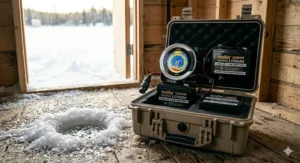
The Deeper PRO+ 2 breaks from every other unit on this list by ditching the cable and transducer arm entirely. It’s a wireless, puck-shaped sonar that generates its own Wi-Fi signal and streams sonar data straight to the Fish Deeper app on your phone — no cellular connection needed, which matters on remote Canadian lakes with no signal.
The honest trade-off here is screen size: you’re reading your phone, not a dedicated display, which can be harder to see in bright sun unless you cup your hand over it. But the upside for Canadian ice anglers who hole-hop by snowmobile is real — there’s no shuttle pack, no battery box, and no cable to manage in -20°C wind, just a unit that fits in a jacket pocket. The 1cm target separation on narrow beam is also genuinely competitive with dedicated flashers twice its price.
Who it’s for: Mobile anglers who drill a lot of holes per day, snowmobile-based anglers, and anyone who wants ice, boat, kayak, and shore fishing covered by one device.
✅ Pros:
- No cables, transducer arm, or separate battery pack to manage in the cold
- Doubles as a summer castable sonar for shore and kayak fishing
- GPS mapping built into the free app
❌ Cons:
- Relies on your phone screen and battery, which both struggle more in extreme cold
- Less refined “flasher feel” than a dedicated dial or LCD flasher
Price & verdict: Around $260–$330 CAD. A smart, modern pick if portability matters more to you than a traditional flasher display.
7. LUCKY Portable Fish Finder
The LUCKY Portable Fish Finder is the simplest, least expensive way to find out if there’s actually water — and fish — under your hole before you invest in anything more serious. It’s a handheld unit with a wired transducer on a 25-foot cable, a basic colour LCD, and a depth range down to roughly 100 metres.
This is squarely a “learn the basics” tool, and the commentary that matters most here is about expectations: it won’t separate two fish stacked close together, and it won’t survive being dropped down a hole repeatedly without a lanyard. But for a parent introducing a kid to ice fishing, or someone testing whether they’ll actually take up the hobby before spending real money, it does the one job that matters — telling you depth and roughly where fish are sitting.
Who it’s for: First-time ice anglers, kids, and anyone testing the waters (literally) before committing to a pricier unit.
✅ Pros:
- Extremely low cost of entry
- Simple, intuitive controls — no learning curve
- Works across ice, kayak, and shore fishing
❌ Cons:
- Limited target separation compared to dedicated flashers
- Basic build quality won’t take years of rough handling
Price & verdict: Around $45–$70 CAD. The right call if you’re not yet sure ice fishing electronics are worth the investment.
How to Set Up and Use Your Flasher on the Ice
Getting a new flasher out of the box and onto the ice for the first time trips up more new anglers than the unit itself ever does. A few habits make the difference between a frustrating first trip and a productive one.
Before you leave home: Charge the battery fully and, if it’s a lead-acid battery, keep it indoors right up until you head out — Canadian winter temperatures can knock 20–30% off a lead-acid battery’s usable runtime overnight in an unheated garage. Lithium-based units (like the Vexilar FLX-28) handle cold storage far better.
On the ice: Drill your hole, clear slush completely (even small ice chips scatter your sonar signal), and lower the transducer 1–2 feet below the bottom of the ice, not just to the waterline. Set your depth range first — most flashers auto-range, but manually confirming bottom depth avoids confusing readings later.
Tuning interference: If a friend’s unit is nearby, both of you should set interference rejection to a different level (most units offer 6–20 step settings) rather than both running at zero. This single step solves 90% of “my flasher is glitching” complaints in group fishing situations.
Common first-30-days mistake: New anglers often crank gain to maximum, assuming more sensitivity equals more fish detected. In practice this just adds noise and false signals. Start at a moderate gain and increase only if you’re missing obvious bottom signal.
Real Canadian Angler Scenarios: Which Flasher Fits You?
The Ottawa Valley weekend angler who drives out to a rental ice hut once or twice a month doesn’t need a $1,000 unit gathering dust the rest of the year. The Garmin Striker Plus 4 Ice Fishing Bundle covers GPS waypoints and clean sonar without the premium price tag, and the bundle’s carrying case makes it easy to grab and go.
The Manitoba or Saskatchewan competitive angler who fishes derbies on big, crowded lakes needs interference rejection above almost anything else. The Vexilar FLX-28 or MarCum LX-7 earns its price tag the first time a dozen other flashers are running within 50 feet and yours stays clean.
The Northern Ontario snowmobile angler who covers serious ground between holes benefits most from ditching the cable altogether. The Deeper PRO+ 2’s wireless design and pocket-sized footprint solve a real logistical problem that a traditional flasher shuttle creates.
The family introducing kids to the sport in places like rural Alberta or the Maritimes doesn’t need precision target separation yet — they need a low-stakes way to show a child that there really are fish down there. The LUCKY Portable Fish Finder fills that role at a price that doesn’t sting if it ends up at the bottom of a tackle box for half the season.
How to Choose an Ice Fishing Flasher in Canada
- Match the unit to your ice season length. If you fish 5+ days a season across multiple lake types, a mid-to-premium flasher (Vexilar FLX-18, MarCum LX-7) pays off faster than you’d expect in fish found per outing.
- Consider your battery realities. Lithium batteries cost more upfront but hold capacity far better in deep Canadian cold than lead-acid alternatives.
- Decide if GPS actually matters to you. On small, familiar ponds it’s a nice-to-have. On big Shield lakes or unfamiliar water, GPS waypoint marking is close to essential.
- Think about mobility. Hole-hoppers and snowmobile anglers benefit disproportionately from lighter, cable-free units like the Deeper PRO+ 2.
- Budget for accessories, not just the unit. A snow shield, spare battery, and a padded carrying case all add real-world durability in Canadian conditions, and most premium units don’t include all of them standard.
- Check Amazon.ca shipping and seller details. Some electronics ship faster from Amazon-fulfilled sellers than third-party marketplace sellers, which matters if you’re buying right before a trip.
- Don’t assume the most expensive unit is the most useful one for you. A guide running derbies and a parent introducing a 9-year-old to the sport have genuinely different “best” choices.
Ice Flasher vs. Traditional Graphing Fish Finder
A flasher and a graphing fish finder solve the same basic problem — locating fish and structure underwater — but they display the answer differently, and that difference matters more on ice than in open water.
A flasher shows everything happening right now on a live dial, with essentially zero lag. A graphing fish finder scrolls a history of returns across the screen left to right, which is excellent for understanding bottom contour and structure over distance while trolling, but introduces a small delay between what’s happening and what you see — a delay that barely matters while trolling but matters a lot while jigging a stationary lure for a slow-moving winter fish.
That’s exactly why units like the Humminbird ICE Helix 5 and Garmin Striker Plus 4 try to offer both: a flasher view for the moment-to-moment jigging decision, and a graph view for understanding the bigger picture of the spot. If you only ever ice fish, a dedicated flasher like the Vexilar FLX-18 is usually the more responsive, more intuitive tool. If you split time between ice and open water, a combo unit earns its extra cost.
Common Mistakes When Buying an Ice Fishing Flasher
Buying based on screen size alone is the most frequent misstep — a bigger display doesn’t always mean better target separation, and a cheaper unit with tighter resolution can outperform a flashier-looking competitor in actual fish-finding ability.
Another common mistake is ignoring battery chemistry. A lead-acid battery rated for “8 hours” in a manufacturer’s lab conditions can deliver noticeably less in a Canadian Prairie cold front, leaving anglers stranded mid-afternoon without realizing why.
Canadian buyers specifically run into a third issue: assuming every U.S.-listed accessory or transducer ships to Canada without checking. Always confirm Amazon.ca availability for the exact bundle and transducer angle you need before ordering, since some niche accessories are U.S.-only.
Finally, many first-time buyers skip reading return policies. Electronics that fail after the first hard frost of the season are a known pain point in this category — confirm your seller’s return window before the ice even forms.
Canadian Ice Safety and Regulations You Should Know
No flasher is worth using if the ice underneath you isn’t safe, and Canadian conditions vary enormously by region and by week. As a general guideline, you need a minimum of about 10 cm (4 inches) of clear, solid ice to walk on safely, with thicker minimums required for snowmobiles, ATVs, and vehicles — though local conditions, moving water, and recent weather can all make posted minimums unreliable. The Government of Canada’s guide to working safely on ice covers and provincial resources like Saskatchewan’s Water Security Agency ice safety guidelines are worth a read before your first trip of the season, regardless of which province you’re fishing in.
On the regulatory side, Canadian residents between 18 and 65 typically need an Outdoors Card and a valid fishing licence to ice fish, with sport and conservation licence options available in most provinces — rules and licence types vary slightly by province, so check your provincial natural resources website before heading out. Destination Ontario’s ice safety guide covers both the safety basics and Ontario’s licensing requirements in one place if you’re fishing that province.
Bilingual product labelling is a legal requirement for goods sold in Canada, so don’t be surprised to see both English and French on flasher packaging shipped through Amazon.ca — it’s standard, not a sign of a grey-market import.
Long-Term Cost and Maintenance in Canada
A flasher is rarely a one-time purchase — budgeting for the full system makes the real cost clearer. Beyond the unit itself, expect to eventually replace a battery (lead-acid batteries in regular winter use typically need replacement every 2–4 seasons), and consider a snow shield or padded case if your unit doesn’t include one, since Canadian winter precipitation is harder on exposed electronics than most U.S. buying guides account for.
Total cost of ownership over five seasons tends to favour the mid-tier units on this list. A $550 CAD Vexilar FLX-18 with one battery replacement over five years lands close in total spend to buying two cheaper $200 units that each fail after a season or two of heavy cold-weather use — with the added cost of lost fishing time when a budget unit dies mid-season. Canadian pricing on electronics like these does typically run a little higher than equivalent U.S. listings once exchange rates and import considerations are factored in, but buying through Amazon.ca avoids cross-border shipping delays, customs surprises, and warranty headaches that come with ordering directly from U.S.-only retailers.
Frequently Asked Questions
❓ Can I use an ice fishing flasher in Canadian winters without it freezing up?
❓ Do ice fishing flashers ship to all Canadian provinces through Amazon.ca?
❓ What's the difference between a flasher and a regular fish finder for ice fishing?
❓ How much ice do I need before using a flasher safely?
❓ Is a budget flasher good enough for casual ice fishing in Canada?
Conclusion
There’s no single “best” ice fishing flasher for every Canadian angler — there’s a best flasher for your season length, your lake size, your budget, and how far you’re willing to walk or ride between holes. The Vexilar FLX-18 remains the most well-rounded mid-tier pick for most hardwater anglers across the country, the Humminbird ICE Helix 5 and Garmin Striker Plus 4 make the most sense if you also fish open water, and the Deeper PRO+ 2 solves a real problem for mobile, hole-hopping anglers covering serious ground on Canadian Shield lakes.
Whichever unit you choose, pair it with sound judgment on ice thickness, a properly licensed setup for your province, and realistic expectations about battery life in the cold — the electronics only help once the basics are covered.
✨ Don’t Miss These Exclusive Deals!
🔍 Ready to upgrade your ice season? Check current pricing and availability on Amazon.ca for any of the flashers above before the season’s best stock sells out.
Recommended for You
- 7 Best 20 lb Propane Tanks for Ice Fishing in Canada (2026)
- 7 Best Propane Hose Extension Ice Shelter Picks for Canada 2026
- Best Electric Heater for Ice Shack in Canada 2026 (Top 7 Picks)
Disclaimer: This article contains affiliate links. As an Amazon Associate, I earn from qualifying purchases. If you purchase products through these links, we may earn a small commission at no additional cost to you.
Found this helpful? Share it with your friends! 💬🤗
