
In This Article
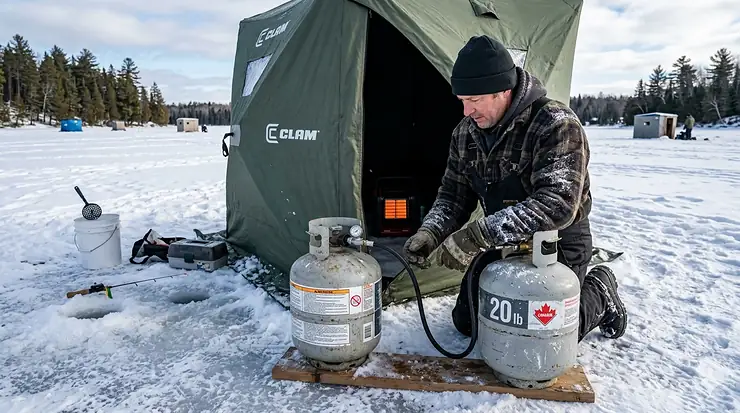
There’s a specific kind of cold that hits you on a Canadian lake at 6 a.m. — the kind that makes your auger feel like it weighs 40 kg and your coffee go lukewarm before you’ve drilled your first hole. The thing standing between that cold and a comfortable day on the ice is usually a 20 lb propane tank ice fishing setup, and most anglers don’t think much about it until the heater sputters out two hours from the truck.
This guide covers seven real, Amazon.ca-available options — from no-frills steel cylinders to smart wireless gauges and sled-mounted holders — along with the parts nobody tells you about: how Canadian winters affect fill levels, what Transport Canada actually allows you to carry in your vehicle, and why a heater that’s perfectly legal in the U.S. might not be approved for indoor use in Canada at all. Whether you’re outfitting a flip-over shack on Lake Simcoe or a permanent hut on Lake Winnipeg, there’s a tank size and setup here that fits.
What Is a 20 lb Propane Tank for Ice Fishing?
A 20 lb propane tank is the standard steel BBQ-style cylinder (about 4.7 gallons or 17.8 L of capacity) repurposed to fuel portable heaters, cook stoves, and tank-top heaters inside an ice shanty. It’s the most common bulk fuel source for ice fishing because it balances burn time, weight, and refill availability better than disposable 1 lb bottles.
Quick Comparison Table
| Product | Size | Standout Feature | Best For | Est. Price (CAD) |
|---|---|---|---|---|
| Flame King YSN230b | 20 lb | Built-in gauge | Most ice anglers | $55–$80 |
| Worthington Pro-Grade 296954 | 20 lb | Wide retail availability | Easy local exchange | $60–$85 |
| Manchester Tank 20 lb Cylinder | 20 lb | New direct Canadian distribution | Bulk/club purchases | $50–$75 |
| Flame King YSN-201 | 20 lb | No-frills steel | Budget-conscious buyers | $40–$60 |
| Flame King YSN-301 | 30 lb | Longer runtime | Multi-day trips, bigger heaters | $85–$120 |
| Flame King YSN401a | 40 lb | Maximum portable capacity | Permanent huts, base camps | $110–$155 |
| Clam Outdoors Sled Organizer | Accessory | Secures tank in sled | Sled/flip-house transport | $35–$55 |
Looking at the table, the gap between a basic 20 lb cylinder and a 30 lb or 40 lb tank isn’t huge in price, but it’s significant in how often you’re hauling a tank back to town for a refill mid-season. A built-in gauge, like the one on the YSN230b, adds maybe $10–$15 CAD over a no-gauge version — cheap insurance against guessing wrong on a -25°C morning when propane pressure readings already run lower than they would in summer.
💬 Just one click — help others make better buying decisions too! 😊
✨ Don’t Miss These Exclusive Deals!
🔍 Take your ice fishing setup to the next level with these carefully selected tanks and accessories. Click on any highlighted item to check current pricing and availability on Amazon.ca.
Top 7 Picks: Expert Analysis
1. Flame King YSN230b 20 lb Steel Propane Tank (Built-in Gauge)
The Flame King YSN230b is a 20 lb welded-steel cylinder with an integrated overfill protection device (OPD) valve and a built-in float gauge. The gauge matters more in Canada than the spec sheet lets on: cold ambient temperatures reduce internal tank pressure, which can make a “full” tank feel sluggish on a tank-top heater — having a visual reading lets you plan a refill before you’re stranded on the ice rather than after.
What most buyers overlook is that this tank ships pre-purged and vacuum-ready, so there’s no waiting period or extra purging fee at the fill station — you can have it filled the same day you buy it. Reviewers consistently note the powder-coated finish holds up well against the road salt and slush that eat away at cheaper tanks parked in a truck bed all winter.
✅ Built-in gauge for at-a-glance level checks
✅ Pre-purged, ready to fill immediately
✅ Rust-resistant powder coat for salty Canadian winters
❌ Gauges on float-style tanks can lose accuracy after a few years
❌ Slightly heavier than gauge-free equivalents
[Check price on Amazon.ca] — around $55–$80 CAD. For most anglers running a single Mr. Heater Big Buddy-style appliance for a weekend, this is the easiest “buy once” option.
2. Worthington Pro-Grade 20 lb Steel Cylinder (296954)
Worthington cylinders are arguably the most common 20 lb tank in Canada simply because they’re stocked at RONA, Canadian Tire, and most propane exchange points, which means a dead tank is never far from a fresh one. The 296954 model holds 4.7 gallons, includes an overfill prevention device, and is finished in Worthington’s Durabond powder coat.
In my experience, the real value of Worthington isn’t a feature — it’s logistics. If your fishing buddy’s tank runs dry and you need a quick swap at a small-town gas station between Thunder Bay and your spot, Worthington and the generic exchange tanks it’s compatible with are what’s sitting in the cage. Some Canadian buyers have flagged that exchange-program tanks get pulled close to their 10- or 12-year requalification date, so it’s worth checking the stamped date collar before paying.
✅ Extremely wide Canadian retail availability
✅ Durable powder coat construction
✅ Compatible with virtually every standard appliance and exchange program
❌ No built-in gauge on the base model
❌ Exchange-program units can be older stock nearing requalification
[Check price on Amazon.ca] — around $60–$85 CAD.
3. Manchester Tank 20 lb Propane Cylinder
Manchester Tank recently began direct service to the Canadian propane market, a move aimed specifically at giving Canadian retailers and bulk buyers better pricing and support than relying solely on cross-border supply chains. For an ice fishing club or a group splitting a bulk order of tanks for a derby weekend, that direct distribution can translate into more consistent stock and fewer cross-border shipping surprises.
The cylinder itself is a conventional 20 lb steel tank with an OPD valve — nothing flashy, but Manchester’s eight decades in cylinder manufacturing show in the welds and the consistency of the powder coat. What stands out for Canadian buyers specifically is less about the tank and more about the company finally treating Canada as a primary market rather than an overflow one.
✅ Backed by a manufacturer now directly serving Canada
✅ Standard OPD valve and durable construction
✅ Good option for bulk/group purchases
❌ Less brand recognition at Canadian retail than Flame King or Worthington
❌ No gauge on the base cylinder
[Check price on Amazon.ca] — around $50–$75 CAD.
4. Flame King YSN-201 20 lb Steel Propane Tank (Budget Pick)
The Flame King YSN-201 strips away the gauge and keeps the essentials: welded steel, OPD valve, powder coat, pre-purged and ready to fill. For anglers who already own a Mopeka or GasWatch sensor (see #7 below) or simply judge fuel level by weight, paying extra for a built-in gauge is money that could go toward gas or gear instead.
What most reviewers overlook when comparing this to gauge models is that float gauges add a mechanical failure point — one more thing that can stick or read incorrectly in extreme cold. A no-gauge tank has nothing to go wrong on that front. The trade-off is obvious: you’re flying blind unless you weigh the tank or use a separate sensor.
✅ Lowest price point in the Flame King lineup
✅ Fewer moving parts to fail in cold weather
✅ Same DOT/TC-rated steel construction as gauge models
❌ No way to check fuel level without a scale or separate gauge
❌ Resale value slightly lower than gauge-equipped tanks
[Check price on Amazon.ca] — around $40–$60 CAD.
5. Flame King YSN-301 30 lb Steel Propane Tank
Stepping up to a Flame King YSN-301 30 lb tank roughly extends your runtime by 50% over a 20 lb cylinder for the same heater, which matters most on multi-day ice fishing trips or when running a larger tank-top heater continuously in a permanent hut. The trade-off is weight: a full 30 lb tank is noticeably harder to muscle in and out of a sled compared to a 20 lb tank, so this pick suits anglers with a vehicle parked nearby or a heavier-duty sled rather than someone walking a kilometre onto the ice.
The specific advantage for ice heater use is that a bigger reservoir means fewer cold-weather pressure dips translate into actual fuel shortages — when it’s -20°C and propane vapour pressure drops, having extra volume in reserve is more forgiving than running a 20 lb tank near empty.
✅ ~50% more runtime than a 20 lb tank for the same appliance
✅ Same OPD safety valve and DOT/TC certification as smaller sizes
✅ Better buffer against cold-weather pressure drops
❌ Meaningfully heavier to transport on foot
❌ Doesn’t fit every tank-top heater bracket without an adapter
[Check price on Amazon.ca] — around $85–$120 CAD.
6. Flame King YSN401a 40 lb Steel Propane Tank
The YSN401a is Flame King’s 40 lb cylinder, and it’s best thought of as bulk propane for ice heater setups rather than a tank you’re hauling across the lake daily. This is the size that makes sense for a permanent or semi-permanent ice hut that stays put for the season, where the tank lives just outside the door and you’re not relocating it every trip.
What the spec sheet won’t tell you is how much this size simplifies winter propane storage logistics: instead of swapping a 20 lb tank every weekend, one 40 lb tank can often carry a moderate heater through several weekends of use, cutting down trips to the fill station in the coldest, least convenient part of the season.
✅ Largest practical capacity for portable use
✅ Fewest refill trips per season
✅ Same DOT/TC steel construction standard as smaller Flame King tanks
❌ Not designed to be carried onto the ice by hand regularly
❌ Requires a vehicle or ATV/snowmobile for transport in most setups
[Check price on Amazon.ca] — around $110–$155 CAD.
7. Clam Outdoors Sled Organizer (Propane Tank Holder)
Rounding out the list is the only non-tank entry: the Clam Outdoors Sled Organizer, designed to mount inside a flip-over fish house sled and secure a propane tank, rods, and tackle so they’re not bouncing around — or worse, tipping a tank valve-down — during the ride out. Anyone who’s driven a sled eight kilometres across a windswept lake knows a loose 20 lb tank turns into a genuine hazard in the back of an Otter or Eskimo sled.
The real value here isn’t storage convenience, it’s safety: a tank that shifts and lands on its valve, or that bangs repeatedly against gear during transport, is exactly the kind of scenario Transport Canada’s securement rules are designed to prevent (more on that below). A $40 organizer is cheap compared to a damaged valve or a slow leak you don’t notice until you’re already set up.
✅ Purpose-built for flip-over ice fishing sleds
✅ Keeps tank upright and secured during transport
✅ Frees up sled space for tackle and an auger
❌ Sized for specific sled models — check fit before buying
❌ Doesn’t fit 30 lb or 40 lb tanks
[Check price on Amazon.ca] — around $35–$55 CAD.
How to Choose a 20 lb Propane Tank for Ice Fishing in Canada
- Match tank size to trip length. A single 20 lb tank typically runs a mid-size tank-top heater for roughly two to four days of moderate use; multi-day or permanent setups should consider 30 lb or 40 lb.
- Check the OPD valve type. Modern tanks use an OPD (overfill prevention device) valve — required at virtually every Canadian fill station, so an older non-OPD tank simply won’t get filled.
- Look at the requalification date. Steel cylinders in Canada generally need periodic requalification; buying new resets that clock, while exchange tanks may already be years into it.
- Decide if you need a gauge. A built-in float gauge is convenient but adds a failure point in extreme cold; a separate wireless sensor like Mopeka’s can be more accurate.
- Plan for transport, not just use. A tank that fits your sled or truck bed securely matters as much as BTU output — see the Transport Canada rules below before you load up.
- Buy from retailers with Canadian fill access. A tank purchased online still needs a place nearby that will fill it; Worthington and Manchester benefit from wide Canadian Tire/RONA-style distribution.
- Budget for the accessories, not just the tank. A holder, gauge, or hose adapter often costs less than the tank itself but solves the problems that actually ruin a day on the ice.
Best Propane Tank Size for Ice Fishing: 20 lb vs. 30 lb vs. 40 lb
If you’re fishing day trips within a short walk or sled ride of your vehicle, a 20 lb tank covers most weekends without becoming a burden to carry. If you’re running a bigger heater for multi-day trips or sharing fuel between a heater and a stove, a 30 lb tank buys meaningfully more runtime for a modest weight increase. If your shelter is semi-permanent and parked at the same spot for the season, a 40 lb tank minimizes refill trips — the trade-off being that it’s not something you’re dragging across the ice by hand.
| Scenario | Recommended Size | Why |
|---|---|---|
| Day trips, walk-in access | 20 lb | Light enough to carry, runs most heaters 2–4 days |
| Multi-day trips, bigger heater | 30 lb | ~50% more runtime, still movable with help |
| Permanent hut, parked all season | 40 lb | Fewest refill trips, vehicle-assisted transport assumed |
The comparison above makes the size decision less about “bigger is better” and more about how the tank actually gets from your truck to your shanty. A 40 lb tank that never gets carried by hand is a great choice; a 40 lb tank you’re expected to drag across uneven ice is a bad one regardless of how much fuel it holds.
Real-World Scenario: Three Canadian Ice Anglers, Three Tank Setups
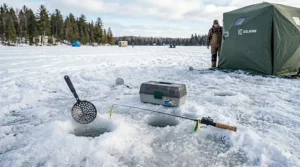
Consider a weekend angler near Barrie, Ontario, walking 200 m onto Lake Simcoe with a flip-over shanty: a 20 lb Flame King YSN230b with a built-in gauge, secured in a Clam Sled Organizer, covers a weekend trip without becoming a burden to haul.
A father-and-son pair fishing a multi-day trip out of Sault Ste. Marie running both a heater and a propane stove will get more value from a 30 lb YSN-301 — the extra capacity means they’re not rationing heat to stretch fuel on the coldest night.
A group with a permanent hut on Lake Winnipeg that stays in place for the season is better served by a 40 lb YSN401a parked just outside the door, refilled every few weekends rather than swapped out after every trip — the size that would be impractical to drag onto the ice by hand becomes the most convenient option once it’s not being moved at all.
Practical Usage Guide: Setup, Storage, and Winterizing Your Tank
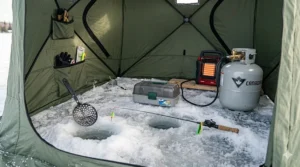
Before your first trip, check the valve threads for grit or ice and make sure the OPD valve turns smoothly — a frozen or gritty valve is the most common reason a tank won’t connect properly at -15°C. Always store propane tanks upright, outdoors, away from the cabin or vehicle interior; never bring a tank inside a vehicle’s passenger compartment for the drive, and never store one in an enclosed shed attached to living space.
In genuinely cold Canadian winters, propane’s internal pressure drops as temperature falls, which can reduce a heater’s output even with fuel remaining in the tank — this is normal physics, not a faulty tank, but it’s why carrying a slightly larger reserve in deep cold makes practical sense. Between trips, store tanks outdoors on a stable, dry surface, never directly on bare ice or snow where moisture can corrode the base over time, and check the collar date stamp each season to track when requalification is due.
Problem → Solution: Common Propane Tank Issues on the Ice
A tank that won’t connect is almost always a frozen or gritty valve thread — warm it gently (never with an open flame) and wipe the threads clean before forcing a connection. A heater that runs weak despite a “full” gauge reading is usually a cold-pressure issue rather than an empty tank; switching to a larger tank size or insulating the base from direct ice contact often helps. A tank that tips or rattles loose during a sled ride is a securement problem, not a tank quality problem — a dedicated holder like the Clam Sled Organizer, or simply strapping the tank upright, solves it directly. Finally, a tank nearing its requalification date may get refused at the pump — checking the collar stamp before the season starts avoids a wasted trip to the fill station.
Canadian Regulations & Safety Standards
Propane tanks and their transport are federally regulated in Canada under the Transportation of Dangerous Goods (TDG) Regulations, administered by Transport Canada. For everyday consumers, a key exemption allows transporting a combined gross mass of up to 150 kg of propane in cylinders no larger than 46 litres — a standard 20 lb BBQ-style tank holds roughly 21–22 litres, so most ice anglers’ setups fall comfortably under that threshold, provided tanks are secured upright and undamaged. Tanks themselves must meet construction standards referenced in CSA B340, and installation of any propane-burning appliance falls under the CSA B149.1 and B149.2 codes that provincial regulators like Ontario’s Technical Standards and Safety Authority enforce locally.
One detail that catches Canadian buyers off guard: several popular U.S.-designed portable heaters that are CSA-certified for indoor use south of the border are only CSA-certified for outdoor use in Canada. Always check the certification label on the heater itself, not just the tank, before assuming it’s approved for use inside an enclosed ice shanty.
Carbon Monoxide & Ice Shanty Safety
This is the section that matters more than any spec comparison. Modern flip-over and hub-style ice shelters are built to be windproof, which also means they trap exhaust gases efficiently — a small heater running in a sealed shelter can build dangerous carbon monoxide levels surprisingly quickly, especially once snow gets banked up around the base and blocks ventilation further. Ontario’s Technical Standards and Safety Authority has investigated fatal carbon monoxide incidents tied to improperly converted or unventilated propane appliances, and consistently recommends a certified carbon monoxide alarm in any space where a fuel-burning device operates, including spaces separate from a primary residence.
For ice fishing specifically, that means: keep at least two vents open at opposite ends of your shelter even in extreme cold, never bank snow tightly enough around the skirt to seal off airflow, and carry a cold-rated carbon monoxide detector rather than relying on smell alone — carbon monoxide is odourless and mixes evenly through enclosed air rather than rising or settling where you’d notice it.
Long-Term Cost & Maintenance in Canada
Buying a new tank outright costs more upfront than a single exchange-program swap, but owning your tank means you’re paying only for the propane added at refill rather than a flat exchange fee — over a season of regular use, refilling typically works out cheaper per litre than repeated exchanges, since exchange programs often fill to a lower percentage of capacity for the same fee. Factor in that Canadian pricing on imported steel tanks tends to run somewhat higher than U.S. equivalents due to import costs and currency exchange, though that gap is offset by avoiding cross-border shipping delays and warranty headaches if something goes wrong with a U.S.-only purchase. Realistically, a well-maintained 20 lb steel tank can last a decade or more before requalification becomes a real cost consideration, making the upfront price difference between budget and premium tanks a minor factor over the tank’s full lifespan.
Features That Actually Matter (And Those That Don’t)
A built-in gauge matters less than people think if you already weigh-check your tank or use a wireless sensor like a Mopeka Pro Check, which mounts magnetically and reads tank levels via Bluetooth without the mechanical failure points of a float gauge. An OPD valve is non-negotiable — without one, Canadian fill stations will simply refuse to fill the tank. Brand prestige matters far less than local fill-station compatibility; a Worthington or Manchester tank that your nearest gas bar will service without question beats a less common brand that looks better on a spec sheet but sends you searching for a compatible filling location. Powder coat quality is a real differentiator in Canadian winters specifically because of road salt exposure during transport, not because of the cold itself.
✨ Don’t Miss These Exclusive Deals!
🔍 Whether you’re upgrading a single weekend tank or outfitting a permanent hut, these picks cover every setup. Click through to check current Amazon.ca pricing before your next trip on the ice.
FAQ
❓ Can I use a 20 lb propane tank inside my ice fishing shanty?
❓ How long does a 20 lb propane tank last for ice fishing?
❓ Where can I refill or exchange a propane tank in Canada?
❓ Can I transport a 20 lb propane tank inside my vehicle in Canada?
❓ Is a 20 lb or 30 lb tank better for ice fishing?
Conclusion
The right 20 lb propane tank for ice fishing in Canada usually comes down to logistics more than features: how far you’re carrying it, how often you can refill it, and whether your nearest fill station actually stocks compatible tanks. For most weekend anglers, a gauge-equipped 20 lb tank like the Flame King YSN230b paired with a secure sled holder covers the bases without overcomplicating things. For longer trips or permanent setups, stepping up to a 30 lb or 40 lb tank trades a bit of portability for meaningfully fewer trips back to town.
Whatever size you land on, the regulatory and safety side isn’t optional — Transport Canada’s transport rules and provincial bodies like TSSA exist because propane and enclosed ice shelters are a genuinely dangerous combination when ventilation or securement gets overlooked. Get the tank right, get the ventilation right, and the cold becomes a lot easier to deal with than the gear.
✨ Don’t Miss These Exclusive Deals!
🔍 Ready to gear up? Check current pricing and availability on Amazon.ca for any of the tanks or accessories above before your next trip on the ice.
Recommended for You
- 7 Best Propane Hose Extension Ice Shelter Picks for Canada 2026
- Best Electric Heater for Ice Shack in Canada 2026 (Top 7 Picks)
- Mr Heater Buddy Ice Fishing: 7 Best Models for Canada 2026
Disclaimer: This article contains affiliate links. As an Amazon Associate, I earn from qualifying purchases. If you purchase products through these links, we may earn a small commission at no additional cost to you.
✨ Found this helpful? Share it with your friends! 💬🤗
